A Comparative Examination and Analysis of Conceptual Frameworks and Intelligence Assessment Instruments in Blind and Low-Vision Adolescents: Challenges, Approaches, and Requirements
Keywords:
intelligence, blind and low-vision adolescents, intelligence assessment instruments, cognitive and sensory characteristics, psychometricsAbstract
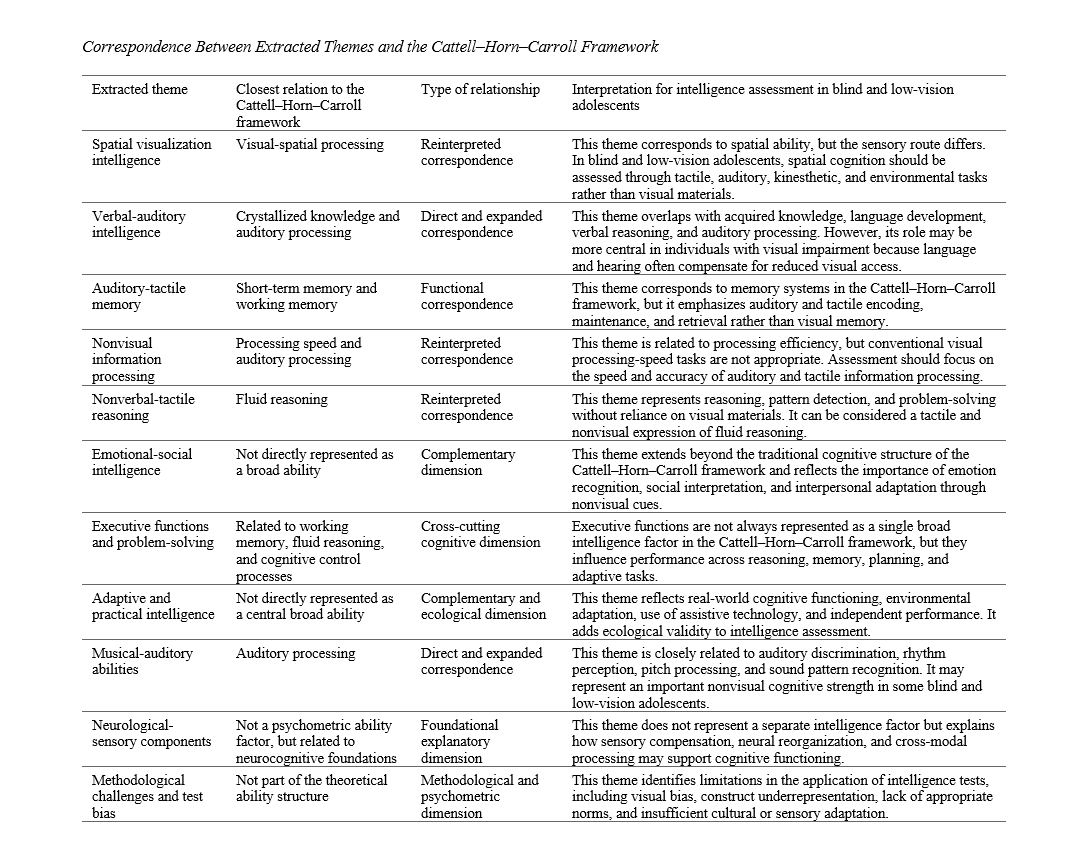
The aim of the present study was to comparatively examine and analyze the conceptual frameworks and intelligence assessment instruments used with blind and low-vision adolescents, identify existing challenges and limitations, and explain the requirements for designing tests appropriate to the cognitive and sensory characteristics of this group. This study was conducted using a qualitative approach based on thematic synthesis. For this purpose, a systematic search of scientific sources was carried out in reputable national and international databases. Studies published between 2003 and 2025 were reviewed. From an initial pool of 83 documents, after applying the inclusion and exclusion criteria and assessing methodological quality, 31 studies, including 24 international studies and 7 national studies, were selected for final analysis. The data were analyzed according to the stages of thematic synthesis, including initial coding, extraction of descriptive themes, and formation of analytical themes. The analysis of the studies led to the identification of 11 main themes, including spatial visualization intelligence, verbal–auditory intelligence, auditory–tactile memory, nonvisual information processing, nonverbal–tactile reasoning, emotional–social intelligence, executive functions, adaptive and practical intelligence, musical–auditory abilities, neurological–sensory components, and methodological challenges in intelligence assessment. The results showed that some of these components overlap with the dimensions of Cattell–Horn–Carroll theory, whereas others require conceptual reinterpretation or expansion within the context of blindness. The findings also indicated that many existing instruments, due to their implicit or explicit reliance on visual processing, face limitations in construct validity, assessment fairness, and adaptation to the characteristics of individuals with visual impairment. The findings of the study suggest that intelligence assessment in blind and low-vision adolescents requires a transition from purely adaptive approaches toward evidence-based conceptual frameworks aligned with the cognitive and sensory characteristics of this group. Accordingly, Cattell–Horn–Carroll theory can provide an appropriate foundation for developing indigenous, multisensory tests free from visual bias and can facilitate more accurate assessment of the cognitive abilities of these individuals.
Downloads
References
Amedi, A., Hofstetter, S., Maidenbaum, S., & Heimler, B. (2017). Task Selectivity as a Comprehensive Principle for Brain Organization. Trends in Cognitive Sciences, 21(5), 307-310. https://doi.org/10.1016/j.tics.2017.03.007
Amedi, A., Malach, R., Hendler, T., Peled, S., & Zohary, E. (2001). Visuo-Haptic Object-Related Activation in the Ventral Visual Pathway. Nature Neuroscience, 4(3), 324-330. https://doi.org/10.1038/85201
Amedi, A., Raz, N., Pianka, P., Malach, R., & Zohary, E. (2003). Early Visual Cortex Activation Correlates with Superior Verbal Memory Performance in the Blind. Nature Neuroscience, 6(7), 758-766. https://doi.org/10.1038/nn1072
Argueso, P. (2022). Human Ocular Mucins: The Endowed Guardians of Sight. Advanced Drug Delivery Reviews, 180, 114074. https://doi.org/10.1016/j.addr.2021.114074
Bedny, M. (2017). Evidence from Blindness for a Cognitively Pluripotent Cortex. Trends in Cognitive Sciences, 21(9), 637-648. https://doi.org/10.1016/j.tics.2017.06.003
Bell, E. C., & Silverman, A. M. (2018). Rehabilitation and Employment Outcomes for Adults Who Are Blind or Visually Impaired: An Updated Report. Journal of Blindness Innovation & Research, 8(1). https://doi.org/10.5241/8-148
Brandao, A. D. O., Magalhaes, R. C., Rocha, A. L. L., Costa, N. D. O., Fernandes, L. C., & Vasconcelos, G. C. (2024). Assessment Tools for Evaluating Neuropsychomotor Development in Children with Visual Impairment: An Integrative Review. Revista Brasileira de Oftalmologia, 83, e0059. https://doi.org/10.37039/1982.8551.20240059
Campos, C. R., & de Cassia Nakano, T. (2018). Intelligence Scale for Children with Visual Impairment-Professional Version: Performance by Type and Degree of Disability. REXE. Revista de Estudios y Experiencias en Educacion, 17(33), 31-44. https://doi.org/10.21703/rexe.20181733ccampos32
Cappagli, G., Finocchietti, S., Baud-Bovy, G., Cocchi, E., & Gori, M. (2017). Multisensory Rehabilitation Training Improves Spatial Perception in Totally but Not Partially Visually Deprived Children. Frontiers in Integrative Neuroscience, 11, 29. https://doi.org/10.3389/fnint.2017.00029
Chen, X., Lu, M., Bu, W., Wang, L., Wang, Y., Xu, Y., & Zhong, M. (2021). Psychometric Properties of WISC-IV Verbal Scales: A Study of Students in China Who Are Blind. Journal of Visual Impairment & Blindness, 115(3), 228-241. https://doi.org/10.1177/0145482X211018520
Chen, Y., Koh, K. H., Ho, J. W. C., Yew, S. M. E., Goh, J. H. L., Lum, E., & Tham, Y. C. (2026). Evaluation of a Community-Based AI-Assisted Visual Impairment Screening Model for Performance, Operational Efficiency, Acceptability, Feasibility, and Costs: Protocol for a 2-Arm Pragmatic Randomized Controlled Trial. Jmir Research Protocols, 15(1), e74164. https://doi.org/10.2196/74164
Chollet, F. (2019). On the Measure of Intelligence. arXiv preprint arXiv:1911.01547.
Correia, K., Bara, T. S., Furlin, V., Prando, C., Iankilevich, P. G., & Cordeiro, M. L. (2026). Impact of Visual Impairment Severity on Working Memory and Executive Function in Children and Adolescents. Frontiers in psychology, 17, 1827656. https://doi.org/10.3389/fpsyg.2026.1827656
Creswell, J. W., & Poth, C. N. (2016). Qualitative Inquiry and Research Design: Choosing among Five Approaches. Sage Publications.
Czerwinska, K., & Piskorska, A. (2018). Cognitive Functioning of a Blind Student in a Foreign Language Classroom. Forum Pedagogiczne,
Flanagan, D. P., Ortiz, S. O., & Alfonso, V. C. (2013). Essentials of Cross-Battery Assessment. John Wiley & Sons.
Hirsch, G. V., Bauer, C. M., & Merabet, L. B. (2015). Using Structural and Functional Brain Imaging to Uncover How the Brain Adapts to Blindness. Annals of Neuroscience and Psychology, 2, 5.
Keith, T. Z., & Reynolds, M. R. (2010). Cattell-Horn-Carroll Abilities and Cognitive Tests: What We've Learned from 20 Years of Research. Psychology in the Schools, 47(7), 635-650. https://doi.org/10.1002/pits.20496
Lamper, C., Onnink, M. L., van Buijsen, M., van der Aa, H. P., & van Munster, E. P. (2026). Adaptations and Interpretation of Intelligence Tests for Adults with Visual Impairment: A Literature Review and Interviews with Healthcare Professionals. medRxiv. https://doi.org/10.64898/2026.03.11.26347170
Liu, L., Tang, C., Chen, J., Lei, Y., Li, Y., & Ding, G. (2026). A Multidimensional Framework for Dissociating the Neuroplasticity of Auditory and Early Language Deprivation. Communications Biology. https://doi.org/10.1038/s42003-026-09900-8
Long, H. A., French, D. P., & Brooks, J. M. (2020). Optimising the Value of the Critical Appraisal Skills Programme (CASP) Tool for Quality Appraisal in Qualitative Evidence Synthesis. Research Methods in Medicine & Health Sciences, 1(1), 31-42. https://doi.org/10.1177/2632084320947559
McLinden, M., Douglas, G., Hewett, R., Cobb, R., Keil, S., Lynch, P., & Thistlethwaite, J. S. (2022). Promoting Equitable Access to Education for Children and Young People with Vision Impairment: A Route-Map for a Balanced Curriculum. Routledge. https://doi.org/10.4324/9781003002321
Nelson, P. A., Dial, J. G., & Joyce, A. (2002). Validation of the Cognitive Test for the Blind as an Assessment of Intellectual Functioning. Rehabilitation Psychology, 47(2), 184. https://doi.org/10.1037/0090-5550.47.2.184
Niemann, M., Prange, A., & Sonntag, D. (2018). Towards a Multimodal Multisensory Cognitive Assessment Framework. 2018 IEEE 31st International Symposium on Computer-Based Medical Systems,
Page, M. J., McKenzie, J. E., Bossuyt, P. M., Boutron, I., Hoffmann, T. C., Mulrow, C. D., & Moher, D. (2021). The PRISMA 2020 Statement: An Updated Guideline for Reporting Systematic Reviews. bmj, 372.
Papadopoulos, K., Koustriava, E., & Kartasidou, L. (2011). The Impact of Residual Vision in Spatial Skills of Individuals with Visual Impairments. The Journal of Special Education, 45(2), 118-127. https://doi.org/10.1177/0022466909354339
Papadopoulos, K., Koustriava, E., & Kartasidou, L. (2012). Spatial Coding of Individuals with Visual Impairments. The Journal of Special Education, 46(3), 180-190. https://doi.org/10.1177/0022466910383016
Park, W. J., & Celikel, T. (2026). Binding as an Enabling Mechanism for Cross-Modal Plasticity. Neuroscience & Biobehavioral Reviews, 106695. https://doi.org/10.1016/j.neubiorev.2026.106695
Pasqualotto, A., & Proulx, M. J. (2012). The Role of Visual Experience for the Neural Basis of Spatial Cognition. Neuroscience & Biobehavioral Reviews, 36(4), 1179-1187. https://doi.org/10.1016/j.neubiorev.2012.01.008
Raczy, K., & Korczyk, M. (2018). Are IQ Tests Enough to Measure Intelligence in the Blind? Brief Review of Available and Potential Methods to Estimate Intelligence in the Blind. Rocznik Kognitywistyczny(11), 17-34.
Rajabi, S., & Alimoradi, K. (2016). Comparison of Spatial Memory and Spatial Orientation among Blind, Low-Vision, and Sighted Individuals. Exceptional Children Quarterly, 16(3), 49-64.
Resnick, L. B. (2024). The Nature of Intelligence. Taylor & Francis.
Roder, B., & Rosler, F. (2003). Memory for Environmental Sounds in Sighted, Congenitally Blind and Late Blind Adults: Evidence for Cross-Modal Compensation. International Journal of Psychophysiology, 50(1-2), 27-39. https://doi.org/10.1016/S0167-8760(03)00122-3
Roder, B., Rosler, F., & Neville, H. J. (2000). Event-Related Potentials during Auditory Language Processing in Congenitally Blind and Sighted People. Neuropsychologia, 38(11), 1482-1502. https://doi.org/10.1016/S0028-3932(00)00057-9
Roder, B., Stock, O., Bien, S., Neville, H., & Rosler, F. (2002). Speech Processing Activates Visual Cortex in Congenitally Blind Humans. European Journal of Neuroscience, 16(5), 930-936. https://doi.org/10.1046/j.1460-9568.2002.02147.x
Schneider, W. J., & McGrew, K. S. (2018). The Cattell-Horn-Carroll Theory of Cognitive Abilities. In Contemporary Intellectual Assessment: Theories, Tests, and Issues (pp. 163).
Sepulveda-Palomo, M., Del Rio, D., Villalobos, D., & Fernandez Gonzalez, S. (2024). Verbal and Spatial Working Memory Capacity in Blind Adults and the Possible Influence of Age at Blindness Onset: A Systematic Review and Meta-Analysis. Neuropsychology Review, 1-19. https://doi.org/10.1016/j.neuroimage.2019.01.073
Shen, L., Huang, Y., Ma, Z., Chen, M., Ma, C., & Clemens, N. H. (2026). How Accurate Are Computer-Adaptive Reading Screeners? A Systematic Review and Meta-Analysis of Validity and Classification Accuracy. School Psychology Review, 1-21. https://doi.org/10.1080/2372966X.2026.2633597
Sternberg, R. J. (2018). The Nature of Human Intelligence. Cambridge University Press.
Thomas, J., & Harden, A. (2008). Methods for the Thematic Synthesis of Qualitative Research in Systematic Reviews. BMC medical research methodology, 8(1), 45. https://doi.org/10.1186/1471-2288-8-45
Tonelli, A., Senna, I., Amadeo, M. B., Setti, W., Domenici, N., Signorini, S., & Gori, M. (2026). The Development of Audio-Tactile Spatial Integration: Unraveling Vision's Contribution. Developmental science, 29(1), e70094. https://doi.org/10.1111/desc.70094
Veldhorst, C., Kef, S., Vervloed, M. P., & Steenbergen, B. (2026). A Longitudinal Study of Development in Language, Cognition, Social Adaptation, and Exploratory Behaviour of Toddlers with Vision Impairment. British Journal of Visual Impairment, 44(2), 327-341. https://doi.org/10.1177/02646196251345325
Vitas, M., Cvjetovic, S., & Dobovisek, A. (2026). A Possible Definition of Intelligence. BioSystems, 105776. https://doi.org/10.1016/j.biosystems.2026.105776
Yildirim, H., & Kaya, L. G. (2025). New Approaches and Theories in Understanding Intelligence and Cognitive Ability Processes. Duzce University Journal of Science and Technology, 13(2), 913-931. https://doi.org/10.29130/dubited.1635523
Downloads
Additional Files
Publication Timeline
- Submitted
- Revised
- Accepted