Designing an Integrated Play Therapy Program Based on the Cognitive-Behavioral Approach and Sensory Integration for Children With Autism
Keywords:
play therapy, cognitive-behavioral approach, sensory integration, autism spectrum disorderAbstract
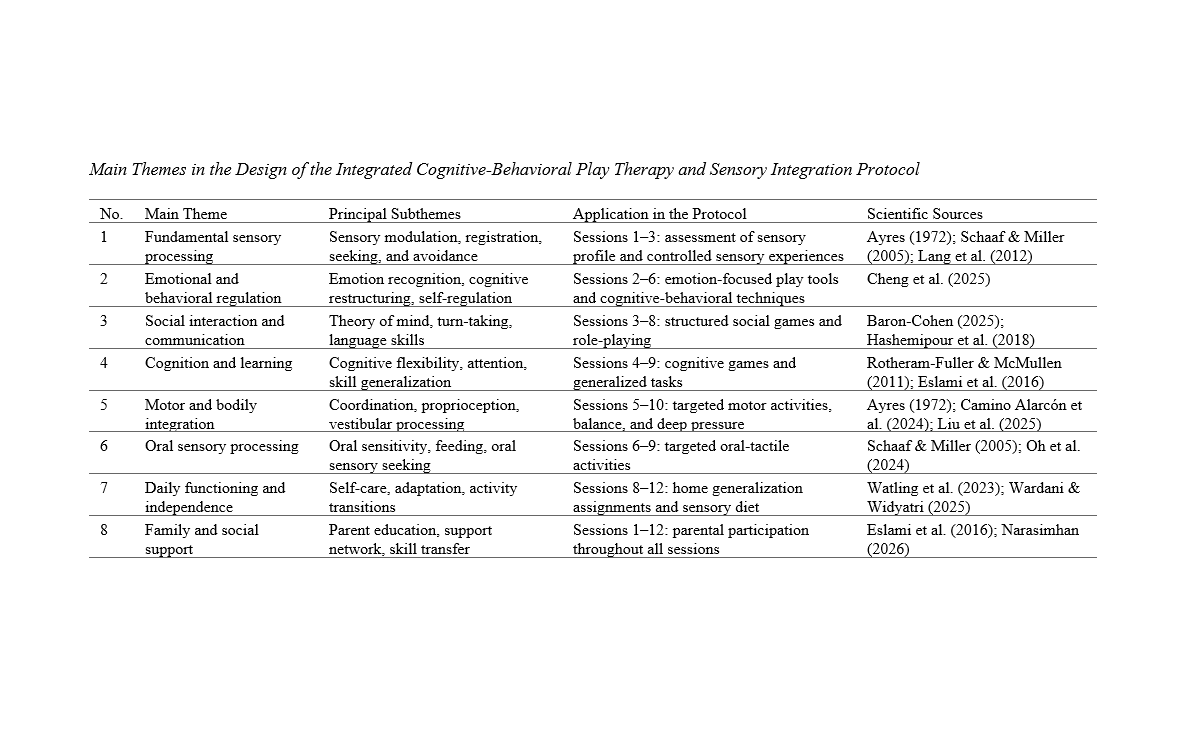
The present study aimed to design an integrated play therapy program based on the cognitive-behavioral approach and sensory integration for children with autism spectrum disorder (ASD). In terms of purpose, this was an applied study, and in terms of methodology, it employed a qualitative research design. Using thematic analysis based on Braun and Clarke’s (2006) six-phase framework, valid and up-to-date theoretical and empirical evidence was systematically reviewed and coded. A step-by-step framework illustrating the process of structuring and designing the integrated play therapy program based on the cognitive-behavioral approach and sensory integration for children with autism was developed according to Intervention Mapping (IM). The integrated cognitive-behavioral play therapy and sensory integration program was subsequently presented to 10 faculty members from the University of Tehran and experienced therapists working in a university clinic for children with neurodevelopmental disorders who were professionally involved in the field of autism spectrum disorder. They were asked to provide expert feedback on the developed intervention package to facilitate its refinement. Quantitative assessment of the content validity of the integrated play therapy program was conducted using the Content Validity Index (CVI) and Content Validity Ratio (CVR). The results indicated that the integrated program resulted in the development of a valid 12-session protocol. The inductive thematic analysis process progressed from 52 initial codes to 22 axial codes, 14 subthemes, and 8 main themes. These eight themes constituted the conceptual pillars of the protocol and integrated the cognitive-behavioral and sensory integration approaches within a spiral, play-based structure, thereby empirically demonstrating the feasibility of the proposed program design. Another finding of the present study was that the integrated program demonstrated satisfactory validity. The CVI calculated for each of the 12 items corresponding to the intervention sessions ranged from .80 to .90, with all values exceeding the accepted threshold of .79. Internal validity was confirmed through member checking and calculation of the CVI. The developed integrated program constitutes a valid intervention for improving sensory responses in children with sensory modulation disorder. Based on the findings, it is recommended that psychologists working with children with special needs use the 12-session integrated protocol developed in this study as a standardized intervention package.
Downloads
References
Awaida, I., Saleh, A. A., El Masri, J., Farhat, S., & El Tourjouman, O. (2024). Evaluating the efficacy of combining sensory room and conventional therapies for Lebanese children with autism: A 10-year study. Cureus, 16(9), e69953. https://doi.org/10.7759/cureus.69953
Azizi, A., Drikvand, F. M., & Sepahvandi, M. A. (2020). Effect of cognitive-behavioral play therapy on working memory, short-term memory and sustained attention among school-aged children with specific learning disorder: A preliminary randomized controlled clinical trial. Current Psychology, 39(6), 2306-2313. https://doi.org/10.1007/s12144-018-9914-7
Baron-Cohen, S., Radecki, M. A., Allison, C., Tsompanidis, A., Greenberg, D. M., Warrier, V., & Frith, U. (2025). Do autistic people have degrees of disability in theory of mind? The importance of meta-analytic convergence. Psychological Inquiry, 36(4), 262-267. https://doi.org/10.1080/1047840X.2025.2605593
Bartholomew Eldredge, L. K., Markham, C. M., Ruiter, R. A. C., Fernández, M. E., Kok, G., & Parcel, G. S. (2022). Planning health promotion programs: An intervention mapping approach (4 ed.). Wiley.
Camino-Alarcón, J., Robles-Bello, M. A., Valencia-Naranjo, N., & Sarhani-Robles, A. (2024). A systematic review of treatment for children with autism spectrum disorder: The sensory processing and sensory integration approach. Children, 11(10), 1222. https://doi.org/10.3390/children11101222
Cheng, Y., Shi, J., Wang, J., & Jiang, Z. (2025). Meta-analysis of cognitive behavioral therapy for improving anxiety symptoms in patients with autism spectrum disorder. Chinese Journal of Child Health Care, 33(4), 431.
Esteki, M., Shahriari Ahmadi, M., Kouchak Entezar, R., Mahmoudi, E., & Mirzakhani, N. (2020). Comparing sensory processing in children with autism spectrum disorder, specific learning disorder, and typically developing children. Rehabilitation Medicine, 9(4), 1-8.
Faramarzi, H., & Ghanei, M. (2019). Effectiveness of cognitive-behavioral play therapy on challenging behaviors in children with high-functioning autism. Psychology of Exceptional Individuals, 9(36), 169-185.
Feizollahi, J., Sadeghi, M., & Rezaei, F. (2020). The effect of cognitive-behavioral play therapy and its integration with parent management training on attention-deficit/hyperactivity symptoms in hyperactive children aged 7-11: A quasi-experimental study. Journal of Rafsanjan University of Medical Sciences, 19(2), 155-172.
Fouad, N., Hafez, N., El-Gebaly, H. H., & Fahiem, R. A. (2023). Efficacy of the sensory integration therapy on language development in autism spectrum disorder children. Egyptian Journal of Ear, Nose, Throat and Allied Sciences, 24(24), 1-8. https://doi.org/10.21608/ejentas.2023.180257.1586
Ghasemian Moghaddam, H., & Mohammadzadeh, H. (2024). Effectiveness of a sensory-motor integration exercise program based on a sensory play approach on spatial visualization and fine motor skills in children with learning disorders. Empowering Exceptional Children, 15(3), 61-75.
Halder, S., & Mahato, A. K. (2019). Cognitive behavior therapy for children and adolescents: Challenges and gaps in practice. Indian Journal of Psychological Medicine, 41(3), 279-283. https://doi.org/10.4103/IJPSYM.IJPSYM_470_18
Hamidifard, S., Dashtbozorgi, Z., & Hafezi, F. (2023). Effectiveness of cognitive-behavioral play therapy on social anxiety and self-injurious behaviors in children with autism. Psychiatric Nursing, 11(3), 70-80.
Hasannataj, F., Taghipour Javan, A., Pourfatemi, F., & Aram, S. S. (2020). Screening and prevalence of autism spectrum disorder in children aged 3-6 attending kindergartens supervised by the Welfare Organization of Mazandaran Province. Journal of Child Mental Health, 7(3), 205-218.
Hashemipour, S. S., & Mohammadi, K. (2018). Effectiveness of child-centered play therapy on emotional and social skills in children with autistic disorder. Preventive Medicine, 5(2), 1-10.
Hosseinzadeh, M. (2021). Effectiveness of cognitive play therapy on attention-deficit/hyperactivity disorder symptoms and impulsivity among boys in the first cycle of elementary school in Tabriz. New Psychological Research, 16(61), 177-190.
Khatoon, A., Iqbal, N., & Masroor, U. (2020). Efficacy of cognitive behavioral play therapy (CBPT) for children with attention deficit hyperactivity disorder (ADHD). Clinical and Counselling Psychology Review, 2(2), 16-27. https://doi.org/10.32350/ccpr.22.02
Kuhaneck, H. M., Watling, R., & Glennon, T. J. (2023). Ayres Sensory Integration for addressing play in autistic children: A multiple-baseline examination. American Journal of Occupational Therapy, 77, 7702205080. https://doi.org/10.5014/ajot.2023.050169
Li, D., Huang, Y., Liu, Y., Sun, F., Zhao, T., & Yin, H. (2026). Emotion regulation interventions for autistic children and adolescents: A panoramic comparison through systematic review and network meta-analysis. Clinical psychology review, 127, 102764. https://doi.org/10.1016/j.cpr.2026.102764
Lyu, B., Ba, Y., Ma, D., Liu, N., Fu, L., & Xue, Y. (2025). Effectiveness of sensory integration-based intervention in autistic children, focusing on Chinese children: A systematic review and meta-analysis. Frontiers in Psychiatry, 16, 1623149. https://doi.org/10.3389/fpsyt.2025.1623149
Mirghafourian, Z., Nouhi, S., & Taher, M. (2022). The effect of cognitive-behavioral sandplay therapy on reducing emotion recognition difficulties and improving social development in boys with autism spectrum disorder. Community Health, 16(2), 82-93.
Morris-Rosendahl, D. J., & Crocq, M. A. (2020). Neurodevelopmental disorders: The history and future of a diagnostic concept. Dialogues in clinical neuroscience, 22(1), 65-72. https://doi.org/10.31887/DCNS.2020.22.1/macrocq
Müller, A., Bába, É. B., Židek, P., Lengyel, A., Lakó, J. H., Laoues-Czimbalmos, N., & Boda, E. (2024). The experiences of motor skill development in children with autism spectrum disorder (ASD) reflected through parental responses. Children, 11(10), 1238. https://doi.org/10.3390/children11101238
Narasimhan, B., Sharma, V. K., Malawade, M., Patil, M., Qushnazarova, U., Shahlo, R., & Matniyozova, M. (2026). Impact of sensory processing disorders on learning outcomes in inclusive classrooms. International Journal of Special Education, 41(1s), 131-143.
Nogay, H. S., & Adeli, H. (2020). Machine learning (ML) for the diagnosis of autism spectrum disorder (ASD) using brain imaging. Reviews in the Neurosciences, 31(8), 825-841. https://doi.org/10.1515/revneuro-2020-0043
Oh, S., Jang, J. S., Jeon, A. R., Kim, G., Kwon, M., Cho, B., & Lee, N. (2024). Effectiveness of sensory integration therapy in children, focusing on Korean children: A systematic review and meta-analysis. World Journal of Clinical Cases, 12(7), 1260. https://doi.org/10.12998/wjcc.v12.i7.1260
Perihan, C., & Bicer, A. (2021). The effects of function-based communication intervention for a student with emotional disturbance in a general education setting. Journal of Research in Special Educational Needs, 21(2), 63-72. https://doi.org/10.1111/1471-3802.12499
Pickard, K., Mellman, H., Frost, K., Reaven, J., & Ingersoll, B. (2023). Balancing fidelity and flexibility: Usual care for young children with an increased likelihood of having autism spectrum disorder within an early intervention system. Journal of Autism and Developmental Disorders, 53(2), 656-668. https://doi.org/10.1007/s10803-021-04882-4
Piller, A., Glennon, T. J., Andelin, L., Auld-Wright, K., McHugh Conlin, J., Teng, K., & Tarver, T. (2026). Occupational therapy interventions using Ayres Sensory Integration for children and youth (2015-2024): A systematic review. American Journal of Occupational Therapy, 80(1), 8001185030. https://doi.org/10.5014/ajot.2025.051130
Pucel, A. D. (2024). Increasing success for children with sensory processing difficulties: Education and support for individuals working with children in community settings.
Rabiei, F., Ehteshamzadeh, P., Homaei, R., & Jairvand, H. (2023). Effectiveness of sensory integration-based play therapy on communication skills, social interaction, stereotyped behaviors, and motor development in boys with autism spectrum disorder. Journal of Child Mental Health, 10(4), 93-108.
Randell, E., Wright, M., Milosevic, S., Gillespie, D., Brookes-Howell, L., Busse-Morris, M., & McNamara, R. (2022). Sensory integration therapy for children with autism and sensory processing difficulties: The SenITA RCT. Health Technology Assessment, 26(29), 1-140. https://doi.org/10.3310/TQGE0020
Robinson, R. (2025). Systemic family therapy through the eyes of a clinical psychology trainee in 2024: History, context and clinical application. Human Systems, 5(3), 225-235. https://doi.org/10.1177/26344041251319529
Salehi, S. M., Esteki, M., Salehi, M., & Amiri Majd, M. (2019). Effectiveness of sensory diet-based play therapy in modulating vestibular and balance sensations in a child with autism spectrum disorder. medical journal of mashhad university of medical sciences, 62(Psychology Special Issue), 1934-1944.
Tasijawa, F. A., & Herwawan, J. H. (2025). Review of Play Therapy Treatment Planning with Children and Families: A Guide for Mental Health Professionals.
Wang, Z., Gui, Y., & Nie, W. (2022). [Retracted] Sensory integration training and social sports games integrated intervention for the occupational therapy of children with autism. Occupational Therapy International, 2022(1), 9693648. https://doi.org/10.1155/2022/9693648
Wardhani, R. D. K., & Widjayatri, R. D. (2025). Play-based intervention to enhance executive function in young children with disabilities: A systematic literature review.
Watling, R., Benevides, T., & Robertson, S. M. (2023). Family-centered interventions for children on the autism spectrum (2013-2021). American Journal of Occupational Therapy, 77(1), 7710393210. https://doi.org/10.5014/ajot.2023.77S10021
Yuan, H. L., Lai, C. Y., Wong, M. N., Kwong, T. C., Choy, Y. S., Mung, S. W., & Chan, C. C. (2022). Interventions for sensory over-responsivity in individuals with autism spectrum disorder: A narrative review. Children, 9(10), 1584. https://doi.org/10.3390/children9101584
Downloads
Additional Files
Publication Timeline
- Submitted
- Revised
- Accepted