Comparison of the Effectiveness of Acceptance and Commitment Therapy and Metacognitive Therapy on Disease Self-Management and Illness Perception in Individuals with Multiple Sclerosis
Keywords:
Acceptance and Commitment Therapy, Metacognitive Therapy, disease self-management, illness perception, multiple sclerosis.Abstract
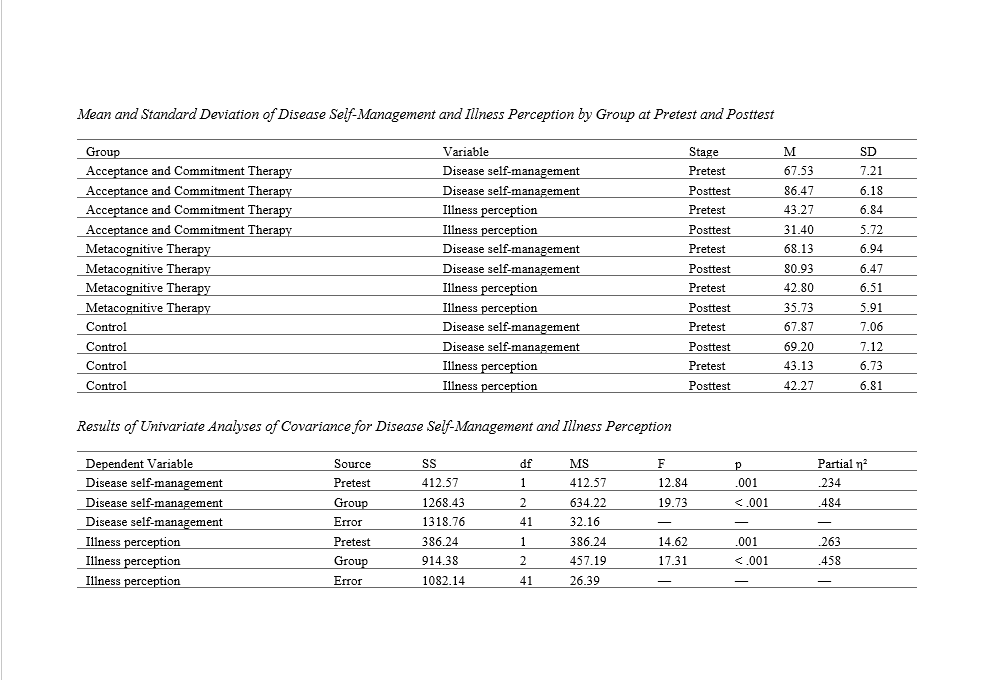
The present study aimed to compare the effectiveness of Acceptance and Commitment Therapy (ACT) and Metacognitive Therapy (MCT) on disease self-management and illness perception in individuals with multiple sclerosis (MS). In terms of purpose, this was an applied study, and in terms of methodology, it employed a quasi-experimental pretest–posttest design with a control group. The study population consisted of individuals with multiple sclerosis who attended healthcare centers and MS-related treatment facilities in the city under study. Among eligible individuals, 45 participants were selected through convenience sampling and randomly assigned to three groups of 15 participants each: an Acceptance and Commitment Therapy group, a Metacognitive Therapy group, and a control group. The experimental groups received their respective therapeutic interventions, whereas the control group received no intervention during the study period. Data were collected using the Multiple Sclerosis Self-Management Scale and the Revised Illness Perception Questionnaire. The data were analyzed using descriptive statistical indices, the Shapiro–Wilk test, Levene’s test, multivariate analysis of covariance (MANCOVA), and univariate analysis of covariance (ANCOVA). The results indicated significant differences among the three groups in disease self-management and illness perception at the posttest stage. Both therapeutic interventions, compared with the control group, resulted in significant improvements in disease self-management and favorable changes in illness perception. Furthermore, pairwise comparisons showed that Acceptance and Commitment Therapy was more effective than Metacognitive Therapy in enhancing disease self-management and improving illness perception. Based on the findings, it can be concluded that both therapeutic approaches are beneficial for promoting psychological adjustment and improving disease management among individuals with multiple sclerosis; however, Acceptance and Commitment Therapy may be more effective than Metacognitive Therapy in improving disease self-management and illness perception.
Downloads
References
Coll-Martínez, C., Salavedra-Pont, J., Buxó, M., Quintana, E., Quiroga-Varela, A., Robles-Cedeño, R., Puig, M., Álvarez-Bravo, G., Ramió-Torrentà, L., & Gich, J. (2023). Differences in metacognition between multiple sclerosis phenotypes: Cognitive impairment and fatigue are key factors. Frontiers in psychology, 14. https://doi.org/10.3389/fpsyg.2023.1163112
Culicetto, L., Lo Buono, V., Sessa, E., Rifici, C., Daleo, G. D., & Quartarone, A. (2024). Importance of coping strategies on quality of life in people with multiple sclerosis: A systematic review. Journal of clinical medicine, 13(18), 5505. https://doi.org/10.3390/jcm13185505
Ebrahimpour Azizi, M., Hajloo, N., & Baghbanian, M. (2026). Effectiveness of Compassion-Focused Acceptance and Commitment Therapy on Experiential Avoidance and Self-Care among Patients with Multiple Sclerosis. Journal of Applied Psychological Research. https://doi.org/10.22059/japr.2026.372422.644862
Han, A. (2022). Effects of mindfulness-and acceptance-based interventions on quality of life, coping, cognition, and mindfulness of people with multiple sclerosis: A systematic review and meta-analysis. Psychology, Health & Medicine, 27(7), 1514-1531. https://doi.org/10.1080/13548506.2021.1894345
Hesami, F., Teymouri, Z., Ghafourian, G., Rezaeizadeh, M., Kashefi, M., Abedi Noghondar, M., & Pourmohammad Ghouchani, K. (2025). Comparing the Effectiveness of Mindfulness-Based Cognitive Therapy and Acceptance and Commitment Therapy on Self-Efficacy and Quality of Life among Patients with Multiple Sclerosis. Quarterly Journal of Experimental and Cognitive Psychology, 2(1), 243-256. https://doi.org/10.61838/qecp.6461
Karimi, M., Thani, F. N., Naghsh, Z., & Ghazaghi, T. (2022). Effectiveness of Acceptance and Commitment Therapy and Cognitive Behavioral Therapy in Increasing Resilience and Quality of Life among Patients with Multiple Sclerosis: A Randomized Clinical Trial. Iranian journal of psychiatry and behavioral sciences, 16(1). https://doi.org/10.5812/ijpbs.107467
King, R., Marrie, R. A., van der Mei, I., Banwell, B., Makaroff, L., Rijke, N., & Helme, A. (2026). Global prevalence of multiple sclerosis surpasses 3 million: 2024 update of the Multiple Sclerosis International Federation Atlas of MS. Multiple Sclerosis Journal. https://doi.org/10.1177/13524585261479954
Luca, M., Eccles, F. J. R., Perez Algorta, G., & Patti, F. (2022). Illness perceptions and outcome in multiple sclerosis: A systematic review of the literature. Multiple Sclerosis and Related Disorders, 67, 104180. https://doi.org/10.1016/j.msard.2022.104180
Luca, M., Luca, A., Patti, F., Perez Algorta, G., & Eccles, F. J. R. (2024). Alexithymia and illness perceptions in persons with multiple sclerosis and their partners. Scientific reports, 14, 25116. https://doi.org/10.1038/s41598-024-76702-5
Masoudi Margmaleki, L., Shaygannejad, V., & Rahimi, R. (2023). Effectiveness of Compassion-Focused Acceptance and Commitment Therapy on Psychological Flexibility and Self-Efficacy in Women with Multiple Sclerosis. Clinical Psychology and Personality, 21(1), 73-84. https://doi.org/10.22070/cpap.2023.15651.1182
Najafi, A., Mousavipour, S., & Sajedinejad, M. A. S. (2024). Comparing the Effectiveness of Logotherapy and Acceptance and Commitment Therapy on Resilience and Quality of Life among Patients with Multiple Sclerosis. Nursing Rehabilitation Research, 10(3), 103-114.
Pöttgen, J., Friede, T., Lau, S., Gold, S. M., Letsch, C., Bender, G., Flachenecker, P., Heesen, C., & Penner, I. K. (2022). Managing neuropsychological impairment in multiple sclerosis—Controlled study on a standardized metacognitive intervention. Multiple Sclerosis and Related Disorders, 59, 103687. https://doi.org/10.1016/j.msard.2022.103687
Sami, P., Emamipour, S., & Rafipour, A. (2022). Effectiveness of Acceptance and Commitment Therapy and Mindfulness-Based Cognitive Therapy on Illness Perception and Treatment Adherence among Patients with Multiple Sclerosis. Hormozgan Medical Journal, 26(4), 185-190. https://doi.org/10.34172/hmj.2022.32
Silverman, S. P. C., Yang, B., Mata-Greve, F., Sajeev, N., Samiee, S., Norton, J., & Hugos, C. L. (2024). Multiple sclerosis fatigue self-management: Strategies and influencing factors 5 years after a multimodal intervention. International Journal of MS Care, 26(4), 363-369. https://doi.org/10.7224/1537-2073.2024-012
Smith, E., & Langdon, D. (2024). A systematic review to explore patients' MS knowledge and MS risk knowledge. Neurological Sciences, 45, 4185-4195. https://doi.org/10.1007/s10072-024-07541-5
Solomon, A. J., Marrie, R. A., & Viswanathan, S. (2023). Global barriers to the diagnosis of multiple sclerosis: Data from the Multiple Sclerosis International Federation Atlas of MS, third edition. Neurology, 101(6), e624-e635. https://doi.org/10.1212/WNL.0000000000207481
Thompson, B., Moghaddam, N., Evangelou, N., Baufeldt, A., & das Nair, R. (2022). Effectiveness of acceptance and commitment therapy for improving quality of life and mood in individuals with multiple sclerosis: A systematic review and meta-analysis. Multiple Sclerosis and Related Disorders, 63, 103862. https://doi.org/10.1016/j.msard.2022.103862
Wendebourg, M. J., Pöttgen, J., & Finlayson, M. (2024). Education for fatigue management in people with multiple sclerosis: Systematic review and meta-analysis. European Journal of Neurology, 31, e16452. https://doi.org/10.1111/ene.16452
Wills, O. C., & Probst, Y. (2022). Understanding lifestyle self-management regimens that improve the life quality of people living with multiple sclerosis: A systematic review and meta-analysis. Health and Quality of Life Outcomes, 20, 153. https://doi.org/10.1186/s12955-022-02046-1
Downloads
Additional Files
Publication Timeline
- Submitted
- Revised
- Accepted