Designing a Quantitative Model for the Development of Sports for Children with Special Needs in Iran
Keywords:
children with special needs, sports development, inclusive sports, grounded theory, structural equation modeling.Abstract
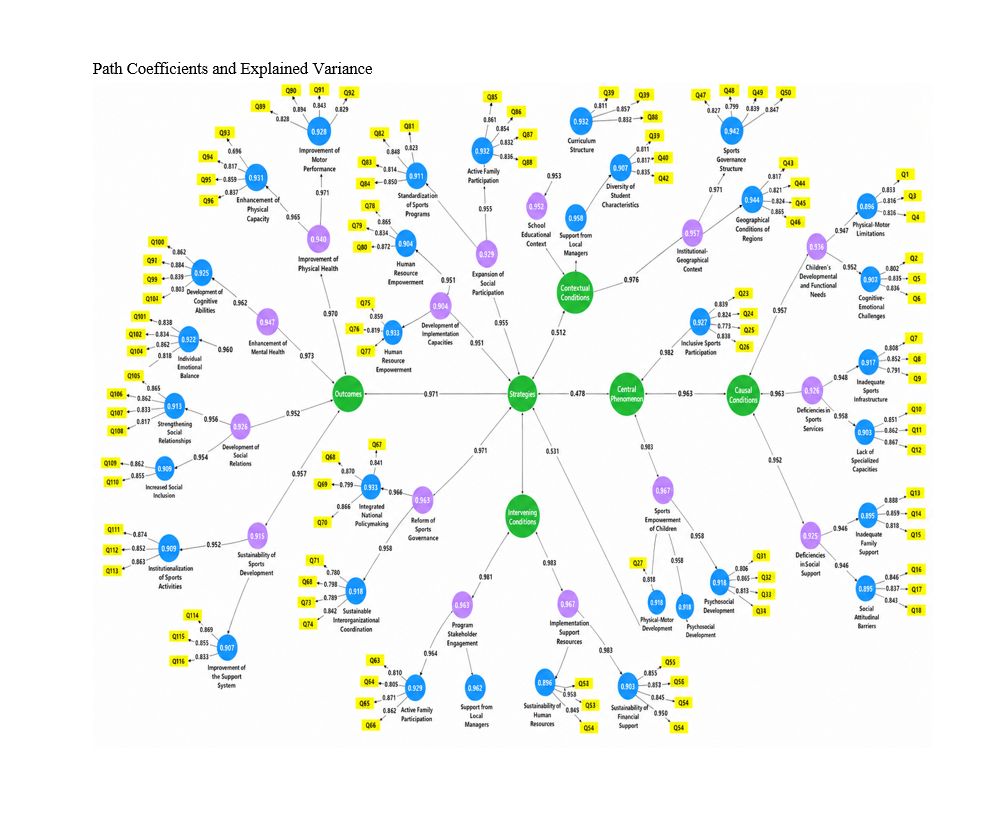
The present study aimed to design a quantitative model for the development of sports for children with special needs in Iran. In terms of purpose, the study was applied-developmental, and methodologically, it employed a descriptive-survey design. The questionnaire was developed based on the components and indicators extracted in relation to the development of sports for children with special needs. Following data collection, the proposed model was examined, tested, and validated using quantitative data. Finally, the final model and the magnitude of the effect of each factor on the development of sports for children with special needs in Iran were presented. The researcher-made questionnaire was distributed among 400 managers, experts, coaches, physical education teachers, special education specialists, rehabilitation experts, and faculty members, and the data were analyzed using partial least squares structural equation modeling (PLS-SEM). Confirmatory factor analysis and structural equation modeling were used to examine and validate the model for the development of sports for children with special needs in Iran. Quantitative data were analyzed using SPSS version 27 and SmartPLS version 3. SPSS was used for descriptive analyses and preliminary data screening, whereas SmartPLS was employed for confirmatory factor analysis, assessment of construct validity and reliability, and validation of the final research model. The quantitative findings indicated that causal conditions had a positive and significant effect on the central phenomenon (path coefficient = 0.96; t = 160.89). Moreover, the central phenomenon (path coefficient = 0.47; t = 33.51), contextual conditions (path coefficient = 0.51; t = 40.47), and intervening conditions (path coefficient = 0.53; t = 47.12) had positive and significant effects on strategies. The effect of strategies on the outcomes of sports development for children with special needs was also positive and significant (path coefficient = 0.97; t = 167.31). The coefficients of determination for the central phenomenon, strategies, and outcomes were 0.928, 0.709, and 0.943, respectively, and the overall model goodness-of-fit index was 0.781. Overall, the research model demonstrated satisfactory explanatory power and goodness of fit and can provide a systematic framework for policymaking and planning for the development of sports for children with special needs in Iran.
Downloads
References
Abdollahi, M. H., Abolhosseini, A., Gholami Torkseluyeh, S., & Enaami Araghi, S. (2024). Identifying factors affecting the development of talent identification in children's sport with an educational sport approach in Iran. New Approaches in Sport Management, 12(44), 18-33.
Ahmadi, Z., & Ghasemzadeh, S. (2022). Effectiveness of group aerobic exercises based on sensory integration theory on gross and fine motor skills in children with Down syndrome. Exceptional Children Quarterly, 22(1), 81-96.
Bengtsson, D., Svensson, J., Wiman, V., Stenling, A., Lundkvist, E., & Ivarsson, A. (2025). Health-related outcomes of youth sport participation: A systematic review and meta-analysis. International Journal of Behavioral Nutrition and Physical Activity, 22(1), 89. https://doi.org/10.1186/s12966-025-01792-x
Bertills, K., & Björk, M. (2024). Facilitating regular Physical Education for students with disability-PE teachers' views. Frontiers in Sports and Active Living, 6, 1400192. https://doi.org/10.3389/fspor.2024.1400192
Chan, Y. S., Jang, J. T., & Ho, C. S. (2022). Effects of physical exercise on children with attention deficit hyperactivity disorder. Biomedical Journal, 45(2), 265-270. https://doi.org/10.1016/j.bj.2021.11.011
Guo, X., Li, C., Zhao, J., Yang, W., Xu, Q., Kawczyński, A., & Clemente, F. M. (2025). Adherence to different types of sports shapes motor competence development in preschool children. Scientific reports, 15(1), 26130. https://doi.org/10.1038/s41598-025-07109-z
Herman, G. V., Bulz, G. C., Herman, M. L., Anca, S., Bulz, A. M., Tofan, G. B., & Sandra, M. (2025). Urban tourism and university sports: Case study on the impact of the National University Football Championship on the destination of Oradea, Romania. Geojournal of Tourism and Geosites, 61(3), 1495-1504. https://doi.org/10.30892/gtg.61309-1519
Ivanović, M. (2024). Contribution of sports to the quality of life in childhood, preadolescence and adolescence. Physical Education and Sport Through the Centuries, 11(2), 67-80. https://doi.org/10.5937/spes2402067I
Jalilvand, M., & Rezheh, A. (2021). Comparison of the effectiveness of the tactical games teaching approach and the traditional method on sport participation motivation in children with developmental coordination disorder. Empowering Exceptional Children, 12(1), 21-30.
Leite, E. (2025). Sports policies and the new projectment economy: A case study of China's path to Olympic success. Revista Brasileira De Ciências Do Esporte, 47, e20250007. https://doi.org/10.1590/rbce.47.e20250007
Liu, X., Han, H., Li, Z., Huang, S., Zhao, Y., Xiao, Q., & Sun, J. (2025). Barriers and facilitators to participation in physical activity for students with disabilities in an integrated school setting: A meta-synthesis of qualitative research evidence. Frontiers in Public Health, 13, 1496631. https://doi.org/10.3389/fpubh.2025.1496631
MacDougall, K. (2022). Strategies to Improve Physical Activity Involvement for Children with Exceptionalities: Exploring Teachers' and Parents' Perceptions and Experiences [Doctoral dissertation,
Nurdin, N. (2024). Analysis of the physical condition of men's futsal players in Monda FC in academic year 2023/2024. JOETAL: Journal of Education, Teaching and Learning, 1(1), 18-23. https://doi.org/10.67045/joetal.v1i2.49
Ponciano Núñez, P. D., & Carter, T. F. (2025). Sport as a tool for social justice: An analysis of critical pedagogy and community capacity building in Central America. Sport, Education and Society, 1-14. https://doi.org/10.1080/13573322.2025.2480117
Rajkumar, M., & Deshpande, A. (2025). From the locker room to the boardroom: How sports shape visionary leadership. In The Value of Vision in Leadership (pp. 165). https://doi.org/10.4018/979-8-3373-2392-3.ch006
Rakaa, O. B., Bassiri, M., & Lotfi, S. (2025). Impact of adapted physical education and para-athletics on mental skills and on pedagogical and school inclusion of teenagers with disabilities. Retos, 68, 82-94. https://doi.org/10.47197/retos.v68.111520
Rütti, T., Vahid, T., Bergman, Z., & Bergman, M. M. (2024). Evaluating the impact of sport for development activities on children through observational and visual data collection and a guiding framework. Journal of Sport for Development, 12(1).
Sharifi, A., Rahimi, M., & Rafiekhah, M. (2024). The effect of sports games designed based on cognitive skills on attention and response inhibition in children with dyslexia. Learning Disabilities, 14(2), 12-24.
Som, C. V. (2024). Building a case for incorporating sport as an indicator in human development index. Sport Sciences for Health, 19(1), 177-184. https://doi.org/10.1007/s11332-022-01017-9
Visser, K. (2024). A situational analysis of community physical activity participation by children and young people with neurodisability [Doctoral dissertation, Cardiff University].
Wade, L., Eime, R., Pankowiak, A., Vella, S., Robinson, K., Kennedy, S., & Eather, N. (2026). The impact of sports participation on psychological health and social outcomes in children and adolescents: A systematic review and update to the "Mental Health through Sport" conceptual model. Systematic Reviews. https://doi.org/10.1186/s13643-026-03104-1
West, K., Hassett, L., Oliveira, J. S., Kwok, W. S., Geerts, M., Gilchrist, H., & Sherrington, C. (2025). Effects of sport and physical recreation on health-related outcomes among children and young people with physical disability: Systematic review with meta-analysis. BMJ Open Sport & Exercise Medicine, 11(2). https://doi.org/10.1136/bmjsem-2024-002350
Wu, D. Y., Tan, T. C., & Wang, Y. T. (2025). A new shortcut for competitive sports development? The purpose of and strategy for developing and introducing sepaktakraw in Taiwan. PLoS One, 20(1), e0317451. https://doi.org/10.1371/journal.pone.0317451
Xu, S., LaPan, C., Lewis, H., Holladay, P., & Dixon, H. (2024). Trust and transformative learning: How faculty-led study abroad experiences foster sense of belonging and community. Journal of Hospitality & Tourism Education, 1-11. https://doi.org/10.1080/10963758.2024.2342814
Zhao, J., Xiang, C., Fadilah, T. K. T., & Luo, H. (2024). The effects of physical activity interventions on children's perception: A systematic review and meta-analysis. Journal of sports science & medicine, 23(2), 289. https://doi.org/10.52082/jssm.2024.289
Zhou, X., Li, J., & Jiang, X. (2024). Effects of different types of exercise intensity on improving health-related physical fitness in children and adolescents: A systematic review. Scientific reports, 14(1), 14301. https://doi.org/10.1038/s41598-024-64830-x
Ziming, L., & Kharchenko, T. (2023). Innovations in the field of sports industry management: Assessment of the digital economy's impact on the qualitative development of the sports industry. Baltic Journal of Economic Studies, 9(3), 10-21. https://doi.org/10.30525/2256-0742/2023-9-3-10-21
Downloads
Additional Files
Publication Timeline
- Submitted
- Revised
- Accepted