Predicting Adaptive School Functioning in Students with ADHD Through Explainable Boosting Machines: The Roles of Cognitive Flexibility, Self-Regulation, and Teacher–Student Relationship Quality
Keywords:
Attention-Deficit/Hyperactivity Disorder, Adaptive School Functioning, Explainable Boosting Machine, Cognitive Flexibility, Self-Regulation, Teacher–Student Relationship QualityAbstract
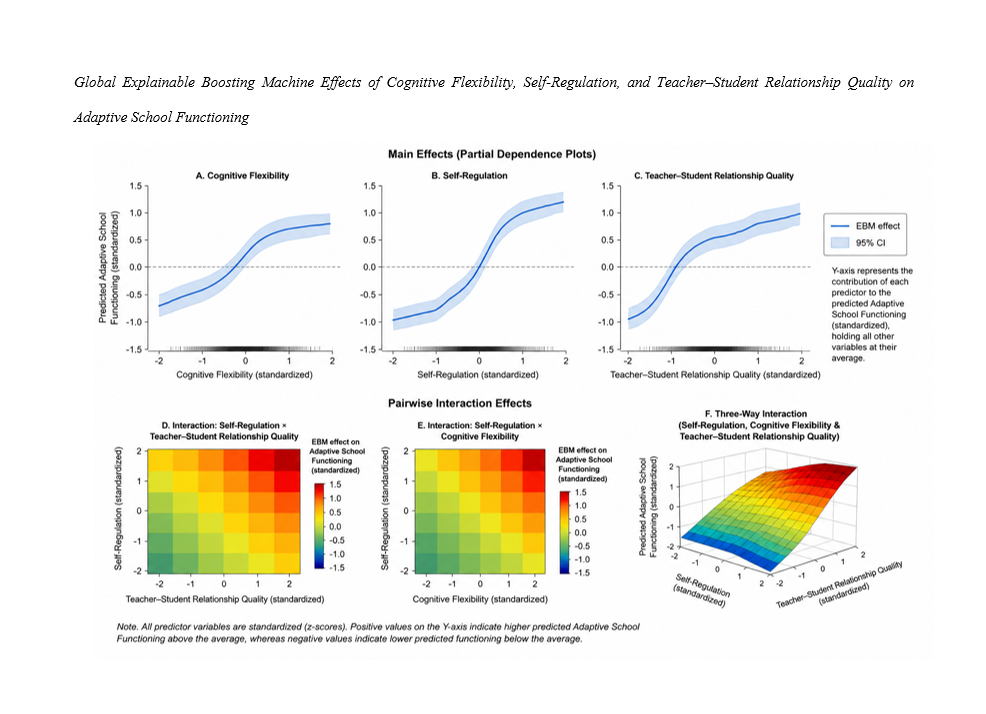
The present study aimed to predict adaptive school functioning among students with Attention-Deficit/Hyperactivity Disorder (ADHD) using an Explainable Boosting Machine (EBM) model and to determine the relative contributions of cognitive flexibility, self-regulation, and teacher–student relationship quality to educational adaptation. This cross-sectional predictive study was conducted among 428 students diagnosed with ADHD who were enrolled in public primary and lower secondary schools in Greece during the 2024–2025 academic year. Participants completed standardized measures of cognitive flexibility, self-regulation, and adaptive school functioning, while teachers evaluated teacher–student relationship quality. Following data screening, descriptive and correlational analyses were conducted. The primary analytical approach involved Explainable Boosting Machines, an interpretable machine learning technique capable of modeling nonlinear relationships and interaction effects. The dataset was divided into training and testing subsets, and five-fold cross-validation was employed to optimize model performance. Model accuracy was assessed using the coefficient of determination (R²), Root Mean Square Error (RMSE), Mean Absolute Error (MAE), and feature importance analyses. Significant positive correlations were observed among all study variables. Adaptive school functioning demonstrated strong associations with self-regulation (r = .73, p < .001), teacher–student relationship quality (r = .69, p < .001), and cognitive flexibility (r = .61, p < .001). The Explainable Boosting Machine model demonstrated excellent predictive performance, explaining 78.4% of the variance in the training dataset and 74.8% of the variance in the testing dataset. Feature importance analyses revealed that self-regulation was the strongest predictor (41.2%), followed by teacher–student relationship quality (33.7%) and cognitive flexibility (25.1%). Nonlinear effect analyses indicated threshold effects for self-regulation and teacher–student relationship quality, while interaction analyses showed that the positive effects of cognitive flexibility were amplified when combined with high levels of self-regulation. The highest predicted levels of adaptive school functioning were observed among students demonstrating strong self-regulation together with highly positive teacher–student relationships. The findings indicate that adaptive school functioning among students with ADHD is best understood as the product of interacting cognitive, behavioral, and relational processes. Self-regulation emerged as the most influential predictor, while teacher–student relationship quality and cognitive flexibility provided substantial additional explanatory value. Explainable machine learning approaches such as EBM offer powerful and interpretable tools for identifying factors associated with educational adaptation and may inform targeted interventions aimed at improving school functioning among students with ADHD.
Downloads
References
Antunes, R., Carneiro, T., Joaquim, L., Matos, M. G. d., Alexandre, J., & Filipe, M. G. (2025). Pilot Evaluation of a Socio-Emotional Learning Program on Executive Functions in Elementary School Students: A Cluster-Randomized Controlled Trial. Frontiers in psychology, 16. https://doi.org/10.3389/fpsyg.2025.1554001
Bombonato, C., Lucchese, B. D., Ruffini, C., Lieto, M., Brovedani, P., Cioni, G., & Pecini, C. (2023). Far Transfer Effects of Trainings on Executive Functions in Neurodevelopmental Disorders: A Systematic Review and Metanalysis. Neuropsychology Review, 34(1), 98-133. https://doi.org/10.1007/s11065-022-09574-z
Cabello, A. M. P., Gil-Pérez, M., & Oliva-Pérez, F. J. (2024). La Enseñanza Del Inglés Al Alumnado Con TDAH. Education in the Knowledge Society (EKS), 25, e31235. https://doi.org/10.14201/eks.31235
Carcelén-Fraile, M. d. C., Hita‐Contreras, F., Mesas-Aróstegui, M. A., & Aibar‐Almazán, A. (2025). Effects of Physical Activity on Executive Function and Emotional Regulation in Children and Adolescents With Neurodevelopmental Disorders: A Systematic Review and Meta-Analysis. Healthcare, 13(19), 2415. https://doi.org/10.3390/healthcare13192415
Ceruti, C., & Marzocchi, G. M. (2025). Beyond the Overlap: Understanding the Empirical Association Between ADHD Symptoms and Executive Function Impairments in Questionnaire-Based Assessments. Children, 12(8), 970. https://doi.org/10.3390/children12080970
Coutinho-Souto, W. K. S., & Fleith, D. d. S. (2022). Giftedness and ADHD: A Systematic Literature Review. Revista de Psicología, 40(2), 1175-1211. https://doi.org/10.18800/psico.202202.019
Delisio, L., Casale‐Giannola, D., & Bukaty, C. A. (2022). Supporting Emotion Regulation in Individuals With ASD , ADHD and Bipolar Disorder Through trauma‐informed Instruction And self‐regulation Strategies. Journal of Research in Special Educational Needs, 23(2), 136-146. https://doi.org/10.1111/1471-3802.12586
Doulou, A., & Drigas, A. (2022). ICTs and Other Non-Pharmacological Interventions for ADHD. Technium Social Sciences Journal, 27, 217-229. https://doi.org/10.47577/tssj.v27i1.5472
Efthymiou, E., Katsarou, D. V., Sofologi, M., Megari, K., Παπαδοπούλου, Σ., Mantsos, E., & Daiban, S. (2025). A Systematic Review of School-Based Behavioral Interventions and the Symbolic Labor of Inclusion for Children With Chronic Illness. Healthcare, 13(16), 1968. https://doi.org/10.3390/healthcare13161968
ElAdl, A. M. (2024). Executive Functions and Their Relationship to Social Skills in Children With and Without Attention Deficit Hyperactivity Disorder (ADHD). المجلة التربوية الشاملة, 2(2), 89-117. https://doi.org/10.21608/ejc.2024.348264
Eși, M.-C. (2024). The Impact of the Montessori Education on Pupils Diagnosed With ADHD: The Analysis of the Perceived Level of Academic Performance, Behaviour, Reactivity, Self-Eficacity, and Social Integration by Reference to Traditional Education Programs. Journal of Education Society & Multiculturalism, 5(1), 72-86. https://doi.org/10.2478/jesm-2024-0005
Frolli, A., Cerciello, F., Esposito, C., Ricci, M. C., Laccone, R. P., & Bisogni, F. (2023). Universal Design for Learning for Children With ADHD. Children, 10(8), 1350. https://doi.org/10.3390/children10081350
Gkora, V., & Christou, A. I. (2023). Executive Functions, Self-Regulation and Social Media for Peace-Based Inclusive Education. Magna Scientia Advanced Research and Reviews, 8(2), 129-140. https://doi.org/10.30574/msarr.2023.8.2.0116
Gkora, V., & Drigas, A. (2024). Enhancing Executive Functions in Children: A Comprehensive Review of Interventions via Digital Technologies and Future Directions. Scientific Electronic Archives, 17(5). https://doi.org/10.36560/17520241974
Goff, T. M., Moody, M. E., Acosta, L. L., & Joyce‐Beaulieu, D. (2022). School-Based Cognitive-Behavioral Therapy in an Inclusion Model for an Adolescent With Comorbid Major Depressive Disorder, Generalized Anxiety Disorder, and Attention Deficit Hyperactivity Disorder: A Case Study. Clinical Case Studies, 21(5), 457-473. https://doi.org/10.1177/15346501221078329
Granziera, H., Collie, R. J., Martin, A. J., & Nassar, N. (2023). Behavioral Self-Regulation Among Children With Hyperactivity and Inattention in the First Year of School: A Population-Based Latent Profile Analysis and Links With Later ADHD Diagnosis. Journal of Educational Psychology, 115(4), 523-538. https://doi.org/10.1037/edu0000677
Herreras, E. B. (2025). Executive Functioning Profiles in Children With Neurodevelopmental Disorders. Behavioral Sciences, 15(9), 1256. https://doi.org/10.3390/bs15091256
Hossain, M. Z., & Bain, J. (2025). Beyond Behavior: Understanding ADHD Burnout and the Need for Belonging in UAE Schools. Psychology in the Schools, 62(10), 4265-4275. https://doi.org/10.1002/pits.70000
Joga‐Elvira, L., Martinez-Olmo, J., Joga, M. L., Jacas, C., Roche‐Martínez, A., & Gasca, C. B. i. (2021). Study of the Interaction Between Executive Function and Adaptive Behavior at School in Girls With Fragile X Syndrome. Genes, 12(8), 1108. https://doi.org/10.3390/genes12081108
Kajka, N., & Kulik, A. (2021). Application of Metacognitive Strategies in the Development of Emotional and Motivational Self-Regulation of Students With Special Educational Needs. Research on Children With ADHD. Current Problems of Psychiatry, 22(4), 284-293. https://doi.org/10.2478/cpp-2021-0020
Liu, J. (2023). Educational Implications of Private Speech for Children’s Problem-Solving Abilities. Journal of Education Humanities and Social Sciences, 8, 1621-1627. https://doi.org/10.54097/ehss.v8i.4535
Martín-Rodríguez, A., Herrero-Roldán, S., & Clemente‐Suárez, V. J. (2025). The Role of Physical Activity in ADHD Management: Diagnostic, Digital and Non-Digital Interventions, and Lifespan Considerations. Children, 12(3), 338. https://doi.org/10.3390/children12030338
McGrath, M. A., Fletcher, K. L., & Bielski, L. M. (2023). Executive Functioning Skills of Children With Listening Difficulties. Psychology in the Schools, 60(9), 3520-3541. https://doi.org/10.1002/pits.22940
Monteiro, E. (2021). An Ecologically Valid Understanding of Executive Functioning. Psychology in the Schools, 59(7), 1390-1401. https://doi.org/10.1002/pits.22627
Núñez, J. M. O., Soto‐Rubio, A., & Pérez‐Marín, M. (2025). Executive Functions and Child Psychopathology: Contextual Differences and Predictors for Detection and Psychoeducational Intervention. Children, 12(9), 1217. https://doi.org/10.3390/children12091217
Pergantis, P. (2024). Facilitators and Barriers to the Development of Giftedness in Children. GSC Advanced Research and Reviews, 18(3), 112-123. https://doi.org/10.30574/gscarr.2024.18.3.0085
Roach, L. A., Byrne, M. K., Howard, S. J., Johnstone, S. J., Batterham, M., Wright, I., Okely, A. D., Renate, H. M. d. G., Wurff, I. S. M. v. d., Jones, A. L., & Meyer, B. J. (2021). Effect of Omega-3 Supplementation on Self-Regulation in Typically Developing Preschool-Aged Children: Results of the Omega Kid Pilot Study—A Randomised, Double-Blind, Placebo-Controlled Trial. Nutrients, 13(10), 3561. https://doi.org/10.3390/nu13103561
Safer‐Lichtenstein, J., Kenworthy, L., Verbalis, A., Ba, C., Mikulich‐Gilbertson, S. K., Anthony, B. J., & Anthony, L. G. (2024). Observing Executive Functioning of Neurodivergent Students and Supporting Practices of Their Teachers in the Classroom. Neurodiversity, 2. https://doi.org/10.1177/27546330241258817
Scionti, N., Luzi, G., Zampini, L., & Marzocchi, G. M. (2023). Identifying Children With Self-Regulation Problems. European Journal of Psychological Assessment, 39(2), 106-113. https://doi.org/10.1027/1015-5759/a000706
Stewart, S., Houghton, S., & Macqueen, L. (2025). Addressing Cognitive Bias in Adolescents With Neurodevelopmental Disorders Using 3-D Animated Serious Games. Pediatric Reports, 17(2), 28. https://doi.org/10.3390/pediatric17020028
Tsampouris, G. (2022). The Relationship of Metacognitive Abilities of Students With ADHD With Their Mathematical Competence With the Use of ICT’s. Edmetic, 11(2), 9. https://doi.org/10.21071/edmetic.v11i2.14569
Uthus, M. (2025). Students With Inattention and Their Experiences of Autonomy in Learning Activities: An Interview Study With Two Students and Their Teachers. Frontiers in psychology, 16. https://doi.org/10.3389/fpsyg.2025.1624279
Villa, M., Palomo-Nieto, M., Gómez, M. Á., & Pérez, L. M. R. (2023). Attentional Neurodiversity in Physical Education Lessons: A Sustainable and Inclusive Challenge for Teachers. Sustainability, 15(6), 5603. https://doi.org/10.3390/su15065603
Wang, L., Peng, X., Dong, H., Ma, C., Liang, G., Zhao, W., Jia, F., & Du, L. (2025). The Effect of Ecological Executive Skills Training on Emotional Problems in Children With Attention-Deficit Hyperactivity Disorder. https://doi.org/10.21203/rs.3.rs-7380036/v1
Wang, Y., Zhao, Y., Hu, L., & Zhang, X. (2025). The Multidimensional Dynamic Feedback Model: A Comprehensive Framework for Understanding and Managing Attention-Deficit/Hyperactivity Disorder. Children, 12(3), 303. https://doi.org/10.3390/children12030303
Downloads
Additional Files
Publication Timeline
- Submitted
- Revised
- Accepted