SHAP-Assisted XGBoost Analysis of Psychological Flourishing in Deaf University Students: Contributions of Identity Integration, Self-Compassion, and Perceived Inclusion
Keywords:
psychological flourishing, deaf university students, identity integration, self-compassion, perceived inclusionAbstract
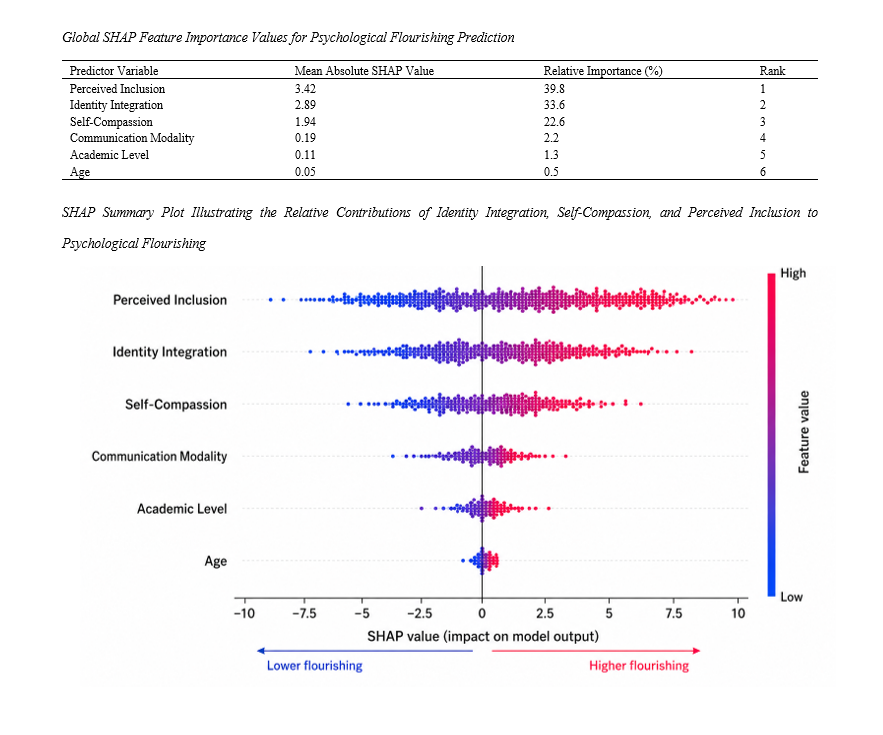
The present study aimed to employ a SHAP-assisted Extreme Gradient Boosting (XGBoost) model to predict psychological flourishing among deaf university students and determine the relative contributions of identity integration, self-compassion, and perceived inclusion to flourishing outcomes. This cross-sectional predictive study was conducted among 428 deaf university students enrolled in Canadian higher education institutions during the 2025–2026 academic year. Participants completed validated measures of psychological flourishing, identity integration, self-compassion, and perceived inclusion. Data were analyzed using XGBoost machine learning algorithms combined with Shapley Additive Explanations (SHAP) to identify the relative importance of predictor variables and provide interpretable explanations of model outputs. The dataset was randomly divided into training and testing subsets using an 80:20 ratio. Five-fold cross-validation and hyperparameter optimization procedures were employed to maximize predictive accuracy and model generalizability. Model performance was evaluated using the coefficient of determination (R²), root mean square error (RMSE), mean absolute error (MAE), and mean absolute percentage error (MAPE). The XGBoost model demonstrated excellent predictive performance, explaining 87.2% of the variance in psychological flourishing in the training dataset and 82.4% in the testing dataset. SHAP analyses identified perceived inclusion as the most influential predictor, accounting for 39.8% of total model importance, followed by identity integration (33.6%) and self-compassion (22.6%). Correlation analyses further revealed significant positive associations between flourishing and perceived inclusion (r = .76, p < .001), identity integration (r = .71, p < .001), and self-compassion (r = .65, p < .001). SHAP dependence patterns indicated that higher levels of all three predictors were associated with substantial increases in predicted flourishing scores, with perceived inclusion exhibiting the strongest and most consistent positive effects. The findings demonstrate that psychological flourishing among deaf university students can be predicted with high accuracy using explainable machine learning approaches. Perceived inclusion emerged as the strongest determinant of flourishing, followed by identity integration and self-compassion, highlighting the critical importance of inclusive educational environments and positive self-related psychological resources. The study underscores the value of SHAP-assisted XGBoost models for advancing understanding of well-being among marginalized student populations and provides evidence for developing interventions that strengthen inclusion, identity affirmation, and self-compassion within higher education settings.
Downloads
References
Bai, C., Liu, R., & Zhang, H. (2026). Moral Elevation, Gratitude, and Meaning in Nurses’ Positive Mental Health. Nursing Ethics. https://doi.org/10.1177/09697330261424358
Bhattacharjee, M. (2022). Embracing the Paradox: A Bodhisattva Path. Religions, 13(1), 67. https://doi.org/10.3390/rel13010067
Bhattarai, A., Bohonos, J. W., & Nomeland, J. R. (2025). ‘Mansplaining’ - Reflections on Teaching Adults in University Classrooms. Advances in Developing Human Resources, 28(1), 8-35. https://doi.org/10.1177/15234223251382408
Blankschaen, K. (2023). Including Transgender Identities in Natural Law. Ergo an Open Access Journal of Philosophy, 10(0). https://doi.org/10.3998/ergo.4648
Calkins, F. C., Finkelstein, S., Martin, M., & Brock, R. L. (2024). The Indirect Impact of Infant Negative Emotionality on Interparental Conflict via Perceptions of Coparenting Challenges: What Prenatal Resources Mitigate This Risk? Family Process, 63(4), 2527-2546. https://doi.org/10.1111/famp.13024
Celidwen, Y., & Keltner, D. (2023). Kin Relationality and Ecological Belonging: A Cultural Psychology of Indigenous Transcendence. Frontiers in psychology, 14. https://doi.org/10.3389/fpsyg.2023.994508
Doherty, J. P., & Nuzum, D. (2023). 'Can You See What I Say?' Beyond Words. Health and Social Care Chaplaincy, 11(2), 205-219. https://doi.org/10.1558/hscc.25862
Fábio, R. M. d. S., Lacerda, S. S., Coelhoso, C. C., Barrichello, C., Tobo, P. R., & Kozasa, E. H. (2021). The Integration of Meditation and Positive Psychology Practices to Relieve Stress in Women Workers (Flourish): Effects in Two Pilot Studies. Behavioral Sciences, 11(4), 43. https://doi.org/10.3390/bs11040043
Gannamraju, S. K. (2025). Lived Experiences of Spiritual Emotional Intelligence: A Bhagavad Gitā-Based Indigenous Model of Psychological Wellbeing. Frontiers in psychology, 16. https://doi.org/10.3389/fpsyg.2025.1730103
Gariba, J. A., & Assenyoh, B. K. (2023). One Lord, One Body: Rethinking Disability in Ghana Through Biblical and Theological Anthropology. Ghana Journal of Religion and Theology, 13(2), 39-61. https://doi.org/10.4314/gjrt.v13i2.4
Goodman, M. L., Theron, L., Seidel, S., Elliott, A., Raimer‐Goodman, L., Keiser, P., Gitari, S., & Gatwiri, C. (2022). Flourishing Communities: A New Model to Promote Sustainable Community Leadership and Transformation in Semi‐rural Kenya. Journal of Community & Applied Social Psychology, 33(3), 756-772. https://doi.org/10.1002/casp.2665
Gulati, S., Hameed, B., Olusanya, B. O., & Newton, C. R. (2023). Neurodiversity and Humanism in Autism: An LMIC Health Care Setting Perspective. Autism, 27(5), 1173-1176. https://doi.org/10.1177/13623613231181477
Hwang, S., & Chang, I. Y. (2025). Negotiation and Solidarity at Cultural Borders in Sport: A Narrative Inquiry Into the Lived Experience of Deaflympians. International Review for the Sociology of Sport. https://doi.org/10.1177/10126902251347113
Iozzio, M. J. (2022). Radical Bioethics: Difference, Disability, and Desiderata. https://doi.org/10.5772/intechopen.97654
Isaee, H., & Barjesteh, H. (2026). Beyond the Self in AI-Enhanced EFL Classrooms: Cultivating Self-Transcendent Emotions, Well-Being, and Speaking Fluency Through Intelligent Simulations. https://doi.org/10.21203/rs.3.rs-8514715/v1
Jain, S. (2021). Exploring the Relationship of Law and Emotions in the Context of Disability Rights Jurisprudence. Jindal Global Law Review, 12(2), 263-292. https://doi.org/10.1007/s41020-021-00156-3
Johansson, J., & Wickström, A. (2022). Constructing a ‘Different’ Strength: A Feminist Exploration of Vulnerability, Ethical Agency and Care. Journal of Business Ethics, 184(2), 317-331. https://doi.org/10.1007/s10551-022-05121-1
Krishnan, S. (2024). Reframing Teacher Candidates’ Views on Disability Through the Writings of Disabled Authors. Research and Practice for Persons With Severe Disabilities, 49(1), 20-35. https://doi.org/10.1177/15407969231223931
Lazzari, C. (2026). A Protocol for a Systematic Review of the Psychosocial Effects of Experiencing Compassion From Others and Its Interpretation Through Secular and Religious Frameworks. Systematic Reviews. https://doi.org/10.1186/s13643-026-03093-1
Leahy, A., & Ferri, D. (2024). Rethinking and Advancing a ‘Bottom-Up’ Approach to Cultural Participation of Persons With Disabilities as Key to Realising Inclusive Equality. International Journal of Law in Context, 20(2), 267-285. https://doi.org/10.1017/s1744552324000041
Lengua, L. J., Calhoun, R., Balinbin, I., Long, R., Spink, K. M., & Angeles, M. (2025). A Well-Being Promotion Program Increases Self-Compassion, Active Coping and Emotion Regulation Among Providers Who Work With Children and Families. BMC Complementary Medicine and Therapies, 25(1). https://doi.org/10.1186/s12906-025-05043-1
Lucibello, K. M., Goldfield, G. S., Alberga, A. S., Leatherdale, S. T., & Patte, K. A. (2024). Exploring the Association Between Internalized Weight Bias and Mental Health Among Canadian Adolescents. Pediatric Obesity, 19(7). https://doi.org/10.1111/ijpo.13118
Magowan, F. (2022). Knowing‐through‐Performing. American Anthropologist, 124(4), 880-884. https://doi.org/10.1111/aman.13787
Manalili, M. A. R. (2021). Ableist Ideologies Stifle Neurodiversity and Hinder Inclusive Education. https://doi.org/10.35542/osf.io/c9mx3
McKimmy, C., Avalos, N., Mejia, D., & Dimidjian, S. (2026). Centering Justice in the Codesign of Mindfulness and Compassion-Based College Curricula. American Journal of Orthopsychiatry, 96(2), 235-252. https://doi.org/10.1037/ort0000817
Nelson, J. M., Jeffrey, A., & Schnitker, S. A. (2025). Mino-Bimaadiziwin and the Pursuit of Harmony. Personality and Social Psychology Review, 29(4), 421-432. https://doi.org/10.1177/10888683251345043
Parmenter, J. G., Winter, S. D., Clements, Z. A., & Taylor, H. G. (2025). How Community and Individual Strengths “Fill Our Cup”: A Preliminary Strengths-Based Psychological Mediation Framework for LGBTQIA+ Communities. Journal of counseling psychology, 72(5), 614-626. https://doi.org/10.1037/cou0000807
Reid, C., & Grant, L. (2024). A Call to Action: Re‐activating the Latent Human Factor for Achieving the UN SDGs—cultivating Courageous Partnerships and Compassionate Human Systems. Psychology and Psychotherapy Theory Research and Practice, 97(3), 408-424. https://doi.org/10.1111/papt.12526
Shani, M. (2024). Coping With Long-Covid Stigma: The Role of Self-Compassion and Self-Coldness. https://doi.org/10.31219/osf.io/3e4cs
Smolen, E. R., & Paul, P. V. (2023). Perspectives on Identity and D/Deaf and Hard-of-Hearing Students. Education Sciences, 13(8), 782. https://doi.org/10.3390/educsci13080782
Wang, Z., Lin, W., Qiu, H., & Lan, Z. C. (2025). “It’s Beyond Enough”: Teachers’ Experiences and Perspectives of Rehabilitation Inclusion for Working With Deaf and Hard of Hearing Children in Rural Areas of China. BMC public health, 25(1). https://doi.org/10.1186/s12889-025-22972-1
Yücel, E., & Dinçer, D. (2024). The Transformative Power of Friendships: Examining the Relationships Among Friendship Quality, Self‐change, and Well‐being. Personal Relationships, 31(2), 301-332. https://doi.org/10.1111/pere.12536
Downloads
Additional Files
Publication Timeline
- Submitted
- Revised
- Accepted