Ego State Therapy: A Randomized Controlled Trial on Prosocial and Health Motivational Outcomes in Young Adults with Physical Disabilities
DOI:
https://doi.org/10.61838/kman.prien.2.4.3Keywords:
Ego, State Therapy, prosocial behavior, health motivation, young adults, physical disabilities, randomized controlled trial, psychological integration, therapy sustainabilityAbstract
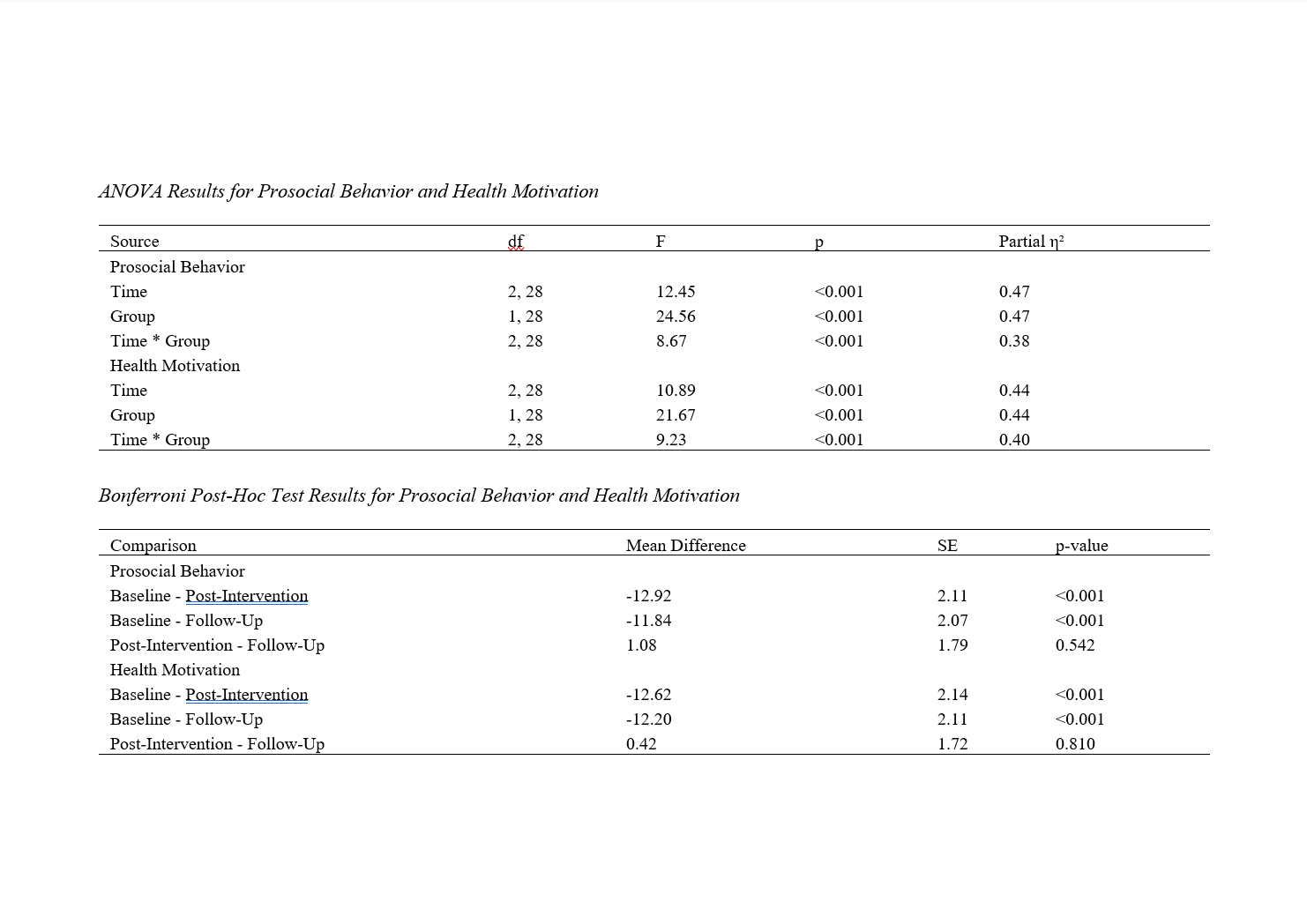
This study aimed to evaluate the effectiveness of Ego State Therapy (EST) in enhancing prosocial behavior and health motivation among young adults with mild physical disabilities. A randomized controlled trial (RCT) design was employed, involving 30 participants aged 18-30 with diagnosed mild physical disabilities. Participants were randomly assigned to either the intervention group (n=15), which received eight 90-minute sessions of EST, or the control group (n=15), which received no intervention. Prosocial behavior and health motivation were assessed using the Prosocialness Scale for Adults (PSA) and the Health Motivation Scale (HMS), respectively, at baseline, post-intervention, and five-month follow-up. Data were analyzed using SPSS-27 software, with analysis of variance (ANOVA) for repeated measurements and Bonferroni post-hoc tests to control for multiple comparisons. Results indicated significant improvements in prosocial behavior (F(2, 28) = 12.45, p < 0.001) and health motivation (F(2, 28) = 10.89, p < 0.001) in the intervention group compared to the control group. These improvements were sustained over the five-month follow-up period, with significant interaction effects between group and time for both prosocial behavior (F(2, 28) = 8.67, p < 0.001) and health motivation (F(2, 28) = 9.23, p < 0.001). Bonferroni post-hoc tests confirmed significant improvements from baseline to post-intervention and from baseline to follow-up in the intervention group, with no significant changes in the control group. Ego State Therapy significantly enhances prosocial behavior and health motivation in young adults with mild physical disabilities, with sustained effects over a five-month follow-up period. These findings suggest that EST is a valuable therapeutic approach for promoting psychological integration and well-being in this population. Future research should explore the mechanisms underlying these effects and the potential benefits of integrating EST with other therapeutic modalities.
Downloads
References
Alessandri, G., Kanacri, B. P. L., Eisenberg, N., Zuffianò, A., Milioni, M., Vecchione, M., & Caprara, G. V. (2014). Prosociality During the Transition From Late Adolescence to Young Adulthood. Personality and Social Psychology Bulletin, 40(11), 1451-1465.https://doi.org/10.1177/0146167214549321
Baumgarten, H. R., & Wheeler, B. L. (2016). The Effects of MusicTherapy on the Prosocial Behaviors of Adults With Disabilities. Music and Medicine, 8(3), 118.https://doi.org/10.47513/mmd.v8i3.475
Berlin, A., & Brodrick, R. (2021). A Safe Place to Suffer: Psychotherapy With Clients for Whom No Improvement May Be Possible. Transactional Analysis Journal, 51(3), 226-240.https://doi.org/10.1080/03621537.2021.1949177
Bock, B. C., Linke, S. E., Napolitano, M. A., Clark, M. M., Gaskins, R. B., & Marcus, B. H. (2018). Exercise Initiation, Adoption, and Maintenance in Adults: Theoretical Models and Empirical Support. 185-208.https://doi.org/10.1037/10465-009
Chen, P., Zhang, Q., Sun, X., Ye, X., Wang, Y., & Yang, X. (2023). How Do Childhood Abuse and Neglect Affect Prosocial Behavior? The Mediating Roles of Different Empathic Components. Frontiers in psychology, 13.https://doi.org/10.3389/fpsyg.2022.1051258
Frederick, C. (2013). The Center Core in Ego State Therapy and Other Hypnotically Facilitated Psychotherapies. American Journal of Clinical Hypnosis, 56(1), 39-53.https://doi.org/10.1080/00029157.2012.747950
Gall, S., Schüz, N., Schüz, B., Martin, K., Abbott-Chapman, J., Ollington, N., Patton, G. C., Dwyer, T., & Venn, A. (2019). Childhood Health Motivation and Adult Cardiometabolic Health in the Childhood Determinants of Adult Health (CDAH) Study. Health Psychology, 38(4), 297-305.https://doi.org/10.1037/hea0000718
Guan, S.-S. A., Fuligni, Andrew J. (2016). Changes in Parent, Sibling, and Peer Support During the Transition to Young Adulthood. Journal of Research on Adolescence, 26(2), 286-299.https://doi.org/10.1111/jora.12191
Lindell, A. K., Campione-Barr, Nicole. (2017). Continuity and Change in the Family System Across the Transition from Adolescence to Emerging Adulthood. Marriage & Family Review, 53(4), 388-416.https://doi.org/10.1080/01494929.2016.1184212
Meier, A., & Allen, G. (2008). Intimate relationship development during the transition to adulthood: Differences by social class. New directions for child and adolescent development,2008(119), 25-39.https://doi.org/10.1002/cd.207
Moilanen, K. L., DeLong, K. L., Spears, S. K., Gentzler, A. L., & Turiano, N. A. (2021). Predictors of initial status and change in self-control during the college transition. Journal of Applied Developmental Psychology, 73, 101235.https://doi.org/10.1016/j.appdev.2020.101235
Streit, C., Carlo, G., Killoren, S. E., & Alfaro, E. C. (2017). Family Members’ Relationship Qualities and Prosocial Behaviors in U.S. Mexican Young Adults: The Roles of Familism and Ethnic Identity Resolution. Journal of Family Issues, 39(4),1056-1084.https://doi.org/10.1177/0192513x16686134
Xu, X., Spinrad, T. L., Xiao, S. X., Xu, J., Eisenberg, N., Laible, D., Berger, R. H., & Carlo, G. (2023). White Children's Prosocial Behavior Toward White Versus Black Peers: The Role of Children's Effortful Control and Parents' Implicit Racial Attitudes. Child development, 94(6), 1581-1594.https://doi.org/10.1111/cdev.13948
Yanagihara, K., Kinugasa, Y., Shirota, K., Inoue, Y., Ishii, H., Tsunoda, F., Iwata, M., Sugihara, S., Takeda, S., Hirai, M., Mimura, A., Kato, M., & Yamamoto, K. (2016). Child ego state is associated with high prevalence of repeated hospitalizations in patients with heart failure. ESC Heart Failure, 3(1), 18-25.https://doi.org/10.1002/ehf2.12060
Zhang, Z., Fu, L., Jing, W., & Liao, Z. (2023). Childhood parental companionship, self-esteem and prosocial behavior in college students: A correlation analysis. Archives of Psychiatric Nursing, 43, 87-91.https://doi.org/10.1016/j.apnu.2023.01.002
Downloads
Additional Files
Publication Timeline
Issue
Section
License

This work is licensed under a Creative Commons Attribution-NonCommercial 4.0 International License.