The Moderating Role of Resilience and Emotion Regulation in the Relationship Between Parenting and Academic Burnout Among Gifted Students in Iraq
Keywords:
parenting, academic burnout, resilience, emotion regulation, gifted studentsAbstract
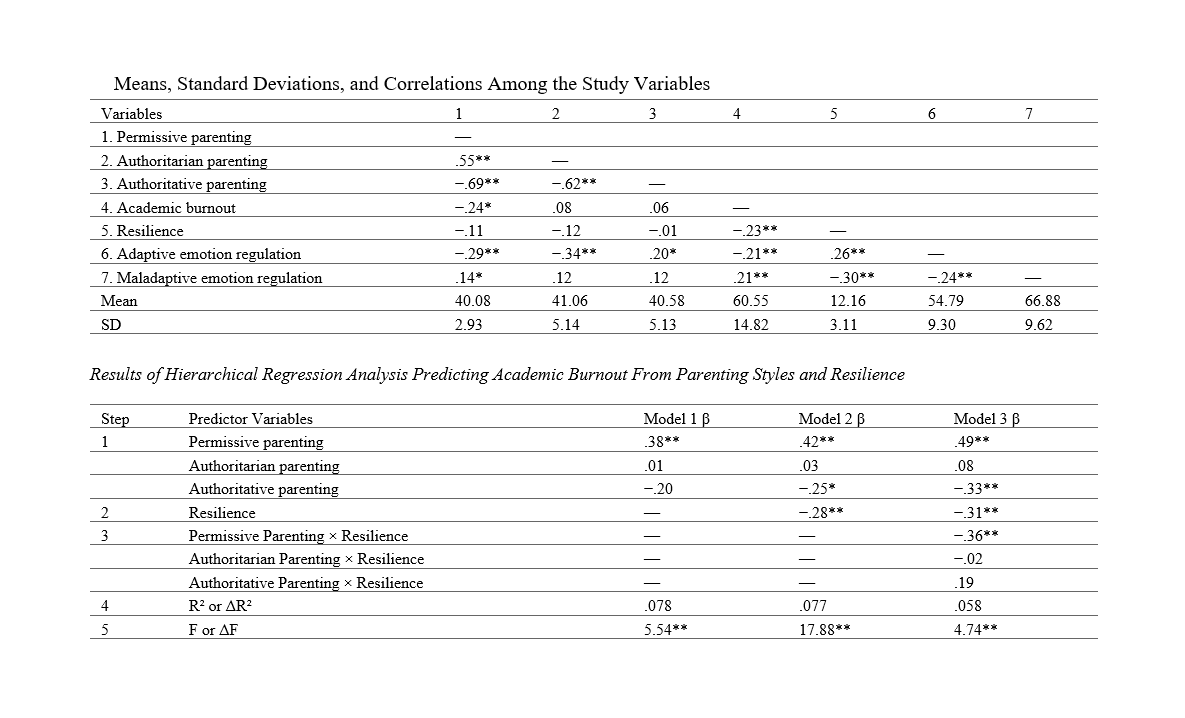
Helping gifted students overcome pressures and stressors throughout their educational trajectory is among the essential responsibilities of educational systems worldwide. This study aimed to determine the moderating role of resilience and emotion regulation in the relationship between parenting and academic burnout among gifted upper-secondary school students in Iraq. The study employed a correlational design, and the statistical population consisted of outstanding upper-secondary school students in Iraq in summer 2024. From this population, 200 students were selected through convenience sampling and subsequently completed four questionnaires: the Brief Resilience Scale (Smith et al., 2008), the Cognitive Emotion Regulation Questionnaire (Garnefski & Kraaij, 2006), the Academic Burnout Questionnaire (Rostami et al., 2011), and the Parenting Styles Questionnaire (Baumrind, 1971). The data were analyzed using Pearson’s correlation coefficient and hierarchical regression analysis in SPSS version 26. The results showed that resilience moderated the relationship between permissive parenting and academic burnout; adaptive emotion regulation moderated the relationship between authoritarian parenting and academic burnout; and maladaptive emotion regulation moderated the relationships of authoritarian and authoritative parenting with academic burnout. The moderating roles of resilience and adaptive and maladaptive emotion regulation in the relationship between parenting styles and academic burnout have important implications for the educational system in Iraq and should be considered in programs designed to support gifted students.
Downloads
References
Ashraf, F., Zareen, G., & Yıldırım, M. (2023). Religious Self-Regulation, Self-Determination, Resilience, and Conflict Management Strategies in a Community Sample of International Muslim Students in Pakistan. Journal of Religion & Spirituality in Social Work: Social Thought, 42, 1-23. https://doi.org/10.1080/15426432.2023.2167255
Bazaz Abkenar, S., & Farhadian, A. (2025). Predicting Academic Burnout Based on School Belongingness, Parenting Styles, and Academic Resilience. Journal of Adolescent and Youth Psychological Studies (JAYPS), 6(3), 79-86. https://doi.org/10.61838/kman.jayps.6.3.9
Benita, M. (2020). Freedom to Feel: A Self-Determination Theory Account of Emotion Regulation. Social and Personality Psychology Compass, 14(11), e12563. https://doi.org/10.1111/spc3.12563
Bogdán, P. M., Varga, K., Katona, S., Gróf, K., & Pakai, A. (2026). Mapping Patterns of Parental Burnout along Psychological Resources and Parenting Styles. Behavioral Sciences, 16(7), 1051. https://doi.org/10.3390/bs16071051
Cai, R. Y., Love, A., Robinson, A., & Gibbs, V. (2023). The Inter-Relationship of Emotion Regulation, Self-Compassion, and Mental Health in Autistic Adults. Autism in Adulthood: Challenges and Management, 5(3), 335-342. https://doi.org/10.1089/aut.2022.0068
Chong, L. Z., Foo, L. K., & Chua, S. L. (2025). Student Burnout: A Review on Factors Contributing to Burnout across Different Student Populations. Behavioral Sciences, 15(2), 170. https://doi.org/10.3390/bs15020170
Ershadi Manesh, S. (2026). Developing a Causal Model of Academic Buoyancy in Gifted Students in Tehran Based on Perceived Parental Relationships and Perceived Teacher-Student Relationships: The Mediating Role of Academic Pressure and Socio-Emotional Competence. Journal of Adolescent and Youth Psychological Studies (JAYPS), 7(1), 1-10. https://doi.org/10.61838/kman.jayps.6174
Fathi, R., Seyf, M. H., & Negahdari, S. (2025). Relationship between Perfectionism and Academic Burnout: Mediating Role of Academic Procrastination and Academic Engagement among Students at Payam Noor University in Shiraz. Iranian Evolutionary Educational Psychology Journal, 7(2), 1-16.
Ghanbaripourtalemi, F., Khosravi Babadi, A. A., & Essareh, A. (2019). Designing a Curriculum Based on the Development of Information Literacy in Upper Secondary Education. New Educational Thoughts, 15(3), 161-184.
Grugan, M. C., Hill, A. P., Madigan, D. J., Donachie, T. C., Olsson, L. F., & Etherson, M. E. (2021). Perfectionism in Gifted Students: A Systematic Review. Educational psychology review, 33(1), 1631-1673. https://doi.org/10.1007/s10648-021-09597-7
Grugan, M. C., Olsson, L. F., Hill, A. P., & Madigan, D. J. (2025). Perfectionism, School Burnout, and School Engagement in Gifted Students: The Role of Stress. Gifted Child Quarterly, 69(3), 255-268. https://doi.org/10.1177/00169862251328015
Hassanzadeh Namin, F., Peymani, J., Ranjbaripour, T., & Abolmaali Al-Hosseini, K. (2019). A Predictive Model of Psychological Well-Being Based on Resilience and Cognitive Emotion Regulation with the Mediating Role of Perceived Stress. Social Psychology Journal, 7(51), 55-67.
Hill, A. P., & Madigan, D. J. (2022). Perfectionism, Mattering, Stress, and Self-Regulation of Home Learning of UK Gifted and Talented Students during the COVID-19 Pandemic. Gifted and Talented International, 37(1), 56-63. https://doi.org/10.1080/15332276.2022.2033649
Huang, J., & Fu, M. (2026). The Relationship between Parental Phubbing and Adolescents' Academic Burnout: A Moderated Chain Mediation Model. Current Psychology, 45, 836. https://doi.org/10.1007/s12144-026-09400-2
Karakaş Mısır, S., & Thomas, M. (2026). Gifted but Misunderstood? An Interpretive Systematic Review of Gifted Education Policy, Practice, and Socio-Emotional Experience in England. Journal of Intelligence, 14(3), 34. https://doi.org/10.3390/jintelligence14030034
Kohansal Nalkiashari, S., Asadi Majareh, S., & Akbari, B. (2022). A Structural Model of the Relationship between Perceived Parenting Styles and Risky Behaviors through the Mediation of Resilience and Emotion Regulation in Adolescents. Psychological Methods and Models, 13(47), 101-116.
Lin, F., & Yang, K. (2021). The External and Internal Factors of Academic Burnout.
Ma, H., Liu, L., Huang, S., Yin, Z., & Liu, T. (2026). Positive Parenting Style and Academic Burnout in Physical Education Teacher Education Students: A Chain Mediating Model of Physical Activity and Meaning in Life. Frontiers in psychology, 17, 1854548. https://doi.org/10.3389/fpsyg.2026.1903004
Madigan, D. J., & Curran, T. (2021). Does Burnout Affect Academic Achievement? A Meta-Analysis of over 100,000 Students. Educational psychology review, 33(1), 387-405. https://doi.org/10.1007/s10648-020-09533-1
Messina, I., Rossi, T., Maniglio, R., Loconsole, C., & Spataro, P. (2025). Risk and Protective Factors in Academic Burnout: Exploring the Mediating Role of Interpersonal Emotion Regulation in the Link with Social Support. Frontiers in psychology, 16, 1536951. https://doi.org/10.3389/fpsyg.2025.1536951
Mohammadi, O., Heydari, A., Eftekhari Saadi, Z., & Joharifard, R. (2024). Predicting Academic Engagement and Burnout Based on Perfectionism and Academic Support in Upper Secondary School Students. Rooyesh-e-Ravanshenasi, 13(2), 131-140.
Ogurlu, U. (2020). Are Gifted Students Perfectionistic? A Meta-Analysis. Journal for the Education of the Gifted, 43(3), 227-251. https://doi.org/10.1177/0162353220933006
Rahmawati, A., I, N., Hidayah, N., Muslihati, M., Rahman, D. H., & Ariffudin, I. (2026). Perfectionism of Gifted Students' Long Term Psychological Impact: A Qualitative Study. COUNSENESIA: Indonesia Journal of Guidance and Counseling, 7(1), 1-11. https://doi.org/10.36728/cijgc.v7i1.6207
Ranjbar Noushari, M., Shokri, O., & Fathabadi, J. (2022). A Phenomenological Analysis of Underachieving Gifted Adolescents' Perceptions of Parenting Practices. Qualitative Research in Behavioral Sciences, 1(2), 57-74.
Rinn, A. N. (2024). A Critique on the Current State of Research on the Social and Emotional Experiences of Gifted Individuals and a Framework for Moving the Field Forward. Gifted Child Quarterly, 68(1), 34-48. https://doi.org/10.1177/00169862231197780
Salazar Kämpf, M., Adam, L., Rohr, M. K., Exner, C., & Wieck, C. (2023). A Meta-Analysis of the Relationship between Emotion Regulation and Social Affect and Cognition. Clinical Psychological Science, 11(6), 1159-1189. https://doi.org/10.1177/21677026221149953
Sukamto, I., Ayriza, Y., Hiryanto, H., Kumullah, R., Murjainah, M., Luansi Ero, P. E., Purwandari, S., Lince, R., & Maulina, D. (2026). Understanding Academic Burnout: A Systematic Literature Review of Its Risk and Protective Factors. Social Sciences & Humanities Open, 13, 102441. https://doi.org/10.1016/j.ssaho.2026.102441
Sun, W., Niu, Q., & Liu, X. (2026). The Relationship between Mindfulness and Learning Burnout among High School Students: The Chain-Mediating Role of Future Time Perspective and Academic Positive Emotions. Behavioral sciences (Basel, Switzerland), 16(2), 188. https://doi.org/10.3390/bs16020188
Wang, S., Liu, X., Yu, S., Zheng, M., & Wei, S. (2026). The Relationship between Parental Autonomy Support and Adolescent Academic Burnout: A Variable-Centered and Person-Centered Analysis. International Journal of Mental Health Promotion, 28(5), 5. https://doi.org/10.32604/ijmhp.2026.076977
Zheng, G., Zhang, Q., & Ran, G. (2023). The Association between Academic Stress and Test Anxiety in College Students: The Mediating Role of Regulatory Emotional Self-Efficacy and the Moderating Role of Parental Expectations. Frontiers in psychology, 14, 1008679. https://doi.org/10.3389/fpsyg.2023.1008679
Downloads
Additional Files
Publication Timeline
- Submitted
- Revised
- Accepted