Structural Model of Fear of Negative Evaluation in Children with Learning Disabilities Based on Maternal Defectiveness/Shame Schema with the Mediating Role of Parental Mentalization
Keywords:
Fear of negative evaluation, specific learning disabilities, parental mentalization, defectiveness/shameAbstract
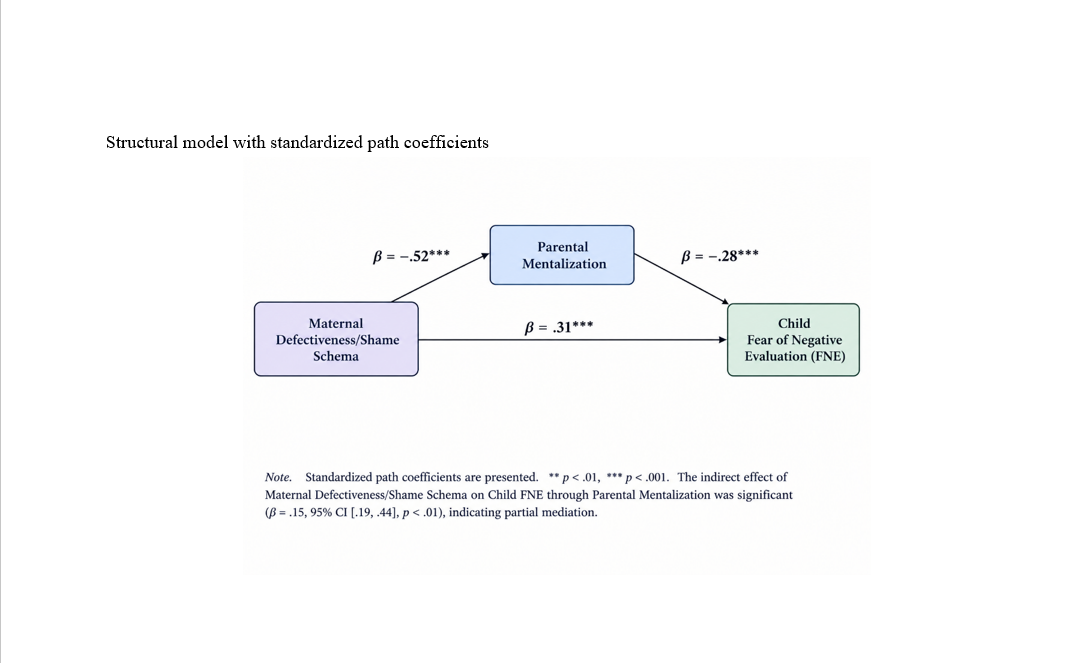
Children with Specific Learning Disabilities (SLD) are highly vulnerable to social anxiety and fear of negative evaluation (FNE); however, the familial mechanisms underlying this vulnerability remain underexplored. This study investigated the mediating role of parental mentalization in the relationship between maternal defectiveness/shame schemas and FNE in children with SLD. Employing a cross-sectional design, the sample consisted of 312 mother-child dyads (children aged 8-12 years). Path analysis was conducted to evaluate the hypothesized structural model, controlling for child's age and mother's education. The structural model demonstrated an excellent fit to the empirical data (χ2/df = 1.87, CFI = 0.98, RMSEA = 0.053). The findings revealed that maternal defectiveness/shame schema significantly and negatively predicted parental mentalization (β = -0.52, p < 0.001) and directly positively predicted child FNE (β = 0.31, p < 0.001). Furthermore, parental mentalization negatively predicted child FNE (β = -0.28, p < 0.001). Bootstrapping analysis confirmed that parental mentalization partially mediated the relationship between maternal defectiveness schema and child FNE (standardized indirect effect = 0.15, unstandardized B = 0.30, p < 0.01). These findings highlight that maternal internalized shame impairs the capacity for reflective functioning, which subsequently exacerbates evaluative fears in children with SLD. Clinical interventions should incorporate family-based approaches, explicitly targeting maternal maladaptive schemas and enhancing parental mentalization to mitigate social anxiety in this clinical population.
Downloads
References
Abbasi, M., & Gheirati, S. (2022). Relationship Between Maternal Depression and Depressive Symptoms and Anxiety in Children With Special Learning Disorders Mediated by Parental Stress. Journal of Learning Disabilities, 11(4), 46-61. https://doi.org/10.22098/jld.2022.10740.2021
Ayar, G., Yalcin, S. S., Artan, O. T., Kahveci, A., & Cop, E. (2024). Which Factors Accompany Maternal Acceptance-Rejection in Children With Specific Learning Disabilities? BMC psychiatry, 24(1), 119-137. https://doi.org/10.1186/s12888-024-05584-8
Fabris, M. A. (2026). Parental Rejection and Risk of Muscle Dysmorphia in Italian Male Adolescents: The Mediating Role of Disconnection and Rejection-Related Early Maladaptive Schemas. Psychology of Men & Masculinity, 27(1), 83-91. https://doi.org/10.1037/men0000545
Fredrick, J. W., & Luebbe, A. M. (2022). Prospective Associations Between Fears of Negative Evaluation, Fears of Positive Evaluation, and Social Anxiety Symptoms in Adolescence. Child Psychiatry & Human Development, 55(1), 195-205. https://doi.org/10.1007/s10578-022-01396-7
Fredrick, J. W., & Luebbe, A. M. (2024). Prospective Associations between Fears of Negative Evaluation, Fears of Positive Evaluation, and Social Anxiety Symptoms in Adolescence. Child Psychiatry & Human Development, 55(1), 195-205.
Gentile, A., Giordano, G., Inguglia, C., Ingoglia, S., & Alesi, M. (2026). Discrepancies between Parent- and Child-Report Internalizing Problems in Specific Learning Disabilities. Learning and Individual Differences, 125, 102845. https://doi.org/10.1016/j.lindif.2025.102845
Guo, L., & Keles, S. (2025). A systematic review of studies with parent-involved interventions for children with specific learning disabilities. European Journal of Special Needs Education, 40(4), 755-772. https://doi.org/10.1080/08856257.2024.2421112
Jokar, L., Khayatan, F., & Golparvar, M. (2026). Comparing the effectiveness of the schema based parenting training program integrated with transactional analysis (ST TA) with parenting based on acceptance and commitment therapy (ACT) on preschool children's behavioral problems and assertiveness.
Jokar, L., Khayyatan, F., & Golparvar, M. (2025). Comparison of the effectiveness of a schema-based parenting package based on transactional analysis with acceptance-based parenting for mothers on the social competence of preschool children. Health and Education in Early Childhood, 6(2), 1-10. https://jeche.ir/article-1-294-fa.html
Karatoprak, S., Akyıldız, A., Emiral, G. Ö., Emiral, E., & Dönmez, Y. E. (2025). Assessment of Parental Attachment and Early Maladaptive Schemas in Juvenile Boy Offenders in Turkiye; A Case–control Study. Legal and Criminological Psychology, 30(2), 349-363. https://doi.org/10.1111/lcrp.70003
Locati, F., Federica, C., Karin, E., Nick, M., & Laura, P. (2025). Mentalization, theory of mind and socioemotional development in middle childhood: Mentalization, TOM and socioemotional skills. Current Psychology: A Journal for Diverse Perspectives on Diverse Psychological Issues. https://doi.org/10.1007/s12144-025-07475-x
Nematzadeh, S., Fatemi, A., Gheysvandi, E., & Nargesi, F. (2026). Which parent, which schema mode? Examining the role of parental gender in adverse childhood experiences. BMC psychology, 14(1), 144. https://doi.org/10.1186/s40359-025-03825-3
Palma, M. D., Izett, E., Rooney, R., McDevitt, M., & Mancini, V. (2026). Interrelationships Between Mentalizing Capacity, Symptoms of Depression and Anxiety, and Coparenting in Parents of School Aged Children. Frontiers in psychology, 17. https://doi.org/10.3389/fpsyg.2026.1481550
Salavou, V., Papanikolaou, K., Pehlivanidis, A., & Giannakopoulos, G. (2026). Mentalization and Emotion Regulation in Adolescent Attachment: A Scoping Review. Children, 13(3), 420. https://doi.org/10.3390/children13030420
Seifi, F., Mollazadeh, J., Aflakseir, A., Rahimi, C., & Simpson, S. (2025). Parent‐Focused Group Schema Coaching; CAREFREE (Carers Programme for Fluency in Resonance and Empowerment in Eating Disorders) Intervention for Parents of Adolescents With Anorexia Nervosa: A Multiple Baseline Design. Clinical Psychology & Psychotherapy, 32(5). https://doi.org/10.1002/cpp.70157
Shariati, F., Niazazari, K., & Jabbary, N. (2024). Presenting a Model for Virtual Education Considering Educational Equity with a Phenomenological Approach in Schools of Golestan Province [Research Article]. Iranian Journal of Educational Sociology, 7(1), 66-78. https://doi.org/10.61838/kman.ijes.7.1.7
Thorén, A., Lindqvist, K., Nemirovski, J. P., & Mechler, J. (2025). Short-term mentalization-based therapy for common childhood mental disorders-a pilot quasi-randomised controlled trial. Clinical Child Psychology and Psychiatry, 30(2), 436-451. https://doi.org/10.1177/13591045251316619
Uysal, M., Gurel Ficicioglu, I. E., Mutlu, M., & Mutluer, T. (2026). Schema Therapy for Children and Adolescents: A Systematic Review of Individual, Group, and Parent-Based Interventions. Clinical Child and Family Psychology Review, 1-16. https://doi.org/10.1007/s10567-026-00568-4
Valipour, A., Jahangir, P., & Rezakhani, S. (2025). Comparison of the Effectiveness of Schema-Based Parenting Training and Adler-Dreikurs Approach on Parenting Burnout and Parenting Stress. The Psychology of Education, 12(1), 35-50. https://doi.org/10.61838/kman.pwj.6.1.11
Xu, T. (2025). Parent-Child Play Therapy Effect on 10 to 12-Year-Old Student’ Reading Performance: A Case of Chinese Male Students With Learning Disabilities. BMC psychology, 13(1). https://doi.org/10.1186/s40359-025-02436-2
Downloads
Additional Files
Publication Timeline
- Submitted
- Revised
- Accepted