Investigating the Effectiveness of the RhythmoGame Method in Reducing Spelling Learning Disorders among First-Cycle Primary School Students
Keywords:
RhythmoGame, Spelling Learning Disorder, Specific Learning Disorder, Primary School Students, Rhythm-Based Intervention, Game-Based LearningAbstract
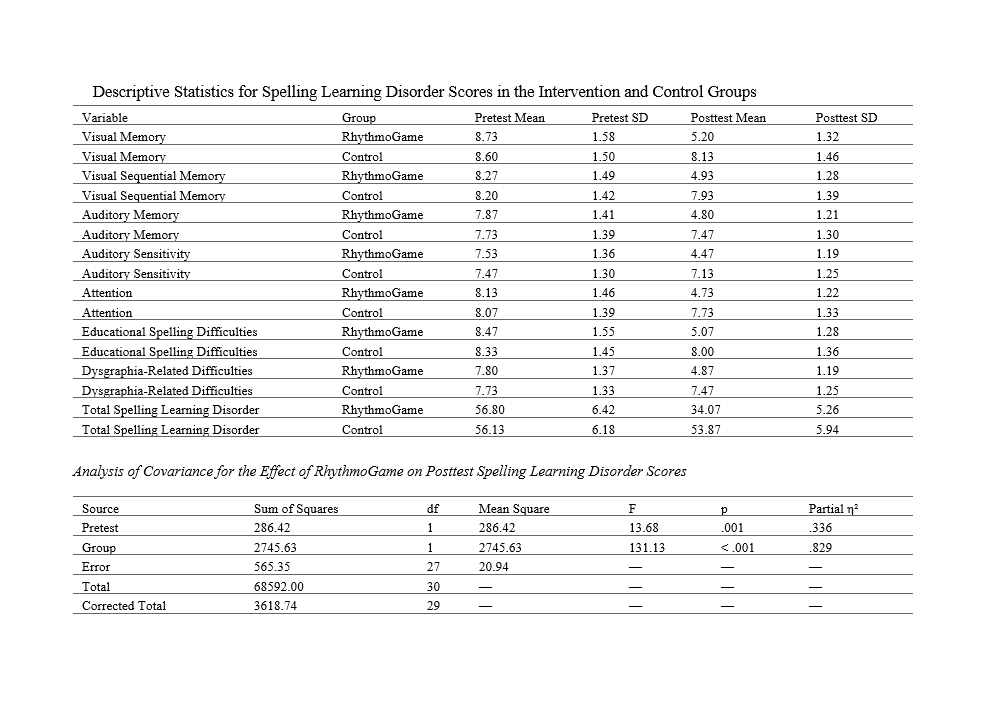
The present study aimed to investigate the effectiveness of the RhythmoGame method in reducing spelling learning disorders among first-cycle primary school students. This study employed a quasi-experimental pretest–posttest design with an intervention group and a control group. The statistical population consisted of primary school students in Sabzevar, Iran, during the 2024–2025 academic year who had been identified as having spelling learning disorder. Thirty eligible students were assigned to the RhythmoGame intervention group and the control group, with 15 students in each group. Data were collected using the Wechsler Intelligence Scale for Children–Fourth Edition, the Colorado Learning Difficulties Questionnaire, and a researcher-developed spelling assessment measuring visual memory, visual sequential memory, auditory memory, auditory sensitivity, attention, educational spelling difficulties, and dysgraphia-related difficulties. The intervention group participated in the RhythmoGame program for two months, with two sessions per week lasting approximately 45–60 minutes. The program included rhythmic games, music, coordinated movement, auditory attention, sequencing, motor planning, response inhibition, and group interaction. The control group continued its usual educational activities. Data were analyzed using analysis of covariance after examining the relevant statistical assumptions. Analysis of covariance showed a statistically significant effect of group membership on posttest spelling learning disorder scores after controlling for pretest scores, F(1, 27) = 131.13, p < .001, partial η² = .829. The pretest covariate was also significant, F(1, 27) = 13.68, p = .001, partial η² = .336. The adjusted posttest results indicated that students in the RhythmoGame group had significantly lower spelling learning disorder scores than those in the control group. The findings indicate that RhythmoGame can be an effective complementary educational intervention for reducing spelling learning disorders in young primary school students, possibly through simultaneous engagement of auditory processing, attention, sequencing, memory, motor coordination, and response control.
Downloads
References
Abrishamizadeh, B. N. (2017). The Effectiveness of Flashcard Training in Improving Written Learning Disorder in Spelling. Educational Technologies in Learning, 4(13), 55-74.
Athalia, Z., Thalia, T. E., & Widianto, M. H. (2024). Revolutionizing Piano Practice: A Game-Based Learning Rhythm Game to Motivate and Support Learners 2024 International Conference of Adisutjipto on Aerospace Electrical Engineering and Informatics (ICAAEEI),
Daneshyar, E., Soleimani, M., Mohammadzadeh, H., & Dehghanizadeh, J. (2019). The Effectiveness of Rhythmic and Group Games on Gross Motor Skills and Social Interaction in Children with Autism.
Ghaffari, K., Yasbolaghi, B., & Abdolvand, K. (2020). The Effectiveness of Word-Play Training on Spelling Problems of First-Grade Elementary Students. Modern Educational Approaches, 15(2), 23-42.
Ghanizadeh Bidokhti, A. (2023). Examining the Effectiveness of a Combined Direct Instruction and Phonological Awareness Program in Reducing Spelling Errors among Elementary Students with Spelling Learning Disorder in Fereydunkenar Eighth National Conference on New Approaches in Education and Research, Mahmoudabad, Iran.
Karimi, B., Alizadeh, H., Farrokhi, N., & Saadipour, E. (2011). Comparison of the Effectiveness of Direct Instruction, Phonological Awareness, and Combined Methods in Reducing Spelling Problems among Elementary School Students. Exceptional Children(3), 255.
Naderi, H., Rostamian, M., & Momeni, F. (2018). The Effectiveness of Perceptual-Motor Skills on Reading, Writing, and Mathematics Performance in Students with Specific Learning Disorder. Disability Studies, 8(-), 0-0.
Najafi, S., Hejazi, D., & Ahmadpour, A. (2024). The Effect of Fundamental Motor Skill Practice Using the Teaching Games for Understanding Approach on Motor and Cognitive Skills of Children with Attention-Deficit/Hyperactivity Disorder. Scientific-Research Bimonthly Journal of Rehabilitation Medicine, 13(2), 392-405.
Niknasab, F., Bagherzadeh, F., Sheikh, Moghadamzadeh, & Houmanian. (2023). The Effect of Transcranial Direct Current Stimulation on Visual-Motor Integration in Children with Developmental Coordination Disorder. Neuropsychology, 9(33), 1-10.
Oladghobad, Abbaspoor, A., Khalatbari, & Afkari. (2021). The Effectiveness of Rosner's Multisensory Teaching Method in Reducing Spelling Writing Disorder among Elementary School Students. Quarterly Journal of Excellence in Counseling and Psychotherapy, 10(39), 26-35.
Pasqualotto, A., & Venuti, P. (2024). Predictors of Reading and Spelling Difficulties in Italian Children: Specific Language and General Cognitive Skills. Learning Disabilities Research and Practice, 40(1), 17-30. https://doi.org/10.1177/09388982241292304
Pourkamali, A., Mohammadi, A., & Haghighat, S. (2022). The Effectiveness of the Fernald Multisensory Approach in Improving Dictation Disorder and Reading Problems in Students with Learning Disabilities. Disability Studies, 12(0), 0-0.
Radtke, B. M., Łada-Maśko, A. B., Jurek, P., Olech, M., & Sajewicz-Radtke, U. (2025). Beyond Reading and Spelling: Exploring Intelligence Profiles in Individuals with Dyslexia through a Cattell-Horn-Carroll Theory Lens. Health Psychology Report. https://doi.org/10.5114/hpr/205989
Sigmund, J. L., Mehlhase, H., Schulte-Körne, G., & Moll, K. (2024). Early cognitive predictors of spelling and reading in German-speaking children. Frontiers in Education. https://doi.org/10.3389/feduc.2024.1378313
Tabrizi, M. (2011). Treatment of Dictation Writing. Forouzan.
Zareifard, R., & Tadayon, E. (2024). Explaining Spelling Errors in Second- and Third-Grade Elementary Students Based on Garman's (1996) Model.
Zoghi, Goodarzi, & Rajabinejad. (2020). The Effect of Educational-Sport Games and Rhythmic Movements on Mathematics Skills of Students with Mathematics Learning Disorder. Educational Psychology Quarterly, 17(59), 375-404.
Downloads
Additional Files
Publication Timeline
- Submitted
- Revised
- Accepted