Comparison of the Effects of Sensory–Motor Integration and Cognitive Restructuring on Executive Functions and Social Skills in Individuals with Autism Spectrum Disorder
Keywords:
autism spectrum disorder, sensory–motor integration, cognitive restructuring, executive functions, social skillsAbstract
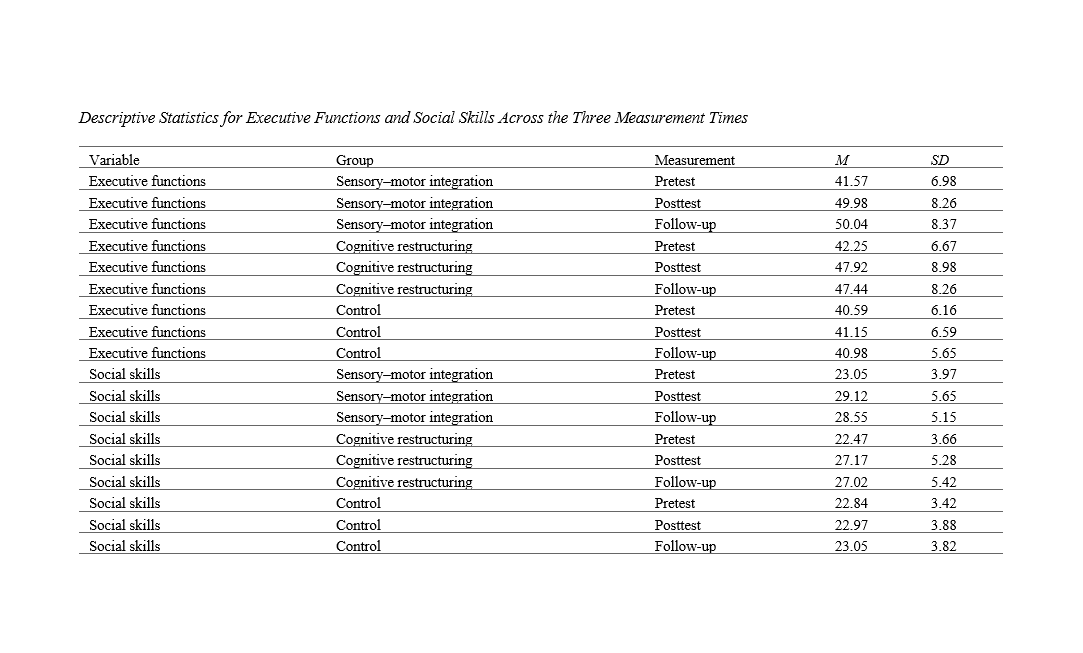
Autism spectrum disorder (ASD) is a complex neurodevelopmental disorder characterized by impairments in social interaction and communication, as well as restricted and repetitive patterns of behavior. Children with this disorder commonly experience substantial difficulties in executive functions and social skills, which may adversely affect their academic and social adjustment. Therefore, identifying and implementing effective interventions to improve these abilities is of particular importance. In recent years, interventions based on sensory–motor integration and cognitive restructuring have received increasing attention as potentially effective approaches for improving cognitive and social functioning in children with autism spectrum disorder. The present study aimed to examine the effectiveness and durability of sensory–motor integration and cognitive restructuring interventions in improving executive functions and social skills among children with autism spectrum disorder. This study employed a quasi-experimental design with pretest, posttest, and two-month follow-up assessments and a control group. The statistical population consisted of students aged 7–12 years with autism spectrum disorder in Kerman, Iran. From this population, 45 participants were selected using purposive sampling and randomly assigned to three groups of 15 participants: the sensory–motor integration group, the cognitive restructuring group, and the control group. The research instruments included the Behavior Rating Inventory of Executive Function (BRIEF) and the Gresham and Elliott Social Skills Rating System (Teacher Form). Data were analyzed using repeated-measures analysis of variance. The results indicated that the effect of time was significant for executive functions (F = 13.90, p < .01) and social skills (F = 9.90, p < .01). In addition, the time × group interaction effect was significant for executive functions (F = 9.90, p < .01, η² = .54) and social skills (F = 9.90, p < .01, η² = .44). Post hoc comparisons showed that both interventions resulted in significant improvements in executive functions and social skills compared with the control group (p < .05). Furthermore, the sensory–motor integration intervention was more effective than cognitive restructuring, and these effects were maintained at the follow-up assessment (executive functions: F = 17.87, p < .01, η² = .45; social skills: F = 12.57, p < .01, η² = .37). Therefore, both interventions are suggested to use to improve executive functions and social skills in individuals with autism spectrum disorder while sensory-motor integration is more effective than cognitive restructuring intervention.
Downloads
References
Adams, J. N., Feldman, H. M., Huffman, L. C., & Loe, I. M. (2015). Sensory Processing in Preterm Preschoolers and Its Association with Executive Function. Early human development, 91(3), 227-233. https://doi.org/10.1016/j.earlhumdev.2015.01.013
Asadi Gandmani, R., Kazemi, F., Pishiyareh, E., Hashemi Azar, J., & Nasaeian, A. (2016). The Relationship between Sensory Processing Patterns and Executive Functions in Students with Autism Disorder. Psychology of Exceptional Individuals, 6(23), 27-48.
Becker, D. R., McClelland, M. M., Geldhof, G. J., Gunter, K. B., & MacDonald, M. (2018). Open-Skilled Sport, Sport Intensity, Executive Function, and Academic Achievement in Grade School Children. BMC Geriatrics, 939-955. https://doi.org/10.1080/10409289.2018.1479079
Behrouzmanesh, P., Naderi, F., Bakhtiarpour, S., & Hafezi, F. (2023). Effectiveness of Sensory Integration-Based Training on the Sensory Status of Children with High-Functioning Autism Spectrum Disorder. Rehabilitation Medicine, 12(4), 760-773.
Bojanek, E. K., Kelly, S. E., Schmitt, L., Pulver, S. L., Sweeney, J. A., Sprenger, A., Unruh, K. E., & Mosconi, M. W. (2025). Sensorimotor Behavior in Individuals With Autism Spectrum Disorder and Their Unaffected Biological Parents. Autism Research, 18(3), 498-514. https://doi.org/10.1002/aur.70000
Dadashzadeh, M., Sheikh, M., Dadashzadeh, H., & Ghaderi, S. (2020). The Effect of Play Therapy on Social Skills and Stereotyped Behaviors of Boys Aged 7 to 10 Years with Autism Spectrum Disorder.
Demetriou, E. A., Lampit, A., & Quintana, D. S. (2018). Autism Spectrum Disorders: A Meta Analysis of Executive Function. Psychological bulletin, 144(11), 1103-1132.
Deng, M., Cai, D., Zhou, X., & Leung, A. W. (2020). Executive Function and Planning Features of Students With Different Types of Learning Difficulties in Chinese Junior Middle School. Learning Disability Quarterly, 0731948720929006. https://doi.org/10.1177/0731948720929006
Denham, S. A., Bassett, H. H., & Zinsser, K. (2023). Social-Emotional Learning and Empathy Development in Childhood. Early Education and Development.
Deveci, S. Ş., Matur, Z., Kesim, Y. Y., Senturk, G. G., Sargın-Kurt, G. G., Ugur, S. A., & Öge, A. E. O. (2020). Effect of the Brain-Derived Neurotrophic Factor Gene Val66Met Polymorphism on Sensory-Motor Integration during a Complex Motor Learning Exercise. Brain Research, 1732, 146652. https://doi.org/10.1016/j.brainres.2020.146652
Fathabadi, R., Sharifi Daramadi, P., & Rezaei, S. (2020). Development of a Cooperative Games Educational Package and Examination of Its Effectiveness on Social Skills in Children with Autism Spectrum Disorder Proceedings of Scientific Conferences,
Garcia, M., & Torres, L. (2021). Effects of Sensorimotor Exercises on Communication and Social Interaction in Children with Autism Spectrum Disorder. Research in Developmental Disabilities, 112, 103912.
Han, J., Waddington, G., Adams, R., & Anson, J. (2023). Proprioception and Motor Control in Human Movement. Sports medicine.
Happé, F., & Frith, U. (2020). Annual Research Review: Looking Back to Look Forward—Changes in the Concept of Autism and Implications for Future Research. Journal of Child Psychology and Psychiatry, 61(3), 218-232. https://doi.org/10.1111/jcpp.13176
Harris, J., & Thompson, L. (2023). Cognitive Restructuring Training and Executive Function Improvement in Children with Autism Spectrum Disorder. Research in Autism Spectrum Disorders, 101, 102086.
Hassanzadeh, M. (2021). Effectiveness of Sensory-Motor Integration Exercises in Improving Symptoms of Children with Autism Spectrum Disorder with Parental Assistance Proceedings of the 10th International Conference on Psychology, Counseling and Educational Sciences,
Hayatinia, R., & Kashkooli, F. (2022). Effectiveness of Sensory-Motor Integration Therapy on Executive Functions and Stereotyped Behavior in Children with Autism in Bushehr Proceedings of the Second National Conference on Applied Ideas in Educational Sciences, Psychology and Cultural Studies, Bushehr, Iran.
Khodabakhshi, M. (2020). Sensory Integration. Bachehaye Aseman Quarterly.
Nguyen, T., Tran, H., & Pham, L. (2021). Sensorimotor Intervention and Reduction of Stereotyped Behaviors in Children with Autism Spectrum Disorder. Occupational Therapy International, 2021, 1-9.
Niehaus, J. (2021). Autism Spectrum Disorder. In Encyclopedia of Evolutionary Psychological Science. Springer. https://doi.org/10.1007/978-3-319-19650-3_300383
Rezaei, S., & Bakhtiari, B. (2019). Development of a Sensory-Motor Intervention Program and Examination of Its Effectiveness in Improving Social Profile and Social Interest in Children with High-Functioning Autism.
Sadati Firouzabadi, S., & Abbasi, S. (2018). Effectiveness of Sensory-Motor Integration Therapy on Reading Problems in Students with Learning Disabilities. Journal of Learning Disabilities, 8(2), 26-37.
Sadeghian, A., Bigdeli, I., & Alizadeh Zarei, M. (2017). Effectiveness of Sensory-Motor Integration Exercises in Improving Symptoms of Children with Autism Spectrum Disorder. Disability Studies, 7(13), 78-91.
Savarese, G., Mandia, R., Diavoletto, A., Impemba, F., Siervi, A. D., Carpinelli, L., Bottiglieri, F., & Corrivetti, G. (2025). Preliminary Results of Sensorimotor Room Training for the Improvement of Sensory and Motor Skills in Children With Autism Spectrum Disorders. Pediatric Reports, 17(1), 4. https://doi.org/10.3390/pediatric17010004
Shahbazi, S., & Heyrani, A. (2018). The Effect of Sensory-Motor Integration Activities on Attention and Working Memory in Children with Developmental Coordination Disorder. Sport Management and Motor Behavior Research Journal, 14(28), 45-60.
Shin-Siung Jung, M. D., & Simon Jung, S. (2020). Pei-Rong Chang. Treatment of Students with ADHD without Medicines, But with Sensory-Motor Integration Training (SMI-Tx)(1) Combing Latest qEEG and Neurofeedback Come to the Shortest and the Best Results. Int J Psychiatr Res, 3(5) 1-15. https://doi.org/10.33425/2641-4317.1072
Shokri, L. (2019). Effectiveness of Sensory Integration-Based Therapy in Reducing Symptoms of Children with Autism in Ahvaz Sixth International Conference on New Research Achievements in Social Sciences, Educational Sciences and Psychology, Isfahan, Iran.
Shumway-Cook, A., & Woollacott, M. (2022). Motor Control: Translating Research into Clinical Practice (6th ed.). Wolters Kluwer.
Sosic-Vasic, Z., Kröner, J., Schneider, S., Vasic, N., Spitzer, M., & Streb, J. (2017). The Association between Parenting Behavior and Executive Functioning in Children and Young Adolescents. Frontiers in psychology, 8, 472. https://doi.org/10.3389/fpsyg.2017.00472
Talvio, M., Berg, M., & Lonka, K. (2015). How Does Continuing Training on Social Interaction Skills Benefit Teachers? Procedia - Social and Behavioral Sciences, 171, 820-829. https://doi.org/10.1016/j.sbspro.2015.01.197
Wen, L., & Wu, Z. (2025). The impact of sensory integration based sports training on motor and social skill development in children with autism spectrum disorder. Sci Rep, 15(1), 19974. https://doi.org/10.1038/s41598-025-05393-3
Downloads
Additional Files
Publication Timeline
- Submitted
- Revised
- Accepted