The Role of Spirituality Therapy Emphasizing the Teachings of Islam in Enhancing Resilience and Reducing Depressive Symptoms Among Families of Children with Autism
Keywords:
resilience, depression, spirituality therapyAbstract
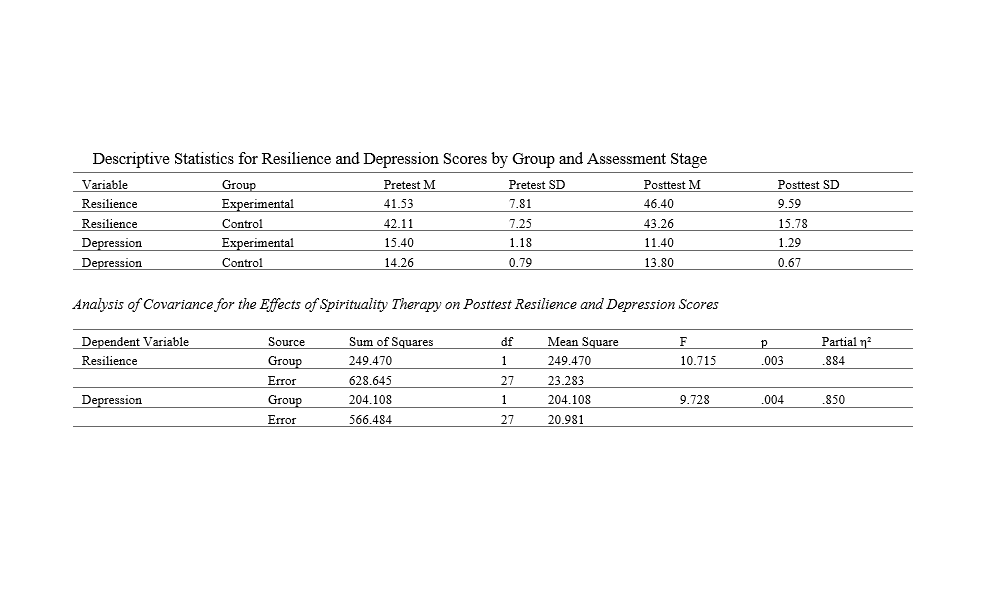
The present study aimed to determine the role of spirituality therapy emphasizing the teachings of Islam in enhancing resilience and reducing depressive symptoms among families of children with autism in Khoy, Iran, in 2024. In terms of its purpose, this study was applied research, and in terms of data collection, it was a field study. The study employed a quasi-experimental method with a pretest–posttest design and a control group. The statistical population comprised all families of children with autism in Khoy who attended one of the rehabilitation and educational centers for children with autism in 2024. Using purposive and convenience sampling, 30 participants were selected and randomly assigned to two groups of 15 participants each (experimental and control). Participants completed the Connor-Davidson Resilience Scale (Connor & Davidson, 2003) and the 13-item Beck Depression Inventory. Participants in the experimental group received 10 sessions of a spirituality therapy program based on Islamic teachings. The data were analyzed using multivariate analysis of covariance (MANCOVA). The results supported the research hypothesis regarding the effectiveness of spirituality therapy in improving resilience and reducing depression among families of children with autism in Khoy. At posttest, parents in the experimental group exhibited significantly higher levels of resilience and lower levels of depressive symptoms than parents in the control group. Therefore, the spirituality therapy program emphasizing the teachings of Islam was effective in enhancing resilience and reducing depressive symptoms among families of children with autism in Khoy.
Downloads
References
Agaibi, C. E., & Wilson, J. P. (2015). Trauma, PTSD, and Resilience: Review of the Literature. Trauma, Violence, & Abuse, 6(3), 195-216.
Ariapouran, S., Rastgoo, E., & Abdollahzadeh Rafi, M. (2024). Effectiveness of Emotion Regulation Training on Depressive Symptoms in Mothers Caring for Children with Intellectual Disability during the COVID-19 Pandemic. Psychological Achievements, 31(1), 1-22.
Bakhshi, A., Normiq, K. N., Hossein Zahi, H., & Zare Tajabadi, M. (2023). The Effectiveness of Spiritual therapy on psychological Hardiness and psychological Distress of Students. Islamic Lifestyle Centered on Health, 7(2), 359-366. https://www.magiran.com/paper/2620733
Balvayeh, M., Naghsh, Z., Rezaei, S., & Afrooz, G. A. (2024). Developming an Educational Program Based on Spiritual Vitality and Evaluating of Its Effectiveness on Hope, Engagement, and Parenting Stress Reduction in Parents of Children with Autism Spectrum Disorder. Razi Journal of Medical Sciences, 31(1). https://doi.org/10.47176/rjms.31.197
Beurel, E., Toups, M., & Nemeroff, C. B. (2020). The Bidirectional Relationship of Depression and Inflammation: Double Trouble. Neuron, 107(2), 234-256.
Faghihi, A. N., & Abbasi Darreh Bidi, A. (2020). Effectiveness of Family-Based Group Spirituality Therapy on Reducing Depressive Symptoms and Rumination among Female Seminary Students at Masoumieh Seminary of Khorramabad. Religion and Family, 1(1), 1-18.
Fazli, A., Bastami, H., Vatan Iman, M., Shahrami Rad, S., & Babaei, H. (2024). Examining Mental Health Quality and Quality of Life of Parents of Children with Autism Spectrum Disorder in Shahroud. Navid No, 27(89), 43-51.
Fereydouni Sarijeh, P., Kia Behdokht Mahmoudi, M., & Salahinejad, M. (2021). Examining the Effect of Spirituality Therapy on Resilience in Hemodialysis Patients. Avicenna Journal of Nursing and Midwifery Care, 29(4), 264-272.
Hatch, D. J., Potter, G. G., Martus, P., Rose, U., & Freude, G. (2019). Lagged versus Concurrent Changes between Burnout and Depression Symptoms and Unique Contributions from Job Demands and Job Resources. Journal of occupational health psychology, 24(6), 617-628.
Isa Zadeh, F., & Saffarinia, M. (2020). Effectiveness of Group Spirituality Therapy on Depression, Mental Health, and Psychological Capital in Individuals Recovered from COVID-19. Quran and Medicine, 5(4), 11-22.
Jadidi Fighan, M., Safari, S., Faramarzi, S., & Jamali Paghaleh, S. (2015). Comparison of Social Anxiety and Social Support among Mothers of Children with Special Needs and Mothers of Healthy Children. Knowledge and research in applied psychology, 16(2), 43-52.
Kamandlou, Z., Haghdadi, H., Haghdadi, H., Hosseinzadeh Oskouei, A., & Samadi Kashan, S. (2020). Comparison of Stress, Anxiety, Depression, and Sleep Quality among Mothers of Children with Autism Spectrum Disorder, Attention-Deficit/Hyperactivity Disorder, and Slow-Paced Development. Empowering Exceptional Children, 11(2), 13-22.
Khaledian, M., Morovat, G., & Moradi, N. (2016). The Effect of Spirituality Therapy with Emphasis on Islamic Teachings on Depressive Symptoms and Adjustment of Students with Complicated Grief. World Scientific News(57), 220-227.
Masefield, S. C., Prady, S. L., Sheldon, T. A., Small, N., Jarvis, S., & Pickett, K. E. (2020). The Caregiver Health Effects of Caring for Young Children with Developmental Disabilities: A Meta-Analysis. Maternal and Child Health Journal, 24(5), 561-574.
Masten, A. S. (2021). Ordinary Magic: Resilience Processes in Development. American Psychology, 56, 227-238.
Mirarjmandi, S. Z. S., Hashemian, K., & Niknam, M. (2015). Effectiveness of Group Spirituality Training in Reducing Depression and Increasing Marital Satisfaction among Married Women in District 5 of Tehran. Educational Psychology Quarterly, 11(35), 137-158.
Moin, Z. Z., Abolmaali Alhoseini, K., & Seirafi, M. r. (2023). A Comparison of Effectiveness of Spiritual Therapy and Acceptance and Commitment Therapy (ACT) on Reducing Existential Anxiety in Women with Breast Cancer. Counseling Culture and Psycotherapy, 14(56), 39-66. https://doi.org/10.22054/qccpc.2023.70009.3011
Mousavi, S. A., Alvani, J., & Ghasemipanah, M. (2021). Determining the Relationship between Emotional Adjustment and Cognitive Emotion Regulation with Resilience among Military Nurses. Journal of Marine Medicine, 3(1), 39-45.
Nasution, L. A., Afiyanti, Y., & Kurniawati, W. (2020). Effectiveness of Spiritual Intervention toward Coping and Spiritual Well-Being on Patients with Gynecological Cancer. Asia-Pacific Journal of Oncology Nursing, 7(3), 273-279.
Nemati Sogolitappeh, F. (2018). The Effect of Spirituality Therapy with Emphasis on Islamic Teachings on Self-Esteem and Resilience in Individuals with Addiction. Behavioral Sciences Research, 16(1), 62-69.
Noviyanty, H., Ismail, Z., Hamjah, S. B. H., & Mohamad, A. D. (2022). Spiritual Psychotherapy and Mental Health: The Forgiveness Therapy in Achieving Spiritual Well-Being of Drug Addicts with Depression Disorders. Second International Conference on Public Policy, Social Computing and Development (ICOPOSDEV 2021),
Rashidzadeh, A. (2020). Effectiveness of Training a Program Based on Spirituality and Islamic Teachings on Anxiety and Academic Resilience of Students. Applied Issues in Islamic Education, 5(1), 7-34.
Saberi, A. (2026). Developing a Spiritual Therapy Package for Migraine Patients and Evaluating Its Effectiveness on Pain Intensity, Pain Catastrophizing Rate, Distress Tolerance, and Resilience of Sufferers [Doctoral dissertation, Najafabad Branch, Islamic Azad University].
Sadati, S. Z., & Mahdavi, F. (2023a). The Effectiveness of Spiritual Therapy Emphasizing Islamic Teachings on Resilience, Religious Orientation, and Life Satisfaction in Divorced Women. Applied Family Therapy, 4(4), 317-330.
Sadati, S. Z., & Mahdavi, F. (2023b). Effectiveness of Spirituality Therapy with Emphasis on Islamic Teachings on Resilience, Religious Orientation, and Life Satisfaction of Divorced Women. Applied Family Therapy, 4(4), 317-330.
Sheyvandi Chelicheh, K., Abdolmaleki, S., Ghalami, Z., & Nafar, Z. (2023). Explaining the Resilience Model Based on Life Purpose and Relationship Quality with the Mediating Role of Spiritual Health in Facing Psychological Pressure Due to COVID-19. Quarterly Journal of Counseling Culture and Psychotherapy, 14(54), 1-34. https://qccpc.atu.ac.ir/article_14612.html
Shiyasi, M., & Naderi, K. (2023). The Effectiveness of Islamic Spiritual Therapy on Perceived Stress and Resilience of Women with a History of Spontaneous Abortion in Isfahan [Master's thesis, University of Quran and Etrat Teachings].
Solmi, M., Song, M., Yon, D. K., Lee, S. W., Fombonne, E., Kim, M. S., & Cortese, S. (2022). Incidence, Prevalence, and Global Burden of Autism Spectrum Disorder from to 2019 across 204 Countries. Molecular Psychiatry, 27(10), 4172-4180.
Soltani, F., Mardani Hamuleh, M., Seyedfatemi, N., Hamidi, H., & Haghani, S. (2022). Spiritual health of mothers of children with autism disorder in Tehran: A descriptive study.
Sucipto, S., Kristanto, H., & Dhevansa, W. C. (2023). Literature Review: The Effect of Spiritual Emotional Freedom Technique Therapy on Patients With Depression. Indonesian Journal of Global Health Research, 5(1), 61-68. https://doi.org/10.37287/ijghr.v5i1.1467
Tali, H. (2022). Parents of Children With Disabilities: Resilience, Coping, and Future Expectations. Journal of Developmental and Physical Disabilities, 14(2), 64-73.
Vahedparast, H., Akabarian, S., Jahanpour, F., Khalafi, S., & Bagherzadeh, R. (2022). A Comparative Study of and Relationship between Parenting Stress and Quality of Life in Couples with a Child with Autism Spectrum Disorder. Psychiatric Nursing, 10(4), 75-84.
Downloads
Additional Files
Publication Timeline
- Submitted
- Revised
- Accepted