The Impact of Augmented Reality Technology on Visual Perception in Preschool Children at Risk of Specific Learning Disorder
Keywords:
augmented reality, learning disorder, preschool children, visual perceptionAbstract
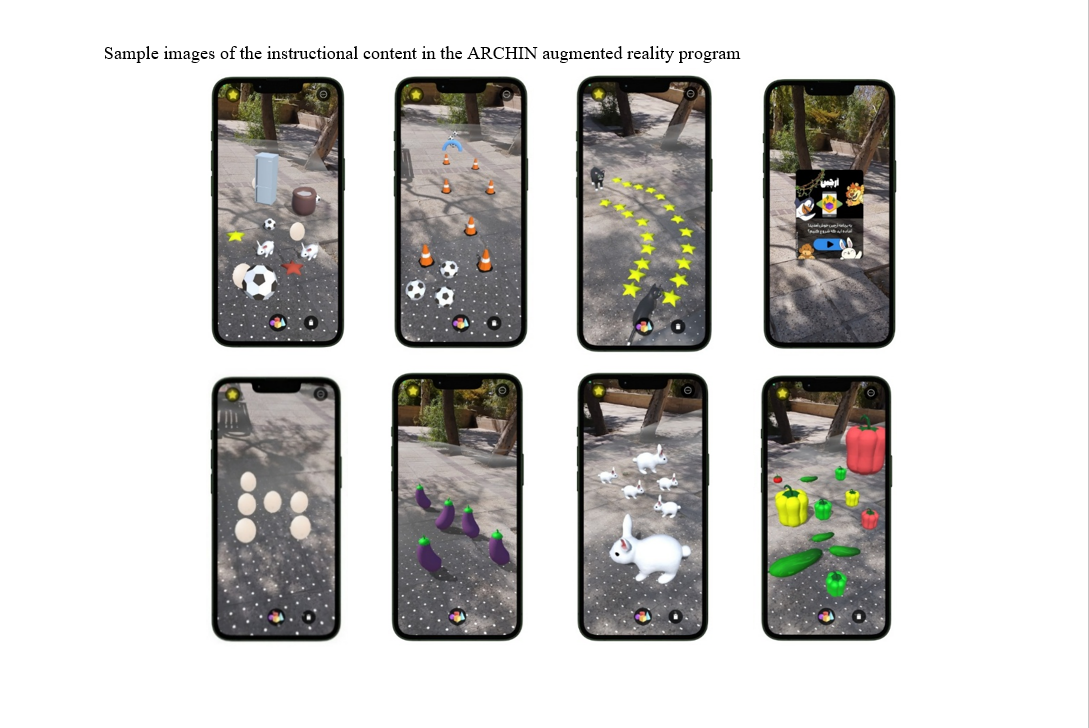
Preschool children at risk of specific learning disorders face challenges in processing visual information due to deficits in visual perception, which can adversely impact their cognitive and academic development. This study aimed to investigate the effect of augmented reality (AR) technology on enhancing visual perception in these children. A quasi-experimental pretest–posttest control group design was employed. The population consisted of preschool children at risk of specific learning disorders in preschools in Darab during the 2024–2025 academic year. Through purposive sampling, 16 children were selected using the Steele (2004) Learning Disabilities Screening Questionnaire and Captain’s Log software, and they were randomly assigned to experimental and control groups (8 children per group). The experimental group underwent eight 30-minute AR-based intervention sessions. The Frostig Visual Perception Test was administered to both groups during the pretest and posttest phases. Analysis of covariance (ANCOVA), controlling for pretest scores, indicated that the experimental group significantly outperformed the control group in visual perception (p < .001, partial η² = .784) and its subcomponents, including eye-motor coordination (p = .007, partial η² = .442), figure-ground discrimination (p = .001, partial η² = .556), constancy of shape (p = .007, partial η² = .443), position in space (p = .018, partial η² = .361), and spatial relationships (p = .017, partial η² = .366). These findings underscore the effectiveness of AR in enhancing visual perception. By providing an interactive, dynamic, and engaging learning environment, AR proves to be an effective tool for early interventions aimed at supporting children with special needs.
Downloads
References
Abbaszadeh Rogoshoi, M. (2023). The effect of digital educational games on visual perception in first-grade dyslexic students Allameh Tabatabai University]. Tehran.
Abd El-Monem, S. A. A. (2024). The effectiveness of an electronic book using augmented reality technology for developing visual and auditory perception skills in preschool children at risk of learning difficulties. Journal of the Faculty of Early Childhood Education, Mansoura University, 11(1), 482-611. https://doi.org/10.21608/maml.2024.417651
Abdollahi, S., Kian Arthi, F., & Rahimian Bogar, S. (2014). Designing a multimedia educational package emphasizing basic learning skills and evaluating its effectiveness in reducing spelling disorder symptoms. Learning Disabilities Quarterly, 3(3), 38-54.
Abedi, A., Malekpour, M., Molavi, H., Arizi, H., & Amiri, S. (2008). Comparison of neuropsychological characteristics in preschool children with learning disabilities, neuropsychological/ developmental, and typical conditions. Research in Exceptional Children, 8, 1-8.
Abedini, R., & Yarmohammadian, A. (2016). The effect of interventions based on multiple intelligences on school readiness in preschool children at risk for learning disabilities. First International Comprehensive Conference on Psychology, Educational Sciences, and Social Sciences, Iran.
Afshari, A., & Rezaei, R. (2019). The effectiveness of the Sound Smart software on executive functions (focused attention, organization and planning ability, auditory and visual working memory) in students with dyslexia. Learning Disabilities Quarterly, 8(3), 26-48. https://jld.uma.ac.ir/article_787_en.html?lang=fa
Aghaei Sabet, S. S., Pourae'temad, H., Jafarzadeh Pour, E., & Hassanabadi, H. (2013). Improving reading performance through visual interventions. Advances in Cognitive Sciences, 15(3), 1-12.
American Psychiatric Association. (2022). Diagnostic and statistical manual of mental disorders (5th, text rev. ed.). American Psychiatric Publishing. https://doi.org/10.1176/appi.books.9780890425787
Arjmandnia, A. A., Sharifi, A., & Rostami, R. (2014). The effectiveness of a computerized cognitive training program on visual-spatial working memory performance in students with mathematics difficulties. Learning Disabilities, 3(4), 6-24.
Azimi, I., & Mousavipour, S. (2014). The effectiveness of the Dikteyar multimedia educational program on improving visual and auditory memory problems in students with spelling disabilities. Journal of Educational Psychology, 10(34), 24-41.
Baragash, R. S., Al-Samarraie, H., Alzahrani, A. I., & Alfarraj, O. (2020). Augmented reality in special education: A meta-analysis of single-subject design studies. European Journal of Special Needs Education, 35(3), 382-397. https://doi.org/10.1080/08856257.2019.1703548
Blanchet, M., & Assaiante, C. (2022). Specific learning disorder in children and adolescents, a scoping review on motor impairments and their potential impacts. Children, 9(6), 892. https://doi.org/10.3390/children9060892
Brand, H. J. (1989). Reliability of the Frostig Test of visual perception in a South African sample. Perceptual and Motor Skills, 69(1), 273-274. https://doi.org/10.2466/pms.1989.69.1.273
Buchner, J., Buntins, K., & Kerres, M. (2022). The impact of augmented reality on cognitive load and performance: A systematic review. Journal of Computer Assisted Learning, 38(1), 285-303. https://doi.org/10.1111/jcal.12617
Buchner, J., & Kerres, M. (2023). Media comparison studies dominate comparative research on augmented reality in education. Computers & Education, 195, 104711. https://doi.org/10.1016/j.compedu.2022.104711
Capobianco, M., Puzzo, C., Di Matteo, C., Costa, A., & Adriani, W. (2025). Current virtual reality-based rehabilitation interventions in neuro-developmental disorders at developmental ages. Frontiers in Behavioral Neuroscience, 18, 1441615. https://doi.org/10.3389/fnbeh.2024.1441615
Captain's Log MindPower Builder. (2020). Captain's Log MindPower Builder.
Carlson, A. G., Rowe, E., & Curby, T. W. (2013). Disentangling fine motor skills' relations to academic achievement: the relative contributions of visual-spatial integration and visual-motor coordination. Journal of Genetic Psychology, 174, 514-533. https://doi.org/10.1080/00221325.2012.717122
Chang, C. T., Chao, W. H., Yang, C. Y., & Semwaiko, G. S. (2025). Evaluating the impact of augmented reality on learning outcomes in K-12 special education: A systematic review. European Journal of Educational Research, 14(4), 1167-1182. https://doi.org/10.12973/eu-jer.14.4.1167
Chang, H. Y., Binali, T., Liang, J. C., Chiou, G. L., Cheng, K. H., Lee, S. W. Y., & Tsai, C. C. (2022). Ten years of augmented reality in education: A meta-analysis of (quasi-) experimental studies to investigate the impact. Computers & Education, 191, 104641. https://doi.org/10.1016/j.compedu.2022.104641
Chang, S. H., & Yu, N. (2017). Visual and haptic perception training to improve handwriting skills in children with dysgraphia. American Journal of Occupational Therapy, 71(2), 1-10. https://doi.org/10.5014/ajot.2017.021311
Dalvand, H., Chamani, N., Rahsepar-Fard, K., Khorrami-Nejad, M., & Dadgar, H. (2023). The effect of online visual games on visual perception, oculomotor, and balance skills of children with developmental dyslexia during the COVID-19 pandemic. International Ophthalmology, 43(12), 5011-5024. https://doi.org/10.1007/s10792-023-02904-x
Del-Moral-Pérez, M. E., López-Bouzas, N., & Castañeda-Fernández, J. (2025). Micro-stories, robotic coding, digital applications, and augmented reality to enhance children's computational thinking. Pixel-Bit: Revista de Medios y Educación(73). https://doi.org/10.12795/pixelbit.115193
Di Giusto, V., Purpura, G., Zorzi, C. F., Blonda, R., Brazzoli, E., Meriggi, P., Reina, T., Rezzonico, S., Sala, R., Olivieri, I., & Cavallini, A. (2023). Virtual reality rehabilitation program on executive functions of children with specific learning disorders: A pilot study. Frontiers in Psychology, 14, 1241860. https://doi.org/10.3389/fpsyg.2023.1241860
Düzyol, E., Yıldırım, G., & Özyılmaz, G. (2022). Investigation of the effect of augmented reality application on preschool children's knowledge of space. Journal of Educational Technology and Online Learning, 5(1), 190-203. https://doi.org/10.31681/jetol.976885
Esmailzadeh Rouzbahani, A., Behroozi, N., Omidian, M., & Maktabi, G. (2022). The effect of computerized cognitive rehabilitation on visual-spatial ability and problem-solving skills of students with mathematics learning disabilities. Proceedings of the Second National Conference on Clinical Psychology of Children and Adolescents, Iran.
Faraji, N., & Karimi Sani, P. (2016). The effect of Dikteyar multimedia educational program on improving visual and auditory memory and academic self-efficacy in second-grade students with spelling disabilities in Shabestar city. Journal of Educational Psychology Skills, 7(3), 13-27.
Farhang Ranjbar, M., Darataj, F., Saadipour, I., & Delavar, A. (2019). Designing a computer-based educational program on mathematical concepts to improve visual-spatial perception (eye-hand coordination) in students with learning disabilities in mathematics and comparing its effectiveness with traditional teaching methods. Learning Disabilities Quarterly, 9(2), 81-94.
Fernández-Batanero, J. M., Montenegro-Rueda, M., & Fernández-Cerero, J. (2022). Use of augmented reality for students with educational needs: A systematic review (2016-2021). Societies, 12(2), 36. https://doi.org/10.3390/soc12020036
Frostig, M., Lefever, D. W., & Whittlesey, J. R. B. (2019). The Frostig Advanced Visual Perception Test (diagnosis and treatment) (10th ed.). Faravan.
Gajre, M. P., & Setia, M. S. (2015). Study of visual perception problems in children with learning disability. Indian Journal of Basic and Applied Medical Research, 4(3), 492-497. https://www.ijbamr.com/assets/images/issues/pdf/June%202015%20492-497.pdf.pdf
Garzón, J. (2021). An overview of twenty-five years of augmented reality in education. Multimodal Technologies and Interaction, 5(7), 37. https://doi.org/10.3390/mti5070037
Gecu-Parmaksiz, Z., & Delialioğlu, Ö. (2020). The effect of augmented reality activities on improving preschool children's spatial skills. Interactive Learning Environments, 28(7), 876-889. https://doi.org/10.1080/10494820.2018.1546747
Hallahan, D. P., Lloyd, J. W., Kaufman, J. M., Weiss, M. P., & Martinez, E. E. (2013). Learning disabilities (4th ed.). Arasbaran.
Intarapreecha, N., & Sangsawang, T. (2023). Incorporating augmented reality to enhance learning for students with learning disabilities: a focus on spatial orientation in physical. Journal of Applied Data Sciences, 4(3), 245-253. https://doi.org/10.47738/jads.v4i3.126
Kakavandi, M., Yazdanbakhsh, K., & Moradi, A. (2020). The effectiveness of computer-based cognitive rehabilitation on improving visual perception in students with specific learning disabilities in Sahneh county. First National Conference on Clinical Child and Adolescent Psychology, Iran.
Kapetanaki, A., Krouska, A., Troussas, C., & Sgouropoulou, C. (2022). Exploiting augmented reality technology in special education: A systematic review. Computers, 11(10), 143. https://doi.org/10.3390/computers11100143
Kayaduman, H., & Sağlam, M. (2023). An examination of the research studies on augmented reality use in preschool education: A bibliometric mapping analysis. Journal of Research on Technology in Education, 56(5), 595-615. https://doi.org/10.1080/15391523.2023.2186988
Kellems, R. O., Eichelberger, C., Cacciatore, G., Jensen, M., Frazier, B., Simon, K., & Zaru, M. (2020). Using video-based instruction via augmented reality to teach mathematics to middle school students with learning disabilities. Journal of Learning Disabilities, 53(4), 277-291. https://doi.org/10.1177/0022219420906452
Khateri, E., Pour Roostai Ardakani, S., & Zaraii Zavaraki, E. (2019). The impact of augmented reality technology on learning in dyslexic second-grade students. Learning Disabilities Quarterly, 10(1), 85-104.
Khateri, E., Pour Roostai Ardakani, S., & Zaraii Zavaraki, E. (2021). The impact of augmented reality technology on academic achievement motivation in dyslexic second-grade students. Learning Disabilities Quarterly, 10(4), 58-86.
Khatib, L., Li, Y., Geary, D., & Popov, V. (2022). Meta-analysis on the relation between visuomotor integration and academic achievement: Role of educational stage and disability. Educational Research Review, 35, 100412. https://doi.org/10.1016/j.edurev.2021.100412
Kord Noghabi, R., & Dertaj, F. (2007). Standardization, validity, and reliability of the Frostig Developmental Test of Visual Perception among first- and second-grade elementary school students in Tehran. Applied Psychology, 1(3), 254-268.
Köse, B., Temizkan, E., Aran, O. T., Galipoğlu, H., Torpil, B., Pekçetin, S., Karabulut, E., & Şahin, S. (2022). Where exactly is the therapist in virtual reality and game-based rehabilitation applications? A randomized controlled trial in children with specific learning disability. Games for Health Journal, 11(3), 200-206. https://doi.org/10.1089/g4h.2021.0241
Kurtz, L. A. (2015). Visual perceptual problems in children with ADHD, autism, and other learning disabilities: A guide for parents and professionals. Avaye Noor. https://books.google.com/books?hl=en&lr=&id=hhcWduyxPFYC&oi=fnd&pg=PP1&dq=Kurtz,+L.+A.+(2015).+Visual+perceptual+problems+in+children+with+ADHD,+autism,+and+other+learning+disabilities:+A+guide+for+parents+and+professionals.+Tehran,+Avaye+Noor.+%09&ots=JHY-g9EKW_&sig=RXTIxejBh5aO9AQgvdTuxRZzuNM
Law, K. A., Neo, H. F., Ng, W., Thye, Y. Y., & Teo, C. C. (2025). Augmented reality technology in aiding preschoolers' education: A preliminary study. Education Sciences, 15(8), 1033. https://doi.org/10.3390/educsci15081033
Lewis Presser, A. E., Braham, E., & Vidiksis, R. (2025). Enhancing preschool spatial skills: A comprehensive intervention using digital games and hands-on activities. Education Sciences, 15(6), 727. https://doi.org/10.3390/educsci15060727
Maresca, G., Corallo, F., De Cola, M. C., Formica, C., Giliberto, S., Rao, G., Crupi, M. F., Quartarone, A., & Pidalà, A. (2024). Effectiveness of the use of virtual reality rehabilitation in children with dyslexia: Follow-up after one year. Brain Sciences, 14(7), 655. https://doi.org/10.3390/brainsci14070655
Mashhadi, S., Akhavan Tafti, M., & Mohsen Pour, M. (2022). Improving visual and auditory skills in students with learning disabilities through a computer-based multimedia educational package. 5th International Conference on Educational Psychology: Psychological and Educational Interventions, Iran.
Meng, H., Yao, R., Zhang, P., Wang, J., & Zhang, Y. (2024). The impact of visual search in Chinese children with developmental dyslexia on reading comprehension: The mediating role of word detection skill and reading fluency. Frontiers in Psychology, 15, 1437187. https://doi.org/10.3389/fpsyg.2024.1437187
Mohammadhossein, N., Richter, A., & Lukosch, S. (2024). Augmented reality in learning settings: A systematic analysis of its benefits and avenues for future studies. Communications of the Association for Information Systems, 54, 29-49. https://doi.org/10.17705/1CAIS.05402
Naqshbandi, H., & Mousavi, F. (2016). The role of multimedia design based on enhancing visual perception in learning mathematics for dyscalculic students. 2nd International Conference on Applied Research in Educational Sciences and Behavioral Studies and Social Pathologies, Iran.
Nobakht, F., Mirmehdi, R., & Heydari, H. (2023). Comparing the effectiveness of computer games on enhancing working memory and visual-spatial perception in students with specific learning disabilities. Razi Journal of Medical Sciences, 31(1), 187.
Nour-Darvishali, A., Ahadi, B., Abolghasemi, A., & Bagherian Sararoudi, R. (2014). Comparing types of perceptual errors in children with and without learning disabilities. Learning Disabilities Quarterly, 3(2), 109.
Özel, Ö., Hançer, B., & Sop, A. (2025). The effect of Augmented Reality (AR) supported geometric shape learning on children's visual perceptual development in early childhood education. Interactive Learning Environments, 33(10), 1-13. https://doi.org/10.1080/10494820.2025.2491627
Pakat Chi, R., Yariyari, F., & Moradi, A. (2013). The effect of computer game-based training on visual memory performance of students with dyslexia. Journal of Exceptional Education, 13(119), 30-38.
Panahi, F. (2018). The effect of computer game training on visual memory performance and social adjustment of students with dyslexia in Osku County. Proceedings of the Seventh Scientific Research Conference on Educational Sciences, Psychology, and Social and Cultural Pathologies of Iran, Iran.
Pourfarahmand, M., & Taher, M. (2020). The effectiveness of computer-based games on visual perception, auditory-spatial perception, and reading tracking speed in students with specific learning disabilities. Learning Disabilities Quarterly, 10(2), 7-24.
Prasomsri, N. (2024). Effect of a writing program by augmented reality technology on writing skill in children with learning disability. Journal of National Educational Testing and Assessment, 5(1), 35-49. https://so02.tci-thaijo.org/index.php/JOURNALNIETS/article/view/268190
Roitvond Giahsavand, N., & Amiri Majd, M. (2019). The effectiveness of Captain Log cognitive software on visual-spatial perception in students with learning disabilities. Exceptional Children Journal, 19(1), 5-14. https://www.sid.ir/paper/262557/en
Şahin, S., Temizkan, E., Güney Yılmaz, G., Baysal Yiğit, A., Sonbahar Ulu, H., Kaya Kara, Ö., Köse, B., & Tanrıverdi, M. (2026). Evaluating the impact of virtual reality interventions on motor and visual perception skills in children with ADHD: A single blind randomized controlled trial. Assistive Technology. https://doi.org/10.1080/10400435.2026.2631729
Sandeep, R. S., Umaiorubagam, G. S., Vignesh Raj, S. D., Anbarasu, D., & Ravikumar, M. (2024). Enhancing visual perception in children ages 4-12 Years: A systematic review of technology-based interventions. Journal of Clinical & Diagnostic Research, 18(7). https://doi.org/10.7860/JCDR/2024/70325.19682
Selvam, B., & Gnana Piragasam, G. A. (2025). Augmented reality's potential for addressing writing challenges in students with learning disabilities. British Journal of Special Education, 52, 147-156. https://doi.org/10.1111/1467-8578.70005
Shokoohi Yekta, M., Lotfi, S. D., Rostami, R., Arjmandnia, A. A., Motamedi Ganeh, N., & Sharifi, A. (2014). The effectiveness of computerized cognitive training on working memory performance in dyslexic children. Audiology and Vestibular Research Journal, 23(3), 46-56.
Sparrowhawk, A., & Heald, Y. (2019). How to use ICT to support children with special educational needs (3rd ed.). Avaye Noor.
Steele, M. M. (2004). Making the case for early identification and intervention for young children at risk for learning disabilities. Early Childhood Education Journal, 32(2), 75-79. https://doi.org/10.1007/s10643-004-1072-x
Taghinejad, M. (2012). The effectiveness of computer-based drawing program on the development of visual-motor coordination skills in preschool children (5-6 years old) Allameh Tabatabai University, Faculty of Psychology and Educational Sciences]. Iran.
Tamnai Far, M., & Alizadeh, H. (2015). The effectiveness of computer games on improving short-term and long-term visual memory in dyslexic students. National Congress of Child and Adolescent Psychology, Iran.
Wertz, M., Calata, R., & Tompkins, J. (2013). The field of special education. Shahrashub.
Wertz, M. J., Calata, R. E., & Tompkins, J. R. (2011). Foundations of education for exceptional children: What teachers need to know about special education. Danjeh.
Wu, W. L., Huang, Y. L., Liang, J. M., Chen, C. H., Wang, C. C., & Ho, W. H. (2022). Interactive digital game for improving visual-perceptual defects in children with a developmental disability: Randomized controlled trial. JMIR Serious Games, 10(2), e34756. https://doi.org/10.2196/34756
Wuang, Y. P., Chen, Y. J., Chiu, Y. H., Wang, C. C., Chen, C. P., Huang, C. L., & Ho, W. H. (2021). Effectiveness of kinesthetic game-based training system in children with visual-perceptual dysfunction. IEEE Access, 9, 153838-153849. https://doi.org/10.1109/ACCESS.2021.3128109
Yahiyozadeh, M. S. (2021). The effect of digital games on visual perception in dyslexic second-grade students Allameh Tabatabai University]. Tehran.
Yang, X., & Meng, X. (2020). Visual processing matters in Chinese reading acquisition and early mathematics. Frontiers in Psychology, 11, 462. https://doi.org/10.3389/fpsyg.2020.00462
Yang, Y., Shi, H., Mavrikis, M., & Geraniou, E. (2024). Exploring children's interaction with AR to enhance spatial skills: Case study on geometry learning. European Conference on Technology Enhanced Learning, Cham.
Yenioglu, B. Y., Ergulec, F., & Yenioglu, S. (2023). Augmented reality for learning in special education: A systematic literature review. Interactive Learning Environments, 31(7), 4572-4588. https://doi.org/10.1080/10494820.2021.1976802
Zahed, A., Rajabi, S., & Omidi, M. (2012). A comparison of social, emotional and educational adjustment and self-regulated learning in students with and without learning disabilities. Journal of Learning Disabilities, 1(2), 43-62. https://jld.uma.ac.ir/%5BDoi.%20http:/jld.uma.ac.ir/%20https:/jld.uma.ac.ir/article_96.html?lang=en
Zaraii Zavaraki, E. (2017).
Zarif, F., Estiri, Z., & Ziadabadi, R. (2021). The effect of motor and computer games on visual memory in dyslexic students. National Conference on Physical Education and Sports Sciences with Limitations in Physical Activities during the COVID-19 Pandemic, Iran.
Downloads
Additional Files
Publication Timeline
- Submitted
- Revised
- Accepted