LightGBM Analysis of Loneliness in Gifted Adolescents: Predictive Contributions of Maladaptive Perfectionism, Emotional Awareness, and Peer Support
Keywords:
Gifted Adolescents, Loneliness, LightGBM, Maladaptive Perfectionism, Emotional Awareness, Peer SupportAbstract
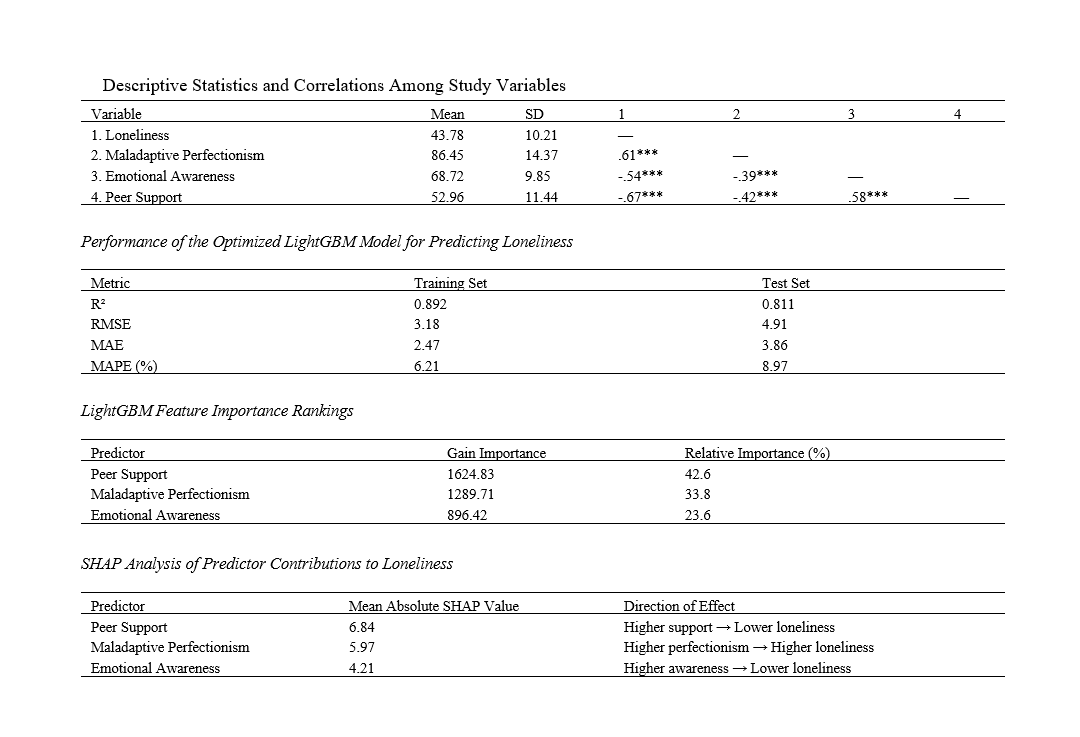
The present study aimed to employ a Light Gradient Boosting Machine (LightGBM) approach to predict loneliness among gifted adolescents based on maladaptive perfectionism, emotional awareness, and peer support and to determine the relative contribution of these variables to loneliness outcomes. This cross-sectional predictive study was conducted among 512 gifted adolescents aged 13 to 18 years recruited from specialized educational programs and secondary schools in Mexico. Participants completed standardized measures of loneliness, maladaptive perfectionism, emotional awareness, and peer support. Data were analyzed using Python and R statistical environments. After preliminary data screening and standardization procedures, a LightGBM regression model was developed using an 80/20 training–testing split. Hyperparameter optimization was performed through five-fold cross-validation and Bayesian optimization. Model performance was evaluated using the coefficient of determination (R²), Root Mean Squared Error (RMSE), Mean Absolute Error (MAE), and Mean Absolute Percentage Error (MAPE). Feature importance analysis and SHapley Additive exPlanations (SHAP) were used to identify and interpret the contribution of predictor variables. The optimized LightGBM model demonstrated strong predictive performance, achieving an R² of .811 in the testing dataset, indicating that the model explained 81.1% of the variance in loneliness scores. Correlational analyses revealed that loneliness was positively associated with maladaptive perfectionism and negatively associated with emotional awareness and peer support. Feature importance analysis identified peer support as the strongest predictor of loneliness (42.6% relative importance), followed by maladaptive perfectionism (33.8%) and emotional awareness (23.6%). SHAP analyses confirmed these findings, showing that lower peer support and higher maladaptive perfectionism substantially increased predicted loneliness levels, whereas higher emotional awareness reduced loneliness risk. The consistency between LightGBM feature importance rankings and SHAP explanations supported the robustness and interpretability of the predictive model. The findings indicate that loneliness among gifted adolescents is shaped by a combination of interpersonal and intrapersonal factors, with peer support emerging as the most influential protective factor, maladaptive perfectionism functioning as a significant risk factor, and emotional awareness contributing additional resilience. The study demonstrates the utility of explainable machine learning approaches for identifying key determinants of psychological well-being in gifted populations and provides evidence to support interventions targeting social connectedness, perfectionistic tendencies, and emotional competencies.
Downloads
References
Akkaya, S., Doğan, A., & Tosik, H. (2021). Investigation of the Relationship Between the Perfectionism and SelfEfficacy of Gifted Children. International online journal of educational sciences, 13(5). https://doi.org/10.15345/iojes.2021.05.001
Bagheri, S., Farahani, H., Watson, P., Bezdan, T., & Rezaiean, K. (2024). Unraveling Symptom Interplay: A Network Analysis of Procrastination in Gifted Students. BMC psychology, 12(1). https://doi.org/10.1186/s40359-024-01868-6
Bearden, A. G., Turnbull, B. W., Wallace, C., Prosser, S., & Vincent, A. (2024). The Effects of a Course‐based Mindfulness Intervention on College Student Perfectionism, Stress, Anxiety, Self‐compassion, and Social Connectedness. Psychology in the Schools, 61(7), 2893-2911. https://doi.org/10.1002/pits.23201
Cash, T. N., & Lin, T. J. (2021). Psychological Well-Being of Intellectually and Academically Gifted Students in Self-Contained and Pull-Out Gifted Programs. Gifted Child Quarterly, 66(3), 188-207. https://doi.org/10.1177/00169862211032987
Chęć, M., Konieczny, K., Michałowska, S., & Rachubińska, K. (2025). Exploring the Dimensions of Perfectionism in Adolescence: A Multi-Method Study on Mental Health and CBT-Based Psychoeducation. Brain Sciences, 15(1), 91. https://doi.org/10.3390/brainsci15010091
Chęć, M., Michałowska, S., Gnych-Pietrzak, A., Rybarska, A., & Strochalska, K. (2024). Temperament and the Experience of Tension and Self-Injurious Behaviour in Adolescents—The Mediating Role of Maladaptive Perfectionism. Brain Sciences, 14(11), 1140. https://doi.org/10.3390/brainsci14111140
Chen, T. (2023). Risk and Protective Factors for Depression During Adolescence. Journal of Education Humanities and Social Sciences, 8, 193-197. https://doi.org/10.54097/ehss.v8i.4248
Dobos, B., Mellor, D., & Pikó, B. (2024). Exploring Fear of Happiness Among University Students: The Role of Perfectionism, Academic Burnout, Loneliness, and Hopelessness. Scandinavian journal of psychology, 65(3), 559-567. https://doi.org/10.1111/sjop.13001
DoĞAn, Ş., & Yilmaz, Ş. (2023). Investigation of the Relationship Between Gifted Students' Attitudes to Collaborative Learning and Their Perfectionist Structure. Journal for the Education of Gifted Young Scientists, 11(3), 325-348. https://doi.org/10.17478/jegys.1325115
Flett, G. L. (2025). Mattering and Depression in Youth. 211-226. https://doi.org/10.1037/0000449-014
Flett, G. L., & Hewitt, P. L. (2022). Perfectionism and Problems in Learning, Performance, and Achievement. 173-199. https://doi.org/10.1037/0000289-009
Flett, G. L., & Hewitt, P. L. (2024). Toward Person-Focused Assessment and Understanding the Human Need to Be Perfect: Commentary and Introduction to the Third Special Issue on Perfectionism. Journal of Psychoeducational Assessment, 42(6), 599-611. https://doi.org/10.1177/07342829241245460
Fu, Y., Li, X., Sun, J., Li, C., Yang, P., & Pan, J. (2025). The Relationship Between Self-Oriented Perfectionism and Athlete Burnout: A Longitudinal Study. Frontiers in psychology, 16. https://doi.org/10.3389/fpsyg.2025.1656816
Fuster‐Rico, A., Pérez‐Marco, M., & Vicent, M. (2025). Other-Oriented Perfectionism in Adolescents: Differences in Internalizing and Externalizing Problems, as Well as in Prosocial Behavior. Frontiers in psychology, 16. https://doi.org/10.3389/fpsyg.2025.1580642
Grugan, M. C., Hill, A. P., Madigan, D. J., Donachie, T. C., Olsson, L. F., & Etherson, M. E. (2021). Perfectionism in Academically Gifted Students: A Systematic Review. Educational psychology review, 33(4), 1631-1673. https://doi.org/10.1007/s10648-021-09597-7
Gu, H. (2022). Maladaptive Perfectionism and Adolescent NSSI: A Moderated Mediation Model of Psychological Distress and Mindfulness. Journal of Clinical Psychology, 78(6), 1137-1150. https://doi.org/10.1002/jclp.23304
Leath, S., Latimer, A. z., Inniss‐Thompson, M. N., Seward, M. D., & Ball, P. (2025). The Pressure to Be Perfect: Stereotype Management, (Mal?) Adaptive Perfectionism and Well-Being Among Black College Women Attending Predominantly White Institutions. Psychology of Women Quarterly, 49(2), 182-204. https://doi.org/10.1177/03616843251329013
Lin, J., & Guo, W. (2024). The Research on Risk Factors for Adolescents’ Mental Health. Behavioral Sciences, 14(4), 263. https://doi.org/10.3390/bs14040263
Livazović, G., & Kuzmanović, K. (2022). Predicting Adolescent Perfectionism: The Role of Socio-Demographic Traits, Personal Relationships, and Media. World Journal of Clinical Cases, 10(1), 189-204. https://doi.org/10.12998/wjcc.v10.i1.189
Oğurlu, Ü. (2020). Are Gifted Students Perfectionistic? A Meta-Analysis. Journal for the Education of the Gifted, 43(3), 227-251. https://doi.org/10.1177/0162353220933006
Olton-Weber, S. R., Hess, R. S., & Ritchotte, J. A. (2020). Reducing Levels of Perfectionism in Gifted and Talented Youth Through a Mindfulness Intervention. Gifted Child Quarterly, 64(4), 319-330. https://doi.org/10.1177/0016986220953392
Raoof, K., Shokri, O., Fathabadi, J., & Panaghi, L. (2024). Unpacking the Underachievement of Gifted Students: A Systematic Review of Internal and External Factors. Heliyon, 10(17), e36908. https://doi.org/10.1016/j.heliyon.2024.e36908
Sánchez-Moncayo, M. R., Ramiro, P., & Guzmán, J. I. N. (2025). Perfectionism and Psychological Well-Being in Adolescents With High Intellectual Abilities. Frontiers in psychology, 16. https://doi.org/10.3389/fpsyg.2025.1617755
Sander, J., Moessner, M., & Bauer, S. (2021). Depression, Anxiety and Eating Disorder-Related Impairment: Moderators in Female Adolescents and Young Adults. International journal of environmental research and public health, 18(5), 2779. https://doi.org/10.3390/ijerph18052779
Sorrenti, L., Meduri, C. F., Fumia, A., & Filippello, P. (2025). The Mediating Role of Dispositional Optimism and Perfectionism on the Relationship Between Perceived Parental Psychological Control and Support and Adolescents’ Well-Being. European Journal of Investigation in Health Psychology and Education, 15(8), 160. https://doi.org/10.3390/ejihpe15080160
Timulák, L., & Keogh, D. (2022). Emotional Vulnerability: The Focus of Transdiagnostic Therapy. 13-32. https://doi.org/10.1037/0000253-002
Tourreix, E., Besançon, M., & Gonthier, C. (2023). Non-Cognitive Specificities of Intellectually Gifted Children and Adolescents: A Systematic Review of the Literature. Journal of Intelligence, 11(7), 141. https://doi.org/10.3390/jintelligence11070141
Tsai, M.-Y. (2023). Comparing Perfectionism, Cognitive Mindset, Constructive Thinking, and Emotional Intelligence in Gifted Students by Grade and Gender. Social Sciences, 12(4), 233. https://doi.org/10.3390/socsci12040233
Winsor, D. L., & Mueller, C. E. (2020). Depression, Suicide, and the Gifted Student: A Primer for the School Psychologist. Psychology in the Schools, 57(10), 1627-1639. https://doi.org/10.1002/pits.22416
Zülfiqar, N., & Abbasi, T. A. A. (2024). Mediating Role of Test Anxiety in Association Between Imposter Phenomenon and Perfectionism Among High-Achieving Students. Journal of Advanced Academics, 35(4), 698-717. https://doi.org/10.1177/1932202x241281782
Downloads
Additional Files
Publication Timeline
- Submitted
- Revised
- Accepted