A LightGBM-Based Prediction Model of Emotional Dysregulation in Children with ADHD: The Roles of Parent–Child Conflict, Cognitive Control, and Sleep Quality
Keywords:
Attention-Deficit/Hyperactivity Disorder, Emotional Dysregulation, LightGBM, Machine Learning, Parent–Child Conflict, Cognitive ControlAbstract
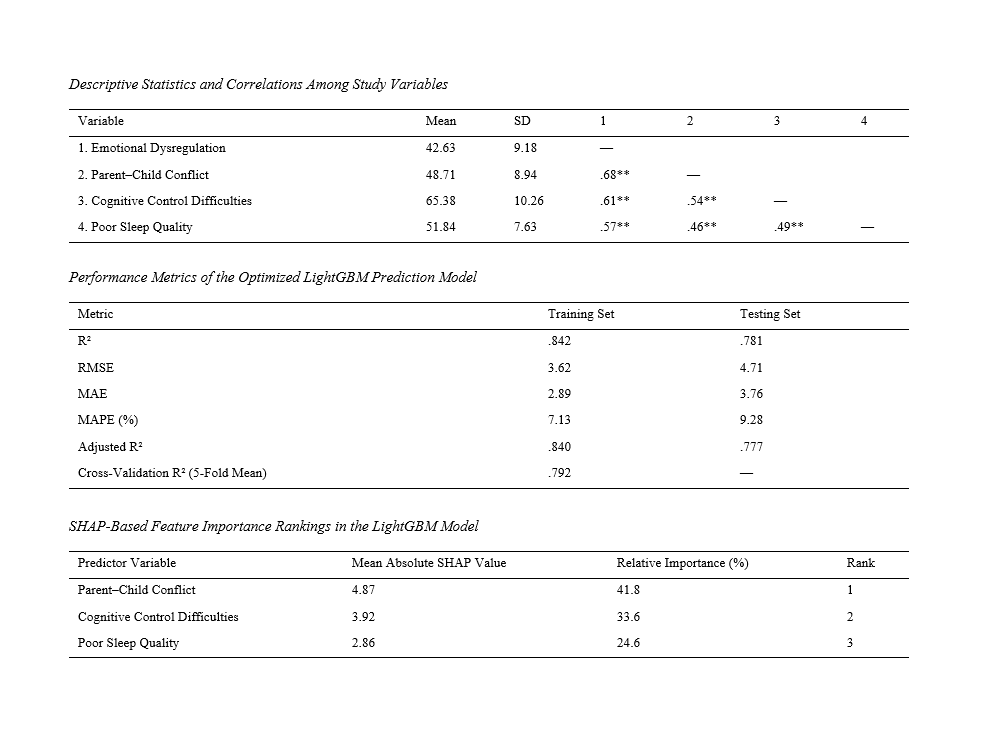
The present study aimed to develop and evaluate a Light Gradient Boosting Machine (LightGBM) model for predicting emotional dysregulation in children with Attention-Deficit/Hyperactivity Disorder (ADHD) based on parent–child conflict, cognitive control difficulties, and sleep quality, while identifying the relative contribution of each predictor using explainable artificial intelligence techniques. This cross-sectional predictive modeling study was conducted among 428 Canadian children diagnosed with ADHD between the ages of 8 and 12 years. Participants were recruited from pediatric neuropsychology clinics, child mental health centers, and educational support programs. Emotional dysregulation was assessed using the Emotion Regulation Checklist, parent–child conflict was measured using the Child–Parent Relationship Scale, cognitive control difficulties were evaluated through the Behavior Rating Inventory of Executive Function–Second Edition, and sleep quality was assessed using the Children’s Sleep Habits Questionnaire. Data preprocessing included standardization, missing-value imputation, and outlier screening. The dataset was divided into training (80%) and testing (20%) subsets. A LightGBM algorithm with five-fold cross-validation and Bayesian hyperparameter optimization was employed. Model performance was evaluated using R², RMSE, MAE, and MAPE indices, and predictor importance was examined using Shapley Additive Explanations (SHAP). Correlation analyses indicated significant positive associations between emotional dysregulation and parent–child conflict (r = .68, p < .001), cognitive control difficulties (r = .61, p < .001), and poor sleep quality (r = .57, p < .001). The optimized LightGBM model demonstrated excellent predictive performance, explaining 84.2% of variance in the training dataset and 78.1% of variance in the testing dataset. Cross-validation yielded a mean R² of .792, indicating strong model stability. SHAP analyses revealed that parent–child conflict was the most influential predictor (41.8%), followed by cognitive control difficulties (33.6%) and poor sleep quality (24.6%). Higher levels of each predictor were associated with increased emotional dysregulation. The findings demonstrate that emotional dysregulation in children with ADHD can be accurately predicted using a machine learning framework that integrates family, cognitive, and sleep-related factors. Parent–child conflict emerged as the strongest determinant, highlighting the importance of family relationships in emotional functioning. The results support the application of explainable artificial intelligence approaches for identifying clinically meaningful risk factors and informing personalized assessment and intervention strategies for children with ADHD.
Downloads
References
Ahmed, G. K., Darwish, A. M., Khalifa, H., & Haridy, N. A. (2022). Relationship Between Attention Deficit Hyperactivity Disorder and Epilepsy: A Literature Review. The Egyptian Journal of Neurology Psychiatry and Neurosurgery, 58(1). https://doi.org/10.1186/s41983-022-00482-w
Alsoqih, N. S., Elmorsy, E. A., Abu‐Khudir, R., Saber, S., Keshk, N., Elnaghy, F., Hamad, R. S., El‐kott, A. F., Negm, S., AlShehri, M. A., Ali, M. A. M., Abdel‐Reheim, M. A., Farrag, A. A., Eissa, H., Gaafar, A. G. A., & Youssef, M. E. (2025). A Systems Biology Perspective on Childhood ADHD : Neurochemical Dysregulation, Brain‐Behavior Interactions, and Emerging Therapeutics. The FASEB Journal, 39(17). https://doi.org/10.1096/fj.202501829rr
Bondopadhyay, U., Díaz-Orueta, U., & Coogan, A. N. (2021). A Systematic Review of Sleep and Circadian Rhythms in Children With Attention Deficit Hyperactivity Disorder. Journal of Attention Disorders, 26(2), 149-224. https://doi.org/10.1177/1087054720978556
Dekkers, T. J., & Hoorn, J. v. (2022). Understanding Problematic Social Media Use in Adolescents With Attention-Deficit/Hyperactivity Disorder (ADHD): A Narrative Review and Clinical Recommendations. Brain Sciences, 12(12), 1625. https://doi.org/10.3390/brainsci12121625
Demi̇rci̇, E., Gül, M. K., Şener, E. F., Önal, M. G., & Dal, F. (2024). Assessment of BDNF and Sialic Acid Levels in Children With ADHD: Relation of Chronotypes. International Journal of Developmental Neuroscience, 84(8), 857-866. https://doi.org/10.1002/jdn.10376
Dimakos, J., Gauthier-Gagné, G., Lin, L., Scholes, S., & Gruber, R. (2021). The Associations Between Sleep and Externalizing and Internalizing Problems in Children and Adolescents With Attention-Deficit/Hyperactivity Disorder. Child and Adolescent Psychiatric Clinics of North America, 30(1), 175-193. https://doi.org/10.1016/j.chc.2020.08.001
Gagnon, K., Labrosse, M., Gingras, M.-A., & Godbout, R. (2021). Sleep Instability Correlates With Attentional Impairment in Boys With Attention Deficit Hyperactivity Disorder. Brain Sciences, 11(11), 1425. https://doi.org/10.3390/brainsci11111425
Gerstner, T., Sævareid, H. I., Johnsen, Å. R., Løhaugen, G. C., & Skranes, J. (2023). Sleep Disturbances in Norwegian Children With Fetal Alcohol Spectrum Disorders (FASD) With and Without a Diagnosis of Attention‐deficit Hyperactivity Disorder or Epilepsy. Alcohol: Clinical and Experimental Research, 47(3), 589-599. https://doi.org/10.1111/acer.15009
Gruber, R., Gauthier-Gagné, G., Little, C., & Fu, Z. (2023). The Associations Between the Homeostatic and Circadian Sleep Processes and the Neurobehavioral Functioning (NBF) of Individuals With ADHD—A Systematic Review. Brain Sciences, 13(8), 1134. https://doi.org/10.3390/brainsci13081134
Kay, B. P., Wheelock, M. D., Siegel, J. S., Raut, R. V., Chauvin, R. J., Metoki, A., Rajesh, A., Eck, A., Pollaro, J., Wang, A., Suljic, V., Adeyemo, B., Baden, N. J., Scheidter, K. M., Monk, J., Ramirez-Perez, N., Krimmel, S. R., Shinohara, R. T., Tervo‐Clemmens, B., . . . Dosenbach, N. U. (2025). Stimulant Medications Affect Arousal and Reward, Not Attention. https://doi.org/10.1101/2025.05.19.654915
Liang, X., Li, R., Wong, S. H., Sum, R. K. W., Wang, P., Yang, B., & Sit, C. H. P. (2022). Physical Activity and Executive Function in Children With ADHD: The Mediating Role of Sleep. Frontiers in Pediatrics, 9. https://doi.org/10.3389/fped.2021.775589
Liang, X., Qiu, H., Haegele, J. A., Xiao, L., Li, M., Li, J., & Li, S. X. (2026). Associations Between Accelerometer-Measured Physical Activity and Sleep Duration and Health Indicators in Children and Adolescents With Attention-Deficit Hyperactivity Disorder: A Systematic Review and Meta-Analysis. Journal of Exercise Science & Fitness, 24(1), 200429. https://doi.org/10.1016/j.jesf.2025.200429
Liang, X., Qiu, H., Wang, P., & Sit, C. H. P. (2022). The Impacts of a Combined Exercise on Executive Function in Children With ADHD: A Randomized Controlled Trial. Scandinavian Journal of Medicine and Science in Sports, 32(8), 1297-1312. https://doi.org/10.1111/sms.14192
Ma, D., Wu, Y., Wang, C., Zhao, F., Xu, Z., & Ni, X. (2024). Characteristics of ADHD Symptoms and EEG Theta/Beta Ratio in Children With Sleep Disordered Breathing. Clinical EEG and Neuroscience, 55(4), 417-425. https://doi.org/10.1177/15500594241234828
Martín-Rodríguez, A., Herrero-Roldán, S., & Clemente‐Suárez, V. J. (2025). The Role of Physical Activity in ADHD Management: Diagnostic, Digital and Non-Digital Interventions, and Lifespan Considerations. Children, 12(3), 338. https://doi.org/10.3390/children12030338
Mayes, S. D., Calhoun, S. L., & Waschbusch, D. A. (2020). Relationship Between Sluggish Cognitive Tempo and Sleep, Psychological, Somatic, and Cognitive Problems and Impairment in Children With Autism and Children With ADHD. Clinical Child Psychology and Psychiatry, 26(2), 518-530. https://doi.org/10.1177/1359104520978459
Mayes, S. D., Waschbusch, D. A., Fernández‐Mendoza, J., & Calhoun, S. L. (2021). Relationship Between Sluggish Cognitive Tempo and Sleep, Psychological, Somatic, and Cognitive Problems in Elementary School Children. Journal of Pediatric Neuropsychology, 7(4), 182-191. https://doi.org/10.1007/s40817-021-00109-7
Özbudak, P., Özaslan, A., Temel, E. Ü., Güney, E., Serdaroğlu, A., & Arhan, E. (2022). New Electrographic Marker? Evaluation of Sleep Spindles in Children With Attention Deficit Hyperactivity Disorder. Clinical EEG and Neuroscience, 55(1), 4-10. https://doi.org/10.1177/15500594221134025
Peña, I. d., Pan, M. C., Thai, C. G., & Alisso, T. (2020). Attention-Deficit/Hyperactivity Disorder Predominantly Inattentive Subtype/Presentation: Research Progress and Translational Studies. Brain Sciences, 10(5), 292. https://doi.org/10.3390/brainsci10050292
Pratiwi, R. D. N., Fitri, S. Y. R., & Mulya, A. P. (2021). The Interventions for Sleep Disorders in Children With Attention Deficit and Hyperactivity Disorder: A Narrative Review. Open Access Macedonian Journal of Medical Sciences, 9(T6), 164-172. https://doi.org/10.3889/oamjms.2021.7585
Qu, X., Kalb, L. G., Holingue, C., Rojo‐Wissar, D. M., Pritchard, A. E., Spira, A. P., Volk, H. E., & Jacobson, L. A. (2023). Association of Time in Bed, Social Jetlag, and Sleep Disturbances With Cognitive Performance in Children With ADHD. Journal of Attention Disorders, 28(1), 99-108. https://doi.org/10.1177/10870547231204010
Rothenberger, A., & Heinrich, H. (2022). Co-Occurrence of Tic Disorders and Attention-Deficit/Hyperactivity Disorder—Does It Reflect a Common Neurobiological Background? Biomedicines, 10(11), 2950. https://doi.org/10.3390/biomedicines10112950
Ruiz‐Herrera, N., Guillén‐Riquelme, A., Díaz‐Román, A., & Buela‐Casal, G. (2021). Sleep, Academic Achievement, and Cognitive Performance in Children With Attention‐deficit Hyperactivity Disorder: A Polysomnographic Study. Journal of Sleep Research, 30(4). https://doi.org/10.1111/jsr.13275
Rzepka-Migut, B., & Paprocka, J. (2020). Efficacy and Safety of Melatonin Treatment in Children With Autism Spectrum Disorder and Attention-Deficit/Hyperactivity Disorder—A Review of the Literature. Brain Sciences, 10(4), 219. https://doi.org/10.3390/brainsci10040219
Saccani, M. S., Ursumando, L., Vara, S. D., Lazzaro, G., Varuzza, C., Vicari, S., & Menghini, D. (2022). Sleep Disturbances in Children With Attentional Deficit Hyperactivity Disorder and Specific Learning Disorders. International journal of environmental research and public health, 19(11), 6411. https://doi.org/10.3390/ijerph19116411
Santos, R. M., Marinho, V., Sabrina Nayara de Araújo, V., Teles, A. S., Sousa, D. L., Bastos, V. H., Souza, L. P. d., Angelina Ketllen Cachoeira de, S., Gabryella Stefane Firmino de, M., & Teixeira, S. (2024). Breaking Boundaries: A Systematic Review of the Application of Non‐invasive Brain Stimulation
Downloads
Additional Files
Publication Timeline
- Submitted
- Revised
- Accepted