Effectiveness of Working Memory Training on Executive Functions and Cognitive Flexibility in Students with Specific Learning Disorder
DOI:
https://doi.org/10.61838/kman.prien.5037Keywords:
Working memory training, executive functions, cognitive flexibility, specific learning disorderAbstract
ABSTRACT
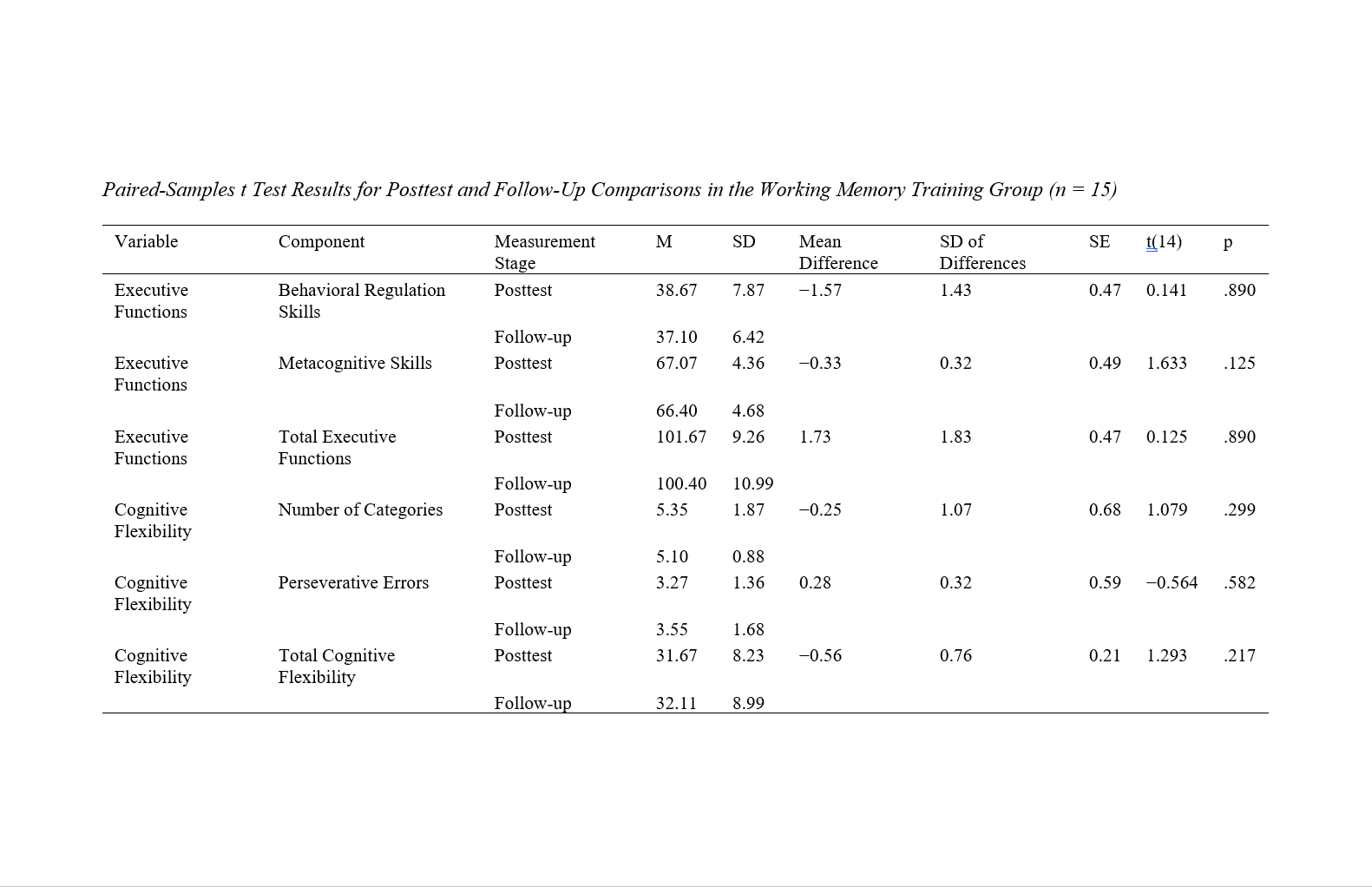
The present study aimed to determine the effectiveness of working memory training on executive functions and cognitive flexibility in students with specific learning disorder. Methodologically, this study was quasi-experimental and employed a pretest–posttest design with a control group. The statistical population included all children diagnosed with specific learning disorders in Ardabil City during the second semester of the 2023–2024 academic year. The research sample consisted of 45 children with specific learning disorder, who were then randomly assigned to two groups of 15 participants each (experimental group and control group). The experimental group received group-based working memory training over 12 sessions of 60 minutes each, whereas the control group did not receive any therapeutic intervention during the study period. Data collection instruments included the Learning Problems Questionnaire developed by Wilcutt et al. (2011), the Behavior Rating Inventory of Executive Function developed by Gioia et al. (2000), and the Wisconsin Card Sorting Test developed by Grant and Berg (1948). The obtained data were analyzed using repeated-measures analysis of variance. The results indicated that working memory training had a significant effect on executive functions and cognitive flexibility in students with specific learning disorder. Accordingly, it can be concluded that working memory training can be used to improve executive functions and cognitive flexibility in students with specific learning disorder.
Downloads
References
Abedi, A., & Malekpour, M. (2010). The effectiveness of early psychological educational interventions on improving executive functions and attention in children with neuropsychological learning disabilities. New Educational Approaches, 5(1). https://nea.ui.ac.ir/article_19039.html
Ahadi, H., & Kakavand, A. (2018). Learning disabilities: From theory to practice. Tehran: Arsbaran Publications.
Alizadeh, H. (2018). Attention-deficit hyperactivity disorder: Characteristics, diagnosis, and treatment. Tehran: Roshd Publications.
Alloway, T. C. (2007). Working memory, reading and mathematical skills in children with developmental coordination disorder. Experimental Child Psychology, 96, 20-36. https://doi.org/10.1016/j.jecp.2006.07.002
Amani, A., Fadaei, E., Tavakoli, M., Shiri, I., & Shiri, V. (2017). A comparison of planning, selective attention, and cognitive flexibility in students with and without specific learning disabilities (reading impairment). Learning Disabilities, 7(2), 94-111. https://www.sid.ir/paper/210226/fa
American Psychiatric, A. (2013). Diagnostic and statistical manual of mental disorders DSM-5. Washington DC, London, and England: Author. https://doi.org/10.1176/appi.books.9780890425596
American Psychiatric, A. (2015). DSM-5-Manual Diagnóstico e Estatístico de Transtornos Mentais. Porto Alegre: Artmed. https://books.google.com/books?hl=en&lr=&id=QL4rDAAAQBAJ&oi=fnd&pg=PT13&dq=American+Psychiatric,+A.+(2015).+DSM-5-Manual+Diagn%C3%B3stico+e+Estat%C3%ADstico+de+Transtornos+Mentais,+Porto+Alegre:+Artmed.+%09&ots=nS4BtJtaES&sig=Ge9CmSKD-KOVhuEMDzYgIcvsrUc
Aspen, H. Y., & Anne, G. E. (2022). How Working Memory and Reinforcement Learning Are Intertwined: A Cognitive, Neural, and Computational Perspective. Journal of Cognitive Neuroscience, 34(4), 551-568. https://doi.org/10.1162/jocn_a_01808
Baron, R. A., & Byrn, D. (2004). Social Psychology: Understanding Human Interaction. Boston: Allyn and Bacon. https://books.google.com/books/about/Social_Psychology.html?id=GzaqAAAACAAJ
Dehghani, Y., & Moradi, N. A.-Z. (2020). The effect of active memory training on planning and cognitive flexibility in students with specific learning disabilities (dyslexia). Neuropsychology, 6(20), 101-120. https://www.sid.ir/paper/266833/fa
Dennis, J. P., & Vander Wal, J. S. (2010). The cognitive flexibility inventory: Instrument development and estimates of reliability and validity. Cognitive therapy and research, 34, 241-253. https://doi.org/10.1007/s10608-009-9276-4
Gadekallu, T. R., Yenduri, G., Kaluri, R., Rajput, D. S., Lakshmanna, K., Fang, K., & Wang, W. (2025). The role of GPT in promoting inclusive higher education for people with various learning disabilities: a review. Peerj Computer Science, 11, e2400. https://doi.org/10.7717/peerj-cs.2400
Gan, Y., Liu, Y., & Zhang, Y. (2004). Flexible coping responses to severe acute respiratory syndrome-related and daily life stressful events. Asian Journal of Social Psychology, 7, 55-66. https://doi.org/10.1111/j.1467-839X.2004.00134.x
Guo, L., & Keles, S. (2025). A systematic review of studies with parent-involved interventions for children with specific learning disabilities. European Journal of Special Needs Education, 40(4), 755-772. https://doi.org/10.1080/08856257.2024.2421112
Horowitz-Kraus, K. (2015). Differential effect of cognitive training on executive functions and reading abilities in children with ADHD and in children with ADHD comorbid with reading difficulties. Journal of Attention Disorders, 19(6), 515-526. https://doi.org/10.1177/1087054713502079
Jacques, S., & Zelazo, P. D. (2005). On the possible roots of cognitive flexibility The Development of Social Cognition and Communication. Mahwah, NJ: Lawrence Erlbaum. https://www.taylorfrancis.com/chapters/edit/10.4324/9781315805634-4/possible-roots-cognitive-flexibility-sophie-jacques-philip-david-zelazo
Jafarzadeh Dashbalagh, H., Janqoo, E., & Hemmati, B. (2019). The effectiveness of play therapy on improving information processing speed and social/emotional processing in students with specific learning disabilities in reading. Journal of Learning Disabilities, 9(1), 71-91. https://jld.uma.ac.ir/article_834.html
Jongbloed-Pereboom, M., Nijhuis-van der Sanden, M. W. G., & Steenbergen, B. (2019). Explicit and implicit motor sequence learning in children and adults; the role of age and visual working memory. Human Movement Science, 64, 1-11. https://doi.org/10.1016/j.humov.2018.12.007
Kamiabi, M., Timouri, S., & Mashhadi, A. (2014). The effectiveness of working memory training on reducing reading difficulties and improving working memory in dyslexic students. Exceptional Education, 2(124), 33-41. https://www.sid.ir/paper/500551/fa
Kartini, A. G., & Susan, E. (2013). Working memory and study skills: a comparison between dyslexic and non-dyslexic adult learners. Social and Behavioral Sciences, 6(97), 271-277. https://doi.org/10.1016/j.sbspro.2013.10.233
Kesler, S. R., Lacayo, N. J., & Jo, B. (2018). A pilot study of an online cognitive rehabilitation program for executive function skills in children with cancer-related brain injury. Department of Psychiatry and Behavioral Sciences, Stanford University, 25(1), 101-112. https://doi.org/10.3109/02699052.2010.536194
Kirk, H. E., Gray, K., Riby, D. M., & Cornish, K. M. (2015). Cognitive training as a resolution for early executive function difficulties in children with intellectual disabilities. Research in Developmental Disabilities, 38, 145-160. https://doi.org/10.1016/j.ridd.2014.12.026
Krause, T. H. (2015). Pinpointing the Deficit in Executive Functions in Adolescents with Dyslexia Performing the Wisconsin Card Sorting Test. Journal of Learning Disabilities, 47(3), 208-223. https://doi.org/10.1177/0022219412453084
Kunlin, Z., Zili, F., Yufeng, W., Stephen, V., Faraone, L., & Suhua, C. (2017). Genetic analysis for cognitive flexibility in the trail-making test in attention deficit hyperactivity disorder patients from single nucleotide polymorphism, gene to pathway level. World Journal of Biological Psychiatry, 25, 1-10. https://www.tandfonline.com/doi/shareview/10.1080/15622975.2017.1386324
Maehler, C., & Schuchardt, K. (2016). The importance of working memory for school achievement in primary school children with intellectual or learning disabilities. Research in Developmental Disabilities, 58, 1-8. https://doi.org/10.1016/j.ridd.2016.08.007
Magalhães, S., Luísa, C., Teresa, L., & Filipe, G. (2020). Executive functions predict literacy and mathematics achievements: The unique contribution of cognitive flexibility in grades 2, 4, and 6. Child Neuropsychology, 26(3), 421-430. https://doi.org/10.1080/09297049.2020.1740188
Pumaccahua, T. T., Wong, E. H., & Eeist, D. J. (2017). Effects of computerized cognitive training on working memory in a school setting. International Journal of Learning, 16(3), 88-104. https://ijlter.org/index.php/ijlter/article/download/863/pdf
Shao, J., Cui, Z., & Bao, Y. (2025). Adaptive sports programs as catalysts for social inclusion and cognitive flexibility in inclusive physical education: The mediating roles of emotional resilience and empathy. BMC psychology, 13(1), 770. https://doi.org/10.1186/s40359-025-03092-2
Swanson, H. L., & Howard, C. B. (2005). Children with reading disabilities: Does dynamic assessment help in the classification? Learning Disability Quarterly, 28, 17-34. https://doi.org/10.2307/4126971
Swanson, H. L., & Jerman, O. (2007). The influence of working memory on reading growth in subgroups of children with reading disabilities. Experimental Child Psychology, 96, 249-283. https://doi.org/10.1016/j.jecp.2006.12.004
Thorell, L. B., Nutley, S. B., Bohlin, G., & Klingberg, T. (2009). Training and transfer effects of executive functions in preschool children. Developmental science, 12(1), 106-113. https://doi.org/10.1111/j.1467-7687.2008.00745.x
Veloso, A., Selene, G., & Marisa, G. F. (2020). Effectiveness of Cognitive Training for School-Aged Children and Adolescents with Attention Deficit/Hyperactivity Disorder: A Systematic Review. Frontiers in psychology, 14, 29-39. https://doi.org/10.3389/fpsyg.2019.02983
Yovel, I., Revelle, W., & Mineka, S. (2005). Who sees trees before forest? The obsessive-compulsive style of visual attention. Psychological Science, 16(2), 123-129. https://doi.org/10.1111/j.0956-7976.2005.00792.x
Zarei, H., Charami, F., & Sharifi, A. A. (2020). The effectiveness of computer-based cognitive rehabilitation on working memory and cognitive flexibility in children with learning disabilities. Cognitive Strategies in Learning, 8(15), 1-18. https://asj.basu.ac.ir/article_3481_446.html
Downloads
Additional Files
Publication Timeline
- Submitted
- Revised
- Accepted