The Relationship Between Mindfulness and Social Anxiety with the Mediating Role of Metacognitive Beliefs in Mothers of Children with Autism and Intellectual Disability
DOI:
https://doi.org/10.61838/kman.prien.5035Keywords:
Mindfulness, Social Anxiety, Metacognitive Beliefs, Mothers of Children with Autism and Intellectual DisabilityAbstract
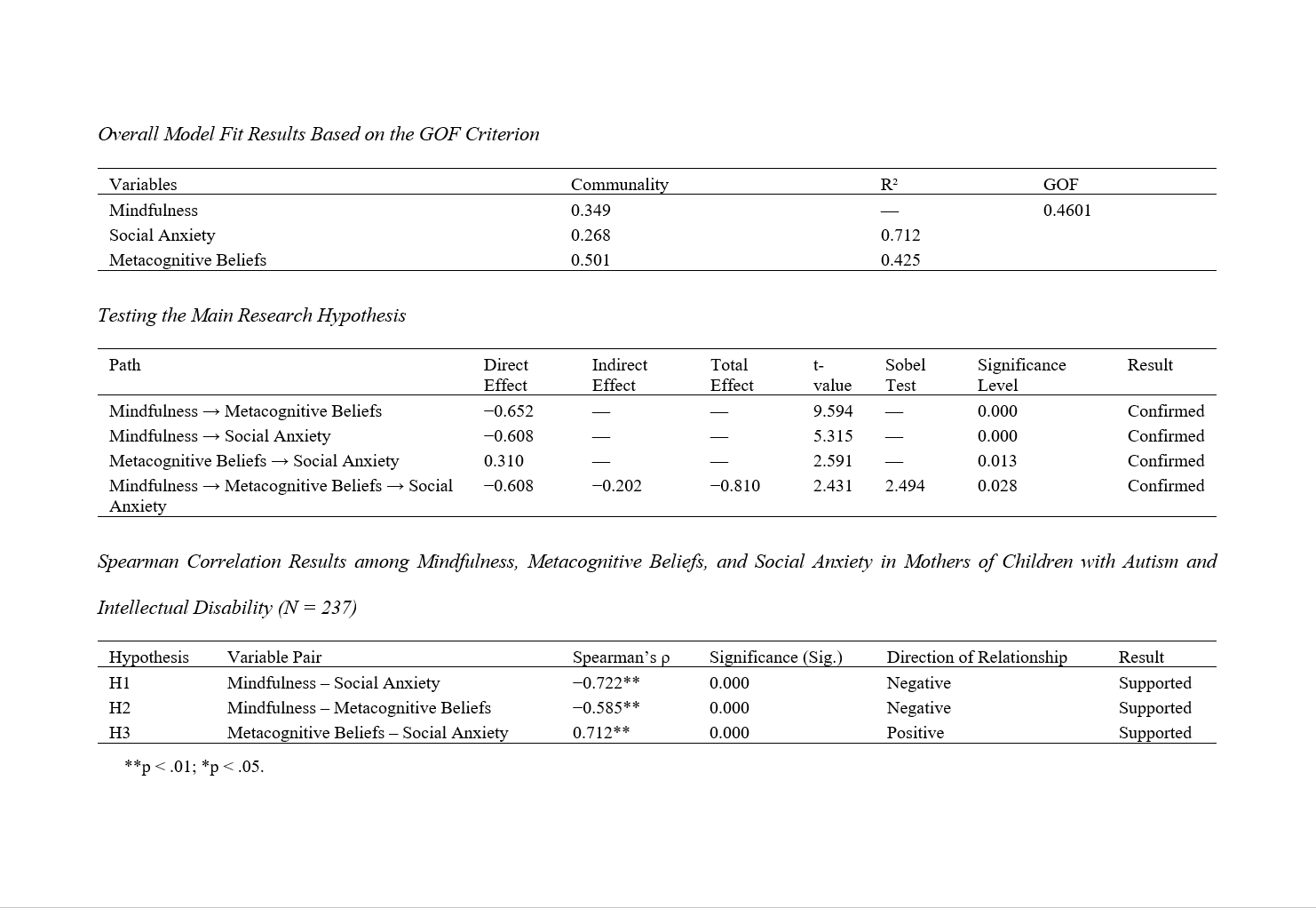
The aim of the present study was to examine the relationship between mindfulness and social anxiety with the mediating role of metacognitive beliefs in mothers of children with autism and intellectual disability. In terms of purpose, the research was applied, and in terms of data collection, it employed a descriptive correlational design based on structural equation modeling. The statistical population included all mothers of children with autism and intellectual disability in Behshahr County, totaling 618 individuals, from whom 237 participants were selected as the sample based on the Krejcie and Morgan table using convenience sampling. Standardized questionnaires—including the Wells and Cartwright-Hatton Metacognitions Questionnaire (2004) (α = 0.79), the Connor et al. Social Anxiety Questionnaire (2000) (α = 0.82), and the Baer et al. Mindfulness Questionnaire (2006) (α = 0.88)—were used as research instruments. For data analysis, descriptive statistics included frequency tables and charts, percentage frequencies, and means; inferential statistics included the Kolmogorov–Smirnov test to assess the normality of variables and correlation coefficients and structural equation modeling to test the research hypotheses, using SPSS 22 and SmartPLS software at a 95% confidence level. The results indicated a significant relationship between mindfulness and social anxiety with the mediating role of metacognitive beliefs in mothers of children with autism and intellectual disability. Additionally, there was a significant negative relationship between mindfulness and metacognitive beliefs with social anxiety in mothers of children with autism and intellectual disability, and a significant negative relationship between mindfulness and metacognitive beliefs in these mothers.
Downloads
References
Abdi, R., & Narimani, A. (2018). Comparing personality dimensions and resilience in mothers of children with autism spectrum disorder and attention deficit/hyperactivity disorder with mothers of normal children. Journal of Disability Studies, 8(70), 1-6. https://www.sid.ir/fileserver/jf/30033139700100.pdf
Aghapour, M., & Najati, A. M. (2019). The effectiveness of mindfulness training on social anxiety disorder among powerlifting athletes. First Biennial Congress on Recent Advances in Psychology and Behavioral Sciences. https://elmnet.ir/article/21189735-88141
Akbari, B. (2019). Predicting psychological distress in mothers of children with autism spectrum disorder based on mindfulness and rumination. Quarterly Journal of Child Mental Health, 6(1), 200-210. https://doi.org/10.29252/jcmh.6.1.17
Al Behbahani, M., Kikhusrovani, M., Amini, N., Narimani, M., & Jamaini, B. A. (2021). The effectiveness of mindfulness training for mothers on reducing aggression in children with autism spectrum disorder. Journal of the Medical Faculty of Mashhad University of Medical Sciences, 64(5), 4061-4072. https://mjms.mums.ac.ir/m/article_19845.html
Amini Fashkhodi, M., Mohammadian, M., & Fathi, M. (2019). The effectiveness of group therapy based on acceptance and commitment in reducing psychological problems in mothers of children with autism spectrum disorder. Journal of Family Research, 14(54), 277-293. https://jfr.sbu.ac.ir/article_97657.html
Asghari, E. (2017). Examining the relationship between metacognitive beliefs and mindfulness with social anxiety among students at Shahid Rajai Higher Education Center in Isfahan.
Bagheri, A., Goodarzi, K., Rouzbehani, M., & Kakabraei, K. (2024). Comparing the effectiveness of metacognitive therapy, solution-focused therapy, and endurance exercises on self-efficacy beliefs in female students with social anxiety disorder. Journal of Psychological Science, 23(137), 133-153. https://psychologicalscience.ir/article-1-2420-en.html
Ghadampour, I., Gholamrezai, S., & Radmehr, P. (2016). The effect of cognitive training based on mindfulness on improving metacognitive beliefs in individuals with comorbid social anxiety and depression. Quarterly Journal of Cognitive Strategies in Learning, 4(6), 38-58. https://civilica.com/doc/769991/
Ghaderi, B., Yazdanbakhsh, K., & Karami, J. (2022). Development and testing of a structural model of social anxiety based on maladaptive early schemas and metacognitive beliefs, with the mediating role of cognitive emotion regulation strategies in adolescent girls. Psychological Sciences Monthly, 21(109), 123-144. https://doi.org/10.52547/JPS.21.109.123
Ghazanfari, F., & Naderi, M. (2019). Developing a model for the etiology of social anxiety in adolescents based on anxiety sensitivity, negative emotion regulation, and insecure attachment styles, with the mediating role of emotion-focused coping strategies. Quarterly Journal of Clinical Psychology Studies, 9(38), 97-130. https://jcps.atu.ac.ir/article_10389.html
Hallajani, F., Jamaini Nejad, F., Dasht Bozorgi, Z., & Ismaili Shad, B. (2019). The impact of group training in positive thinking on the psychological health of mothers with children with autism. Research in Nursing and Midwifery, 5(4), 65-72. https://ijrn.ir/article-1-426-fa.html
Hazrati, Y., & Abdi, H. (2024). The effect of mindfulness-based cognitive behavioral therapy on social anxiety, self-efficacy, and quality of life in adults with stuttering with a language psychology approach. Journal of Behavioral Sciences Research, 22(1), 15-27. https://rbs.mui.ac.ir/browse.php?a_id=1750&sid=1&slc_lang=en
Heydari, M., Azmoudeh, M., & Abdali, H. R. (2018). The causal relationship between mindfulness and social anxiety with the mediation of rumination and dysfunctional attitudes among students of Islamic Azad University in Zanjan. Quarterly Journal of Psychology and Behavioral Sciences of Iran, 4(13), 70-80. https://www.noormags.ir/view/fa/articlepage/1819863/
Hoshyar, M., Kakavand, A., & Ahmadi, A. (2018). The effectiveness of mindfulness on the quality of life and coping styles of mothers of children with autism spectrum disorder. Quarterly Journal of Social Work, 7(2), 32-39. https://socialworkmag.ir/article-1-392-en.pdf
Hossein Zadeh, Z., Kakavand, A., & Ahmadi, A. (2016). The mediating role of maternal mindfulness and family resilience in the relationship between behavioral problems of children with autism spectrum disorders and maternal psychological well-being. Journal of Exceptional Individuals, 6(23), 151-178. https://jpe.atu.ac.ir/article_7371.html?lang=en
Jazaieri, H., Lee, I. A., Goldin, P. R., & Gross, J. J. (2016). Pre-treatment social anxiety severity moderates the impact of mindfulness-based stress reduction and aerobic exercise. Psychology and Psychotherapy: Theory, Research and Practice. https://doi.org/10.1111/papt.12060
Kuçukparlak, A. C. (2021). Investigating the relationship between theory of mind and attachment characteristics with disease severity in social anxiety disorder. Clinical psychology review, 79, 11-24. https://pubmed.ncbi.nlm.nih.gov/33795955/
Kulasinghe, K., Whittingham, K., & Mitchell, A. E. (2021). Mental health, broad autism phenotype and psychological inflexibility in mothers of young children with autism spectrum disorder in Australia: A cross-sectional survey. Autism. https://doi.org/10.1177/1362361320984625
Miranda, A., Mira, A., Berenguer, C., Rosello, B., & Baixauli, I. (2019). Parenting stress in mothers of children with autism without intellectual disability: Mediation of behavioral problems and coping strategies. Frontiers in psychology, 10, 464-464. https://doi.org/10.3389/fpsyg.2019.00464
Öztekin, G. G. (2024). The Effects of Social Anxiety on Subjective Well-Being Among Adolescents: The Mediating Roles of Mindfulness and Loneliness. Iğdır Üniversitesi Sosyal Bilimler Dergisi(36), 220-236. https://doi.org/10.54600/igdirsosbilder.1433959
Porter, E., Chambless, D. L., & Keefe, J. R. (2017). Criticism in the Romantic Relationships of Individuals With Social Anxiety. Behavior therapy, 48(4), 517-532. https://doi.org/10.1016/j.beth.2016.11.002
Rabat Mili, S., & Karimi, M. (2018). The predictive role of metacognitive beliefs, mindfulness, and fear of negative evaluation in social anxiety among adolescents. Social Psychology Research, 8(31), 51-68. https://www.socialpsychology.ir/article_87485.html?lang=en
Ronchi, L., Banerjee, R., & Lecce, S. (2019). Theory of Mind and Peer Relationships: The Role of Social Anxiety. Review of Social Development, 29(2), 101-107. https://doi.org/10.1111/sode.12417
Solem, S., & Wells, A. (2015). A metacognitive perspective on mindfulness: An empirical investigation. BMC psychology, 3(1), 1-10. https://doi.org/10.1186/s40359-015-0081-4
Strand, E. R., Nordahl, H., Hjemdal, O., & Nordahl, H. M. (2023). Metacognitive Beliefs Predict Interpersonal Problems in Patients With Social Anxiety Disorder. Scandinavian journal of psychology, 64(6), 819-824. https://doi.org/10.1111/sjop.12943
Taheri, H. (2025). The effectiveness of mindfulness-based cognitive therapy on social anxiety and loneliness in adolescents. Ethics Committee in Research. https://ethics.atu.ac.ir/article_18969.html
Talebi, M. (2020). The effectiveness of mindfulness-based cognitive therapy on the levels of anxiety and happiness among nurses. Journal of Ibn Sina Nursing and Midwifery Care, 29(2), 126-136. https://doi.org/10.30699/ajnmc.29.2.126
Talha, A., Chrystyna, K., Junghee, L., Daniel, F., & Benjamin, T. (2020). Social anxiety is negatively associated with theory of mind and empathic accuracy. Journal of abnormal psychology, 129(1), 108-113. https://doi.org/10.1037/abn0000493
Tamimi, Y., Soleimani Zadeh, N., Eftekhari, N., & Nemat, Z. (2020). The effectiveness of acceptance and commitment therapy on adjustment and social anxiety in mothers of children with autism. Journal of Disability Studies, 10(42), 1-6. https://elmnet.ir/doc/2185536-29852
Tarman, G., & Sari, B. (2021). The Mediating Role of Mindfulness on Social Anxiety and Procrastination. International journal of mental health and addiction. https://doi.org/10.1007/s11469-021-00637-5
Downloads
Additional Files
Publication Timeline
- Submitted
- Revised
- Accepted