Examining the Effectiveness of the Fernald Multisensory Approach on Body Self-Concept in Elementary Students with Learning Disabilities
DOI:
https://doi.org/10.61838/kman.prien.4819Keywords:
Fernald multisensory approach, body self-concept, learning disabilities, elementary studentsAbstract
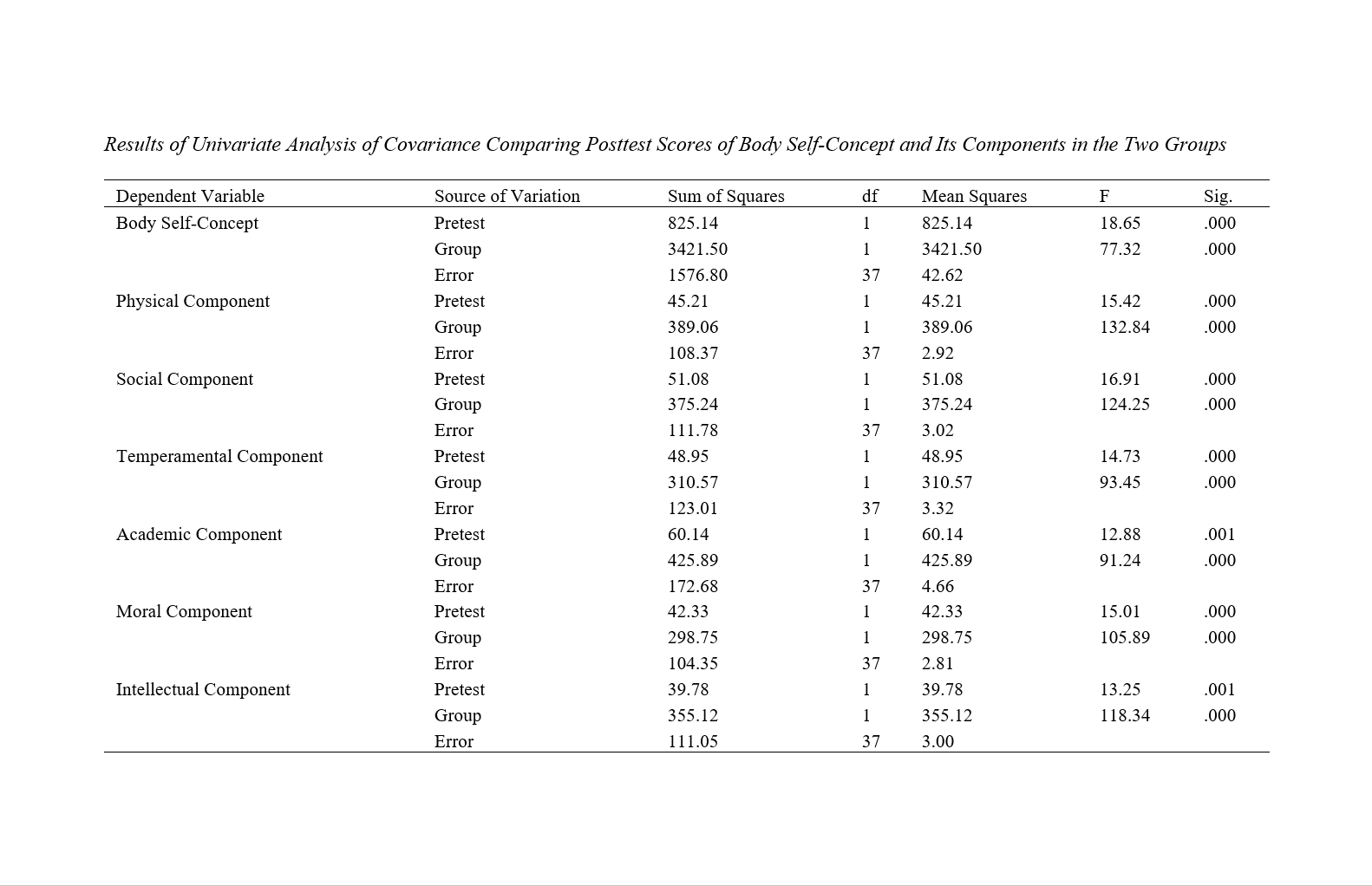
Students with learning disabilities, in addition to academic difficulties, often experience psychological challenges such as negative body self-concept, which can adversely affect their social and academic functioning. This study aimed to determine the effectiveness of the Fernald multisensory approach on body self-concept in elementary school students with learning disabilities. This research employed a quasi-experimental design with a pretest–posttest structure and a control group. The statistical population consisted of students with learning disabilities in the city of Zahedan, from whom 40 students were selected through purposive sampling and randomly assigned to experimental and control groups (20 students per group). The experimental group received 15 instructional sessions based on the Fernald multisensory approach, while the control group received no intervention. The measurement instrument was the Marsh Body Self-Description Questionnaire, and data were analyzed using analysis of covariance. The findings indicated that instruction based on the Fernald multisensory approach had a significant positive effect on improving overall body self-concept and all of its components (physical, social, temperamental, academic, moral, and intellectual) in the experimental group compared to the control group (p < .001). These results suggest that the intervention, by creating successful learning experiences, substantially improved the students’ self-perceived body image. Based on the findings, it can be concluded that the Fernald multisensory approach is an effective and efficient intervention for enhancing body self-concept in students with learning disabilities. Therefore, incorporating this approach into school-based support and rehabilitation programs and counseling centers may contribute to simultaneous improvement in academic performance and psychological well-being among these students.
Downloads
References
Anggraeni, W., & Hendriani, W. (2022). The Development of Educational Practices for Children with Dyslexia in Indonesia. Jurnal Psikologi Pendidikan dan Konseling: Jurnal Kajian Psikologi Pendidikan dan Bimbingan Konseling, 8(2). https://doi.org/10.26858/jppk.v8i2.37373
Behbahani, E., Asgari, P., Heydari, A., & Marashian, F. (2021). Comparison of the Effectiveness of Fernald's Multisensory Training and Computer Game Training on Dyslexia in Elementary Students with learning Disabilities. Iranian Journal of Educational Sociology, 4(1), 58-69. https://doi.org/10.52547/ijes.4.1.58
Dehghani, Y., & Moradi, N. (2020). The effect of working memory training on planning and cognitive flexibility of students with specific learning disorder (dyslexic). Journal of Neuropsychology, 6(1), 101-120. https://clpsy.journals.pnu.ac.ir/article_6795.html?lang=en
Fatimah, N., Ansyah, E. H., & Ghozali Rusyid, A. (2025). Dynamics of cognitive development of dyslexia students through multisensory learning. Proceeding of International Conference on Social Science and Humanity,
Heidari Khormizi, S. H. (2022). Comparative anthropometric and body self-concept of active and inactive teachers in Mehriz city [Master's thesis, Payame Noor University of Yazd]. Taft.
Karimi Bahrasemani, A., Cherami, M., Sharifi, T., & Ghazanfari, A. (2021). Effectiveness of sensory-motor integration intervention on self-esteem and mathematical performance of mathematics in students with mathematical learning disability. Journal of Exceptional Children, 21(2), 101-110. https://joec.ir/article-1-1326-en.html
Khademi Adel, L., Bani Mali, S. A., Dortaj, F., & Asadzadeh, H. (2024). Investigating the Effectiveness of Multi-Sensory Methods and Cognitive-Behavioral Intervention on Self-Discipline and Self-Assessment of 9-10 Year Old Dyslexic Girls. Theory and Practice in Teacher Training, 10(17). https://www.researchgate.net/publication/385693559_The_Eeffectiveness_of_Multi-Sensory_Methods_and_Cognitive-Behavioral_Intervention_on_Self-Discipline_and_Self-Assessment_of_Dyslexic_Female_Students_of_9-10_years
Kunasegran, K., & Subramaniam, V. (2024). Exploring multisensory in enhancing literacy of dyslexic students. International Journal of Academic Research in Progressive Education and Development, 13(3), 2933-2941. https://doi.org/10.6007/IJARPED/v13-i3/22649
Marsh, H. W. (1994). Using the National Longitudinal Study of 1988 to evaluate theoretical models of self-concept: The Self-Description Questionnaire. Journal of Educational Psychology, 86(3), 439-456. https://doi.org/10.1037/0022-0663.86.3.439
Miccinati, J. (1979). The Fernald Technique: Modifications Increase the Probability of Success. Journal of Learning Disabilities, 12(2), 139-142. https://doi.org/10.1177/002221947901200302
Olad Ghobad, T., Abbaspour Azar, Z., Khalatbari, J., & Afkari, F. (2021). Comparison of the effectiveness of Fernald and Rossner's multisensory teaching methods on reducing the spelling disorder of elementary students. International Journal of Pediatrics, 9(4), 13365-13375. https://jpp.mums.ac.ir/article_20840.html
Pourkamali, A., Mohammadi, A., & Haghighat, S. (2022). The effect of education based on Fernald's multisensory approach on improving visual memory and fluency of students with learning disabilities. Journal of Studies and Psychological in Adolescents and Youth, 2(2), 290-300. https://doi.org/10.52547/jspnay.2.2.290
Rahmonovna, S. (2025). Pedagogical Foundations of Using the Multi-Sensory Approach for Teaching English To Students with Learning Disabilities. European International Journal of Philological Sciences, 5(6), 78-84. https://doi.org/10.55640/eijps-05-06-14
Sarajar, D., & Pratiwi, P. (2024). Analysis of multisensory learning media needs for children identified with dyslexia disorder. Counsenesia Indonesian Journal of Guidance and Counseling, 5(1), 73-82. https://doi.org/10.36728/cijgc.v5i1.3538
Tajdar Malmiry, B. S. (2023). The mediating role of parents' anxious thoughts in the relationship between hyperactivity and learning disorders of second-period preschool students in district one of Yazd city [Master's thesis, Payame Noor University of Yazd]. Taft.
Thani, P., Koohzad, N., & Ahmadi, F. (2022). Comparison of the Effectiveness of Fernald's Sensory Method and Educational Games on Writing Disorder in Elementary School Students. Advances in Bioscience and Clinical Medicine, 10(1), 1-7. https://doi.org/10.7575/aiac.abcmed.v.10n.1p.1
Yazdi Nezhad, E., Rahimi, C., Mohammadi, N., & Sarafraz, M. R. (2023). Comparison of the effectiveness of sensory integration method and central nervous system reorganization method on visual-spatial skills of students with specific learning disorder. Journal of Disability Studies, 13, 124. https://jdisabilstud.org/article-1-2895-en.html
Downloads
Additional Files
Publication Timeline
- Submitted
- Revised
- Accepted