Effectiveness of Short-Term Dynamic Psychotherapy on Identity and Self-Esteem in Families with Exceptional Children
DOI:
https://doi.org/10.61838/kman.prien.3.1.9Keywords:
short-term dynamic psychotherapy, identity, self-esteem, parents of exceptional children, emotional integrationAbstract
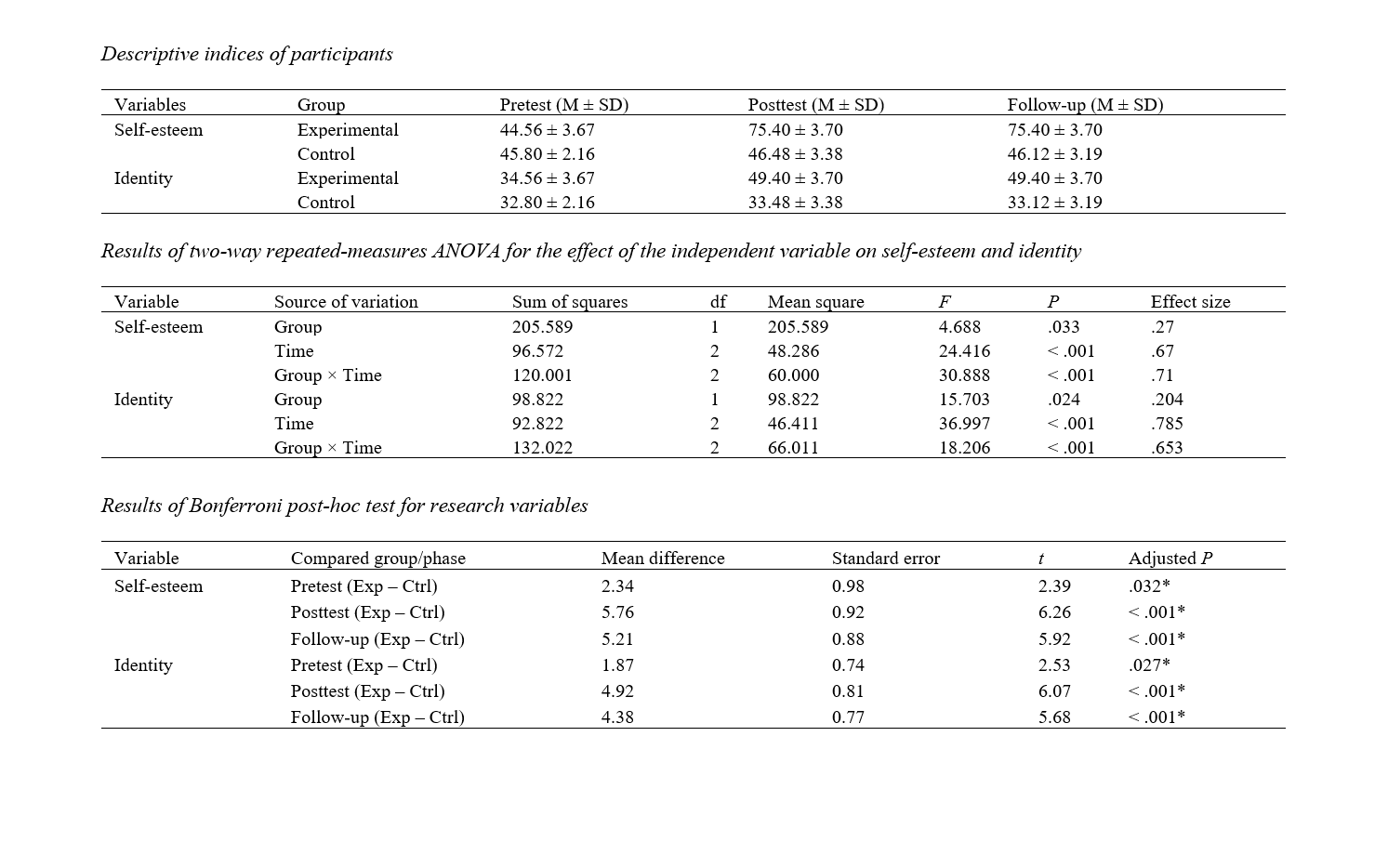
This study aimed to investigate the effectiveness of short-term dynamic psychotherapy (STDP) on improving identity integration and self-esteem among parents of exceptional children. The study employed a quasi-experimental design with a pretest–posttest–follow-up format and a control group. The statistical population included all parents of exceptional children in Tehran in 2025. A total of 30 parents were selected using convenience sampling and randomly assigned to experimental and control groups (15 participants each). The experimental group received 15 weekly sessions of 90-minute Intensive Short-Term Dynamic Psychotherapy (ISTDP), while the control group received no intervention. The Self-Esteem Scale (Crocker et al., 2003) and the Marcia Identity Status Questionnaire (Adams & Bennion, 1986) were used to measure variables at three stages: pretest, posttest, and two-month follow-up. Data were analyzed using repeated-measures ANOVA in SPSS-26, along with Kolmogorov–Smirnov, Levene, Mauchly, and Box’s M tests to confirm statistical assumptions. Results indicated a significant improvement in the experimental group compared to the control group in both self-esteem (F = 4.688, p = .033, η² = .27) and identity integration (F = 15.703, p = .024, η² = .20). Within-group comparisons showed significant progress across all three stages in self-esteem (p < .001) and identity (p < .001). Interaction effects between group and time were also significant for both variables (p < .001), confirming the sustained positive impact of STDP during the follow-up phase. Bonferroni post-hoc analysis revealed consistent mean score increases in the experimental group compared to the control group at each stage. Short-term dynamic psychotherapy effectively enhances identity coherence and self-esteem among parents of exceptional children by addressing unconscious conflicts and facilitating emotional integration. It can be applied as a supportive intervention in counseling and rehabilitation settings for families facing the psychological challenges of disability.
Downloads
References
Abbass, A., Kisely, S., & Kroenke, K. (2009). Short term psychodynamic psychotherapy for somatic disorders: Systematic review and meta analysis of clinical trials. Psychotherapy and psychosomatics, 78(5), 265–274. https://doi.org/10.1159/000228247
Abbass, A., Nowoweiski, S., Bernier, D., Tarzwell, R., & Beutel, M. (2014). Review of psychodynamic psychotherapy neuroimaging studies. Psychotherapy and psychosomatics, 83(3), 142–147. https://doi.org/10.1159/000358841
Abbass, A., & Town, J. M. (2020). Intensive short-term dynamic psychotherapy: A systematic review and meta-analysis of outcome research. Harvard Review of Psychiatry, 28(2), 97–108. https://doi.org/10.1097/HRP.0000000000000248
Abbass, A., Town, J. M., & Driessen, E. (2012). Intensive short term dynamic psychotherapy: A systematic review and meta analysis of outcome research. Harvard Review of Psychiatry, 20(2), 97–108. https://doi.org/10.3109/10673229.2012.677347
Benson, P. R. (2021). The impact of child disability on parental well-being: A longitudinal study. Journal of Family Psychology, 35(3), 321–331. https://doi.org/10.1037/fam0000812
Brown, T. J., Clark, C., & Smith, L. (2022). Stigma and social support: Experiences of parents of children with developmental disabilities. Journal of Intellectual Disability Research, 66(4), 287–299. https://doi.org/10.1111/jir.12903
Dearing, R. L., & Tangney, J. P. (2011). Shame in psychopathology: Prevention and treatment. American Psychological Association. https://awspntest.apa.org/doi/10.1037/12326-014
Di Sarno, M. (2021). Shame change in psychotherapy: A scoping review and meta analysis. Mediterranean Journal of Clinical Psychology, 9(1), 91–112. https://quarterlyecp.com/index.php/ecp/article/view/139?articlesBySimilarityPage=2
Driessen, E., Van, H. L., Don, F. J., Peen, J., Kool, S., Westra, D., & Dekker, J. (2010). The efficacy of short term psychodynamic psychotherapy for depression: A meta analysis. Clinical psychology review, 30(1), 25–36. https://doi.org/10.1016/j.cpr.2009.08.010
Dykens, E. M., & Lambert, W. (2023). Parenting children with intellectual disabilities: Challenges and opportunities for growth. American Journal on Intellectual and Developmental Disabilities, 128(1), 45–58. https://doi.org/10.1352/1944-7558-128.1.45
Frederick, R. J., & Town, J. M. (2021). Emotional processing in intensive short-term dynamic psychotherapy: Enhancing self-compassion and identity integration. Psychodynamic Psychiatry, 49(2), 178–196. https://doi.org/10.1521/pdps.2021.49.2.178
Guo, L., & Keles, S. (2025). A systematic review of studies with parent-involved interventions for children with specific learning disabilities. European Journal of Special Needs Education, 40(4), 755-772. https://doi.org/10.1080/08856257.2024.2421112
Lilliengren, P., Johansson, R., Town, J. M., Kisely, S., & Abbass, A. (2017). Intensive short term dynamic psychotherapy for generalized anxiety disorder: A pilot effectiveness study. Clinical Psychology and Psychotherapy, 24(6), 1317–1327. https://doi.org/10.1002/cpp.2101
Marshak, L. E., Prezant, F. P., & L'Amoreaux, N. (2022). The evolving identity of parents of children with disabilities: A narrative review. Families, Systems, & Health, 40(1), 12–22. https://doi.org/10.1037/fsh0000654
Nakhaei Moghadam, R., Bahrainian, S. A., & Nasri, M. (2024). The effectiveness of intensive and short-term dynamic psychotherapy on attachment styles, somatization and health anxiety in patients with chronic pain. Journal of Assessment and Research in Applied Counseling (JARAC), 6(1). https://journals.kmanpub.com/index.php/jarac/article/view/1287
Rostafinski, T. J. (2016). Schizoid personality: Fear of engagement and proneness to shame. Journal of Clinical Psychology, 72(3), 210–225. https://www.rostafinski.com/articles/schizoid-personality/
Sarlaki, A., Farokhzad, M., Khanzadeh, F., Younesi Sinaki, M., Razavi Mahdian, S. Z., & Tayyar Parvin, M. (2024). Effectiveness of Intensive Short-Term Dynamic Psychotherapy on Object Relations, Anger, and Guilt in Women with Major Depressive Disorder. Psychological Achievements, 30(1), 89-102. https://psychac.scu.ac.ir/article_18967.html
Schwartz, S. J., Zamboanga, B. L., & Luyckx, K. (2020). Identity development in the 21st century: New directions and integrative frameworks. Developmental Psychology, 56(8), 1498–1510. https://doi.org/10.1037/dev0000998
Scripps, E., Sutherland, D., Langdon, P. E., Hastings, R. P., & Gray, K. M. (2025). Supporting Parents of Adolescents With Intellectual Disabilities: A Systematic Review of Interventions. Journal of Applied Research in Intellectual Disabilities, 38(1). https://doi.org/10.1111/jar.70004
Shedler, J. (2010). The efficacy of psychodynamic psychotherapy. American psychologist, 65(2), 98–109. https://doi.org/10.1037/a0018378
Smith, J. A., & Anderson, K. (2021). Parental identity and well-being in families of children with autism spectrum disorder. Autism Research, 14(6), 1123–1134. https://doi.org/10.1002/aur.2489
Town, J. M., Abbass, A., Stride, C., & Bernier, D. (2017). A randomized controlled trial of intensive short term dynamic psychotherapy for treatment resistant depression: The Halifax Depression Study. Journal of affective disorders, 214, 15–25. https://doi.org/10.1016/j.jad.2017.02.035
Werner, S., & Shulman, C. (2020). Subjective well-being, family dynamics, and parenting children with disabilities. Journal of Child and Family Studies, 29(5), 1356–1368. https://doi.org/10.1007/s10826-019-01675-2
Winarick, D., & Bornstein, R. F. (2015). Contrasting correlates of schizoid and avoidant traits: Internalized shame and schizoid features. Personality and individual differences, 78, 24–29. https://www.researchgate.net/publication/273400009_Toward_resolution_of_a_longstanding_controversy_in_personality_disorder_diagnosis_Contrasting_correlates_of_schizoid_and_avoidant_traits
Downloads
Additional Files
Publication Timeline
- Submitted
- Revised
- Accepted