Detraining Effects on Body Mass Index and Motor Performance in Boys with Down Syndrome: A One-Year Follow-Up Study
DOI:
https://doi.org/10.61838/kman.prien.3.2.7Keywords:
Down syndrome, upper-limb coordination, motor skills, aerobic training, resistance trainingAbstract
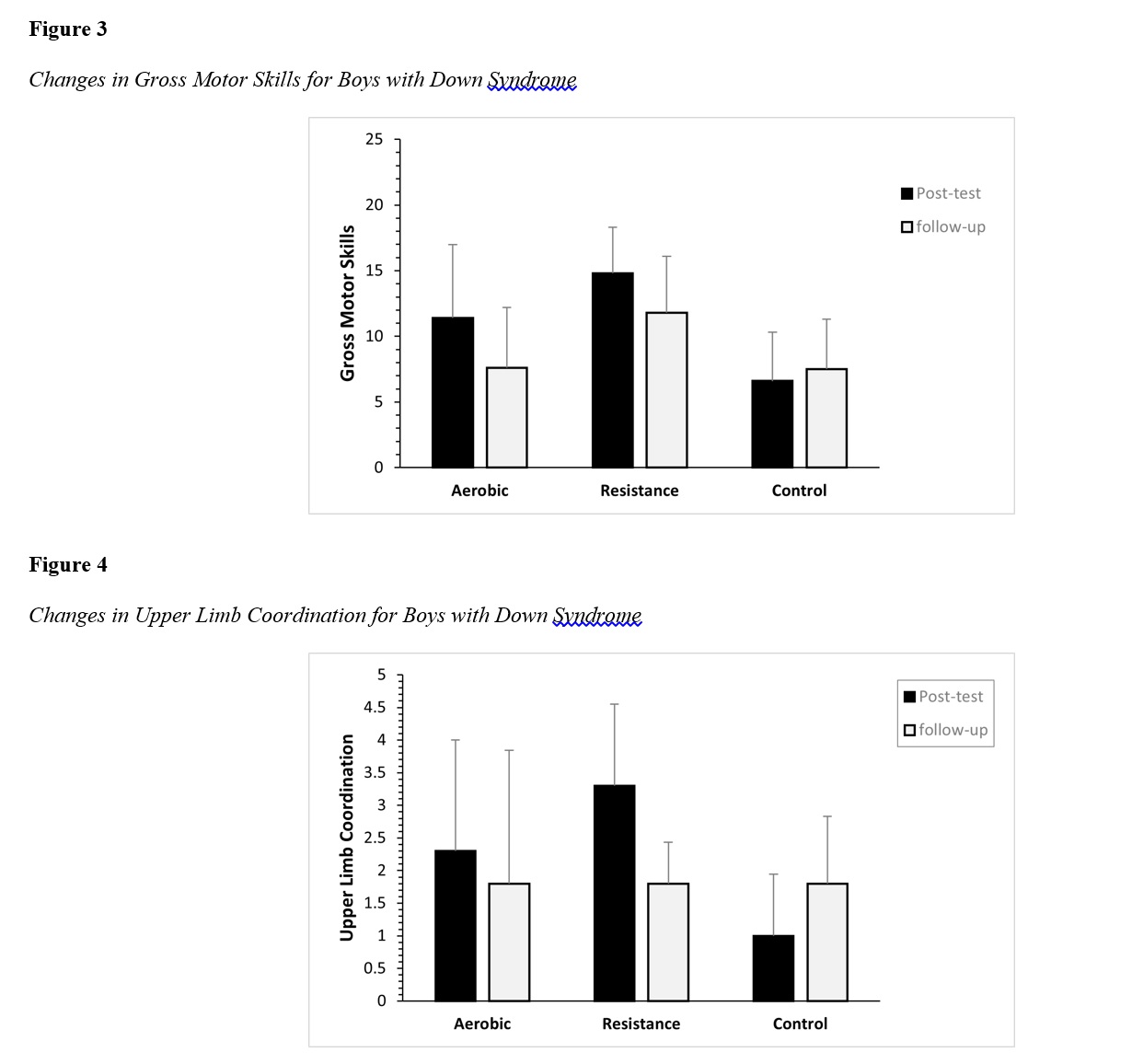
Down syndrome is one of the most common chromosomal disorders and is associated with multiple challenges in cognitive, motor, and physical development. The aim of the present study was to evaluate changes in body mass index (BMI) and perceptual–motor performance in boys with Down syndrome one year after completing a six-week program of aerobic and resistance exercises under conditions of detraining. This quasi-experimental study used a pretest–posttest–one-year follow-up design and was conducted on 30 boys with Down syndrome aged 7 to 14 years (BMI = 18.6367 ± 3.479). Participants were randomly assigned to three groups: aerobic training, resistance training, and control. After completing the six-week training program, all participants underwent a one-year detraining period and were re-evaluated at the end of this period. Data were analyzed using multivariate analysis of variance with repeated measures. The results showed a significant increase in BMI across all groups over the one-year period (p < .001). In addition, gross motor skills, fine motor skills, and upper-limb coordination, which had improved following the initial intervention, showed a marked decline during detraining. The degree of skill regression was less pronounced in the resistance training group compared to the aerobic training group; however, this difference was not sufficient to prevent performance decline over time. Overall, the findings indicated that the positive effects of short-term exercise interventions in children with Down syndrome do not persist without ongoing physical activity. These results underscore the importance of designing continuous, combined, and long-term rehabilitative exercise programs to prevent the deterioration of motor abilities and to maintain physical health indicators in this vulnerable population.
Downloads
References
Ashcroft, R. E. (2008). The declaration of Helsinki. The Oxford textbook of clinical research ethics, 21, 141-148. https://books.google.com/books?hl=en&lr=&id=gvRzB3ZVOngC&oi=fnd&pg=PA141&dq=Ashcroft,+R.+E.+(2008).+%22The+declaration+of+Helsinki.%22+The+Oxford+textbook+of+clinical+research+ethics+21:+141-148.+%09&ots=ZYXxNdvFDd&sig=6OV_Ez3sl4lO0mtht7Y6sk9zIYg
Aslam, A. A., Baksh, R. A., Pape, S. E., Strydom, A., Gulliford, M. C., Chan, L. F., Consortium, G.-D., & Mara, H. Y. S. A. C. L. P. M.-C. B. J. L. P. D. (2022). Diabetes and obesity in Down syndrome across the lifespan: A retrospective cohort study using UK electronic health records. Diabetes Care, 45(12), 2892-2899. https://diabetesjournals.org/care/article-abstract/45/12/2892/147691
Boer, P. (2018). Effects of detraining on anthropometry, aerobic capacity and functional ability in adults with D own syndrome. Journal of Applied Research in Intellectual Disabilities, 31, 144-150. https://onlinelibrary.wiley.com/doi/abs/10.1111/jar.12327
Bosquet, L., & Mujika, I. (2012). Detraining. In (Vol. 30, pp. 100-106). https://www.google.com/url?sa=t&source=web&rct=j&opi=89978449&url=https://www.researchgate.net/publication/236590070_Detraining&ved=2ahUKEwiE5beor_6PAxUwAfsDHXdkIggQFnoECBcQAQ&usg=AOvVaw16FlYB7WKfvtNNWujuvy1S
Esparza Ocampo, K., Gastélum Espinoza, W., Angulo Rojo, C., Guadrón Llanos, A., Aguirre Villalobos, S., Camberos Barraza, J., De la Herran‐Arita, A. K., & Magaña Gomez, J. (2025). Assessment of Cardiometabolic Risk Factors in Children With Down Syndrome With Normal Weight: A Comparative Study Against a Non–Down Syndrome Cohort. Journal of Intellectual Disability Research. https://onlinelibrary.wiley.com/doi/abs/10.1111/jir.13241
González‐Agüero, A., Vicente‐Rodríguez, G., Moreno, L., Guerra‐Balic, M., Ara, I., & Casajus, J. (2010). Health‐related physical fitness in children and adolescents with Down syndrome and response to training. Scandinavian Journal of Medicine & Science in Sports, 20(5), 716-724. https://onlinelibrary.wiley.com/doi/abs/10.1111/j.1600-0838.2010.01120.x
Iglesias‐Díaz, L., López‐Ortiz, S., García‐Chico, C., Santos‐Lozano, A., & González‐Lázaro, J. (2025). Lifting Limits: The Impact of Strength Training in Down Syndrome—A Systematic Review and Meta‐Analysis. Journal of Intellectual Disability Research. https://onlinelibrary.wiley.com/doi/abs/10.1111/jir.13259
Koolwijk, P., de Jonge, E., Mombarg, R., Remmers, T., Van Kann, D., van Aart, I., Savelsbergh, G., & de Vries, S. (2024). Changes in Motor Competence of 4–8-Year-Old Children: A Longitudinal Study. International journal of environmental research and public health, 21(2), 190. https://www.mdpi.com/1660-4601/21/2/190
Kyriakidou, G., Tsalis, G., & Evaggelinou, C. (2024). Impact of a Three-Month Training Break on Swimming Performance in Athletes with Intellectual Disability. Sports, 12(12), 330. https://www.mdpi.com/2075-4663/12/12/330
Lei, Z., Yuan, K., Xu, J., Miao, Y., Dai, Y., Wang, J., & Chang, J. (2025). Effects of physical exercises on balance in children with down syndrome: a systematic review and meta-analysis. BMC Sports Science, Medicine and Rehabilitation, 17(1), 1-11. https://link.springer.com/article/10.1186/s13102-025-01222-2
Melo, G. L. R., Neto, I. V. d. S., Fonseca, E. F. d., Stone, W., & Nascimento, D. d. C. (2022). Resistance training and Down Syndrome: A narrative review on considerations for exercise prescription and safety. Frontiers in Physiology, 13, 948439. https://www.frontiersin.org/articles/10.3389/fphys.2022.948439/full
Mendonca, G. V., Pereira, F. D., & Fernhall, B. (2011). Effects of combined aerobic and resistance exercise training in adults with and without Down syndrome. Arch Phys Med Rehabil, 92(1), 37-45. https://doi.org/10.1016/j.apmr.2010.09.015
Molinari, S., Fossati, C., Nicolosi, M. L., Di Marco, S., Faraguna, M. C., Limido, F., Ocello, L., Pellegrinelli, C., Lattuada, M., Gazzarri, A., Lazzerotti, A., Sala, D., Vimercati, C., Capitoli, G., Daolio, C., Biondi, A., Balduzzi, A., & Cattoni, A. (2024). Endocrine, auxological and metabolic profile in children and adolescents with Down syndrome: from infancy to the first steps into adult life. Front Endocrinol (Lausanne), 15, 1348397. https://doi.org/10.3389/fendo.2024.1348397
Montalva-Valenzuela, F., Andrades-Ramírez, O., Ferrari, G., Adsuar, J. C., Gorla, J. I., Farías-Valenzuela, C., Mendoza-Muñoz, M., Nanjarí-Miranda, R., & Castillo-Paredes, A. (2025). Effects of exercise, physical activity and sports on physical fitness and body composition in children and adolescents with Down syndrome: a systematic review. Discover Social Science and Health, 5(1), 96. https://pmc.ncbi.nlm.nih.gov/articles/PMC11252580/
Moreau, M., Benhaddou, S., Dard, R., Tolu, S., Hamzé, R., Vialard, F., Movassat, J., & Janel, N. (2021). Metabolic diseases and Down syndrome: how are they linked together? Biomedicines, 9(2), 221. https://www.mdpi.com/2227-9059/9/2/221
Post, E. M., Kraemer, W. J., Kackley, M. L., Caldwell, L. K., Volek, J. S., Sanchez, B. N., Focht, B. C., Newton, R. U., Häkkinen, K., & Maresh, C. M. (2022). The Effects of Resistance Training on Physical Fitness and Neuromotor-Cognitive Functions in Adults With Down Syndrome. Front Rehabil Sci, 3, 927629. https://doi.org/10.3389/fresc.2022.927629
Robinson, J., Chawla, N., Patel, S., Spey, E., McNulty, O., & Kaur, G. (2024). Neurodevelopmental Abnormalities in Down Syndrome: Assessing Structural and Functional Deficits. Cureus, 16(12), e76156. https://doi.org/10.7759/cureus.76156
Silva, L. M., Schalock, M., Garberg, J., & Smith, C. L. (2012). Qigong massage for motor skills in young children with cerebral palsy and Down syndrome. The American journal of occupational therapy : official publication of the American Occupational Therapy Association, 66(3), 348-355. https://doi.org/10.5014/ajot.2012.003541
Torabi, F., & Khodarahmi, R. (2025). Comparison of the Effect of Exercise Types on Perceptual-Motor Performance in Boys with Down Syndrome. International Journal of Sport Studies for Health, 8(1). https://search.ebscohost.com/login.aspx?direct=true&profile=ehost&scope=site&authtype=crawler&jrnl=25885782&AN=184741258&h=iWz%2BVJoIwVMg5njiYhaVyWRLwAuH8NjxmF2jtAU2o7CHhpJ1vLYWALe%2F9djvupaPYKVECnLVRwfWX69xqe6Mdw%3D%3D&crl=c
Zolghadr, H., Yahyaei, M., Sedaghati, P., & Ahmadabadi, S. (2025). The impact of exercise interventions on postural control in individuals with Down syndrome: a systematic review and meta-analysis. BMC Sports Science, Medicine and Rehabilitation, 17(1), 35. https://doi.org/10.1186/s13102-025-01096-4
Downloads
Additional Files
Publication Timeline
- Submitted
- Revised
- Accepted
Issue
Section
License
Copyright (c) 2025 Farnaz Torabi (Corresponding Author); Reza Khodarahmi, Mahdiyeh Zamankhanpour (Author)

This work is licensed under a Creative Commons Attribution-NonCommercial 4.0 International License.