Barriers and Facilitators to Using VR-Based Therapy for Emotional Regulation in Youth with Exceptional Needs
DOI:
https://doi.org/10.61838/kman.prien.3.3.6Keywords:
virtual reality therapy, emotional regulation, exceptional needs, qualitative research, implementation barriers, therapeutic facilitatorsAbstract
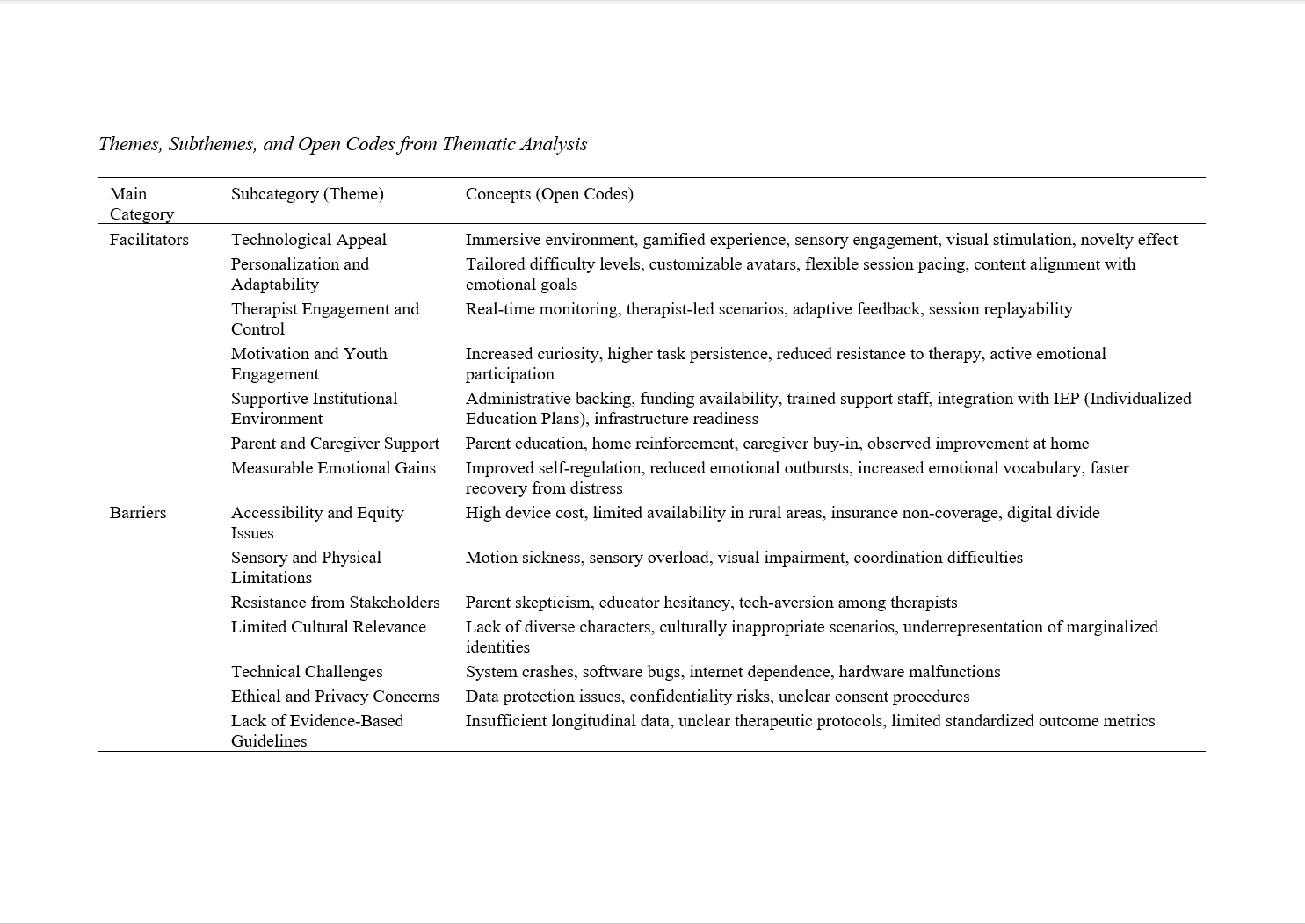
This study aimed to explore the barriers and facilitators influencing the implementation of virtual reality (VR)-based therapy for emotional regulation in youth with exceptional needs. A qualitative research design was employed using semi-structured interviews with 23 purposefully selected participants, including special education teachers, therapists, caregivers, and VR developers, all based in Minnesota, USA. Participants were selected based on their direct involvement with VR therapy programs for youth with neurodevelopmental or emotional regulation challenges. Interviews were conducted until theoretical saturation was reached. Data were transcribed verbatim and analyzed using thematic analysis in NVivo 14, following Braun and Clarke’s six-phase framework. The analysis revealed two main thematic categories: facilitators and barriers. Facilitators included seven subthemes: technological appeal, personalization, therapist control, motivation and engagement, institutional support, caregiver involvement, and observable emotional gains. Barriers were categorized into seven subthemes as well: accessibility and equity issues, sensory limitations, stakeholder resistance, cultural irrelevance, technical difficulties, ethical and privacy concerns, and lack of standardized guidelines. Participants reported that immersive features, real-time therapist adjustments, and family buy-in enhanced VR’s therapeutic effectiveness. Conversely, cost constraints, lack of culturally appropriate content, and technical or ethical challenges hindered adoption. Quotes from stakeholders enriched the thematic interpretation and contextualized the results. VR-based therapy shows promising potential in enhancing emotional regulation among youth with exceptional needs due to its immersive, customizable, and engaging design. However, successful implementation depends on addressing contextual challenges, including accessibility, technical infrastructure, and cultural inclusivity. Stakeholder collaboration and the development of standardized protocols are essential to scale VR interventions in educational and clinical contexts.
Downloads
References
Aprilia, Y. D., Suwandayani, B. I., & Kuncahyono, K. (2025). Optimalisasi Penggunaan Teknologi Augmented Reality Di Era Digital Pada Sekolah Dasar. Cetta Jurnal Ilmu Pendidikan, 8(1), 15-24. https://doi.org/10.37329/cetta.v8i1.3844
Arnfred, B., Svendsen, J. K., Adjourlu, A., & Horthøj, C. (2023). Scoping Review of the Hardware and Software Features of Virtual Reality Exposure Therapy for Social Anxiety Disorder, Agoraphobia, and Specific Phobia. Frontiers in Virtual Reality, 4. https://doi.org/10.3389/frvir.2023.952741
Baker, N. A., Baird, J. M., Kenney, M., & Monahan, K. (2025). Analyzing Characteristics of Immersive Virtual Reality Experiences for Chronic Pain Management: Assessing the Interrater Reliability of the Virtual Reality Activity Analysis for Pain Instrument. British Journal of Occupational Therapy. https://doi.org/10.1177/03080226251340852
Boque, J. C., Jaime, J., Juayong, R. A., & Jamora, R. D. G. (2021). Virtual Reality Tool for Rehabilitation of Patients With Parkinson’s Disease: A Conceptual Design Review. https://doi.org/10.3233/faia210076
Estrada, J. G., Simeone, A. L., Higgins, M., Powell, W., & Powell, V. (2018). Inside Looking Out or Outside Looking In? , 1-8. https://doi.org/10.1145/3206505.3206529
Gill, G., & Dudonienė, V. (2019). Virtual Reality Therapy for Upper Extremity Functions Following Stroke. a Systematic Review. Reabilitacijos Mokslai Slauga Kineziterapija Ergoterapija, 2(21). https://doi.org/10.33607/rmske.v2i21.1235
Gill, G., & Dudonienė, V. (2020). Virtualiosios Realybės Terapija Rankų Funkcijai Po Insulto. Sisteminė Straipsnių Apžvalga. Reabilitacijos Mokslai Slauga Kineziterapija Ergoterapija, 2(21). https://doi.org/10.33607/rmske.v2i21.826
Hemphill, S., Rodríguez, S., Wang, E., Koeppen, K., Aitken-Young, B., Jackson, C., Simons, L. E., & Caruso, T. J. (2021). Virtual Reality Augments Movement During Physical Therapy. American Journal of Physical Medicine & Rehabilitation, 101(3), 229-236. https://doi.org/10.1097/phm.0000000000001779
Jaya, H., Haryoko, S., Baharuddin, A. R., Lu’mu, Saharuddin, Mantasia, & Suhardi, I. (2022). Potential Utilization of Virtual Reality Learning for Vocational School Teachers. World Journal of Advanced Engineering Technology and Sciences, 7(2), 054-061. https://doi.org/10.30574/wjaets.2022.7.2.0119
Li, X., Zhang, C., & Wu, Y. (2022). Deconstruction of Immersive Animation Image Interaction Design Under Virtual Reality Technology. Wireless Communications and Mobile Computing, 2022, 1-11. https://doi.org/10.1155/2022/2104633
LoJacono, C. T., MacPherson, R. P., Kuznetsov, N. A., Raisbeck, L. D., Ross, S. E., & Rhea, C. K. (2018). Obstacle Crossing in a Virtual Environment Transfers to a Real Environment. Journal of Motor Learning and Development, 6(2), 234-249. https://doi.org/10.1123/jmld.2017-0019
Mahsuda, N., Ananth, C., Farukh, Z., Fakhriddin, K., Iskandar, M., & Kumar, T. A. (2023). Theoretical and Methodological Foundations of Virtualization of Social Services. https://doi.org/10.1109/accai58221.2023.10200862
Matsangidou, M. (2025). Virtual Reality Reminiscence Therapy in Dementia Care: A Systematic Review of Research (Preprint). https://doi.org/10.2196/preprints.73539
Meindl, J. N., Saba, S., Gray, M., Stuebing, L., & Jarvis, A. (2019). Reducing Blood Draw Phobia in an Adult With Autism Spectrum Disorder Using Low‐cost Virtual Reality Exposure Therapy. Journal of Applied Research in Intellectual Disabilities, 32(6), 1446-1452. https://doi.org/10.1111/jar.12637
Nijs, K., Treunen, T., Jalil, H., Lensen, M., Wintmolders, H., Keunen, B., Vanloon, M., Callebaut, I., Geebelen, L., Velde, M. V. d., & Stessel, B. (2025). Effect of Virtual Reality (VR) Therapy on Pain Sensation in Patients Undergoing Hand Surgery Under Ultrasound-Guided Regional Anesthesia: A Randomized Controlled Trial. Regional Anesthesia & Pain Medicine, rapm-2025-106418. https://doi.org/10.1136/rapm-2025-106418
Nikiema, S., Barro, S. G., Kantagba, Y. M., Kabore, W. C., & Staccini, P. (2025). Design and Development of a Virtual Reality Tool for Shoulder Rehabilitation. https://doi.org/10.3233/shti250124
Oliveira, J. M., Muñoz, R., Duarte, J. B. F., Neto, A. V. L., Menezes, J. W. M., & Victor Hugo, C. d. A. (2021). Intelligent Virtual Reality Therapy Systems for Motor and Cognitive Rehabilitation: A Survey Based on Clinical Trial Studies. Journal of Artificial Intelligence and Systems, 3(1), 130-156. https://doi.org/10.33969/ais.2021.31009
Sharma, M., Singh, A., & Rohit. (2024). Responsible AI Implementation in the Hospitality Sector. 367-382. https://doi.org/10.4018/979-8-3693-9173-0.ch014
Shiban, Y. (2018). Virtuelle Expositionstherapie Bei Angststörungen. Der Nervenarzt, 89(11), 1227-1231. https://doi.org/10.1007/s00115-018-0596-z
Smith, V., Warty, R. R., Sursas, J. A., Payne, O., Nair, A., Krishnan, S., Costa, F. d. S., Wallace, E. M., & Vollenhoven, B. (2020). The Effectiveness of Virtual Reality in Managing Acute Pain and Anxiety for Medical Inpatients: Systematic Review. Journal of medical Internet research, 22(11), e17980. https://doi.org/10.2196/17980
Tabrizi, M., Manshaee, G., Ghamarani, A., & Rasti, J. (2020). Comparison of the Effectiveness of Virtual Reality with Neurofeedback on the Impulsivity of Students with Attention Deficit/Hyperactivity Disorder (ADHD) [Research]. Journal of Exceptional Children, 20(1), 115-128. http://joec.ir/article-1-1121-en.html
Елхова, О. И. (2024). Phenomenology of Virtual Reality Perception. Vestnik of Northern (Arctic) Federal University Series Humanitarian and Social Sciences(5), 97-106. https://doi.org/10.37482/2687-1505-v378
范, 丽. (2017). The Development Status and Prospect of Virtual Reality Industry. Software Engineering and Applications, 06(06), 199-204. https://doi.org/10.12677/sea.2017.66023
Downloads
Additional Files
Publication Timeline
- Submitted
- Revised
- Accepted
Issue
Section
License
Copyright (c) 2025 Armin Khadem Fini (Author); Seyed Milad Saadati (Corresponding Author)

This work is licensed under a Creative Commons Attribution-NonCommercial 4.0 International License.