Identifying the Digital Literacy Needs of Adolescents with Intellectual Disabilities: A Focus Group Study
DOI:
https://doi.org/10.61838/kman.prien.3.3.5Keywords:
Intellectual disability, digital literacy, adolescents, focus group, inclusive education, digital inclusion, qualitative researchAbstract
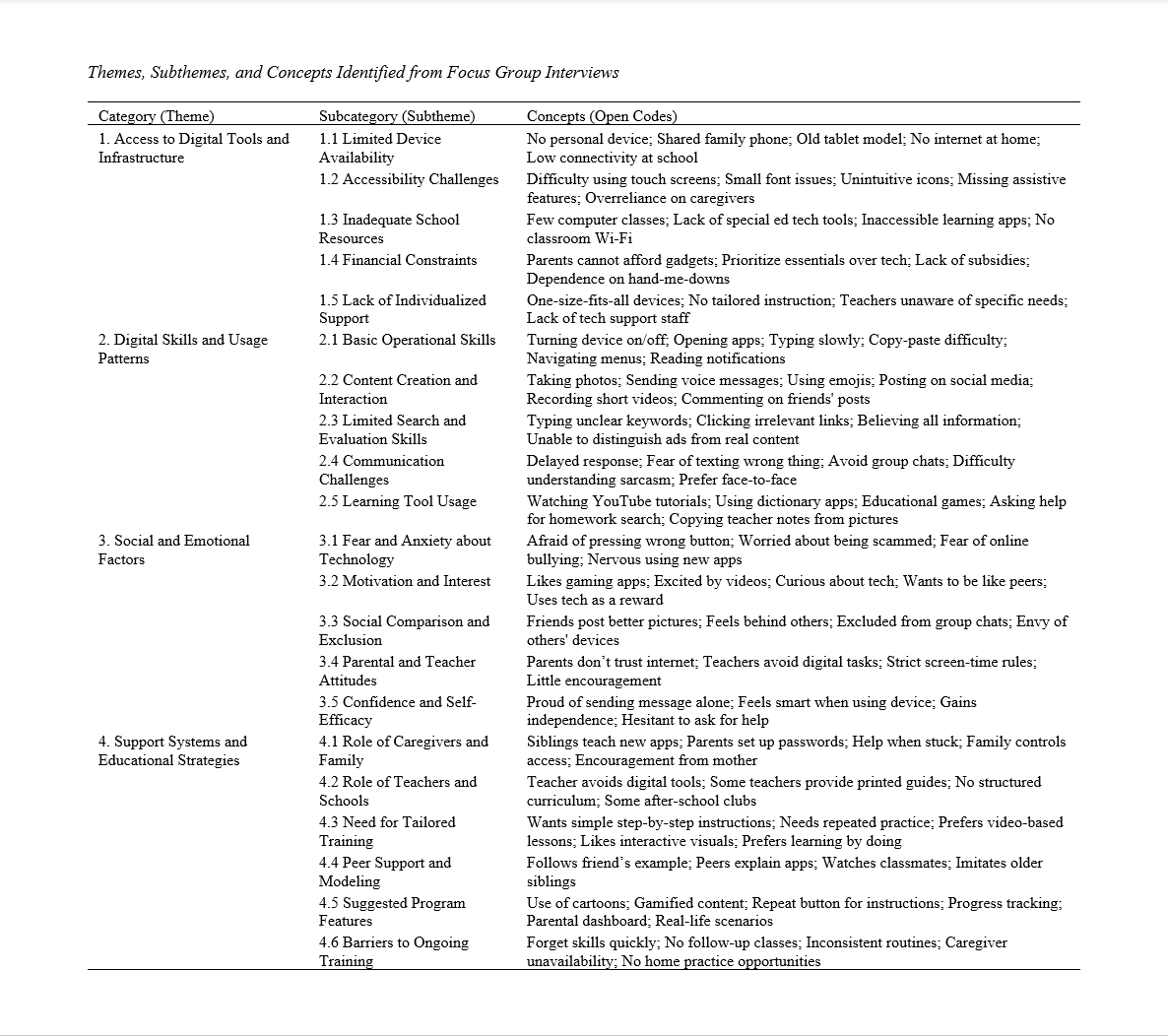
This study aimed to explore the digital literacy needs, challenges, and support preferences of adolescents with intellectual disabilities to inform inclusive educational practices and policy interventions. A qualitative research design was employed using semi-structured focus group interviews with 20 adolescents aged 13–18 years diagnosed with mild to moderate intellectual disabilities in Taiwan. Participants were recruited through purposive sampling from both inclusive mainstream schools and special education centers. Data collection was conducted through four focus groups, each comprising five participants. The interviews were audio-recorded, transcribed verbatim, and analyzed thematically using NVivo 14 software. Thematic saturation guided the completion of data collection. Trustworthiness was enhanced through triangulated coding, member checking, and maintaining an audit trail. Analysis revealed four overarching themes: (1) access to digital tools and infrastructure, (2) digital skills and usage patterns, (3) social and emotional factors, and (4) support systems and educational strategies. Participants reported limited and unequal access to digital devices, inadequate school resources, and lack of individualized digital instruction. While many adolescents demonstrated basic digital engagement (e.g., opening apps, watching videos), they struggled with more complex tasks such as evaluating online content or engaging in digital communication. Emotional barriers included fear of making mistakes and social comparison with peers. Support from family members and peers emerged as critical, while participants emphasized a need for gamified, visual, and hands-on digital training tailored to their learning styles. Adolescents with intellectual disabilities experience significant barriers to digital inclusion, stemming from infrastructural, cognitive, emotional, and instructional gaps. Addressing these challenges requires context-sensitive, learner-centered interventions and greater collaboration among educators, families, and policymakers to ensure equitable access to digital literacy education.
Downloads
References
Assainova, A., & Anuar, G. (2025). Online Prototyping for Digital Skills and Career Aspiration in Adolescents With Autism and Intellectual Disabilities. https://doi.org/10.21203/rs.3.rs-6403096/v1
Belimova, P. A., Zashchirinskaia, O. V., Turchaninov, E. E., Nikiforov, A. A., & Ivanyuhin, R. R. (2024). Manifestations of Psychological Defenses in Decoding Graphic Communication Means in Individuals With Intellectual Disabilities. Общество Социология Психология Педагогика(5). https://doi.org/10.24158/spp.2024.5.4
Cao, Y. (2024). A Case Study of Social Work Intervention in Behavioural Deviations of Adolescents With Intellectual Disabilities-Based on the Cognitive Behavioural Therapy Model. Tssehr, 8, 51-56. https://doi.org/10.62051/rqmed108
Chauke, T., Poggenpoel, M., Myburgh, C., & Ntshingila, N. (2021). Experiences of Parents of an Adolescent With Intellectual Disability in Giyani, Limpopo Province, South Africa. Health Sa Gesondheid, 26. https://doi.org/10.4102/hsag.v26i0.1538
Cheon, J.-M., & Kim, W.-S. (2021). A Relationship Between Theory of Mind and Pragmatic Language in Adolescents With Mild Intellectual Disabilities. Audiology and Speech Research, 17(1), 60-72. https://doi.org/10.21848/asr.200036
Elgiar, A., Kassem, I., El-Rahman, A. A., & Saleh, S. (2022). Effect of Nursing Intervention on Reproductive Health Knowledge Among Adolescent Females With Educable Intellectual Disabilities. Menoufia Nursing Journal, 7(1), 369-379. https://doi.org/10.21608/menj.2022.245845
Emerson, E., Totsika, V., Hatton, C., & Hastings, R. P. (2023). The Mental Health and Well-Being of Adolescents With/Without Intellectual Disability in the UK. Epidemiology and Psychiatric Sciences, 32. https://doi.org/10.1017/s204579602300080x
Georgoula, E., Koustriava, E., & Papadopoulos, K. (2025). Technology‐enhanced Cognitive Training for Individuals With Autism Spectrum Disorder and Intellectual Disability. British Journal of Special Education. https://doi.org/10.1111/1467-8578.70026
Hidayat, S. A., Hartini, S., & Wahyuni, B. (2021). Factors Related With Sexual Behavior in Intellectual Disabilities in SLB (Special Needs School) Districts of Bantul, Yogyakarta. The Malaysian Journal of Nursing, 12(4). https://doi.org/10.31674/mjn.2021.v12i04.012
Jalil-Abkenar, S. S. (2023). Triple-P: Interaction of Mother-Adolescent With Intellectual and Developmental Disability. Journal of Intellectual Disabilities, 29(2), 259-270. https://doi.org/10.1177/17446295231224125
Jeyachandran, V., Ranjelin, S. P. D., & Kumar, A. (2022). Sexual Health and Safety of Adolescents With Intellectual Disability: Challenges and Concerns Among Special Educators in India. Journal of Intellectual Disabilities, 28(1), 104-117. https://doi.org/10.1177/17446295221136224
Lapshina, L. M., Romanova, E., Kokhan, S., Balashkevich, N., Gizatullina, A., & Ван, О. Т. (2021). Features of the Performance of Cognitive Auditory Evoked Potentials by Adolescents With Intellectual Disabilities. Laplage Em Revista, 7(3), 435-443. https://doi.org/10.24115/s2446-62202021731326p.435-443
Lo, J. W. K., & Joyce, L. C. (2022). The Perceived Helpfulness of Structural Family Therapy in Caring for Hong Kong Chinese Families of an Adolescent With Intellectual Disabilities: A Qualitative Inquiry. British Journal of Learning Disabilities, 51(3), 440-449. https://doi.org/10.1111/bld.12510
Malapela, R. G., & Thupayagale‐Tshweneagae, G. (2022). Enablers to Enhance School-Based Adolescents With Intellectual Disabilities’ Learning: A Narrative Approach. Journal of Intellectual Disabilities, 28(1), 83-92. https://doi.org/10.1177/17446295221141947
Marrus, N., Koth, K. A., Hellings, J. A., McDonald, R. G., Gwynette, M. F., Muhle, R., Lohr, W. D., & Vasa, R. A. (2022). Psychiatry Training in Autism Spectrum Disorder and Intellectual Disability: Ongoing Gaps and Emerging Opportunities. Autism, 27(3), 679-689. https://doi.org/10.1177/13623613221112197
Mills, A. S. (2025). Thriving for Adolescents With Intellectual Disability: A Photo‐Elicitation Qualitative Study. Journal of Applied Research in Intellectual Disabilities, 38(3). https://doi.org/10.1111/jar.70077
Niculae, M. C. (2024). Lying as a Compensatory Mechanism in Adolescents With Intellectual Disabilities. Review of Psychopedagogy, 13(1), 69-79. https://doi.org/10.56663/rop.v13i1.75
Park, E. Y. (2025). Understanding Social Networking Sites Use and Perceived Usefulness in Adolescents and Adults With Intellectual Disabilities: A Technology Acceptance Model Approach. Sylwan. https://doi.org/10.59879/88fqj
Volkova, S. V. (2024). Comparative Analysis of the Prerequisites for Social Communication of Adolescents With Mental Disorders. Pedagogical Image, 18(1), 77-90. https://doi.org/10.32343/2409-5052-2024-18-1-77-90
Vovchenko, O. (2021). Specifics of the Crisis of Adolescence Persons With Disabilities of Intellectual Development. Scientific Notes of Ostroh Academy National University Psychology Series, 1(13), 30-38. https://doi.org/10.25264/2415-7384-2021-13-30-38
Кучинський, В. О. (2023). Формування Стресостійкості У Дітей З Інтелектуальними Порушеннями У Ранньому Підлітковому Віці Засобами Арт-Терапевтичних Технологій. https://doi.org/10.36059/978-966-397-353-1-13
Downloads
Additional Files
Publication Timeline
- Submitted
- Revised
- Accepted
Issue
Section
License
Copyright (c) 2025 Wei Yu Tou (Corresponding Author); Xiao Wang (Author)

This work is licensed under a Creative Commons Attribution-NonCommercial 4.0 International License.