Explaining the Emotional and Psychological Impact of Assistive Technologies on Adolescents with Visual Impairments
DOI:
https://doi.org/10.61838/kman.prien.3.2.3Keywords:
Assistive technologies, visual impairment, adolescent psychology, independence, emotional adaptation, digital divide, educational accessibilityAbstract
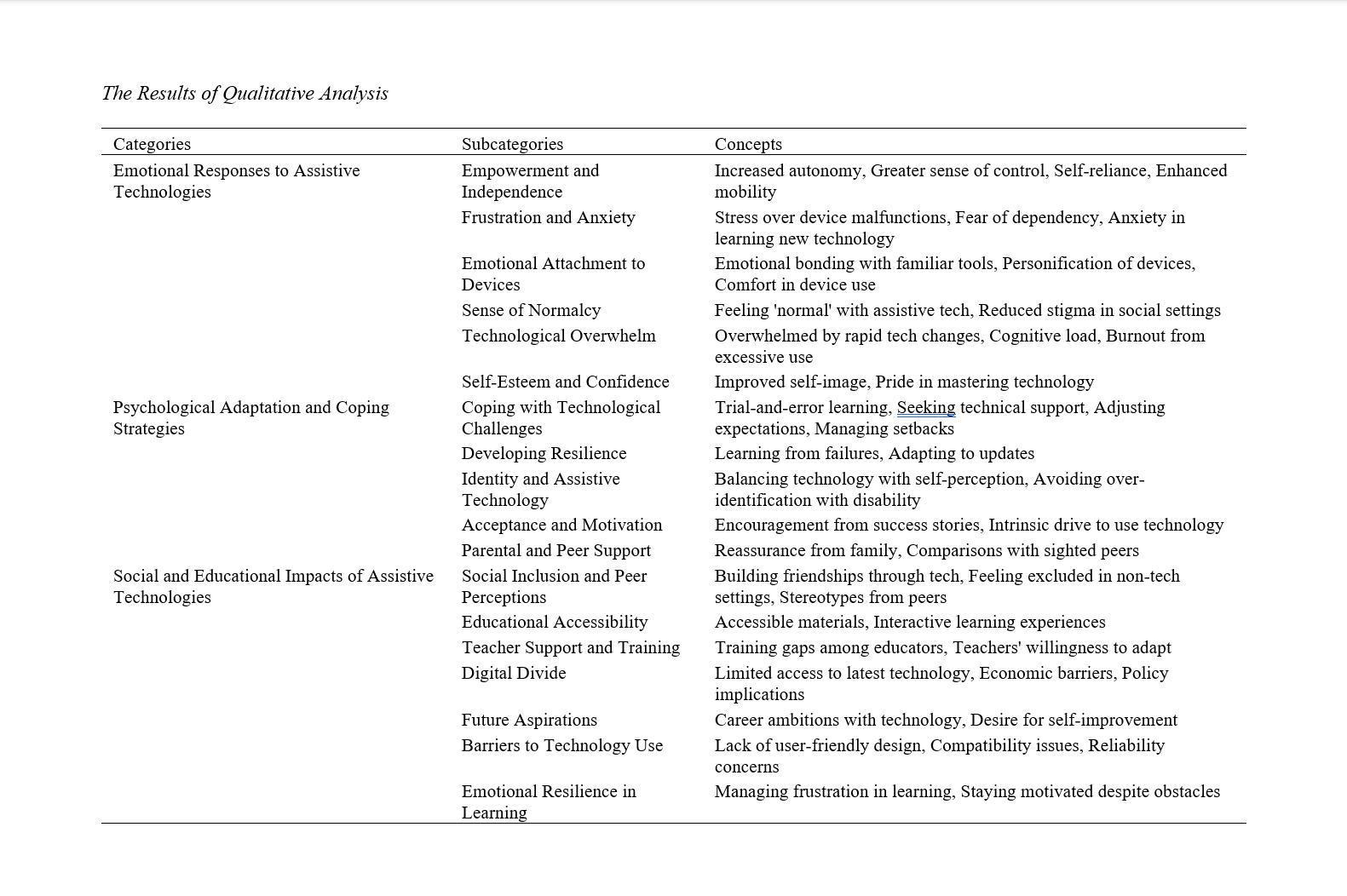
This study explores the emotional and psychological impact of assistive technologies on adolescents with visual impairments. A qualitative research design was employed using semi-structured interviews with 20 adolescents with visual impairments recruited through online platforms. Theoretical saturation guided data collection, and NVivo software was used for thematic analysis. The study examined participants’ emotional responses, psychological adaptation, and the social and educational impacts of assistive technology use. The results revealed that while assistive technologies enhanced empowerment, independence, and self-esteem, they also introduced challenges such as frustration, technological overwhelm, and social stigma. Many participants reported emotional attachment to their assistive devices, highlighting their role in fostering confidence and reducing dependence. However, rapid technological advancements contributed to anxiety and stress, particularly when transitioning to new tools. Psychological adaptation strategies included trial-and-error learning, seeking technical support, and developing resilience. Social support from parents, teachers, and peers played a crucial role in shaping participants’ experiences, with inadequate support leading to increased frustration. The digital divide further influenced participants’ emotional well-being, as access to advanced assistive technologies varied across socioeconomic backgrounds, impacting academic performance and social inclusion. Assistive technologies significantly shape the emotional and psychological well-being of adolescents with visual impairments by promoting independence and confidence while also posing adaptation challenges. The findings highlight the need for better accessibility training for educators, increased social support, and user-centered technological designs to reduce cognitive load and frustration. Bridging the digital divide is essential to ensure equitable access to advanced assistive technologies, fostering positive developmental outcomes for visually impaired adolescents.
Downloads
References
Abdulhakeem, S., Shaame, A. A., & Juma, S. (2024). Exploring the Impact of Assistive Technology on Academic Achievement for Visually Impaired Students in Zanzibar’s Primary Schools.Journal of Advances in Education and Philosophy, 8(11), 689-702. https://doi.org/10.36348/jaep.2024.v08i11.006
Arifin, M., Yusuf, M., Sunardi, S., & Rahman, A. (2024).Implementation of Assistive Technology for Visually Impaired Students in the Formal Education Sector. Picsar,3(1), 561-571. https://doi.org/10.57142/picsar.v3i1.602
Dikici, H., & Sikinbayev, B. (2024). Study of the Influence of Artificial Intelligence Technologies on the Independent Formation of Information Culture in Teenagers With Visual Impairments. Вестник, 75-85. https://doi.org/10.47649/vau.24.v74.i3.07
Dolzake, N. (2024). Review on Desktop Assistant for Visually Impaired: MIME.AI. Interantional Journal of Scientific Research in Engineering and Management, 08(04), 1-5.https://doi.org/10.55041/ijsrem31324
Filetti, A. V., Ceroni, L. B., França, P. H. C., & Eliseo, M. A.(2024). Assistive Mobility Technology for Visually Impaired.1-4. https://doi.org/10.1145/3657242.3658592
Gawande, R. M. (2024). Android Based Object Detection System for Visually Impaired. International Journal for Research in Applied Science and Engineering Technology, 12(2), 1319-1327. https://doi.org/10.22214/ijraset.2024.58593
Grigoryeva, M. V., Shamionov, R. М., Grinina, E. S., & Sosonnik,A. V. (2022). Types of Academic Adaptation of Adolescents With Limited Health Capacities. Perspectives of Science and Education, 60(6), 319-336.https://doi.org/10.32744/pse.2022.6.18
Jannah, M., Irdha, M. F., Rambe, M., & Az-Zahra, T. C. S. (2023).Dampak Penggunaan Gadget Terhadap Perkembangan Emosional Remaja. Mutiara, 2(1), 93-106.https://doi.org/10.59059/mutiara.v2i1.861
Kim, N. (2023). A Study on the Development of Interactive Technology for the Convenience of the Visually Impaired. Jitc, 5(1), 31-38. https://doi.org/10.69478/jitc2023v5n1a04
Kuzdeuov, A., Nurgaliyev, S., & Varol, H. A. (2023). ChatGPT for Visually Impaired and Blind.https://doi.org/10.36227/techrxiv.22047080.v1
Manitsa, I., & Barlow‐Brown, F. (2022). The Role of Habilitation Services in the Lives of Children and Adolescents With VisualImpairments. British Journal of Visual Impairment, 42(2),445-455. https://doi.org/10.1177/02646196221144870
Mankar, M. S. P., Gawande, R. M., Sankhala, D., Vispute, S., & Watpal, N. (2024). Empowering the Blind: An AI Driven Indoor Assistance for Visually Impaired. International Journal for Research in Applied Science and EngineeringTechnology, 12(4), 5702-5711.https://doi.org/10.22214/ijraset.2024.61273
Mnyanyi, C. (2023). ICT-Based Assistive Technology for Empowering Persons With Visual Impairment. Jipe, 14(2).https://doi.org/10.61538/jipe.v14i2.1214
Nazir, M. A., Ali, H. H., & Sabir, M. A. (2024). Impact of Assistive Technology on Acquiring Learning Competence Among Learners With Visual Impairment. Sra, 2(2), 434-449.https://doi.org/10.70670/sra.v2i2.88
Rastogi, D., & Srivastava, V. C. (2024). Observational Study to Enhance Reading in Visually Impaired Patients. InternationalJournal of Innovative Science and Research Technology, 729-757. https://doi.org/10.38124/ijisrt/ijisrt24oct1061
S., G. A., R., S. S., K., K., & A., M. (2025). Understanding the Testimonials: Play Activity Challenges and Need for Peer Support Among Visually Impaired Adolescents. International Journal for Multidisciplinary Research, 7(1).https://doi.org/10.36948/ijfmr.2025.v07i01.36657
Saini, R. (2021). Impacting Health of Students With Visual Impairment Through Yoga. Towards Excellence, 153-164. https://doi.org/10.37867/te130314
Sajjad, W., & Ismail, W. U. (2024). OrCam MyEye 2.0, a Dire Need to Revolutionize the Lives of Congenital or Acquired Visually Impaired Patients in Pakistan. Pakistan Journal of Ophthalmology, 40(2). https://doi.org/10.36351/pjo.v40i2.1679
Salam, S. N. A. (2025). Designing Interactive Mobile Learning Applications for Visually Impaired Children. International Journal of Interactive Mobile Technologies (Ijim), 19(03), 87-114. https://doi.org/10.3991/ijim.v19i03.52091
Shevkar, M. N., kolapkar, M. N., Kakad, M. O., Patil, M. M., & Barve, M. R. (2024). Blind Vision Voice Assistant. International Journal of Advanced Research in Science Communication and Technology, 244-247.https://doi.org/10.48175/ijarsct-15546
Sidiqua, N. (2022). An Experimental Study to Identify the Effect of Assistive Technology on Academic Achievement of Visually Impaired Students. Pakistan Social Sciences Review,6(II). https://doi.org/10.35484/pssr.2022(6-ii)72
Stanley, D. D. (2023). Assistive Technology for Visual Impairment. Shanlax International Journal of Arts Science and Humanities, 11(S1i2-Nov), 17-21.https://doi.org/10.34293/sijash.v11is1i2-nov.7309
Szekely, R., Holloway, C., & Bandukda, M. (2025). Understanding the Psychosocial Impact of Assistive Technologies for People With Visual Impairments: Protocol for a Scoping Review.Jmir Research Protocols, 14, e65056.https://doi.org/10.2196/65056
Tyron, O., Доценко, Л., & Каряка, І. (2024). Phototherapy as the Tool of Emotional Identification Development of Adolescents. Journal of Education and Learning (Edulearn),18(4), 1362-1371.https://doi.org/10.11591/edulearn.v18i4.21482
Yuan, Z., & Zhou, W. (2024). Exploration of Tactile-Oriented Toy Design for Visually Impaired Children. Communications in Humanities Research, 34(1), 304-308.https://doi.org/10.54254/2753-7064/34/20240171
Downloads
Additional Files
Publication Timeline
Issue
Section
License

This work is licensed under a Creative Commons Attribution-NonCommercial 4.0 International License.