Predicting Adaptive Behavior by Self-Advocacy and Resilience in Adults with ADHD
DOI:
https://doi.org/10.61838/kman.prien.3.1.5Keywords:
ADHD, adaptive behavior, self-advocacy, resilience, adults with ADHD, psychological predictorsAbstract
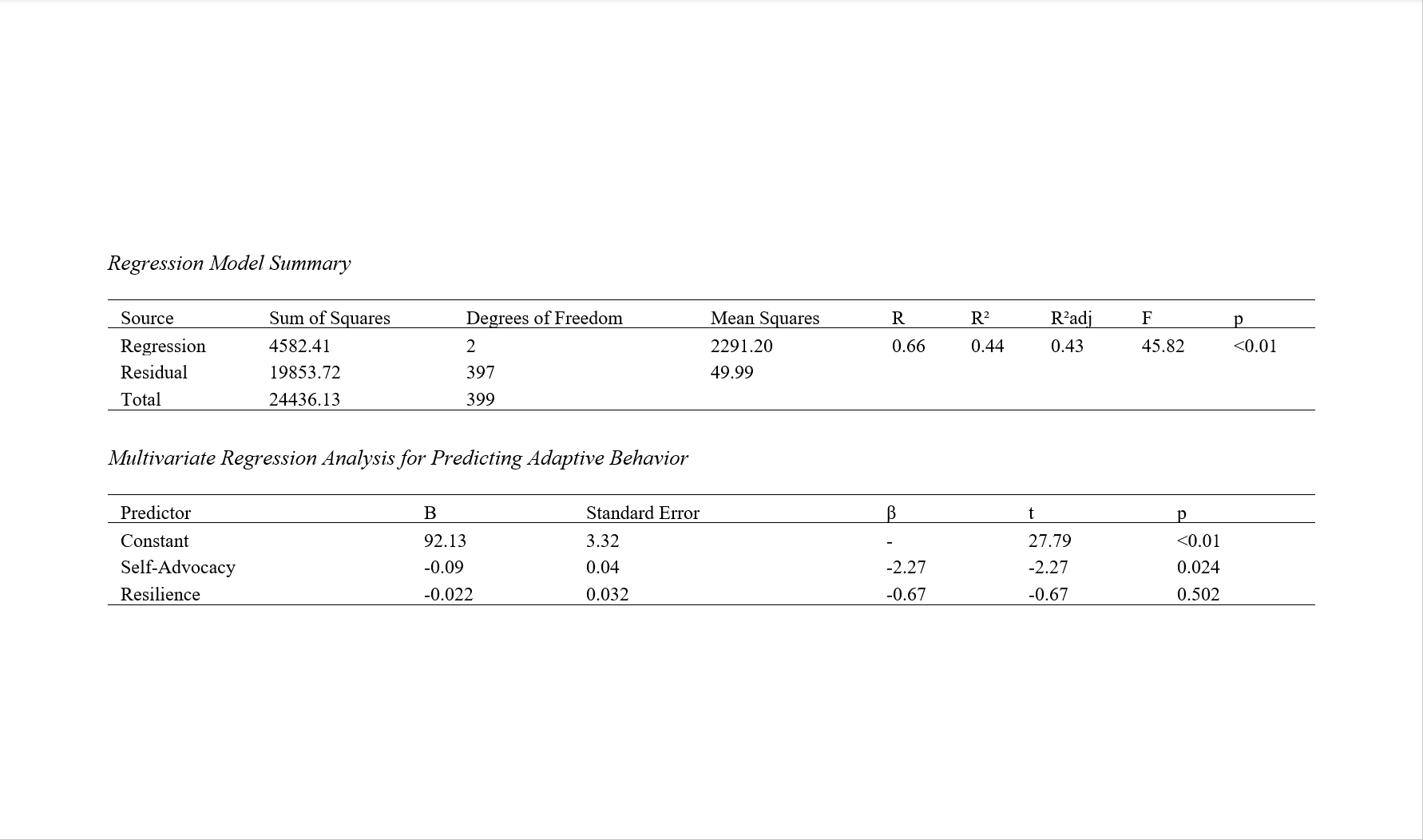
This study aimed to examine the predictive relationship between self-advocacy, resilience, and adaptive behavior in adults with ADHD. A correlational descriptive research design was used, with a sample of 400 adults with ADHD recruited through online platforms and mental health clinics. Participants completed standardized assessments, including the Adaptive Behavior Assessment System-Third Edition (ABAS-3) for adaptive behavior, the Self-Advocacy Measure for Youth and Adults (SAMYA), and the Connor-Davidson Resilience Scale (CD-RISC). Data were analyzed using Pearson correlation and multiple linear regression in SPSS-27 to evaluate the relationships between self-advocacy, resilience, and adaptive behavior. Descriptive statistics indicated moderate levels of adaptive behavior (M = 85.32, SD = 9.87), self-advocacy (M = 60.41, SD = 11.56), and resilience (M = 69.87, SD = 14.92). Pearson correlation results revealed significant positive associations between adaptive behavior and both self-advocacy (r = 0.58, p < 0.01) and resilience (r = 0.62, p < 0.01). Multiple linear regression showed that self-advocacy and resilience collectively accounted for 44% of the variance in adaptive behavior (F(2, 397) = 45.82, p < 0.01, R² = 0.44). However, when examined separately, self-advocacy (B = -0.09, p = 0.024) had a significant negative predictive effect, while resilience (B = -0.022, p = 0.502) was not a significant predictor. The findings suggest that while both self-advocacy and resilience are correlated with adaptive behavior, their individual predictive effects differ, with self-advocacy playing a more prominent role. These results highlight the importance of fostering self-advocacy skills in adults with ADHD to enhance adaptive functioning. Further research is needed to explore moderating factors that may influence these relationships.
Downloads
References
Archi, S. E., Barrault, S., García, M., Branger, S., Maugé, D., Ballon, N., & Brunault, P. (2023). Adult ADHD Diagnosis,Symptoms of Impulsivity, and Emotional Dysregulation in a Clinical Sample of Outpatients Consulting for a Behavioral Addiction. Journal of Attention Disorders, 27(7), 731-742.https://doi.org/10.1177/10870547231161336
Breuer, D., Wirth, E. v., Mandler, J., Schürmann, S., & Döpfner, M. (2020). Predicting Delinquent Behavior in Young Adults With a Childhood Diagnosis of ADHD: Results From the Cologne Adaptive Multimodal Treatment (CAMT) Study. European Child & Adolescent Psychiatry, 31(4), 553-564.https://doi.org/10.1007/s00787-020-01698-y
Carvalho, N. P. d., Andreara De Almeida, E. S., Caiafa, L., & Paula, J. J. d. (2024). Efficacy of Cognitive-Behavioral Therapy for Adults With ADHD: A Systematic Review. Paidéia (Ribeirão Preto), 34. https://doi.org/10.1590/1982-4327e3420
Effat, S., Elshahawy, H. H., Sakr, H. M., Shorub, E., & Azab, S. E. (2020). Correlation of Psychopathology and White Matter Abnormalities in Fathers of Children With ADHD: Cross Sectional Study. QJM, 113(Supplement_1).https://doi.org/10.1093/qjmed/hcaa054.021
Ginapp, C. M., Greenberg, N. R., Macdonald-Gagnon, G., Angarita, G. A., Bold, K. W., & Potenza, M. N. (2023). “Dysregulated Not Deficit”: A Qualitative Study on Symptomatology of ADHD in Young Adults. PLoS One, 18(10),e0292721.https://doi.org/10.1371/journal.pone.0292721
Grassi, G., Moradei, C., & Cecchelli, C. (2024). Prevalence and Clinical Phenotypes of Adult Patients With Attention Deficit Hyperactivity Disorder and Comorbid Behavioral Addictions. Journal of Behavioral Addictions, 13(2), 473-481.https://doi.org/10.1556/2006.2024.00020
Hotte-Meunier, A., Sarraf, L., Bougeard, A., Bernier, F. P., Voyer, C., Deng, J., Asmar, S. E., Σταμάτη, Α., Corbière, M., Villotti, P., & Sauvé, G. (2024). Strengths and Challenges to Embrace Attention-Deficit/Hyperactivity Disorder in Employment—A Systematic Review. Neurodiversity, 2.https://doi.org/10.1177/27546330241287655
Liu, Y., Wang, L., Xie, S., Pan, S., Zhao, J., Zou, M., & Sun, C. (2021). Attention Deficit/Hyperactivity Disorder Symptoms Impair Adaptive and Social Function in Children With Autism Spectrum Disorder. Frontiers in Psychiatry, 12.https://doi.org/10.3389/fpsyt.2021.654485
Meachon, E. J., & Alpers, G. W. (2022). How Are You Getting By? Coping in Developmental Coordination Disorder Versus Attention-Deficit/Hyperactivity Disorder. British Journal of Occupational Therapy, 86(1), 42-52.https://doi.org/10.1177/03080226221113505
Miranda, A., Berenguer, C., Miranda, B. R., Martınez ́ -Raga, J., & Mulas, F. (2021). Contribution of Family, Behavioral, and Neuropsychological Factors to Long-Term Functional Outcomes in Young Adults With ADHD: A 12-Year FollowUp Study. Sustainability, 13(2), 814.https://doi.org/10.3390/su13020814
Okutucu, F. T., & Gök, D. K. (2023). Relationship Between Suicidal Behavior/Self-Mutilation and Vitamin B12 and Folic Acid Levels in Adult Attention Deficit Hyperactivity Disorder. Annals of Medical Research, 30(12), 1.https://doi.org/10.5455/annalsmedres.2023.10.291
Pollak, Y., Shoham, R., Dayan, H., Gabrieli-Seri, O., & Berger, I. (2021). Symptoms of ADHD Predict Lower Adaptation to the COVID-19 Outbreak: Financial Decline, Low Adherence to Preventive Measures, Psychological Distress, and IllnessRelated Negative Perceptions. Journal of Attention Disorders, 26(5), 735-746.https://doi.org/10.1177/10870547211027934
Ramsay, J. R. (2020). Cognitive Interventions in Action: Common Issues in Cognitive Behavior Therapy for Adult ADHD. 87-123.https://doi.org/10.1037/0000158-006
Ramsay, J. R. (2021). Adult Attention-Deficit/Hyperactivity Disorder. 389-421.https://doi.org/10.1037/0000219-012
Soler-Gutiérrez, A.-M., Pérez-González, J. C., & Mayas, J. (2023). Evidence of Emotion Dysregulation as a Core Symptom of Adult ADHD: A Systematic Review. PLoS One, 18(1), e0280131.https://doi.org/10.1371/journal.pone.0280131
Surman, C., & Walsh, D. M. (2023). Do ADHD Treatments Improve Executive Behavior Beyond Core ADHD Symptoms in Adults? Evidence From Systematic Analysis of Clinical Trials. The Journal of Clinical Pharmacology, 63(6), 640-653.https://doi.org/10.1002/jcph.2209
Todzia, A. (2024). Principles of ADHD Diagnosis in Adults the Diagnosis of ADHD in Adults Poses Unique Challenges Due to the Subtlety of Symptoms and the Presence of Comorbidities. European Psychiatry, 67(S1), S36-S36.https://doi.org/10.1192/j.eurpsy.2024.128
Turner, D., Hertz, P. G., Biedermann, L., Barra, S., & Retz, W. (2022). Paraphilias in ADHD and Their Association With Hypersexuality.https://doi.org/10.21203/rs.3.rs-2111503/v1
Wirth, E. v., Breuer, D., Mandler, J., Schürmann, S., & Döpfner, M. (2021). Prediction of Educational Attainment and Occupational Functioning in Young Adults With a Childhood Diagnosis of ADHD: Results From the Cologne Adaptive Multimodal Treatment (CAMT) Study. Journal of Attention Disorders, 26(7), 1018-1032.https://doi.org/10.1177/10870547211045740
Yildirim, F., & Dalkıran, M. (2022). Childhood Maltreatment and Suicidal Behavior Among Adults With Attention Deficit Hyperactivity Disorder. Medicine Science | International Medical Journal, 11(3), 1217.https://doi.org/10.5455/medscience.2022.04.098
Zhang, S., Chen, C., Zhou, Y., Pan, M., Li, H., Zhao, M., Dong, M., Si, F., Liu, L., Wang, Y., & Qian, Q. (2024). The Chinese Version of the Compensatory ADHD Behaviors Scale (CABS): A Study on Reliability, Validity, and Clinical Utility.Neuropsychiatric Disease and Treatment, Volume 20, 1025-1040.https://doi.org/10.2147/ndt.s463974
Downloads
Additional Files
Publication Timeline
Issue
Section
License

This work is licensed under a Creative Commons Attribution-NonCommercial 4.0 International License.