Identifying the Cognitive and Emotional Components of Self-Advocacy in Exceptional Learners
DOI:
https://doi.org/10.61838/kman.prien.3.1.3Keywords:
Self-advocacy, exceptional learners, cognitive components, emotional resilience, metacognition, self-efficacy, educational supportAbstract
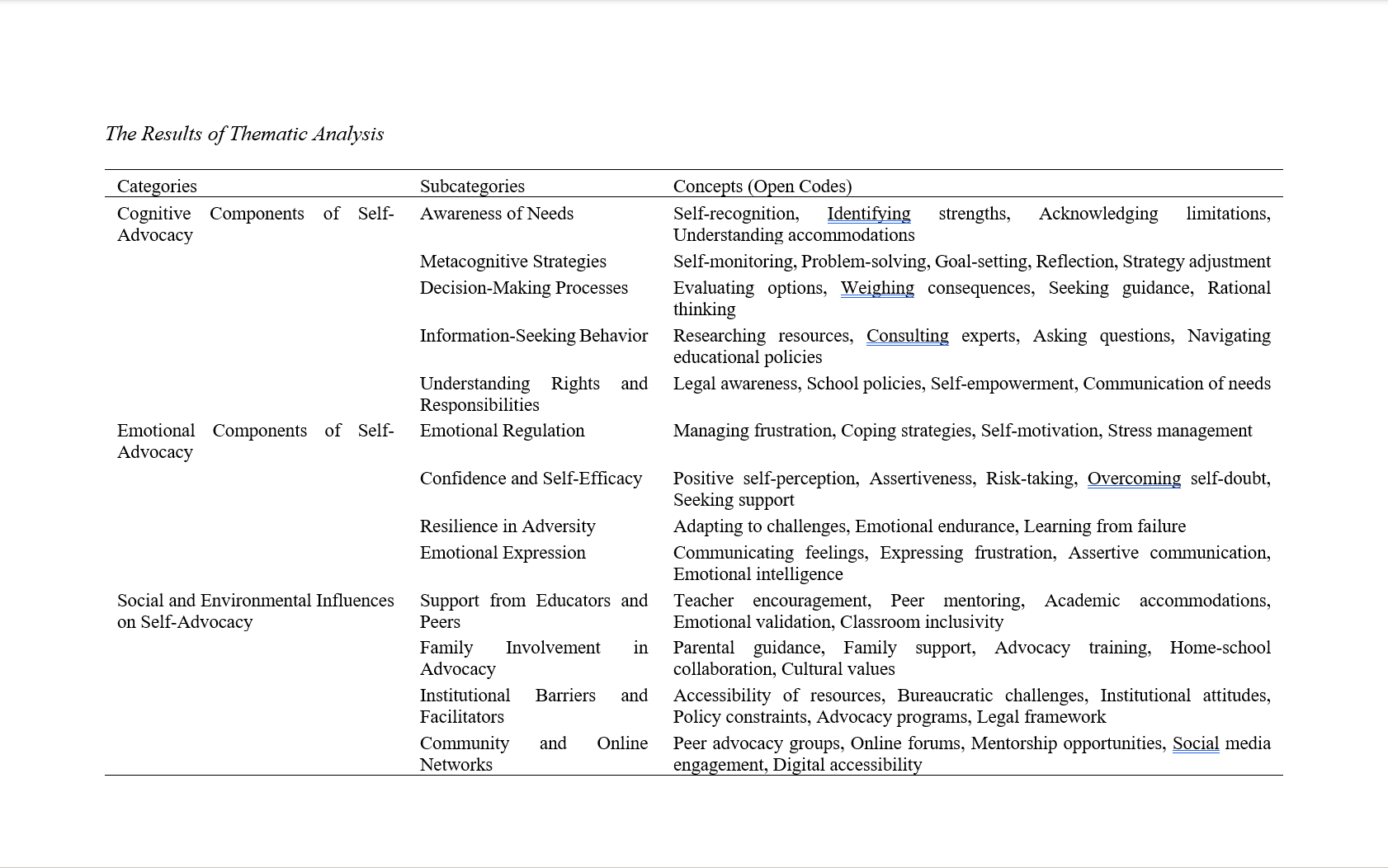
This study aims to identify the cognitive and emotional components of self-advocacy in exceptional learners and examine the external factors that influence their ability to advocate for themselves in educational settings. A qualitative research design was employed, utilizing semi-structured interviews with 29 exceptional learners recruited through online platforms. Theoretical saturation was reached, ensuring comprehensive data collection. NVivo software was used to conduct thematic analysis, identifying key cognitive and emotional factors related to self-advocacy. Participants shared their experiences regarding metacognitive awareness, decision-making, emotional regulation, and external support systems, providing rich qualitative data for analysis. The results indicated that self-advocacy among exceptional learners is shaped by cognitive competencies, including metacognition, decision-making, and information-seeking behaviors, as well as emotional factors such as self-efficacy, resilience, and emotional regulation. Participants who demonstrated strong metacognitive strategies and confidence were more effective self-advocates, whereas those facing anxiety or low self-efficacy struggled to assert their needs. External factors, such as educator support, family involvement, and institutional policies, played a critical role in shaping advocacy experiences. Online networks and digital advocacy resources were identified as valuable tools for enhancing self-advocacy skills. However, institutional barriers, including bureaucratic challenges and lack of awareness among educators, posed significant obstacles for learners. The study highlights the complexity of self-advocacy in exceptional learners, emphasizing the interplay between cognitive awareness, emotional resilience, and external support structures. Enhancing self-advocacy skills requires targeted interventions, including advocacy training, institutional support, and digital resource accessibility.
Downloads
References
Abdullah, N. A., Sharif, S., Ahmad, N., G, G. S. S., Yean, C. P., & Rahmat, N. H. (2023). An Investigation of Language Learning Strategies Used by Undergraduattes: Are There Relationship Acorss Variables. International Journal of Academic Research in Business and Social Sciences, 13(3).https://doi.org/10.6007/ijarbss/v13-i3/16540
Akpan, E. T., Umoh, J. B., & James, G. D. (2024). Principal Component Analysis of Cognitive Executive Functions: A Predictive Model of Academic Performance of Students in Mathematics in Secondary Schools. Asian Journal of Education and Social Studies, 50(6), 222-231.https://doi.org/10.9734/ajess/2024/v50i61408
Bradshaw, K. (2024). Perspective Chapter: Self-Efficacy and Cognitive Distortion in the Learning Environment.https://doi.org/10.5772/intechopen.113777
Chen, J., Zhang, L. J., & Chen, X. (2022). L2 Learners’ SelfRegulated Learning Strategies and Self-Efficacy for Writing Achievement: A Latent Profile Analysis. Language Teaching Research.https://doi.org/10.1177/13621688221134967
Cheng, Y., Liu, H., Yuan, Y., Zhang, Z., & Zhao, J. (2022). What Makes Employees Green Advocates? Exploring the Effects of Green Human Resource Management. International journal of environmental research and public health, 19(3), 1807.https://doi.org/10.3390/ijerph19031807
Crawford, C. M., Andrews, S., & Wallace, J. K. Y. (2021). Implicit Cognitive Vulnerability Through Nudges, Boosts, and Bounces. International Journal of Hyperconnectivity and the Internet of Things, 6(1), 1-14.https://doi.org/10.4018/ijhiot.285588
Day, E. J., Prado, J., & Edmonds, L. (2022). Initiating the Third Wave for English Learners: Teaching Self-Advocacy. Gatesol Journal, 32(2).https://doi.org/10.52242/gatesol.168
Fu, W. L., Zhang, J., Zhang, D., Li, T., Lan, M., & Liu, N. (2025). An Empirical Study of Adaptive Feedback to Enhance Cognitive Ability in Programming Learning Among College Students: A Perspective Based on Multimodal Data Analysis. Journal of Educational Computing Research.https://doi.org/10.1177/07356331241313126
Gentner, N. M., & Seufert, T. (2020). The Double-Edged Interactions of Prompts and Self-Efficacy. Metacognition and Learning, 15(2), 261-289. https://doi.org/10.1007/s11409-020-09227-7
Heck, A. J., Chase, A. J., & Cross, C. E. (2022). The Foundations of Success in Health Professions Education. 260-284.https://doi.org/10.4018/978-1-6684-5969-0.ch013
Ismail, D., & Hastings, P. (2020). A Sensor-Lite Anxiety Detector for Foreign Language Learning.https://doi.org/10.33965/ihci_get2020_202010l003
Karimova, K., & Csapó, B. (2021). Cognitive and Affective Components of Verbal Self-Concepts and Internal/External Frame of Reference Within the Multidimensional Verbal Domain. Sage Open, 11(2).https://doi.org/10.1177/21582440211018683
Moturu, B. P., & Lent, R. W. (2022). Self-Assertive Efficacy and Workplace Advocacy Behavior: A Social Cognitive Analysis. Journal of counseling psychology.https://doi.org/10.1037/cou0000645
Nur Natasha Eliana Abdul, R., Siti Nur Yasmin Sheikh, S., Shanaa Fatihah Mohd Abu, B., Zaki, N. A. M., & Majid, A. A. (2024).Exploring Strategies in Language Learning. International Journal of Academic Research in Business and Social Sciences, 14(5).https://doi.org/10.6007/ijarbss/v14-i5/21343
Nurudin, S. M., Zarina, M. Z., Yaacob, N. A., Kamarudin, N. A., Hassan, F., & Rahmat, N. H. (2023). Motivational Belief, Cognitive Strategy Use &Amp; Self-Regulation Alliance Pertaining Students Learning Achievement. International Journal of Academic Research in Business and Social Sciences, 13(7).https://doi.org/10.6007/ijarbss/v13-i7/17184
Omar, S. K., Ismail, W., Nadri, H. N., & Azram, A. A. R. (2023). The Influence of Motivational Beliefs on Self-Regulated Learning Strategies: The Case for ESL Learners. International Journal of Academic Research in Business and Social Sciences, 13(11).https://doi.org/10.6007/ijarbss/v13-i11/19321
Pfeifer, M. A., Reiter, E. M., Hendrickson, M., & Stanton, J. D. (2020). Speaking Up: A Model of Self-Advocacy for STEM Undergraduates With ADHD and/or Specific Learning Disabilities. International Journal of Stem Education, 7(1).https://doi.org/10.1186/s40594-020-00233-4
Scott, I., Hubinette, M., Goes, T. v. d., & Kahlke, R. (2024). Through a Tainted Lens: A Qualitatve Study of Medical Learners’ Thinking About Patient &Amp;lsquo;Deservingness’ Of Health Advocacy. Perspectives on Medical Education, 13(1).https://doi.org/10.5334/pme.1314
Siti Mariam bt Mohammad, I., Siti Zarikh Sofiah Abu, B., Sumery, Z., Amat, D. W., & Sah, S. N. M. (2023). Influence of Learning Strategies in the Learning of ESL. International Journal of Academic Research in Business and Social Sciences, 13(12).https://doi.org/10.6007/ijarbss/v13-i12/18523
Viberg, O., Kukulska‐Hulme, A., & Peeters, W. (2023). Affective Support for Self-Regulation in Mobile-Assisted Language Learning. International Journal of Mobile and Blended Learning, 15(2), 1-15.https://doi.org/10.4018/ijmbl.318226
Wang, D., Jing, Z., & Qin, L. (2023). Influence of a Distributed Learning Environment on Learners’ Performance.International Journal of Emerging Technologies in Learning(Ijet), 18(09), 117-130.https://doi.org/10.3991/ijet.v18i09.37829
Zalli, M. M. M., Nordin, H., & Hashim, R. A. (2019). The Role of Self-Regulated Learning Strategies on Learners’ Satisfaction in Massive Open Online Course (MOOC): Evidence From Malaysia MOOC. International Journal of Innovative Technology and Exploring Engineering, 8(10), 2286-2290.https://doi.org/10.35940/ijitee.j1138.0881019
Downloads
Additional Files
Publication Timeline
Issue
Section
License

This work is licensed under a Creative Commons Attribution-NonCommercial 4.0 International License.