Exploring the Psychological Impact of Virtual Learning on Students with Special Educational Needs
DOI:
https://doi.org/10.61838/kman.prien.3.1.1Keywords:
virtual learning, special educational needs, psychological impact, online education, emotional challenges, cognitive difficulties, social adaptationAbstract
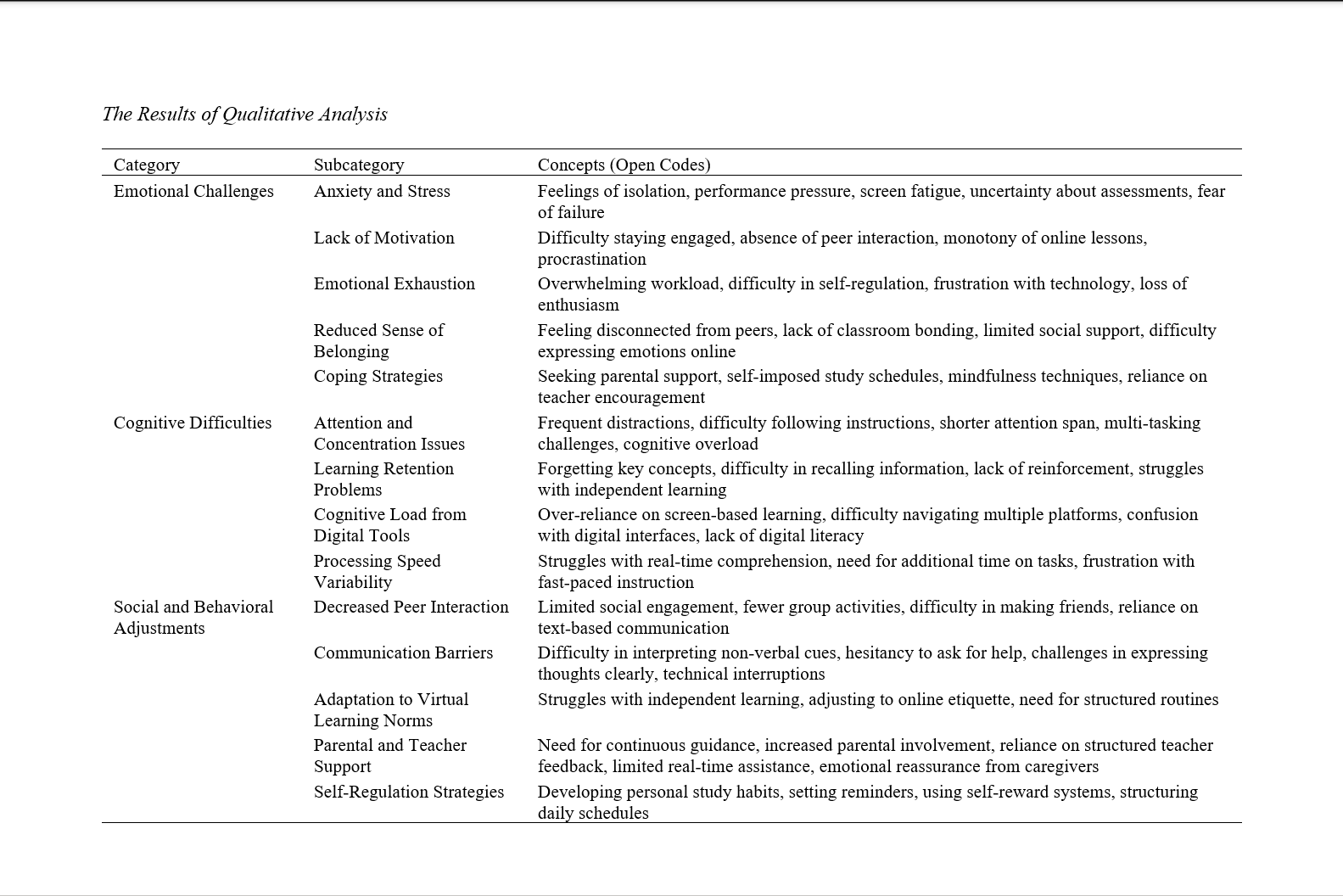
This study aims to explore the psychological impact of virtual learning on students with special educational needs (SEN). This qualitative study utilized semi-structured interviews with 24 students with SEN recruited through online platforms. Theoretical saturation was reached, and data were analyzed using NVivo software following a thematic analysis approach. The interviews explored students’ experiences with virtual learning, including emotional responses, cognitive struggles, and social adaptation. Themes were identified through an iterative coding process, ensuring reliability and depth in capturing the psychological effects of digital education on this population. The results indicate that virtual learning has led to heightened emotional distress, including anxiety, stress, and reduced motivation, largely due to isolation and the absence of structured classroom environments. Participants reported significant cognitive challenges, such as attention difficulties, cognitive overload from digital tools, and struggles with learning retention. Socially, students experienced decreased peer interaction, communication barriers, and difficulty adapting to digital learning norms. However, some students developed coping mechanisms such as parental support and self-regulation strategies. The findings align with previous research highlighting the adverse effects of digital learning on students with disabilities, emphasizing the need for targeted interventions. The psychological impact of virtual learning on students with SEN is profound, affecting their emotional well-being, cognitive engagement, and social adaptation. While some students benefit from digital learning’s flexibility, most require additional support to mitigate stress, cognitive overload, and social isolation. Educators and policymakers must prioritize inclusive digital education strategies, enhance accessibility, and provide structured support systems to improve learning experiences for students with SEN.
Downloads
References
Abdat, R., Opoku, M. P., Safi, M., Harballeh, S. A., & Garces‐Bacsal, R. M. (2023). Virtual Training on Stress Management for the Mothers of Children With Disabilities in the United Arab Emirates. International journal of environmental research and public health, 20(2), 1450.https://doi.org/10.3390/ijerph20021450
Adamiv, M., Matsuk, L., & Kuzenko, О. (2021). Формування В Дітей Дошкільного Віку Із Порушеннями Психофізичного Розвитку Ціннісного Ставлення До Життя. Освітні Обрії, 52(1), 53-56.https://doi.org/10.15330/obrii.52.1.53-56
Amo‐Adjei, J., Essuman, R., Nurzhynska, A., Deliege, A., Sharma, G., Iddrisu, I., & Nikoi, C. (2023). Experiences of Parents and Stakeholders in Caring For, and Supporting Children With Special Needs in Ghana. PLoS One, 18(3), e0281502.https://doi.org/10.1371/journal.pone.0281502
Balgimbekov, S., Kushnazarova, K., & Bolatkyzy, S. (2020). Psychological and Pedagogical Features of the Physical Education of Children With Disabilities. Pedagogy and Psychology, 44(3), 85-93. https://doi.org/10.51889/2020-3.2077-6861.11
Bennadi, D., Konekeri, V., Maurya, M., Reddy, V., Satish, G., & Reddy, C. K. (2020). Oral Hygiene Negligence Among Institutionalized Mentally Disabled Children in Mysore City—A Call for Attention. Journal of Family Medicine and Primary Care, 9(4), 2045.https://doi.org/10.4103/jfmpc.jfmpc_720_19
Colvin, M., Reesman, J. L., & Glen, T. (2024). Neurodevelopment in the Post-Pandemic World.https://doi.org/10.1093/9780197762660.001.0001
Dameria, E. (2022). Model of Fulfilling the Rights of Displaced Children With Special Needs With Mental Disabilities in North Aceh. JLPG.https://doi.org/10.7176/jlpg/118-12
Faizah, N., & Sulfiana, S. (2023). Dampak Bullying Pada Tingkat Kepercayaan Diri Penyandang Disabilitas. La Tenriruwa, 2(1), 41-63.https://doi.org/10.30863/jbpi.v2i1.5220
Fitria, D., Wahyuni, S., Supliyani, E., Djamilus, F., Kurniarum, A., & Sumarni, S. (2024). The Effectiveness of HIV/AIDS Education Models for Adolescents With Speech Disabilities. Healthcare in Low-resource Settings.https://doi.org/10.4081/hls.2024.11973
González, M., Zeidan, J., Lai, J., Yusuf, A., Wright, N., Steiman, M., Karpur, A., Shih, A., Elsabbagh, M., & Shikako‐Thomas,K. (2022). Socio-Demographic Disparities in Receipt of Clinical Health Care Services During the COVID-19 Pandemic for Canadian Children With Disability. BMC Health Services Research, 22(1).https://doi.org/10.1186/s12913-022-08672-1
Harris, B., McClain, M. B., O’Leary, S. C., & Shahidullah, J. D. (2021). Implications of COVID-19 on School Services for Children With Disabilities: Opportunities for Interagency Collaboration. Journal of Developmental & Behavioral Pediatrics, 42(3), 236-239.https://doi.org/10.1097/dbp.0000000000000921
Hsieh, W. Y. (2023). Supporting Young Exceptional Children’s Mental Health in the Early Childhood Classroom. TEACHING Exceptional Children, 56(3), 182-193.https://doi.org/10.1177/00400599231174425
Javed, A., & Imran, N. (2023). Schools: A Vital Component of Child and Adolescent Mental Health. Ijocp, 3(01), 1-4.https://doi.org/10.54169/ijocp.v3i01.80
Okazawa, S.-i. (2023). Editorial: Action Research on Education for Children With Multiple Disabilities in Japan. Journal of Special Education Research, 12(1), 1-4.https://doi.org/10.6033/specialeducation.12.s01
Painter, K., & Scannapieco, M. (2021). Children and Adolescents With Mental Illness and the Education System.https://doi.org/10.1093/oso/9780190927844.003.0018
Piñeros-Ortíz, S. E., Hernández-Yasnó, M. A., & EscobarCórdoba, F. (2023). Impact of Distance Learning and the Full Return to in-Person Classes on the Mental Health of the Pediatric Population During the Covid-19 Pandemic.https://doi.org/10.1590/scielopreprints.6094
Rasoulian-Kasrineh, M., & Tabatabaei, S. M. (2021). Virtual Reality Among Children With Mental Disorders: A MiniReview. Advances in Health and Behavior, 4(1), 177-181.https://doi.org/10.25082/ahb.2021.01.004
Riemersma, I., Santvoort, F. v., Doesum, K. V., Hosman, C. M. H., Janssens, J., Weeland, M. M., & Otten, R. (2021). SocialEmotional Problems of Children With Mild Intellectual Disabilities Having Parents With Mental Health Concerns: A Quantitative Comparison Study. Journal of Intellectual Disabilities, 26(4), 811-823.https://doi.org/10.1177/17446295211030092
Shapovalova, M., Levin, M. Е., Boyko, Y. P., & Abdullaeva, A. S. (2023). Disability of the Population in Mental Disorders. Russian Military Medical Academy Reports, 42(3), 247-255.https://doi.org/10.17816/rmmar562986
Shikako‐Thomas, K., Lencucha, R., Hunt, M., Jodoin, S., Chandra, A., Katalifos, A., González, M., Yamaguchi, S., Cardoso, R., Elsabbagh, M., Hudon, A., Martens, R., Cogburn, D. L., Seth, A., Currie, G., Roth, C., Finlay, B., & Zwicker, J. (2023). Children With Disabilities in Canada During the COVID-19 Pandemic: An Analysis of COVID-19 Policies Through a Disability Rights Lens. Children, 10(6), 942.https://doi.org/10.3390/children10060942
Speidel, R., Wong, T. K. Y., Al‐Janaideh, R., Colasante, T., & Malti, T. (2023). Nurturing Child Social-Emotional Development: Evaluation of a Pre-Post and 2-Month FollowUp Uncontrolled Pilot Training for Caregivers and Educators. Pilot and Feasibility Studies, 9(1).https://doi.org/10.1186/s40814-023-01357-4
Täljedal, T., Granlund, M., Almqvist, L., Osman, F., Selinus, E. N., & Fängström, K. (2023). Patterns of Mental Health Problems and Well-Being in Children With Disabilities in Sweden: A Cross-Sectional Survey and Cluster Analysis. PLoS One, 18(7), e0288815.https://doi.org/10.1371/journal.pone.0288815
Tanaka, M. (2023). Activities for Independent Living at Schools for Those With Physical Disabilities and Health Impairments.Journal of Special Education Research, 11(2), 61-64.https://doi.org/10.6033/specialeducation.11.61
Tandon, S., Shah, R. K., & Choudhary, S. (2022). Oral Health Status in Mentally Disabled Children, Dental Care Knowledge of Parents, and the Impact of Audiovisual Oral Health Education Program. International Journal of Clinical Pediatric Dentistry, 15(2), 143-148.https://doi.org/10.5005/jp-journals-10005-2332
Taylor, S. S., & Abernathy, T. V. (2022). Sexual Health Education for Youth With Disabilities: An Unmet Need.https://doi.org/10.5772/intechopen.104420
Toseeb, U., & Asbury, K. (2022). A Longitudinal Study of the Mental Health of Autistic Children and Adolescents and Their Parents During COVID-19: Part 1, Quantitative Findings. Autism, 27(1), 105-116.https://doi.org/10.1177/13623613221082715
Vorontsova, A. A., & Shipkova, Y. N. (2019). Analysis of the Experience of Private Tutoring Activities With Children With Limited Health Opportunities. Vestnik Kostroma State University Series Pedagogy Psychology Sociokinetics(2), 26-29.https://doi.org/10.34216/2073-1426-2019-25-2-26-29
Wu, B., Zheng, C., & Huang, B. (2022). Influence of Science Education on Mental Health of Adolescents Based on Virtual Reality. Frontiers in psychology, 13.https://doi.org/10.3389/fpsyg.2022.895196
Шубочкина, Е. И., & Ibragimova, E. M. (2022). Actual Medical and Social Problems of Education and Vocational Training for Children With Intellectual Disorders. Hygiene and Sanitation, 101(11), 1379-1385.https://doi.org/10.47470/0016-9900-2022-101-11-1379-1385
Downloads
Additional Files
Publication Timeline
Issue
Section
License

This work is licensed under a Creative Commons Attribution-NonCommercial 4.0 International License.