Nutritional Challenges and Eating Habits in Children with Sensory Processing Disorders
DOI:
https://doi.org/10.61838/kman.prien.2.3.5Keywords:
Sensory Processing Disorder, eating habits, nutritional challenges, qualitative study, children, sensory sensitivity, parental strategies, therapeutic interventionsAbstract
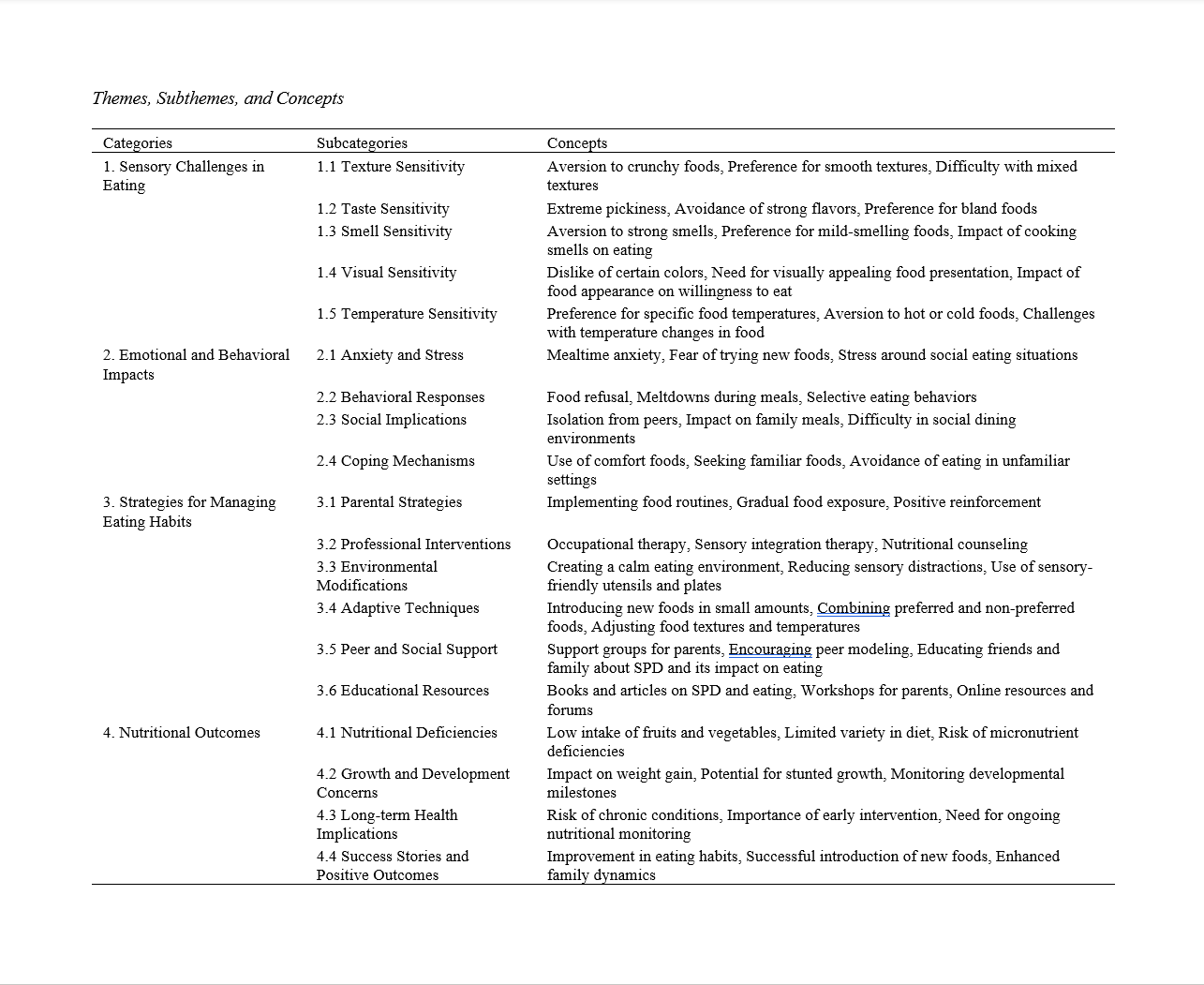
The objective of this study was to explore the nutritional challenges and eating habits of children with Sensory Processing Disorders (SPD) through qualitative analysis. The focus was on identifying specific sensory sensitivities, emotional and behavioral impacts, and effective management strategies to improve nutritional outcomes. This qualitative study involved semi-structured interviews with caregivers of 20 children aged 4-12 years diagnosed with SPD. Participants were recruited from pediatric therapy centers, support groups, and online forums. Data were collected until theoretical saturation was reached. The interviews were transcribed and analyzed using thematic analysis to identify key themes and patterns related to eating behaviors and nutritional challenges. The analysis revealed five main sensory challenges impacting eating habits: texture sensitivity, taste sensitivity, smell sensitivity, visual sensitivity, and temperature sensitivity. Emotional and behavioral impacts included mealtime anxiety, food refusal, and social isolation. Various strategies were employed by parents and professionals to manage these challenges, such as implementing food routines, gradual food exposure, and sensory integration therapy. The study also highlighted nutritional deficiencies and growth concerns associated with restricted diets in children with SPD, as well as success stories where tailored interventions led to improvements in eating habits and overall nutritional status. Children with SPD face significant sensory, emotional, and behavioral challenges that impact their eating habits and nutritional intake. Tailored interventions that address individual sensory profiles and involve a collaborative approach between parents, educators, and healthcare professionals are crucial for managing these challenges effectively. The study underscores the need for ongoing research and practical strategies to support better nutritional outcomes for children with SPD.
Downloads
References
Alibrandi, A. (2023). Food Selectivity in Children With Autism Spectrum Disorder: A Statistical Analysis in Southern Italy. Children, 10(9), 1553.https://doi.org/10.3390/children10091553
Bell, K., Coulthard, H., & Wildbur, D. J. (2017). Self‐Disgust Within Eating Disordered Groups: Associations With Anxiety, Disgust Sensitivity and Sensory Processing. European Eating Disorders Review, 25(5), 373-380.https://doi.org/10.1002/erv.2529
Breland, J. Y., Donalson, R., Nevedal, A., Dinh, J., & Maguen, S. (2017). Military Experience Can Influence Women's Eating Habits. Appetite, 118, 161-167.https://doi.org/10.1016/j.appet.2017.08.009
Cermak, S. A., Curtin, C., & Bandini, L. G. (2010). Food Selectivity and Sensory Sensitivity in Children With Autism Spectrum Disorders. Journal of the American Dietetic Association, 110(2), 238-246.https://doi.org/10.1016/j.jada.2009.10.032
Dovey, T. M., Kumari, V., & Blissett, J. (2019). Eating Behaviour, Behavioural Problems and Sensory Profiles of Children With Avoidant/Restrictive Food Intake Disorder (ARFID), Autistic Spectrum Disorders or Picky Eating: Same or Different? European Psychiatry, 61, 56-62.https://doi.org/10.1016/j.eurpsy.2019.06.008
Dumont, É., Jansen, A., Duker, P. C., Seys, D. M., Broers, N. J., & Mulkens, S. (2023). Feeding/Eating Problems in Children: Who Does (Not) Benefit After Behavior Therapy? A Retrospective Chart Review. Frontiers in Pediatrics, 11.https://doi.org/10.3389/fped.2023.1108185
Engel-Yeger, B., Hardal-Nasser, R., & Gal, E. (2015). The Relationship Between Sensory Processing Disorders and Eating Problems Among Children With Intellectual Developmental Deficits. British Journal of Occupational Therapy, 79(1), 17-25.https://doi.org/10.1177/0308022615586418
Kinnaird, E., Norton, C. S., Pimblett, C., Stewart, C., & Tchanturia, K. (2019). Eating as an Autistic Adult: An Exploratory Qualitative Study. PLoS One, 14(8), e0221937.https://doi.org/10.1371/journal.pone.0221937
Luciana de Barros Correia, F. (2018). Deleterious Oral Habits in Preschool Children With Sensory Processing Disorder: An Association Study. Advances in Dentistry & Oral Health, 9(3).https://doi.org/10.19080/adoh.2018.09.555761
McIntosh, C. E., Kandiah, J., & Boucher, N. R. (2019). Practical Considerations for School Nurses in Improving the Nutrition of Children With Autism Spectrum Disorder. Nasn School Nurse, 34(5), 296-302.https://doi.org/10.1177/1942602x18822775
Nadon, G., Feldman, D. E., Dunn, W., & Gisel, E. G. (2011). Association of Sensory Processing and Eating Problems in Children With Autism Spectrum Disorders. Autism Research and Treatment, 2011, 1-8.https://doi.org/10.1155/2011/541926
Roriz, C. F. F. (2023). Does the Pediatric Dentistry Know About Sensory Processing Disorder? An Integrative Review. Online Journal of Dentistry & Oral Health, 6(5).https://doi.org/10.33552/ojdoh.2023.06.000648
Saure, E., Lepistö-Paisley, T., Raevuori, A., & Laasonen, M. (2022). Atypical Sensory Processing Is Associated With Lower Body Mass Index and Increased Eating Disturbance in Individuals With Anorexia Nervosa. Frontiers in Psychiatry,13.https://doi.org/10.3389/fpsyt.2022.850594
Smith, J. (2016). Sensory Processing as a Predictor of Feeding/Eating Behaviors in Children With Autism Spectrum Disorder. The Open Journal of Occupational Therapy, 4(2).https://doi.org/10.15453/2168-6408.1197
Stein, A., Stein, J. N., Walters, E. A., & Fairburn, C. G. (1995). Eating Habits and Attitudes Among Mothers of Children With Feeding Disorders. bmj, 310(6974), 228-228.https://doi.org/10.1136/bmj.310.6974.228
Stein, A., Woolley, H. T., Cooper, S., Winterbottom, J., Fairburn, C. G., & Cortina‐Borja, M. (2006). Eating Habits and Attitudes Among 10-Year-Old Children of Mothers With Eating Disorders. The British Journal of Psychiatry, 189(4), 324-329.https://doi.org/10.1192/bjp.bp.105.014316
Strączek, K., Horodnicka‐Józwa, A., Szmit-Domagalska, J., Petriczko, E., Safranow, K., & Walczak, M. (2021). The Influence of Maternal Nutritional Behavior on the Nutritional Behavior of Children With Excess Body Weight. Pediatric Endocrinology Diabetes and Metabolism, 27(3), 159-169.https://doi.org/10.5114/pedm.2021.107721
Withrow, N., & Alvidrez, L. (2019). The Development of the Sensory Processing, Aberrant Mealtime Behavior, Motor Inventory for Eating (SAMIE) in Children With an ASD. Advances in Autism, 5(4), 268-281.https://doi.org/10.1108/aia-08-2018-0025
Downloads
Additional Files
Publication Timeline
Issue
Section
License

This work is licensed under a Creative Commons Attribution-NonCommercial 4.0 International License.