Differentiated Instruction in Mixed-Ability Classrooms: Experiences of Special Education Teachers
DOI:
https://doi.org/10.61838/kman.prien.2.3.3Keywords:
Differentiated instruction, mixed-ability classrooms, special education, inclusive education, teacher experiences, educational strategies, student engagementAbstract
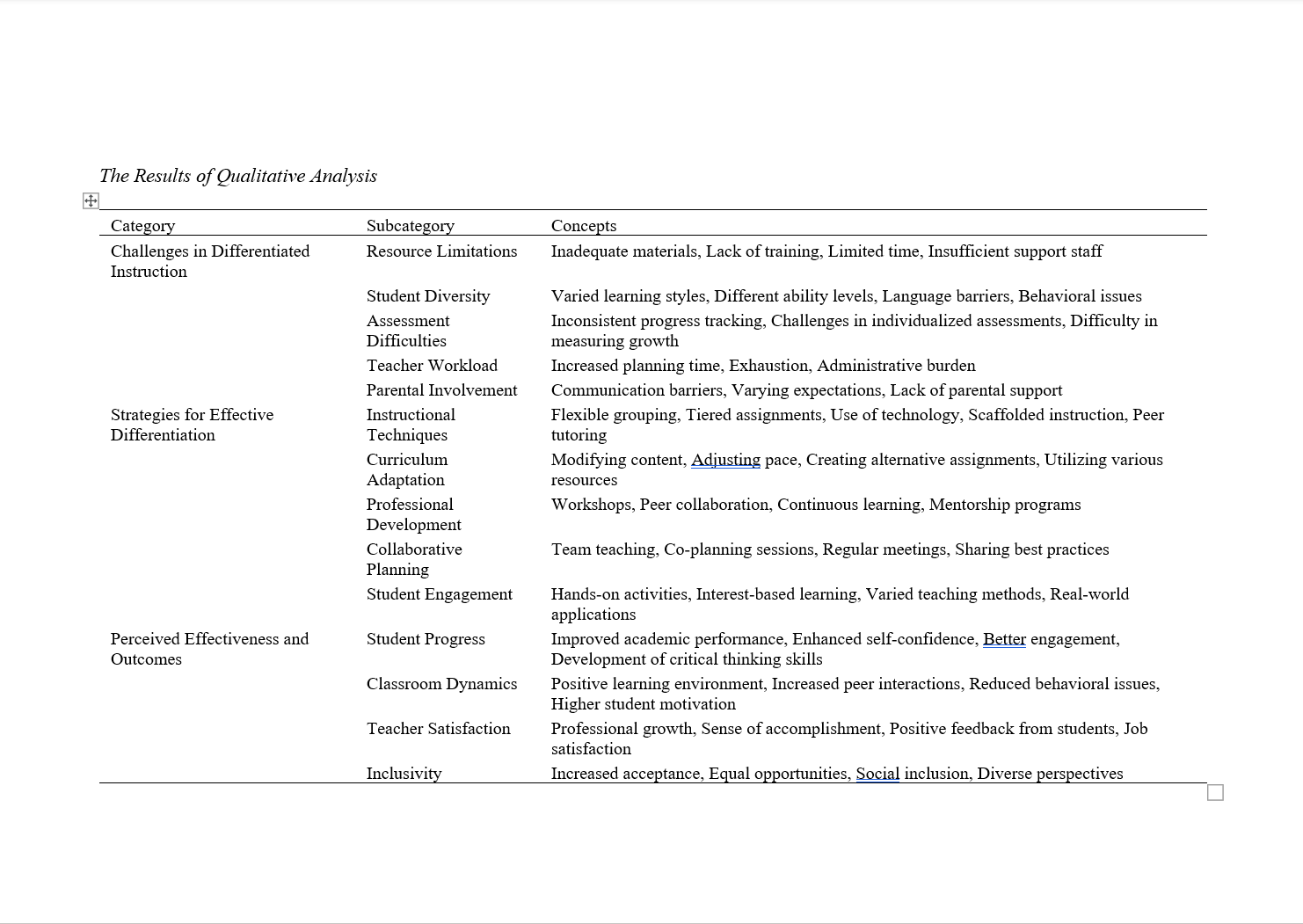
This study aims to explore the experiences of special education teachers in implementing differentiated instruction (DI) within mixed-ability classrooms. This qualitative research utilized a phenomenological approach to gain in-depth insights into the participants' experiences. Data were collected through semi-structured interviews with 25 special education teachers from various schools in a metropolitan area. Participants were selected through purposive sampling to ensure they had significant experience with DI. The interviews, each lasting 60 to 90 minutes, were transcribed verbatim and analyzed using thematic analysis. The data collection continued until theoretical saturation was achieved, ensuring a comprehensive understanding of the teachers' experiences. The analysis revealed three main themes: challenges in differentiated instruction, strategies for effective differentiation, and perceived effectiveness and outcomes. Teachers reported significant challenges, including resource limitations, managing student diversity, assessment difficulties, increased workload, and issues with parental involvement. To address these challenges, teachers employed strategies such as flexible grouping, curriculum adaptation, professional development, collaborative planning, and enhancing student engagement. The perceived effectiveness of DI included improved student progress, positive changes in classroom dynamics, increased teacher satisfaction, and greater inclusivity. Differentiated instruction is a vital approach in mixed-ability classrooms, promoting equitable learning opportunities for all students. Despite the challenges, the strategic implementation of DI leads to significant positive outcomes in student performance and classroom inclusivity. Schools should support teachers through professional development, adequate resources, and collaborative opportunities to enhance the effectiveness of DI. Further research should focus on larger, diverse samples and mixed-methods approaches to provide a more comprehensive understanding of DI practices.
Downloads
References
Aftab, J. (2016). Teachers’ Beliefs About Differentiated Instructions in Mixed Ability Classrooms: A Case of Time Limitation. Journal of Education and Educational Development, 2(2), 94.https://doi.org/10.22555/joeed.v2i2.441
Aljaser, A. M. (2019). Examining the Implications of Differentiated Instruction for High School Students’ SelfActualization. International Journal of Education and Practice, 7(3), 184-199.https://doi.org/10.18488/journal.61.2019.73.184.199
Faber, J. M., Glas, C. A., & Visscher, A. J. (2017). Differentiated Instruction in a Data-Based Decision-Making Context. School effectiveness and school improvement, 29(1), 43-63.https://doi.org/10.1080/09243453.2017.1366342
Febriyanti, E. R., & Arapah, E. (2018). Differentiating Instructions to Teach English Reading Comprehension for Mathematics Department Students.https://doi.org/10.2991/iccite-18.2018.17
Geisler, J. L., Hessler, T., Gardner, R., & Lovelace, T. S. (2009).Differentiated Writing Interventions for High-Achieving Urban African American Elementary Students. Journal of Advanced Academics, 20(2), 214-247.https://doi.org/10.1177/1932202x0902000202
Hidayati, F. (2020). Differentiated Instruction in the Mathematics Classroom: Teachers’ Teaching Experience in a Teacher Professional Development. International Journal on Teaching and Learning Mathematics, 3(1), 37-45.https://doi.org/10.18860/ijtlm.v3i1.9699
Hove, N. (2022). The Inclusiveness of Mixed Ability Grouping in Johannesburg Primary Schools. South African Journal of Childhood Education, 12(1).https://doi.org/10.4102/sajce.v12i1.1047
Hughes, L. (1999). Action Research and Practical Inquiry: How Can I Meet the Needs of the High-Ability Student Within My Regular Education Classroom? Journal for the Education of the Gifted, 22(3), 282-297.https://doi.org/10.1177/016235329902200304
Liou, S.-R., Cheng, C. Y., Chu, T. P., Chang, C. H., & Liu, H.-C. (2023). Effectiveness of Differentiated Instruction on Learning Outcomes and Learning Satisfaction in the Evidence‐based Nursing Course: Empirical Research Quantitative. Nursing Open, 10(10), 6794-6807.https://doi.org/10.1002/nop2.1926
Magableh, I. S. I., & Abdullah, A. B. (2020a). The Effectiveness of Differentiated Instruction by Streaming: A Preliminary Study of Current Practices in the UAE. International Journal of Learning Teaching and Educational Research, 19(6), 95-110.https://doi.org/10.26803/ijlter.19.6.6
Magableh, I. S. I., & Abdullah, A. B. (2020b). On the Effectiveness of Differentiated Instruction in the Enhancement of Jordanian Students’ Overall Achievement. International Journal of Instruction, 13(2), 533-548.https://doi.org/10.29333/iji.2020.13237a
Marks, A. R., Woolcott, G., & Markopoulos, C. (2021). Differentiating Instruction: Development of a Practice Framework for and With Secondary Mathematics Classroom Teachers. International electronic journal of mathematics education, 16(3), em0657.https://doi.org/10.29333/iejme/11198
Onyishi, C. N., & Sefotho, M. M. (2020). Teachers’ Perspectives on the Use of Differentiated Instruction in Inclusive Classrooms: Implication for Teacher Education. International Journal of Higher Education, 9(6), 136.https://doi.org/10.5430/ijhe.v9n6p136
Tomlinson, C. A., Brighton, C. M., Hertberg, H. L., Callahan, C. M., Moon, T. R., Brimijoin, K., Conover, L. A., & Reynolds, T. D. (2003). Differentiating Instruction in Response to Student Readiness, Interest, and Learning Profile in Academically Diverse Classrooms: A Review of Literature. Journal for the Education of the Gifted, 27(2-3), 119-145.https://doi.org/10.1177/016235320302700203
Valiandes, S. (2015). Evaluating the Impact of Differentiated Instruction on Literacy and Reading in Mixed Ability Classrooms: Quality and Equity Dimensions of Education Effectiveness. Studies in Educational Evaluation, 45, 17-26.https://doi.org/10.1016/j.stueduc.2015.02.005
Downloads
Additional Files
Publication Timeline
Issue
Section
License

This work is licensed under a Creative Commons Attribution-NonCommercial 4.0 International License.