Differentiated Instruction Strategies for Students with Learning Disabilities
DOI:
https://doi.org/10.61838/kman.prien.1.1.3Keywords:
Differentiated instruction, learning disabilities, inclusive education, student engagement, academic achievement, professional development, instructional strategies, educational challenges, support mechanismsAbstract
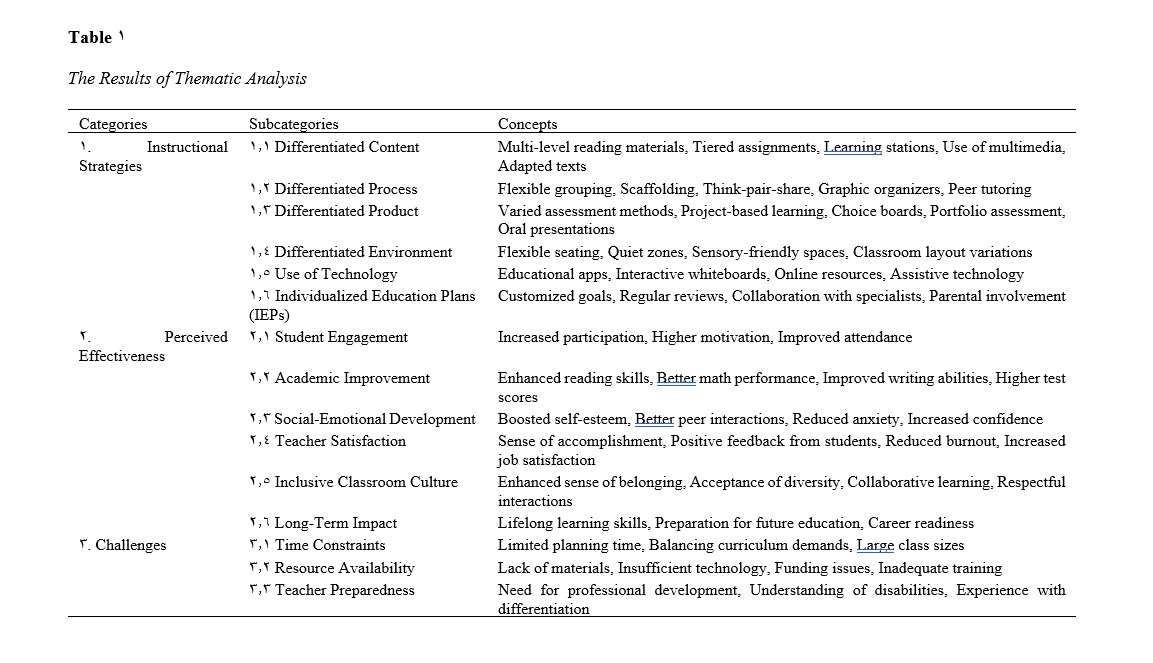
The objective of this study was to explore and identify effective differentiated instruction (DI) strategies for students with learning disabilities in mainstream educational settings. This qualitative research involved semi-structured interviews with 21 participants, including general education teachers, special education teachers, and educational administrators from an urban school district. Participants were selected through purposive sampling, ensuring a diverse representation of educators with extensive experience in teaching students with learning disabilities. Data collection continued until theoretical saturation was achieved. Thematic analysis was conducted to identify patterns and themes related to DI strategies, perceived effectiveness, implementation challenges, and support mechanisms. The study identified several key DI strategies, including differentiated content, process, product, and environment, along with the integration of technology. These strategies were reported to enhance student engagement, academic achievement, and social-emotional development. However, significant challenges such as time constraints, limited resources, and the need for professional development were highlighted. Support mechanisms, including professional development opportunities, collaborative practices, administrative backing, community resources, parental engagement, and technological support, were identified as crucial for successful DI implementation. Differentiated instruction is an effective approach to addressing the diverse needs of students with learning disabilities, promoting inclusivity and improving educational outcomes. Despite its benefits, the successful implementation of DI requires addressing substantial challenges through targeted support mechanisms. Future research should focus on expanding the sample size, exploring long-term impacts, and investigating the role of technology in DI. Practical recommendations include enhancing professional development, fostering collaboration, securing administrative support, engaging community resources, and increasing parental involvement.
Downloads
References
Abramo, J. M. (2015). Gifted Students With Disabilities. Music Educators Journal, 101(4), 62-69.https://doi.org/10.1177/0027432115571367
Aghaziarati, A., Fard, F. R., Rahimi, H., & Parsakia, K. (2023). Investigating the Effect of Electrical Stimulation (tDCS) of the Prefrontal Cortex of the Brain on the Improvement of Behavioral and Neurological Symptoms of Children with Specific Learning Disabilities. Health Nexus, 1(2), 44-50.https://doi.org/10.61838/kman.hn.1.2.6
Allsopp, D., Minskoff, E. H., & Bolt, L. (2005). Individualized Course-Specific Strategy Instruction for College Students With Learning Disabilities and ADHD: Lessons Learned From a Model Demonstration Project. Learning Disabilities Research and Practice, 20(2), 103-118.https://doi.org/10.1111/j.1540-5826.2005.00126.x
Anderson, P. L., & Corbett, L. (2008). Literature Circles for Students With Learning Disabilities. Intervention in School and Clinic, 44(1), 25-33.https://doi.org/10.1177/1053451208318681
Babbitt, B. C., & Miller, S. (1996). Using Hypermedia to Improve the Mathematics Problem-Solving Skills of Students With Learning Disabilities. Journal of Learning Disabilities, 29(4), 391-401.https://doi.org/10.1177/002221949602900407
Black, R. D., Weinberg, L. A., & Brodwin, M. G. (2015). Universal Design for Learning and Instruction: Perspectives of Students With Disabilities in Higher Education. Exceptionality Education International, 25(2).https://doi.org/10.5206/eei.v25i2.7723
Bourke, A., Strehorn, K. C., & Silver, P. (2000). Faculty Members' Provision of Instructional Accommodations to Students With LD. Journal of Learning Disabilities, 33(1), 26-32.https://doi.org/10.1177/002221940003300106
Chandra, C. (2024). The Influence of Positive Discipline, Differentiated Instruction Strategies, and Learning Motivation on the Learning Outcomes of Buddhist Religious Education. Journal of World Science, 3(1), 79-92.https://doi.org/10.58344/jws.v3i1.530
Downing, J. A., & Parker, B. (2006). Instructional Adaptations for Students With Learning Disabilities. Intervention in School and Clinic, 42(1), 56-58.https://doi.org/10.1177/10534512060420011101
Fahsl, A. J., & McAndrews, S. L. (2011). Journal Writing. Intervention in School and Clinic, 47(4), 234-244.https://doi.org/10.1177/1053451211424602
Jitendra, A. K., Edwards, L., Sacks, G., & Jacobson, L. A. (2004). What Research Says About Vocabulary Instruction for Students With Learning Disabilities. Exceptional Children, 70(3), 299-322.https://doi.org/10.1177/001440290407000303
Krishan, I. Q., & Al-rsa’i, M. S. (2023). The Effect of TechnologyOriented Differentiated Instruction on Motivation to Learn Science. International Journal of Instruction, 16(1), 961-982.https://doi.org/10.29333/iji.2023.16153a
Lancaster, P., Lancaster, S., Schumaker, J. B., & Deshler, D. D. (2006). The Efficacy of an Interactive Hypermedia Program for Teaching a Test-Taking Strategy to Students With HighIncidence Disabilities. Journal of Special Education Technology, 21(2), 17-30.https://doi.org/10.1177/016264340602100202
Lancaster, P., Schumaker, J. B., & Deshler, D. D. (2002). The Development and Validation of an Interactive Hypermedia Program for Teaching a Self-Advocacy Strategy to Students With Disabilities. Learning Disability Quarterly, 25(4), 277-302.https://doi.org/10.2307/1511358
Rao, K., Torres, C., & Smith, S. J. (2021). Digital Tools and UDLBased Instructional Strategies to Support Students With Disabilities Online. Journal of Special Education Technology, 36(2), 105-112.https://doi.org/10.1177/0162643421998327
Satsangi, R., Sigmon, S. D., & Bouck, E. C. (2022). Video Modeling in Mathematics: Supplemental Instruction to Support Student Learning. Intervention in School and Clinic, 58(5), 355-360.https://doi.org/10.1177/10534512221114388
Sayeski, K. L. (2011). Effective Spelling Instruction for Students With Learning Disabilities. Intervention in School and Clinic, 47(2), 75-81.https://doi.org/10.1177/1053451211414191
Strogilos, V. (2018). The Value of Differentiated Instruction in the Inclusion of Students With Special Needs/ Disabilities in Mainstream Schools. SHS Web of Conferences, 42, 00003.https://doi.org/10.1051/shsconf/20184200003
Vaughn, S., Hughes, M. T., Moody, S. W., & Elbaum, B. (2001). Instructional Grouping for Reading for Students With LD. Intervention in School and Clinic, 36(3), 131-137.https://doi.org/10.1177/105345120103600301
Yıldırım, H. H., & Yikmiş, A. (2022). The Effectiveness of Concrete-Representational-Abstract Instruction Strategies in the Instruction of Fractions to Students With Learning Disabilities. European Journal of Special Education Research, 8(3).https://doi.org/10.46827/ejse.v8i3.4363
Downloads
Additional Files
Publication Timeline
Issue
Section
License

This work is licensed under a Creative Commons Attribution-NonCommercial 4.0 International License.