Counseling Strategies for Enhancing Self-Advocacy in Young Adults with Disabilities
DOI:
https://doi.org/10.61838/kman.prien.1.1.2Keywords:
Self-advocacy, young adults with disabilities, qualitative research, counseling strategies, assistive technology, empowerment, barriers, support systemsAbstract
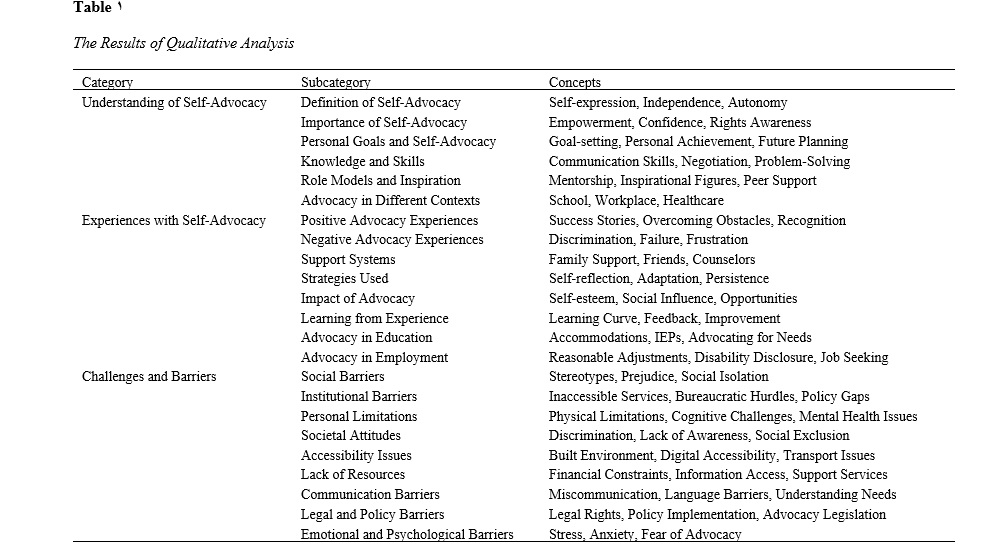
The objective of this study was to explore and develop effective counseling strategies to enhance self-advocacy among young adults with disabilities. This qualitative research involved semi-structured interviews with 22 young adults aged 18 to 30 with various disabilities, including physical, intellectual, and developmental disabilities. Participants were recruited through disability support organizations, educational institutions, and social media platforms. The data collection focused on understanding participants' experiences, challenges, and strategies related to self-advocacy. Thematic analysis was used to identify key themes and patterns in the data, with the goal of achieving theoretical saturation. The analysis revealed three main themes: understanding of self-advocacy, experiences with self-advocacy, and challenges and barriers to self-advocacy. Participants highlighted the importance of self-advocacy for personal empowerment and independence. Positive advocacy experiences were linked to increased self-esteem and better outcomes in education and employment. Support systems, such as family and counselors, were crucial in facilitating self-advocacy. However, significant barriers included societal attitudes, institutional policies, and personal limitations. Assistive technology and comprehensive leadership training were identified as effective strategies for enhancing self-advocacy skills. Enhancing self-advocacy among young adults with disabilities requires targeted counseling interventions that focus on building essential skills and addressing barriers. Collaborative approaches involving family and community support are critical. Policymakers should implement inclusive policies and ensure access to assistive technologies. Future research should explore the long-term impact of self-advocacy training and consider the intersectionality of disability with other factors such as race and gender.
Downloads
References
Carter, E. W., Lane, K. L., Cooney, M., Weir, K., Moss, C. K., & Machalicek, W. (2013). Self-Determination Among Transition-Age Youth With Autism or Intellectual Disability: Parent Perspectives. Research and Practice for Persons With Severe Disabilities, 38(3), 129-138.https://doi.org/10.1177/154079691303800301
Grenwelge, C., Zhang, D., & Landmark, L. J. (2010). Comprehensive Leadership Training for Youth With Disabilities. TEACHING Exceptional Children, 42(4), 62-68.https://doi.org/10.1177/004005991004200407
Karpicz, J. R. (2020). “Just My Being Here Is Self-Advocacy”: Exploring the Self-Advocacy Experiences of Disabled Graduate Students of Color. Jcscore, 6(1), 137-163.https://doi.org/10.15763/issn.2642-2387.2020.6.1.137-163
Lee, S.-H. (2023). The Experiences of Students With Intellectual and Developmental Disabilities, Parents, and Teachers Regarding Health Self-Advocacy Program With SchoolHome Connection: A Qualitative Study. Frontiers in Psychiatry, 14.https://doi.org/10.3389/fpsyt.2023.1273324
Lindstrom, L., Doren, B., & Miesch, J. (2011). Waging a Living: Career Development and Long-Term Employment Outcomes for Young Adults With Disabilities. Exceptional Children, 77(4), 423-434.https://doi.org/10.1177/001440291107700403
Lindstrom, L., Kahn, L. G., & Lindsey, H. (2013). Navigating the Early Career Years: Barriers and Strategies for Young Adults With Disabilities. Journal of Vocational Rehabilitation, 39(1), 1-12.https://doi.org/10.3233/jvr-130637
Rabiei, L., Masoudi, R., Moghadasi, J., Esmaeili, S., Khairi, F., & Hakim, A. (2013). Evaluation the efficiency of school-based assertiveness program on self-advocacy and selfdetermination skills in high school students. Journal of Shahrekord University of Medical Sciences, 15(1), 11-22.www.magiran.com/p1110969
Reis, S. M., McGuire, J. M., & Neu, T. W. (2000). Compensation Strategies Used by High-Ability Students With Learning Disabilities Who Succeed in College. Gifted Child Quarterly, 44(2), 123-134.https://doi.org/10.1177/001698620004400205
Ripat, J., & Woodgate, R. L. (2017). The Importance of Assistive Technology in the Productivity Pursuits of Young Adults With Disabilities. Work, 57(4), 455-468.https://doi.org/10.3233/wor-172580
Schmidt, E. K., Faieta, J., & Tanner, K. (2019). Scoping Review of Self-Advocacy Education Interventions to Improve Care. Otjr Occupational Therapy Journal of Research, 40(1), 50-56.https://doi.org/10.1177/1539449219860583
Tideman, M., & Svensson, O. (2015). Young People With Intellectual Disability—The Role of Self-Advocacy in a Transformed Swedish Welfare System. International Journal of Qualitative Studies on Health and Well-Being, 10(1), 25100.https://doi.org/10.3402/qhw.v10.25100
Wehmeyer, M. L. (2014). Self‐Determination: A Family Affair. Family Relations, 63(1), 178-184.https://doi.org/10.1111/fare.12052
Additional Files
Publication Timeline
Issue
Section
License

This work is licensed under a Creative Commons Attribution-NonCommercial 4.0 International License.