The Effectiveness of Mindfulness on Selective Attention, Visuospatial Memory, and Academic Performance in Elementary School Students with Attention-Deficit/Hyperactivity Disorder
DOI:
https://doi.org/10.61838/kman.prien.3.1.10Keywords:
ADHD, mindfulness training, selective attention, visuospatial memory, academic performanceAbstract
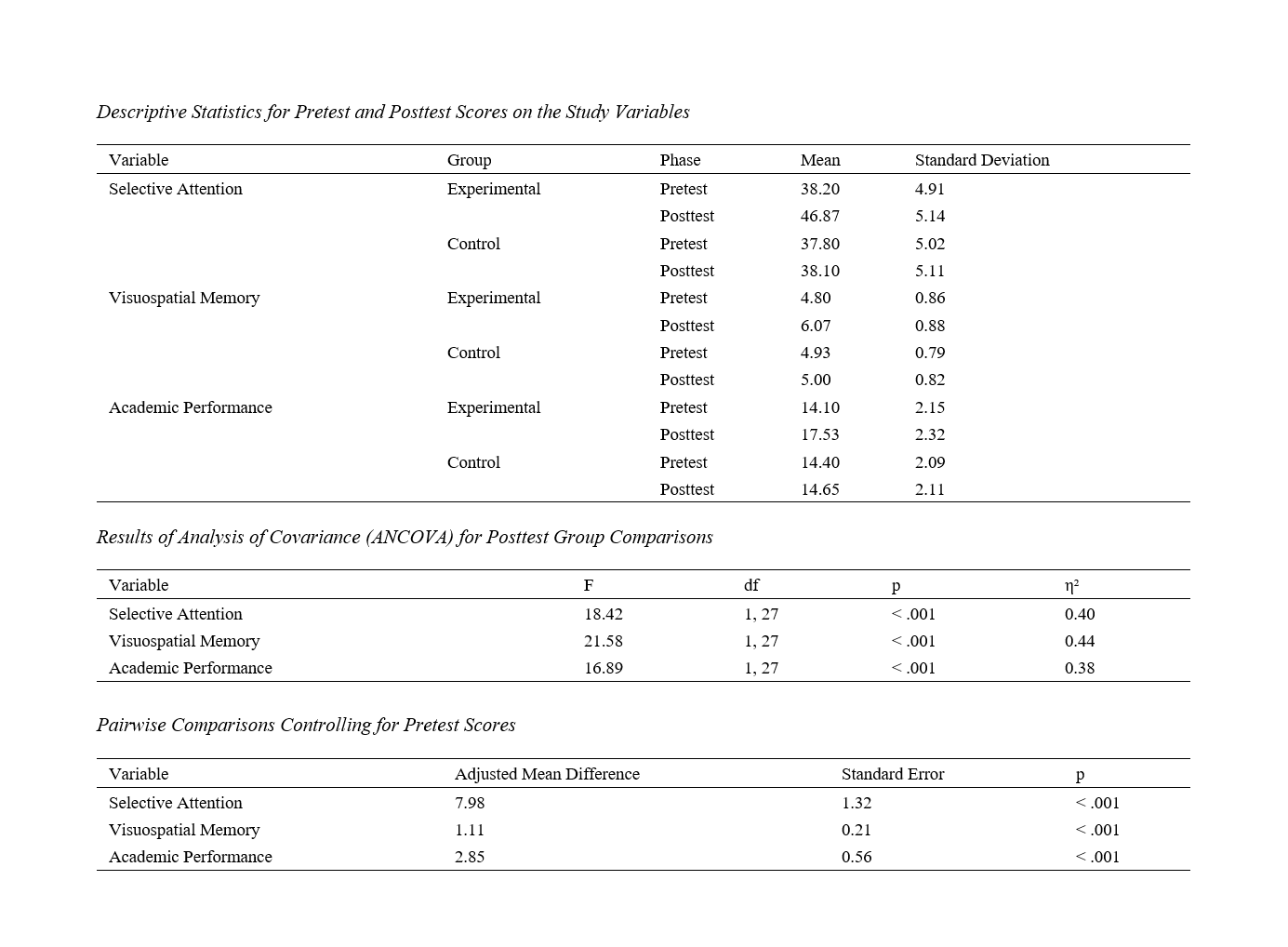
The present study aimed to examine the effectiveness of a mindfulness training program on selective attention, visuospatial memory, and academic performance in elementary school students diagnosed with ADHD. This study employed a quasi-experimental design with a pretest–posttest control group. A total of 30 elementary school students diagnosed with ADHD were randomly assigned to an experimental group (n = 15) and a control group (n = 15). The experimental group participated in eight 45-minute sessions of a mindfulness training program based on Mindfulness-Based Stress Reduction (MBSR) and Mindfulness-Based Cognitive Therapy (MBCT) protocols, while the control group continued with routine school activities. Selective attention was assessed using the Stroop Test, visuospatial memory was measured with the Corsi Block-Tapping Test, and academic performance was evaluated through continuous assessment scores and an Academic Performance Questionnaire. Data were analyzed using analysis of covariance (ANCOVA) while controlling for pretest effects. The findings indicated that the mindfulness intervention led to significant improvements in selective attention, visuospatial memory, and academic performance in the experimental group compared with the control group. In addition, correlations between cognitive indices and academic performance increased following the intervention, highlighting the role of cognitive mechanisms in enhancing academic achievement. Mindfulness training can serve as an effective complementary intervention alongside other treatment approaches to improve cognitive and academic functioning in students with ADHD. It is recommended that mindfulness programs be implemented in schools with the involvement of parents and teachers. Future research should incorporate follow-up periods, larger sample sizes, and neuropsychological indicators to further elucidate the mechanisms underlying these effects.
Downloads
References
Aboalola, N. A. (2023). The effectiveness of a mindfulness-based intervention on improving executive functions and reducing the symptoms of ADHD in young children. Applied Neuropsychology: Child. https://doi.org/10.1080/21622965.2023.2203321
Alamro, A. R. (2025). Effects of mindfulness e-activities on academic resilience in ADD/ADHD students. Journal of Development and Research. https://doi.org/10.57197/JDR-2025-0005
Badia-Aguarón, T., Royuela-Colomer, E., Pera-Guardiola, V., Vergés-Balasch, P., Cebolla, A., Luciano, J. V., Soler, J., Feliu-Soler, A., & Huguet Miguel, A. (2024). Combining mindfulness and cognitive training in children with attention deficit hyperactivity disorder: Study protocol of a pilot randomized controlled trial (the NeuroMind study). Frontiers in psychology, 15. https://doi.org/10.3389/fpsyg.2024.1291198
Flook, L., Hirshberg, M. J., Gustafson, L., McGehee, C., Knoeppel, C., Tello, L. Y., & Davidson, R. J. (2025). Mindfulness training enhances students' executive functioning and social emotional competence. Applied Developmental Science, 29(2), 141-160. https://doi.org/10.1080/10888691.2023.2297026
Ghandkanlou, J. Y. (2025). Examining the relationship between symptoms of attention-deficit/hyperactivity disorder and academic performance of middle school students. International Journal of Higher Education and Sustainability. https://ijhespub.org/index.php/pub/article/view/149
Holopainen, M., Hintsanen, M., Lahti, J., Vahlberg, T., & Volanen, S. M. (2025). Can a Universal Mindfulness Intervention in Schools Reduce ADHD Symptoms among Adolescents? A Cluster Randomized Controlled Trial. Scandinavian journal of psychology, 66(3), 338-354. https://doi.org/10.1111/sjop.13090
Jaismin, Chukkali, S., Peter, A., Maurya, R., & Panchal, S. (2025). Effects of Mindfulness-Based Intervention on Academic Anxiety: Enhancing Well-Being of Rural Adolescents. Journal of Health Management. https://doi.org/10.1177/09720634251326491
Kong, L., Zhao, M., Huang, W., Zhang, W., & Liu, J. (2025). The Impact of Academic Anxiety on Smartphone Addiction Among College Students: The Mediating Role of Self-Regulatory Fatigue and the Moderating Role of Mindfulness. https://doi.org/10.21203/rs.3.rs-5898815/v1
Lee, Y. C., Chen, C. R., & Lin, K. C. (2022). Effects of mindfulness-based interventions in children and adolescents with ADHD: A systematic review and meta-analysis of randomized controlled trials. International journal of environmental research and public health, 19(22). https://doi.org/10.3390/ijerph192215198
Mohammadzadegan, R., Farid, A., Chalbianlou Hasratnalu, G., & Misrabadi, J. (2023). The effectiveness of a mindfulness-based social-emotional learning program on emotional self-regulation and symptoms of Attention Deficit/Hyperactivity Disorder in children. Psychology Growth, 12(3), 25-34. https://frooyesh.ir/article-1-4413-fa.html
Mohseni Nasab, Z., Saket, S., Deylami Pooya, M., Basiti, S., & Jafari, S. (2024). The Effectiveness of Mindfulness Training on Executive Functions (Working Memory and Attention) and Self-Efficacy in Patients with Anxiety Disorders. Cognitive Psychology Journal, 12(1), 31-45. https://jcp.khu.ac.ir/article-1-3787-en.html
Monsillion, J., Romo, L., & Zebdi, R. (2025). Exploring the Effects of a School Mindfulness-Based Intervention in French Primary Public Schools-A Pilot Study. Pediatric Reports, 17(2), 31. https://doi.org/10.3390/pediatric17020031
Rabipour, F., Hoseini-Nasab, S. D., & Salari, A. (2024). The effectiveness of mindfulness-based therapy on working memory indices in patients with hypertension: A randomized clinical trial. Feyz Journal of Medical Sciences, 27(5), 501-511. http://feyz.kaums.ac.ir/browse.php?a_id=4995&sid=1&slc_lang=en
Rafat, H., & Arefi, M. (2022). The combined effectiveness of mindfulness training and neurofeedback on reducing anxiety in children with Attention Deficit Hyperactivity Disorder during the COVID-19 crisis. New Psychological Research, 17(66). https://psychologyj.tabrizu.ac.ir/article_15275.html
Safari, M., Teimoori, S., Bayazi, M. H., & Rajaee, A. (2023). Effectiveness of mindfulness interventions based on stress reduction on parent-child tension in parents of children with Attention-Deficit/Hyperactivity Disorder. Razi Journal of Medical Sciences, 30(5), 154-162. https://rjms.iums.ac.ir/browse.php?a_id=8475&sid=1&slc_lang=en
Sultan, M. A., Nawaz, F. A., Alattar, B., Khalaf, E., Shadan, S., El-Abiary, N., Tegginmani, S., Qasba, R. K., & Jogia, J. (2025). Assessing the impact of mindfulness programs on attention-deficit/ hyperactivity disorder in children and adolescents: a systematic review. BMC pediatrics, 25(1), 32. https://doi.org/10.1186/s12887-024-05310-z
Sultan, M. A., Pornnoppadol, C., & Atsariyasing, W. (2022). Effectiveness of mindfulness-based parenting programs in reducing parenting stress in parents of children and adolescents with Attention-Deficit/Hyperactivity Disorder: Systematic review and meta-analysis. Siriraj Medical Journal, 74(6), 371-380. https://doi.org/10.33192/Smj.2022.45
Wang, X. (2025). Exploring the impact of mindfulness, subjective well-being, and music engagement on academic performance of students in higher educational institutions. Humanities and Social Sciences Communications, 12(1), 1-14. https://doi.org/10.63313/SSH.2003
Zhong, S. Y., Guo, J. H., Zhou, X. N., Liu, J. L., & Jiang, C. L. (2024). Effects of brief mindfulness meditation training on attention and dispositional mindfulness in young adult males. Acta Psychologica, 246, 104277. https://doi.org/10.1016/j.actpsy.2024.104277
Downloads
Additional Files
Publication Timeline
- Submitted
- Revised
- Accepted