Improving Visual and Auditory Perception in Students with Specific Learning Disorder with Impairment in Reading through a Multisensory Educational Package
DOI:
https://doi.org/10.61838/kman.prien.4736Keywords:
Specific Learning Disorder, Multisensory Educational Package, Visual Perception, Auditory Perception, Educational Intervention.Abstract
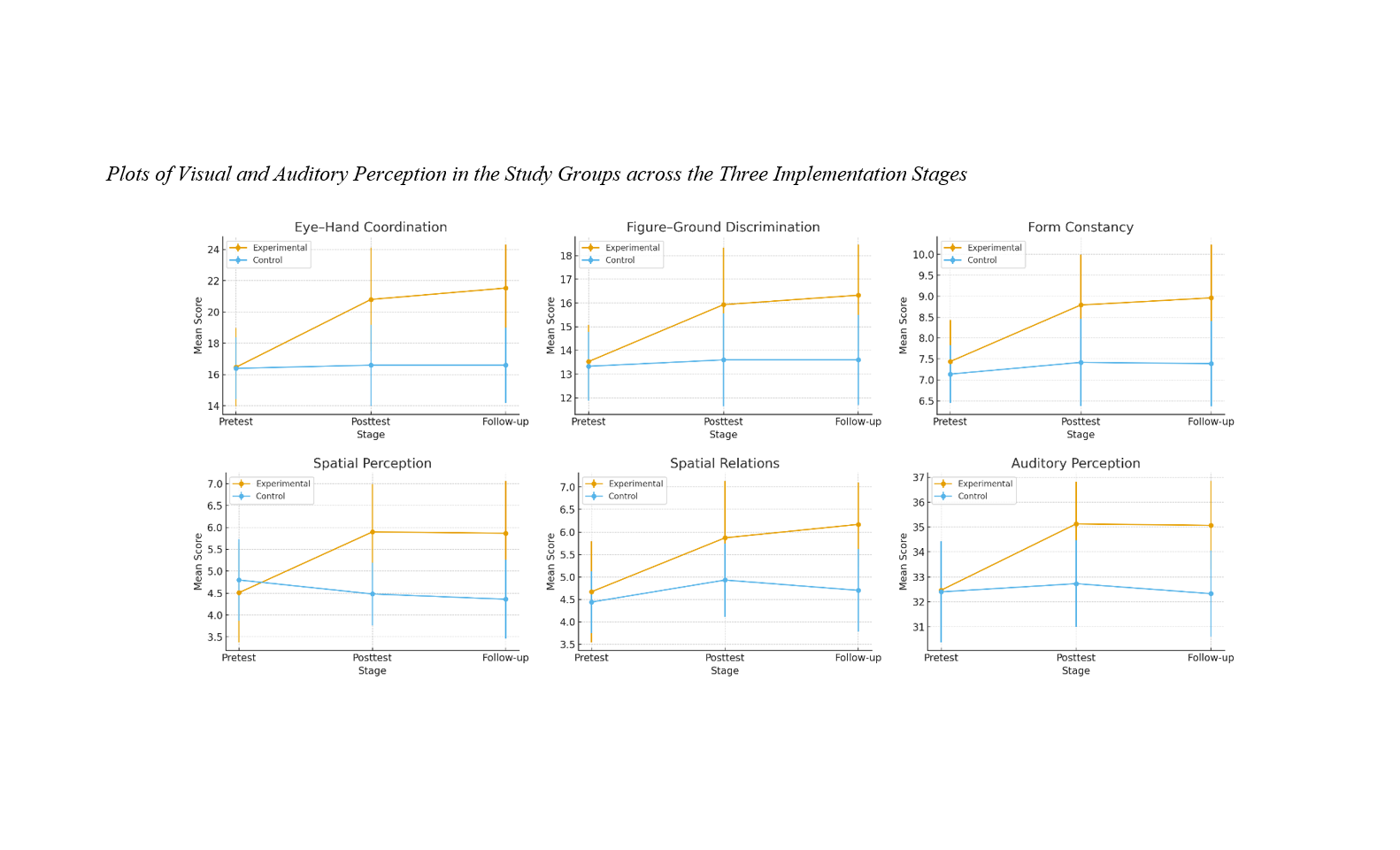
This study aimed to examine the effectiveness of a multisensory educational package (Colored Cubes) on improving visual and auditory perception in students aged 7–11 years with Specific Learning Disorder (SLD) with impairment in reading. This quasi-experimental study employed a pretest–posttest design with a control group and follow-up assessments. The statistical population consisted of children diagnosed with SLD with impairment in reading according to DSM-5 criteria, attending psychological centers in District 12 of Tehran during the 2024–2025 academic year. Thirty eligible participants were selected through convenience sampling and randomly assigned to experimental and control groups (15 each). The research instruments included the Frostig Developmental Test of Visual Perception and the Wepman Auditory Discrimination Test. The experimental group received a structured multisensory intervention—comprising colored cubes, age-appropriate flashcards, and phonological awareness activities—across twelve 45-minute sessions, while the control group received no intervention. Data were analyzed using repeated-measures ANOVA in SPSS-26 at a significance level of p < 0.05. The results of repeated-measures ANOVA revealed significant group-by-time interaction effects across all dimensions of visual perception—eye–hand coordination, figure–ground discrimination, form constancy, spatial perception, and spatial relations—as well as auditory discrimination (p < 0.001). Bonferroni post hoc comparisons indicated that improvements in all perceptual domains were maintained in both three- and six-month follow-ups. Effect size estimates (η² = 0.17–0.64) confirmed a strong and stable impact of the multisensory intervention over time compared with the control group. The multisensory educational package (Colored Cubes) effectively enhanced and sustained visual and auditory perceptual functions in children with SLD and reading impairment. The integration of visual, auditory, and kinesthetic modalities provides a promising framework for educational and therapeutic settings targeting perceptual deficits in dyslexic learners.
Downloads
References
Adjiovski, B., Bogatinoska, D. C., Ismajloska, M., & Malekian, R. (2024). Enhancing educational technology in lectures for school students with learning disabilities: A comprehensive analysis. Sn Computer Science, 5(6), 716. https://doi.org/10.1007/s42979-024-03049-z
Alkhawalde, M. A., & Khasawneh, M. A. S. (2024). Designing gamified assistive apps: A novel approach to motivating and supporting students with learning disabilities. International Journal of Data and Network Science, 8(1), 53-60. https://doi.org/10.5267/j.ijdns.2023.10.018
American Psychiatric, A. (2023). Diagnostic and Statistical Manual of Mental Disorders (DSM-5). Arjmand Pub. https://psychiatryonline.org/doi/book/10.1176/appi.books.9780890425596
Amiri Ahmadi, M., Ebrahimi Ghavam, S., Dortaj, F., Shyvandi Chelcheh, K., & Delavar, A. (2023). Development and Validation of a Training Package Based on Positive Emotional Stimuli for Teaching Self-Regulation Strategies and Cognitive Strategies on the Reading Performance of Students with Dyslexia. Empowerment of Exceptional Children, 14(2). https://www.ceciranj.ir/article_179055_en.html
Bakhtiari, J., Dadgar, H., Khatoonabadi, S. A. R., & Ghorbani, R. (2012). Investigation of Auditory Discrimination Skills in 4-6 Year-Old Normal Persian-Speaking Children. Modern Rehabilitation Journal, 6(2). https://www.magiran.com/paper/1063124/survey-of-auditory-discrimination-skill-in-4-6-years-old-children-in-semnan-city?lang=en
Basak, R., & Yaman, S. (2023). Effect of Frostig visual perception training program on visual perception skills of first graders. International Journal of Education and Literacy Studies, 11(4), 190-204. https://doi.org/10.7575/aiac.ijels.v.11n.4p.190
Bertoni, S., Andreola, C., Mascheretti, S., Franceschini, S., Ruffino, M., Trezzi, V., Molteni, M., Sali, M. E., Salandi, A., Gaggi, O., Palazzi, C., Gori, S., & Facoetti, A. (2024). Action video games normalise the phonemic awareness in pre-readers at risk for developmental dyslexia. NPJ Science of Learning, 9(1), 25. https://doi.org/10.1038/s41539-024-00230-0
Chokron, S., Kovarski, K., & Dutton, G. N. (2021). Cortical visual impairments and learning disabilities. Frontiers in human neuroscience, 15, 713316. https://doi.org/10.3389/fnhum.2021.713316
Dashtipour, M., Taher, M., Vahedi, H., & Hossein Khanzadeh, A. (2024). Comparing the Effectiveness of Cognitive Rehabilitation, Barkley-Based Intervention, and Neurofeedback on the Reading Performance of Children with Dyslexia. Journal of Knowledge & Health in Basic Medical Sciences, 19(4). https://civilica.com/doc/2186507/
Donolato, E., Cardillo, R., Mammarella, I. C., & Melby-Lervåg, M. (2022). Research review: Language and specific learning disorders in children and their co-occurrence with internalizing and externalizing problems: A systematic review and meta-analysis. Journal of Child Psychology and Psychiatry, 63(5), 507-518. https://doi.org/10.1111/jcpp.13536
Dostálová, N., Pátková Daňsová, P., Ježek, S., Vojtechovska, M., & Šašinka, Č. (2024). Towards the intervention of dyslexia: A complex concept of dyslexia intervention system using eye-tracking. Proceedings of the 2024 Symposium on Eye Tracking Research and Applications,
Economou, M., Vanden Bempt, F., Van Herck, S., Glatz, T., Wouters, J., Ghesquière, P., Vanderauwera, J., & Vandermosten, M. (2024). Cortical structure in pre-readers at cognitive risk for dyslexia: Baseline differences and response to intervention. Neurobiology of Language, 5(2), 264-287. https://doi.org/10.1162/nol_a_00122
Esmaeili Anvar, S., Ghorban Hormozi, R., Rafieipour, A., & Sabet, M. (2023). The Effectiveness of a Lateral Dominance Strengthening Training Package on Perceptual and Visual Perception Functions in Children with Specific Learning Disorder. Psychology of Exceptional Individuals, 12(4). https://jpe.atu.ac.ir/article_15574.html
Eyvazi, S., Karami, H., & Yazdankhah, K. (2023). Design, Development, and Validation of the "Hamrah" Written Cognitive Rehabilitation Draft Package. Neuropsychology, 9(32). https://clpsy.journals.pnu.ac.ir/article_10491.html
Fatimah, N., Ansyah, E. H., & Affandi, G. R. (2025). Dynamics of cognitive development of dyslexia students through multisensory learning. Proceeding of International Conference on Social Science and Humanity,
Fattahi, S., Ghorban Hormozi, R., Farrokhi, N., & Sadeepour, A. (2025). Comparing the Effectiveness of Training Based on the Self-Regulated Strategy Development Model and Cognitive Strategies Training Based on Englert's Model on the Reading Disorder of Students with Learning Disabilities. Educational & Psychological Studies, 22(57). https://jeps.usb.ac.ir/article_8939.html
Flanagan, S., Wilson, A. M., Gabrielczyk, F. C., MacFarlane, A., Feltham, G., Mandke, K., & Goswami, U. (2025). A longitudinal study of tapping to the beat by school-aged children with and without dyslexia: Assessments of the mediating role of phonology. Frontiers in Developmental Psychology, 3, 1528427. https://doi.org/10.3389/fdpys.2025.1528427
Guo, L., & Keles, S. (2025). A systematic review of studies with parent-involved interventions for children with specific learning disabilities. European Journal of Special Needs Education, 40(4), 755-772. https://doi.org/10.1080/08856257.2024.2421112
Iaia, M., Vizzi, F., Carlino, M. D., Turi, M., Marinelli, C. V., & Angelelli, P. (2024). Specific learning disabilities and associated emotional-motivational profiles: A study in Italian university students. Frontiers in psychology, 15, 1365980. https://doi.org/10.3389/fpsyg.2024.1365980
Khademi Adel, L., Bani Maleki, S. A., Dortaj, F., & Asadzadeh, H. (2024). Investigating the Effectiveness of Multisensory Methods and Cognitive-Behavioral Intervention on Self-Discipline and Self-Assessment of 9-10 Year-Old Female Students with Dyslexia. Theory and Practice in Teacher Education, 10(17). https://itt.cfu.ac.ir/article_3281.html?lang=en
Kord Noghaby, R., & Dortaj, F. (2007). Standardization, Validity, and Reliability of the Frostig Developmental Test of Visual Perception Among First and Second Grade Elementary School Students in Tehran. Journal of Applied Psychology, 1(3). https://apsy.sbu.ac.ir/article_94475.html?lang=en
Kunasegran, K., & Subramaniam, V. (2024). Exploring multisensory in enhancing literacy of dyslexic students. International Journal of Academic Research in Progressive Education and Development, 13(3), 2933-2941. https://doi.org/10.6007/IJARPED/v13-i3/22649
Le Cunff, A., Dommett, E., & Giampietro, V. (2024). Neurophysiological measures and correlates of cognitive load in attention-deficit/hyperactivity disorder (ADHD), autism spectrum disorder (ASD) and dyslexia: A scoping review and research recommendations. European Journal of Neuroscience, 59(2), 256-282. https://doi.org/10.1111/ejn.16201
Lim, L., & Oei, A. C. (2015). Reading and spelling gains following one year of Orton-Gillingham intervention in Singaporean students with dyslexia. British Journal of Special Education, 42(4), 374-389. https://doi.org/10.1111/1467-8578.12104
Mendes, B. B., & Kirby, J. R. (2024). The effects of a morphological awareness intervention on reading and spelling ability of children with dyslexia. Learning Disability Quarterly, 47(4), 222-233. https://doi.org/10.1177/07319487241259775
Meng, H., Yao, R., Zhang, P., Wang, J., & Zhang, Y. (2024). The impact of visual search in Chinese children with developmental dyslexia on reading comprehension: The mediating role of word detection skill and reading fluency. Frontiers in psychology, 15, 1437187. https://doi.org/10.3389/fpsyg.2024.1437187
Micheletti, S., Galli, J., Vezzoli, M., Scaglioni, V., Agostini, S., Calza, S., Merabet, L. B., & Fazzi, E. (2024). Academic skills in children with cerebral palsy and specific learning disorders. Developmental Medicine & Child Neurology, 66(6), 778-792. https://doi.org/10.1111/dmcn.15808
Mirzaei, H., Faramarzi, S., Jahanifar, M., & Masnavi, A. (2024). The Effectiveness of a Multimedia Learning Environment Model Training Package on Academic Engagement and Academic Avoidance in Students with Specific Learning Disorder in Mathematics. Psychology of Exceptional Individuals, 12(4). https://jpe.atu.ac.ir/article_17944.html
Mosafer, A., & Sadati Firouz Abadi, S. S. (2025). The Impact of a Reading Program Based on Working Memory and Phonology on the Phonological Awareness of Children with Dyslexia. Journal of Applied Psychology, 19(2). https://apsy.sbu.ac.ir/article_105677.html
Okey-Kalu, O. J. (2025). Understanding dyslexia through the perspective of phonological awareness deficit theory. Shodh Sari-An International Multidisciplinary Journal, 4(1), 118-126. https://doi.org/10.59231/SARI7783
Patil, S., Apare, R., Borhade, R., & Mahalle, P. (2024). Intelligent approaches for early prediction of learning disabilities in children using learning patterns: A survey and discussion. Journal of Autonomous Intelligence, 7(5), 1329. https://doi.org/10.32629/jai.v7i5.1329
Paudel, S., & Acharya, S. (2024). A comprehensive review of assistive technologies for children with dyslexia. https://arxiv.org/html/2412.13241v1
Putri, Y. A. U., & Hendriani, W. (2024). Multisensory methods as teachers' efforts in dealing with dyslexic children in elementary school: Literature review. Psychosophia: Journal of Psychology, Religion, and Humanity, 6(1), 32-44. https://doi.org/10.32923/psc.v6i1.3652
Rahmonovna, S. N. (2025). Pedagogical foundations of using the multi-sensory approach for teaching English to students with learning disabilities. European International Journal of Philological Sciences, 5(6), 46-48. https://doi.org/10.55640/eijps-05-06-14
Rezaei, S. (2024). Development of a Neuropsychological Rehabilitation Program and Investigation of its Effectiveness on the Reading Performance of Students with Dyslexia. Learning Disabilities, 13(3). https://jld.uma.ac.ir/%20https:/jld.uma.ac.ir/article_3068.html?lang=en
Robertson, E. K., Mimeau, C., & Deacon, S. H. (2024). Do children with developmental dyslexia have syntactic awareness problems once phonological processing and memory are controlled? Frontiers in Language Sciences, 3, 1388964. https://doi.org/10.3389/flang.2024.1388964
Sarajar, D., & Pratiwi, P. (2024). Analysis of multisensory learning media needs for children identified with dyslexia disorder. Counsenesia Indonesian Journal of Guidance and Counseling, 5(1), 73-82. https://doi.org/10.36728/cijgc.v5i1.3538
Sedaghati, S., Foroughi, R., Shafaee, B., & Marathi, M. R. (2010). Investigation of the Prevalence of Dyslexia in Normal First to Fifth Grade Elementary School Students in Isfahan. Audiology, 19(1), 1-8. https://www.magiran.com/paper/719089/prevalence-of-dyslexia-in-first-to-fifth-grade-elementary-students-isfahan-iran?lang=en
Sobhani, F., Hassanzadeh, S., & Rezaei, T. (2024). A Comparative Study of Spoken Language Components in Students with Dyslexia and Their Normal Peers in First and Second Grades of Elementary School. Scientific Journal of Rehabilitation Medicine, 13(1), 120-131. https://doi.org/10.32598/SJRM.13.1.8
Ward, M., Thomson, J., Xu, L., & Uí Dhonnchadha, E. (2024). Enhancing language learning for dyslexic learners: Integrating text-to-speech AI in CALL. EuroCALL 2024: CALL for humanity,
Yenduri, G., Kaluri, R., Rajput, D. S., Lakshmanna, K., Gadekallu, T. R., Mahmud, M., & Brown, D. J. (2023). From assistive technologies to metaverse: Technologies in inclusive higher education for students with specific learning difficulties. IEEE Access. https://doi.org/10.1109/ACCESS.2023.3289496
Downloads
Additional Files
Publication Timeline
- Submitted
- Revised
- Accepted