Teachers’ Narratives on Implementing AI-Based Learning Tools for Students with Severe Disabilities
DOI:
https://doi.org/10.61838/kman.prien.2.2.4Keywords:
AI-based learning tools, special education, severe disabilities, teacher experiences, student engagement, implementation challenges, professional developmentAbstract
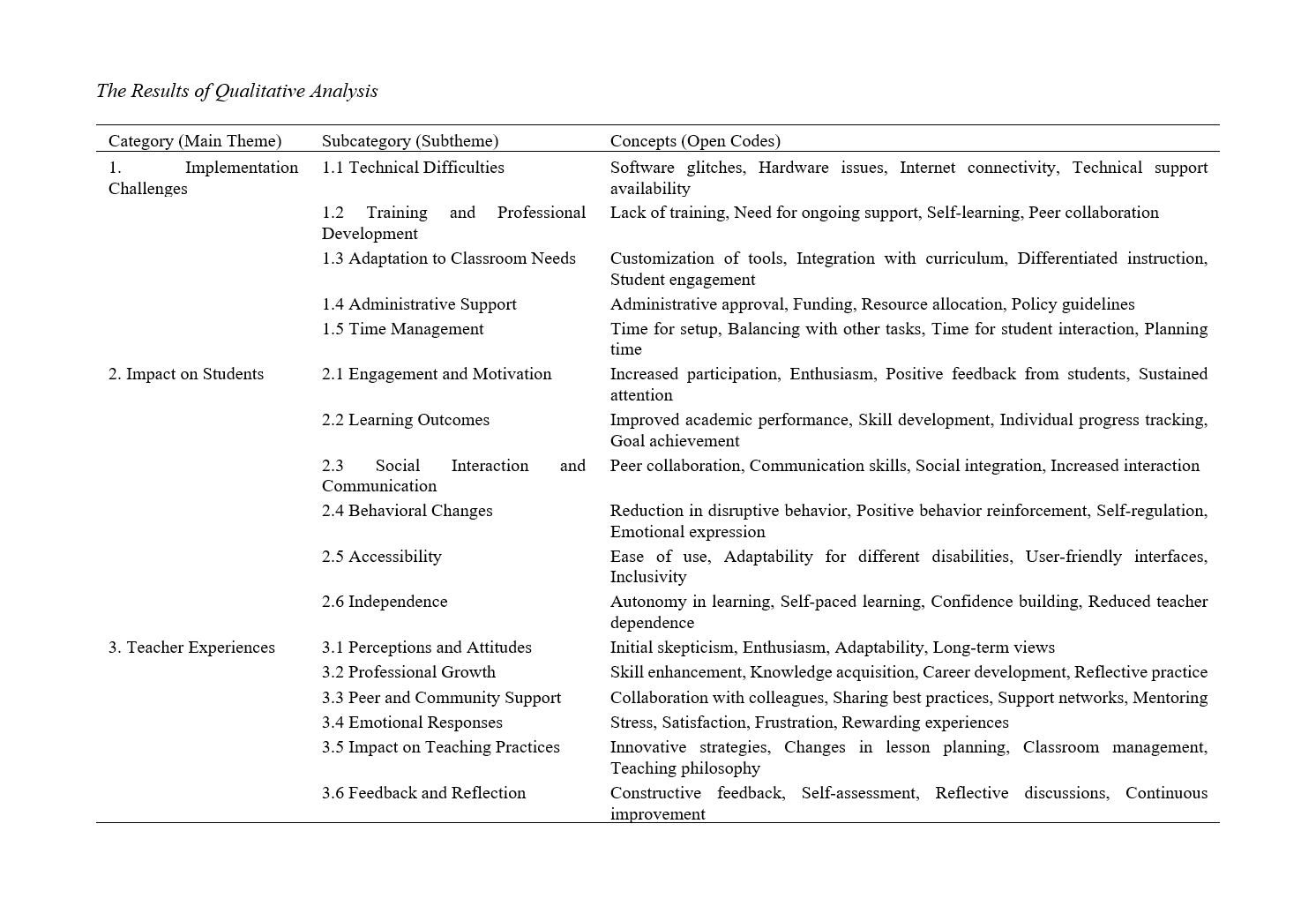
This study aims to explore teachers' narratives on implementing AI-based learning tools for students with severe disabilities. The objective is to understand the challenges faced, the impacts on students, and the experiences of teachers using these technologies in special education settings. A qualitative research design was employed, using semi-structured interviews to gather data from 16 certified special education teachers with experience in using AI-based learning tools. Participants were selected through purposive sampling to ensure a diverse range of perspectives. Interviews were transcribed and subjected to thematic analysis to identify key themes and patterns in the data. Three main themes emerged from the analysis: implementation challenges, the impact on students, and teacher experiences. Teachers reported significant technical difficulties, inadequate training, and limited administrative support as major challenges. Despite these issues, AI tools had a positive impact on student engagement, motivation, learning outcomes, social interaction, and behavioral changes. Teachers experienced a range of emotions, from initial skepticism to eventual acceptance, and highlighted the importance of peer support and professional growth. The study underscores the transformative potential of AI in special education, while also identifying critical areas that need attention for successful implementation. The integration of AI-based learning tools in special education offers significant benefits for students with severe disabilities, including enhanced engagement, improved learning outcomes, and better social interactions. However, successful implementation requires addressing technical issues, providing comprehensive training, securing administrative support, and fostering a culture of feedback and reflection. Future research should focus on long-term impacts, comparative effectiveness of different AI tools, and the development of effective training programs. Educational institutions must prioritize these areas to maximize the positive impact of AI technologies in special education.
Downloads
References
Adeleye, O. O. (2024). Innovative Teaching Methodologies in the Era of Artificial Intelligence: A Review of Inclusive Educational Practices. World Journal of Advanced Engineering Technology and Sciences, 11(2), 069-079.https://doi.org/10.30574/wjaets.2024.11.2.0091
Almufareh, M. F. (2023). Intellectual Disability and Technology: An Artificial Intelligence Perspective and Framework. 2(4).https://doi.org/10.57197/jdr-2023-0055
Barua, P. D., Vicnesh, J., Gururajan, R., Oh, S. L., Palmer, E. E., Azizan, M. M., Kadri, N. A., & Acharya, U. R. (2022). Artificial Intelligence Enabled Personalised Assistive Tools toEnhance Education of Children With Neurodevelopmental Disorders—A Review. International journal of environmental research and public health, 19(3), 1192.https://doi.org/10.3390/ijerph19031192
Fichten, C. S., Pickup, D., Asunsion, J., Jorgensen, M., Vo, C., Legault, A., & Libman, E. (2022). State of the Research on Artificial Intelligence Based Apps for Post-Secondary Students With Disabilities. Exceptionality Education International, 31(1), 62-76.https://doi.org/10.5206/eei.v31i1.14089
Grunhut, J., Marques, O., & Wyatt, A. T. M. (2022). Needs, Challenges, and Applications of Artificial Intelligence in Medical Education Curriculum. Jmir Medical Education, 8(2), e35587.https://doi.org/10.2196/35587
Heng, T., & Tabunshchyk, V. (2021). Teaching Tech to Talk: K-12 Conversational Artificial Intelligence Literacy Curriculum and Development Tools. Proceedings of the Aaai Conference on Artificial Intelligence, 35(17), 15655-15663.https://doi.org/10.1609/aaai.v35i17.17844
Lawrence, L. (2023). How Teachers Conceptualise Shared Control With an AI Co‐orchestration Tool: A Multiyear Teacher‐centred Design Process. British Journal of Educational Technology, 55(3), 823-844.https://doi.org/10.1111/bjet.13372
Nganji, J. T., & Brayshaw, M. (2017). Disability-Aware Adaptive and Personalised Learning for Students With Multiple Disabilities. International Journal of Information and Learning Technology, 34(4), 307-321.https://doi.org/10.1108/ijilt-08-2016-0027
Sarwar, M. A. (2024). The Role of Artificial Intelligence in Shaping the Future of Education at Higher Secondary Level. Journal of Education and Social Studies, 5(1), 34-45.https://doi.org/10.52223/jess.2024.5104
Wu, Y. (2024). Study on the Impact of Utilizing ChatGPT and Other AI Tools for Feedback in EAP Writing Classrooms on the Discursive Writing Performance of English Major Students. Tssehr, 4, 143-150.https://doi.org/10.62051/4se95x52
Downloads
Additional Files
Publication Timeline
Issue
Section
License

This work is licensed under a Creative Commons Attribution-NonCommercial 4.0 International License.