Executive Functioning as a Mediator Between Parental Involvement and Math Achievement in Children with Learning Disabilities
DOI:
https://doi.org/10.61838/kman.prien.3.3.1Keywords:
Parental involvement, Executive functioning, Math achievement, Learning disabilities, Mediation model, Structural equation modeling, Cognitive developmentAbstract
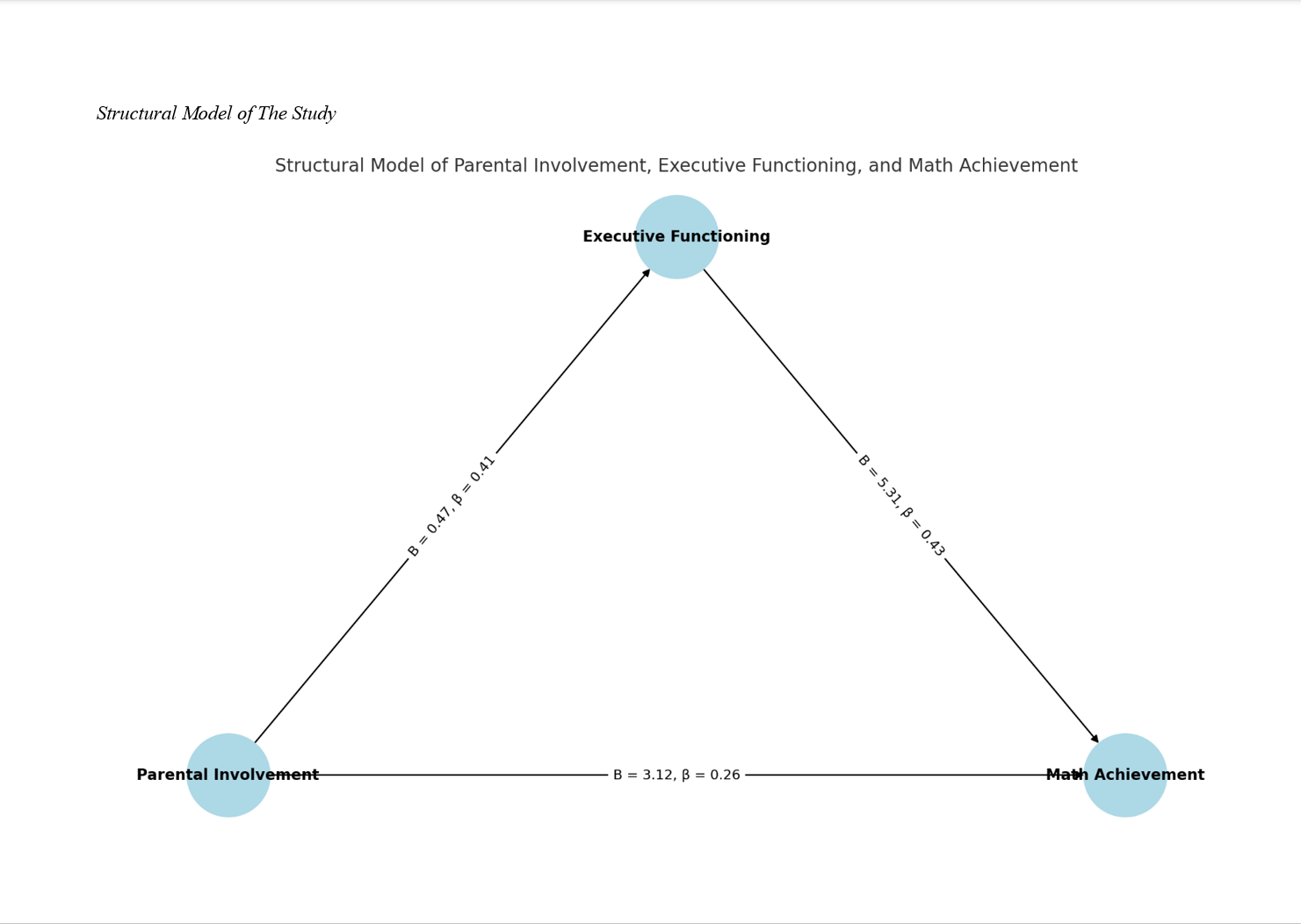
This study aimed to examine the mediating role of executive functioning in the relationship between parental involvement and math achievement among children with learning disabilities. A descriptive correlational research design was employed, involving 379 Malaysian parents of children aged 9 to 12 years diagnosed with learning disabilities. Participants were selected using stratified random sampling based on the Morgan and Krejcie (1970) sample size determination table. Data were collected using three validated instruments: the Parent and School Survey (PASS) to assess parental involvement, the Behavior Rating Inventory of Executive Function (BRIEF) to measure children's executive functioning, and the Math Composite of the Wechsler Individual Achievement Test–Third Edition (WIAT-III) for math achievement. Pearson correlation analysis was conducted using SPSS version 27, and structural equation modeling (SEM) was performed using AMOS version 21 to test the hypothesized mediation model and assess the model fit. Pearson correlation results indicated significant positive relationships among all variables: parental involvement and executive functioning (r = .41, p < .001), parental involvement and math achievement (r = .36, p < .001), and executive functioning and math achievement (r = .48, p < .001). The SEM revealed an acceptable model fit (χ²/df = 1.84, CFI = 0.97, RMSEA = 0.045), and confirmed that executive functioning significantly mediated the effect of parental involvement on math achievement. Both the direct effect (β = 0.26, p < .01) and the indirect effect through executive functioning (β = 0.18, p < .001) were statistically significant. The findings underscore the importance of executive functioning as a cognitive mechanism through which parental involvement enhances mathematical performance in children with learning disabilities. Educational interventions should integrate strategies to strengthen both parental engagement and children’s executive functioning skills to optimize academic outcomes.
Downloads
References
Alosoufe, L., & Abozead, S. E. (2024). Impact of Parental Possessiveness on the Academic Achievement of School Age Students at Ajloun Governorate, Jordan. International Journal of Research in Paediatric Nursing, 6(1), 87-94. https://doi.org/10.33545/26641291.2024.v6.i1b.156
Anbar, N., Cheie, L., & Visu‐Petra, L. (2022). Math Anxiety, Math Achievement and Gender Differences Among Primary School Children and Their Parents From Palestine. International Journal of Learning Teaching and Educational Research, 21(8), 326-334. https://doi.org/10.26803/ijlter.21.8.19
Banerji, R., Berry, J., & Shotland, M. (2017). The Impact of Maternal Literacy and Participation Programs: Evidence From a Randomized Evaluation in India. American Economic Journal Applied Economics, 9(4), 303-337. https://doi.org/10.1257/app.20150390
Betts, A. (2021). The RESET Framework: Examining Critical Factors in Parent-Child Math Participation. https://doi.org/10.22492/issn.2189-1036.2021.21
Çarkoğlu, C., Eason, S. H., & Purpura, D. J. (2023). Building the Parent and Child Math Anxiety Network Model From Empirical Evidence. Child Development Perspectives, 17(3-4), 115-121. https://doi.org/10.1111/cdep.12484
DiStefano, M., Retanal, F., Bureau, J. F., Hunt, T. E., Lafay, A., Osana, H. P., Skwarchuk, S. L., Trepiak, P., Xu, C., LeFevre, J. A., & Maloney, E. A. (2023). Relations Between Math Achievement, Math Anxiety, and the Quality of Parent–Child Interactions While Solving Math Problems. Education Sciences, 13(3), 307. https://doi.org/10.3390/educsci13030307
Im, H., & Kang, S.-J. (2023). The Relationship Between Parents’ Math Expectations and Children’s Math Achievements: Mediating Effects of Home Math Practices by Difficulty Level and Dependency on Private Math Education. Korean Journal of Child Studies, 44(4), 457-470. https://doi.org/10.5723/kjcs.2023.44.4.457
Jiawen, W., Barger, M. M., Oh, D. D., & Pomerantz, E. M. (2022). Parents’ Daily Involvement in Children’s Math Homework and Activities During Early Elementary School. Child development, 93(5), 1347-1364. https://doi.org/10.1111/cdev.13774
Kiss, A. J., & Vukovic, R. K. (2020). Exploring Educational Engagement for Parents With Math Anxiety. Psychology in the Schools, 58(2), 364-376. https://doi.org/10.1002/pits.22451
Kwon, K. A., Im, H., & Beisly, A. (2024). Parental Expectation, Attitudes, and Home Numeracy Environment in Korea and in the U.S.: Potential Sources of Asian Math Advantages. Education Sciences, 14(10), 1133. https://doi.org/10.3390/educsci14101133
Libertus, M. E. (2024). Parent-Focused Interventions to Support Children’s Early Math Learning. Current Directions in Psychological Science, 33(1), 3-9. https://doi.org/10.1177/09637214231212806
Liu, Y., & Leighton, J. P. (2021). Parental Self-Efficacy in Helping Children Succeed in School Favors Math Achievement. Frontiers in Education, 6. https://doi.org/10.3389/feduc.2021.657722
MacDonald, C., Oh, D. D., Barger, M. M., Cimpian, A., & Pomerantz, E. M. (2024). Does Inducing Growth-Oriented Mindsets About Math Ability in Parents Enhance Children’s Math Mindsets, Affect, and Achievement? Developmental Psychology, 60(12), 2396-2408. https://doi.org/10.1037/dev0001768
Oh, D. D., Barger, M. M., & Pomerantz, E. M. (2022). Parents’ Math Anxiety and Their Controlling and Autonomy-Supportive Involvement in Children’s Math Learning: Implications for Children’s Math Achievement. Developmental Psychology, 58(11), 2158-2170. https://doi.org/10.1037/dev0001422
Peixoto, F., Mata, L., Campos, M., Caetano, T., Radišić, J., & Niemivirta, M. (2023). ‘Am I to Blame Because My Child Is Not Motivated to Do Math?’: Relationships Between Parents’ Attitudes, Beliefs and Practices Towards Mathematics and Students’ Mathematics Motivation and Achievement. European Journal of Psychology of Education, 39(2), 1561-1586. https://doi.org/10.1007/s10212-023-00774-6
Poisall, M., Cook, O., Hart, S. A., Conlon, R. A., Barroso, C., Geer, E. A., & Ganley, C. M. (2023). Relations Between Parents' Math Anxiety and Children's Math Learning, and the Role of Homework Help. https://doi.org/10.31234/osf.io/7q4vr
Retanal, F., Johnston, N. B., Burr, S. D. L., Storozuk, A., DiStefano, M., & Maloney, E. A. (2021). Controlling-Supportive Homework Help Partially Explains the Relation Between Parents’ Math Anxiety and Children’s Math Achievement. Education Sciences, 11(10), 620. https://doi.org/10.3390/educsci11100620
Sánchez-Pérez, N., Fuentes, L. J., & González-Salinas, C. (2024). The Contribution of Children’s Effortful Control to Math Performance Is Partially Mediated by Math Anxiety. European Journal of Psychology of Education, 39(3), 2655-2679. https://doi.org/10.1007/s10212-024-00801-0
Schaeffer, M. W., Rozek, C. S., Berkowitz, T., Levine, S. C., & Beilock, S. L. (2018). Disassociating the Relation Between Parents’ Math Anxiety and Children’s Math Achievement: Long-Term Effects of a Math App Intervention. Journal of Experimental Psychology General, 147(12), 1782-1790. https://doi.org/10.1037/xge0000490
Šilinskas, G., & Kikas, E. (2017). Parental Involvement in Math Homework: Links to Children’s Performance and Motivation. Scandinavian Journal of Educational Research, 63(1), 17-37. https://doi.org/10.1080/00313831.2017.1324901
Silver, A. M., Elliott, L., & Libertus, M. E. (2022). Parental Math Input Is Not Uniformly Beneficial for Young Children: The Moderating Role of Inhibitory Control. Journal of Educational Psychology, 114(5), 1178-1191. https://doi.org/10.1037/edu0000679
Wang, H., Chen, Y., Yang, X., Yu, X., Zheng, K., Lin, Q., Cheng, X., & He, T. (2022). Different Associations of Parental Involvement With Children’s Learning of Chinese, English, and Math: A Three-Wave Longitudinal Study. European Journal of Psychology of Education, 38(1), 269-285. https://doi.org/10.1007/s10212-022-00605-0
Zhang, F., Jiang, Y., Ming, H., Ren, Y., Wang, L., & Huang, S. (2020). Family Socio‐economic Status and Children’s Academic Achievement: The Different Roles of Parental Academic Involvement and Subjective Social Mobility. British Journal of Educational Psychology, 90(3), 561-579. https://doi.org/10.1111/bjep.12374
Zhang, X., Hu, B. Y., Zou, X., & Ren, L. (2020). Parent–child Number Application Activities Predict Children’s Math Trajectories From Preschool to Primary School. Journal of Educational Psychology, 112(8), 1521-1531. https://doi.org/10.1037/edu0000457
Downloads
Additional Files
Publication Timeline
- Submitted
- Revised
- Accepted
Issue
Section
License
Copyright (c) 2025 Nur Sali (Author); Maryam Mohd Yusof (Corresponding Author); Norlela Abo Zaren (Author)

This work is licensed under a Creative Commons Attribution-NonCommercial 4.0 International License.