Impact of Sandplay Therapy in Reducing Self-Handicapping Behaviors and Improving the Quality of Life in Children with Autism Spectrum Disorder (ASD)
DOI:
https://doi.org/10.61838/kman.prien.3.2.5Keywords:
Sandplay Therapy, Autism Spectrum Disorder, Self-Handicapping, Quality of Life, Randomized Controlled Trial, Psychological InterventionAbstract
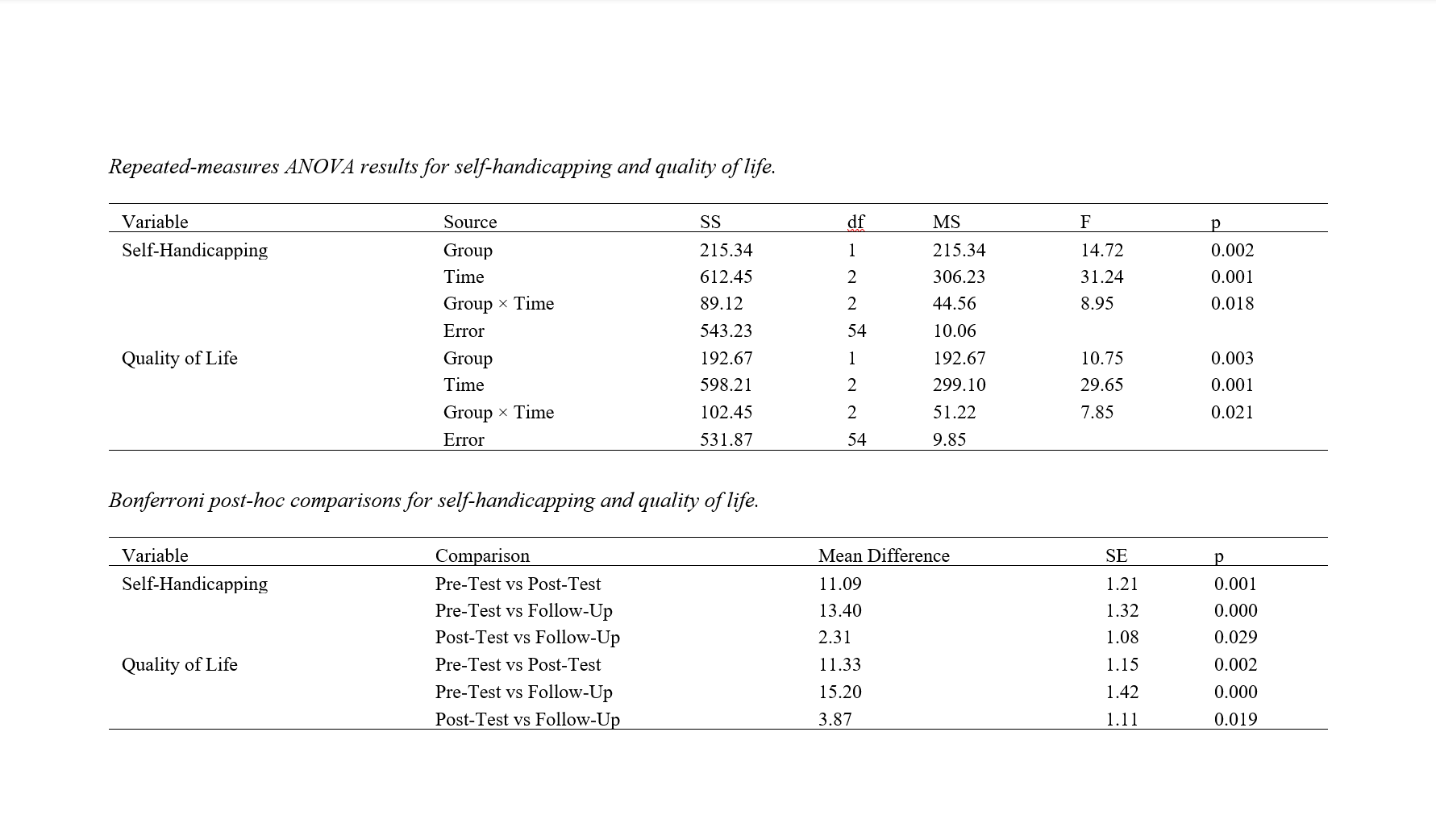
This study aimed to examine the effectiveness of Sandplay Therapy in reducing self-handicapping behaviors and improving the quality of life in children with autism spectrum disorder (ASD). A randomized controlled trial was conducted with 30 children diagnosed with ASD, who were randomly assigned to either the experimental group (n = 15) receiving Sandplay Therapy or the control group (n = 15) receiving no intervention. The intervention consisted of eight 90-minute sessions conducted over eight weeks. Self-handicapping behaviors were measured using the Self-Handicapping Scale (SHS), and quality of life was assessed using the Pediatric Quality of Life Inventory (PedsQL), both of which demonstrated established validity and reliability. Assessments were conducted at pre-test, post-test, and five-month follow-up. Data were analyzed using repeated-measures ANOVA, with post-hoc comparisons conducted using the Bonferroni test. The results indicated a significant reduction in self-handicapping behaviors in the experimental group from pre-test (M = 42.85, SD = 4.31) to post-test (M = 31.76, SD = 3.76) and further at follow-up (M = 29.45, SD = 3.45), while no significant changes were observed in the control group. Similarly, quality of life improved significantly in the experimental group, with scores increasing from pre-test (M = 52.12, SD = 5.12) to post-test (M = 63.45, SD = 4.78) and follow-up (M = 67.32, SD = 4.50), whereas the control group remained stable. ANOVA results confirmed significant main effects of time and group, as well as a significant interaction effect (p < 0.05). Bonferroni post-hoc comparisons indicated that improvements were sustained at follow-up. Sandplay Therapy is an effective intervention for reducing self-handicapping behaviors and enhancing the quality of life in children with ASD, with sustained benefits observed at follow-up. These findings highlight the potential of nonverbal, expressive therapies in supporting emotional regulation and adaptive functioning in children with ASD.
Downloads
References
Ammann, R. (2022). Sandplay: Traces in the Sand – Traces in the Brain. Journal of Analytical Psychology, 67(4), 962-978.https://doi.org/10.1111/1468-5922.12840
Cunningham, L. (2020). Ethical Issues in Sandplay Therapy Practice and Research, by Sana Loue, Editor. JST, 29(1).https://doi.org/10.61711/jst.2020.29.1s.109
Dickson, S. J., Oar, E. L., Kangas, M., Johnco, C. J., Lavell, C. H., Seaton, A. H., McLellan, L. F., Wuthrich, V. M., & Rapee, R. M. (2024). A systematic review and meta-analysis of impairment and quality of life in children and adolescents with anxiety disorders. Clinical Child and Family Psychology Review, 27(2), 342-356.https://doi.org/10.1007/s10567-024-00484-5
Freedle, L. R. (2022). Sandplay Therapy: An Evidence-Based Treatment. JST, 31(1),129-136.https://doi.org/10.61711/jst.2022.31.1.898
Hong, E. J., & Kim, H. E. (2022). A Study on the Symbols in the Sandplay Therapy of Children in Divorced Families by Age. Journal of Symbols & Sandplay Therapy, 13(1), 101-159.https://doi.org/10.12964/jsst.22003
Kalff, D. (2024). "Beyond the Shadow": The Special Lecture From the 6th International Congress of Sandplay Therapy in Japan. JST, 33(2), 119-141.https://doi.org/10.61711/jst.2024.33.2.553
Kaplan, J. (2019). Mandala: Circle of Transformation. JST, 28(1).https://doi.org/10.61711/jst.2019.28.1.876
Karimi, P., Baseri, A., & Razini, H. H. (2024). The effectiveness of mindfulness-based cognitive therapy on procrastination and self handicapping of students with academic failure. Rooyeshe-Ravanshenasi Journal (RRJ), 13(1), 171-180.https://frooyesh.ir/browse.php?a_id=3781&sid=1&slc_lang=en&ftxt=1
Khalid, N. F., Ramli, M., & Zaharudin, R. (2024). Exploring the Effectiveness of Sand Play Therapy on Emotional Regulation Among Autism Students Using the Fuzzy Delphi Method. International Journal of Education Psychology and Counseling, 9(56), 1141-1152.https://doi.org/10.35631/ijepc.956072
Kim, J., & Seong, N. (2023). An Exploratory Study on Sandplay Therapy for Enhancing School Adaptation of Elementary School Students: A Focus on Domestic Research Since 2010. Journal of Symbols & Sandplay Therapy, 14(3), 21-42.https://doi.org/10.12964/jsst.23009
Kim, J., Shin, H. J., Kim, M., Park, E.-K., Son, M., Oh, K.-H., Lee, N.-Y., Lee, S. J., Lee, E., Jeon, S., Ji, S., & Jang, M. (2021). Auto-Ethnography of Self-Growth Stories for the Individuation of School Counselors (Professional TeacherCounselors and Professional Counselors) Who Are Suffering From ‘Between’ - Based on Insight in Sandplay Therapy and Dream Analysis. Journal of Symbols & Sandplay Therapy, 12(2), 171-201.https://doi.org/10.12964/jsst.21010
LeBel, E. S. (2024). Archetypal Affects: Healing and Consciousness in Sandplay Therapy. JST, 33(1), 59-80.https://doi.org/10.61711/jst.2024.33.1.782
Matta, R. M. d., & Ramos, D. G. (2023). The Effectiveness of Sandplay Therapy Versus Cognitive Behavioral Therapy: A Comparative Study. Estudos De Psicologia (Campinas), 40. https://doi.org/10.1590/1982-0275202340e210099
Olaniyi, A. K., Atuheire, S., Lally, L., Kane, R., Danilova, I. S., Walker, C., Earls, L., & Holton, E. (2021). The Effects of Group Sand Play on the Psychological Health and Resilience of Street Children and Adolescents in Uganda. Journal of Symbols & Sandplay Therapy, 12(1), 235-268.https://doi.org/10.12964/jsst.21006
Parkinson, J. (2018). Landscapes and Maori Mythology in Aotearoa and in Sandplay Therapy. JST, 27(2).https://doi.org/10.61711/jst.2018.27.2.762
Rong-shuang, Z., & Zhou, Y. (2023). Research on the Therapeutic Effect of Sandplay Intervention on Emotional and Behavioral Problems of a Primary School Student. Journal of Contemporary Educational Research, 7(10), 173-178.https://doi.org/10.26689/jcer.v7i10.5474
Tan, J., Yin, H., Meng, T., & Guo, X. (2021). Effects of Sandplay Therapy in Reducing Emotional and Behavioural Problems in School‐age Children With Chronic Diseases: A Randomized Controlled Trial. Nursing Open, 8(6), 3099-3110. https://doi.org/10.1002/nop2.1022
Troudart, M. (2020). A Closed Letter and an Open Letter: On Dreams and Sandplay Scenes. JST, 29(1).https://doi.org/10.61711/jst.2020.29.1.243
Wiersma, J. K., Freedle, L. R., McRoberts, R., & Solberg, K. B. (2022). A Meta-Analysis of Sandplay Therapy Treatment Outcomes. International Journal of Play Therapy, 31(4), 197-215. https://doi.org/10.1037/pla0000180
Yeo Ho Soo Ah, S. (2019). Effect of Sandplay Therapy on Study Stress and Academic Self-Efficacy of Korean-Chinese Children*. Journal of Symbols & Sandplay Therapy, 10(2), 89-104.https://doi.org/10.12964/jsst.19011
Yuxi, R., Shuqi, J., Cong, L., Li, S., & Yueyu, L. (2024). A Systematic Review of the Effect of Sandplay Therapy on Social Communication Deficits in Children With Autism Spectrum Disorder. Frontiers in Pediatrics, 12.https://doi.org/10.3389/fped.2024.1454710
Zelcek, B., & Pouya, S. (2024). Investigation of the Effect of the Sandplay Therapy in the Open Area to Improve the Social Behaviour of Children With Autism Spectrum Disorder. Support for Learning, 39(3), 149-164.https://doi.org/10.1111/1467-9604.12486
Zhao, Q., & Chen, K. (2021). The Process and Effects of Group Sandplay on the Intervention of the Children’s Problem Behaviour From the Perspective of Mentalization.https://doi.org/10.21203/rs.3.rs-384441/v1
Downloads
Additional Files
Publication Timeline
Issue
Section
License

This work is licensed under a Creative Commons Attribution-NonCommercial 4.0 International License.