Identifying Key Components of Identity Development in Adolescents with Sensory Impairments
DOI:
https://doi.org/10.61838/kman.prien.3.2.2Keywords:
Adolescents, sensory impairments, identity development, social inclusion, self-perception, cultural belonging, coping strategiesAbstract
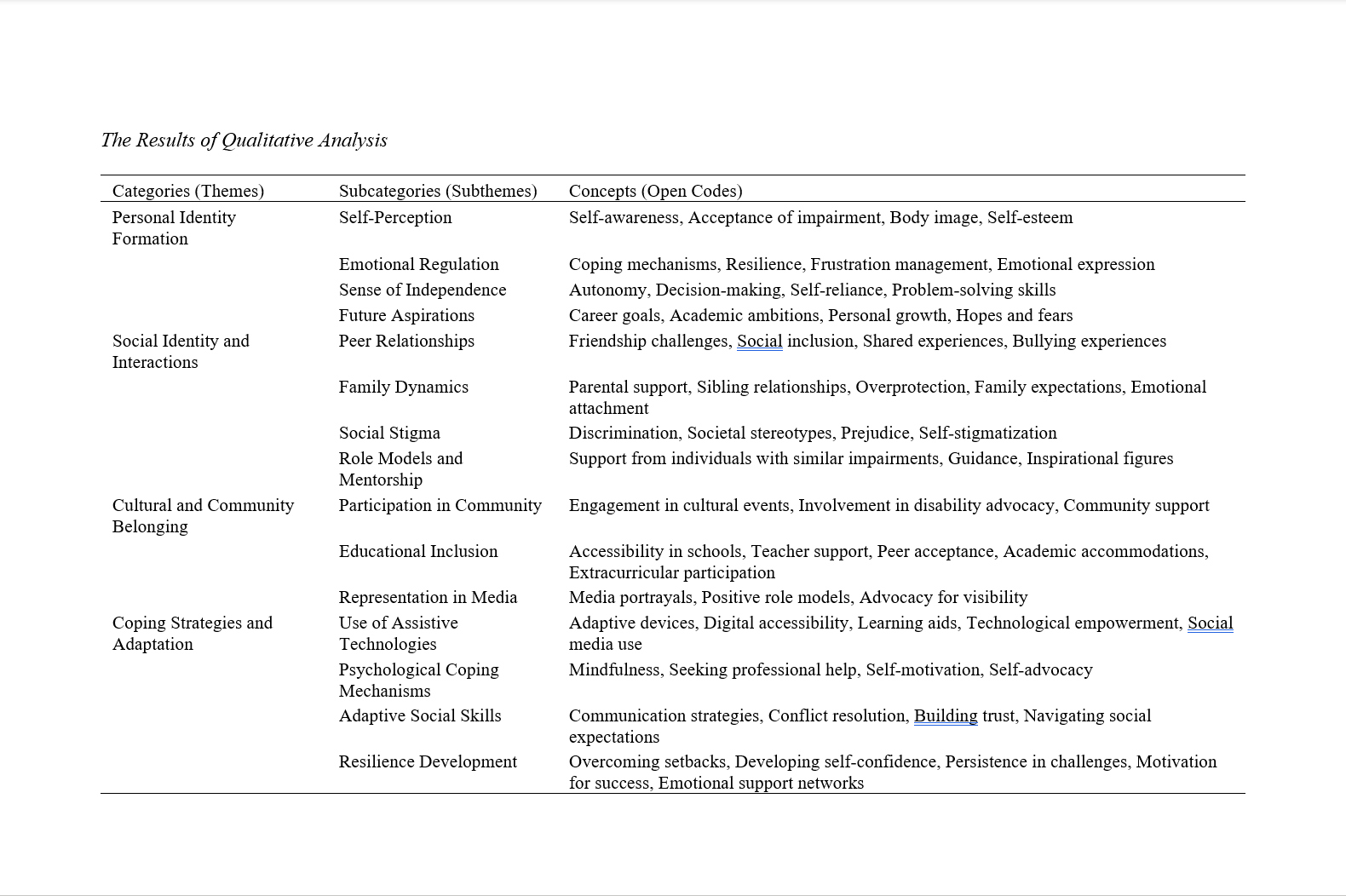
This study aimed to explore the key components of identity development in adolescents with sensory impairments. This qualitative study employed a phenomenological approach to examine the lived experiences of adolescents with sensory impairments. Data were collected through semi-structured interviews with 31 participants recruited via online platforms. Theoretical saturation was reached, ensuring a comprehensive understanding of identity development in this population. Interviews were transcribed and analyzed using thematic analysis, with NVivo software facilitating the identification of core themes and subthemes. The results highlighted four primary themes shaping identity development in adolescents with sensory impairments. Personal identity formation was influenced by self-perception, emotional regulation, autonomy, and future aspirations. Social identity was shaped by peer relationships, family dynamics, social stigma, and the presence of mentors. Cultural and community belonging emerged as a significant factor, with participants emphasizing the role of cultural engagement, media representation, and community participation in shaping their identity. Coping strategies, including the use of assistive technologies, psychological resilience, and adaptive social skills, were found to play a crucial role in navigating identity-related challenges. These findings align with existing literature emphasizing the intersection of self-perception, social interactions, and cultural narratives in identity formation. The study underscores the complexity of identity development in adolescents with sensory impairments, highlighting the interplay between personal, social, cultural, and adaptive factors. The findings suggest that fostering inclusive educational environments, providing mentorship opportunities, and improving media representation can positively impact identity formation in this population. Further research is needed to explore identity development across diverse cultural and socioeconomic backgrounds to develop targeted interventions.
Downloads
References
Cakar, M. E., Cummings, K. K., Bookheimer, S. Y., Dapretto, M., & Green, S. A. (2023). Age-Related Changes in Neural Responses to Sensory Stimulation in Autism: A CrossSectional Study. Molecular Autism, 14(1). https://doi.org/10.1186/s13229-023-00571-4
Cakar, M. E., Okada, N. J., Cummings, K. K., Jung, J., Bookheimer, S. Y., Dapretto, M., & Green, S. A. (2024). Functional Connectivity of the Sensorimotor Cerebellum in Autism: Associations With Sensory Over-Responsivity. Frontiers in Psychiatry,15. https://doi.org/10.3389/fpsyt.2024.1337921
Cushley, L., Mo, M., Petõ, T., & Jackson, A. J. (2024). The Impact of COVID-19 on People With a Visual Impairment in Northern Ireland: A Sensory Support View. International journal of environmental research and public health, 21(12),1701. https://doi.org/10.3390/ijerph21121701
Gaya, S., & Ahmad, N. (2024). The Concept of Islamic Identity and Its Importance for Muslim Youth. Al Daulah Jurnal Hukum Pidana Dan Ketatanegaraan,13(1),34-49. https://doi.org/10.24252/al-daulah.v13i1.46879
Hocking, M. C., Albee, M., Brodsky, C., Shabason, E. K., Wang, L., Schultz, R. T., & Herrington, J. D. (2021). Face Processing and Social Functioning in Pediatric Brain Tumor Survivors. Journal of Pediatric Psychology, 46(10), 1267-1275. https://doi.org/10.1093/jpepsy/jsab067
karvonen, M., Goth, K., Eloranta, S. J., & Kaltiala‐Heino, R. (2022). Identity Integration in Adolescents With Features of Gender Dysphoria Compared to Adolescents in General Population. Frontiers in Psychiatry, 13. https://doi.org/10.3389/fpsyt.2022.848282
Katz‐Wise, S. L., Galman, S. C., Friedman, L. E., & Kidd, K. M. (2021). Parent/Caregiver Narratives of Challenges Related to Raising Transgender and/or Nonbinary Youth. Journal of Family Issues,43(12),3321-3345.https://doi.org/10.1177/0192513x211044484
Khanlou, N. (2021). Year 2020: How Will It Impact Identities of Children and Youth Over Time? International journal of mental health and addiction, 20(3), 1834-1836.https://doi.org/10.1007/s11469-021-00484-4
Leal, A. S. M., Alba, L. A., Cummings, K. K., Jung, J., Waizman, Y., Moreira, J. F. G., Saragosa‐Harris, N. M., Ninova, E., Waterman, J., Langley, A. K., Tottenham, N., Silvers, J. A., & Green, S. A. (2022). Sensory Processing Challenges as a Novel Link Between Early Caregiving Experiences and Mental Health. Development and Psychopathology, 35(4), 1968-1981. https://doi.org/10.1017/s0954579422000633
Lindsay, S., Dain, N., & Hsu, S. (2024). Exploring the Employment Experiences of Young Adults With Multiple Minoritized Identities: A Qualitative Study Focusing on Race and NonApparent Disabilities. PLoS One, 19(11), e0313295. https://doi.org/10.1371/journal.pone.0313295
Mah, H. Y., Ishak, W. S., & Rahman, M. H. A. (2020). Prevalence and Risk Factors of Dual Sensory Impairment Among Community‐dwelling Older Adults in Selangor: A Secondary Data Analysis. Geriatrics and Gerontology International, 20(10), 911-916. https://doi.org/10.1111/ggi.14011 Nambuwasam, S. G., Liyanage, S., & Yatigammana, M. R. K. N. (2024). A Review on the Ict Literacy Acquisition of Moderate Hearing-Impaired Youth by Adapted Constructivism and Learnativity Content Development. European Journal of Special Education Research, 10(4).https://doi.org/10.46827/ejse.v10i4.5467
Nieman, C. L., & Deal, J. A. (2024). Advancing the Science of Sensory Health and Cognition: From Epidemiology to Intervention. Innovation in Aging, 8(Supplement_1), 609-609. https://doi.org/10.1093/geroni/igae098.1995
Nikita, R., & Asha, N. (2024). Challenges Faced by Visually Impaired Educated Youth in Seeking Jobs: The SocioTechnical Approach. International Journal of Transformations in Business Management, 14(2), 1-5. https://doi.org/10.37648/ijtbm.v14i02.001
Osborne, K. J., Kraus, B., Curran, T., Earls, H. A., & Mittal, V. A. (2021). An Event-Related Potential Investigation of Early Visual Processing Deficits During Face Perception in Youth at Clinical High Risk for Psychosis. Schizophrenia Bulletin, 48(1), 90-99. https://doi.org/10.1093/schbul/sbab068 Pandi, S. E., Gainau, M. S., Kabanga, L., & E.A.Y.Karetji, N. (2024). Strengthening Christian Values in the Formation of Adolescent Identity at Gloria Sentani High School. Abdi Masyarakat,6(1),51.https://doi.org/10.58258/abdi.v6i1.6969
Patterson, G., Cummings, K. K., Jung, J., Okada, N. J., Tottenham, N., Bookheimer, S. Y., Dapretto, M., & Green, S. A. (2021). Effects of Sensory Distraction and Salience Priming on Emotion Identification in Autism: An fMRI Study. Journal of Neurodevelopmental Disorders,13(1). https://doi.org/10.1186/s11689-021-09391-0
Prasanth, A. P., Ralimol, M. R., & Girish, S. (2024). A Qualitative Study on Kerala Youth Diaspora. Journal of Business Management and Information Systems, 11, 7-14. https://doi.org/10.48001/jbmis.2024.si1002
Rivas‐Drake, D., Pinetta, B. J., Juang, L. P., & Agi, A. (2021). Ethnic-Racial Identity as a Source of Resilience and Resistance in the Context of Racism and Xenophobia. Review of General Psychology, 26(3), 317-326.https://doi.org/10.1177/10892680211056318
S., S. K. (2023). Impact of Cultural Globalisation on Indian Youth:Facing the Challenges of Dialectical Identity. International Journal for Multidisciplinary Research,5(6). https://doi.org/10.36948/ijfmr.2023.v05i06.11064
Sánchez, A. M., Pool, J., Bower, J., Paasch, V., & Magee, W. L. (2023). Best Practice Recommendations for Using Music With Children and Young People With Disorders of Consciousness. Music and Medicine, 15(1). https://doi.org/10.47513/mmd.v15i1.885
Sirju, T. (2021). Negotiating Identity : Indo-Trinidadian Youth and Their Perceptions of Self Definition and Agency. https://doi.org/10.32920/ryerson.14643714.v1
Subramanian, L., & Kattumuri, R. (2024). Comparison of Scheduled Caste Youth Lifestyles and Those of Other Castes in Tamil Nadu: Youth Subculture and Identity. Young. https://doi.org/10.1177/11033088241284479
Downloads
Additional Files
Publication Timeline
Issue
Section
License

This work is licensed under a Creative Commons Attribution-NonCommercial 4.0 International License.