The Effect of Play Therapy on Sensory Processing and Distress Tolerance in Adolescents with Mild Intellectual Disabilities
DOI:
https://doi.org/10.61838/kman.prien.3.1.4Keywords:
Play therapy, sensory processing, distress tolerance, intellectual disabilities, adolescent intervention, emotional regulationAbstract
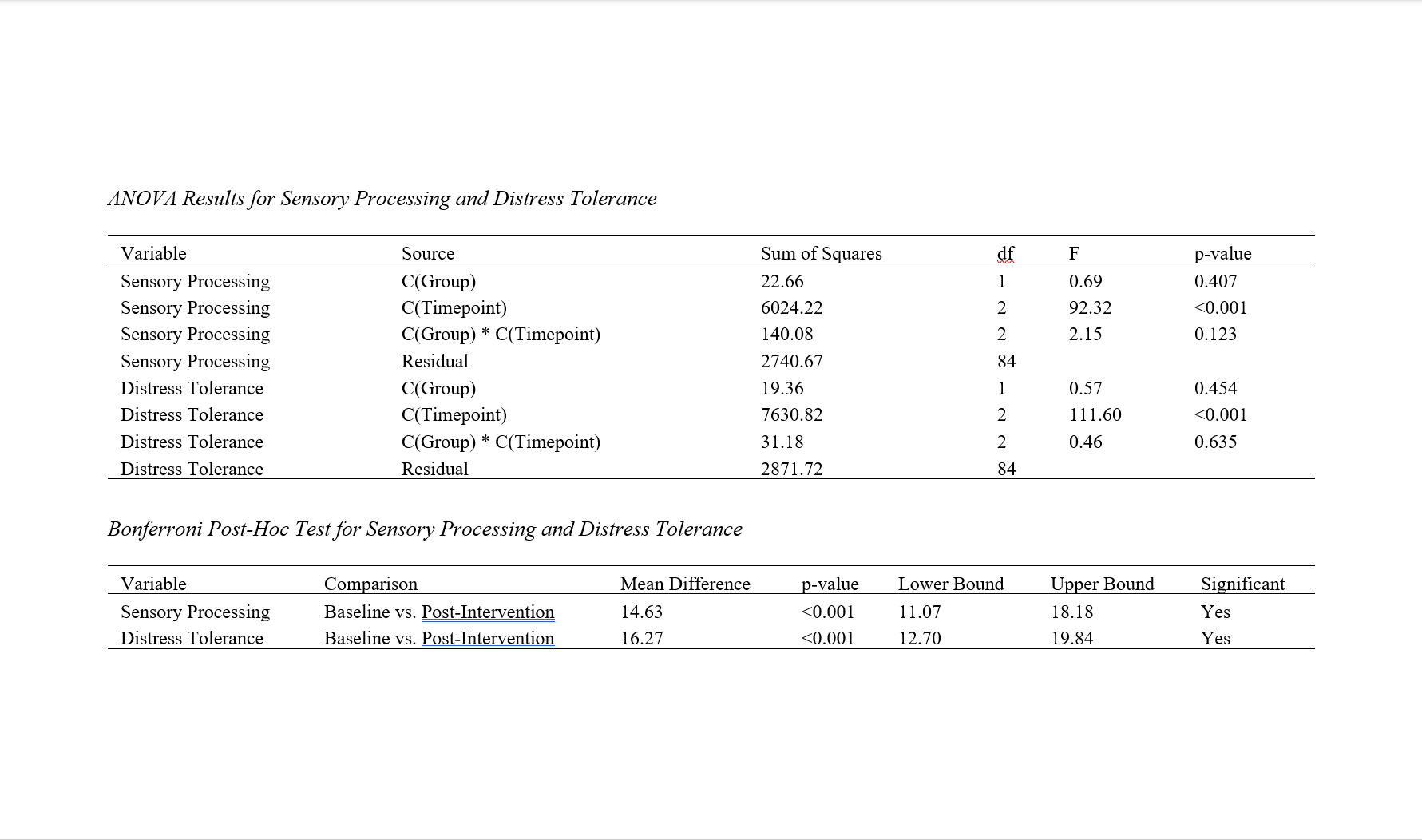
This study aimed to examine the effectiveness of play therapy in improving sensory processing and distress tolerance in adolescents with mild intellectual disabilities. A randomized controlled trial was conducted with 30 adolescents aged 12 to 17 years, randomly assigned to either an intervention group (n = 15) receiving eight 90-minute sessions of play therapy or a control group (n = 15) receiving no intervention. Sensory processing and distress tolerance were assessed at baseline, post-intervention, and five-month follow-up using standardized measures. Data analysis was performed using repeated-measures analysis of variance (ANOVA) and Bonferroni post-hoc tests in SPSS-27 to evaluate within-group and between-group differences over time. The results indicated a significant main effect of time for both sensory processing (F(2, 84) = 92.32, p < 0.001) and distress tolerance (F(2, 84) = 111.60, p < 0.001), demonstrating substantial improvements across timepoints. The intervention group showed a notable increase in sensory processing scores from baseline (M = 48.72, SD = 5.91) to post-intervention (M = 64.15, SD = 6.38) and follow-up (M = 69.03, SD = 5.79), whereas the control group exhibited minimal change. Similarly, distress tolerance scores improved significantly in the intervention group (baseline: M = 42.85, SD = 6.27; post-intervention: M = 58.74, SD = 5.69; follow-up: M = 63.92, SD = 6.08), with no substantial improvement in the control group. The Bonferroni post-hoc test confirmed significant pairwise differences between baseline and subsequent assessments. Play therapy was found to be an effective intervention for enhancing sensory processing and distress tolerance in adolescents with mild intellectual disabilities, with improvements sustained at follow-up. These findings suggest that play-based interventions can be a valuable therapeutic approach for promoting sensory integration and emotional regulation in this population.
Downloads
References
Ahn, S.-N., & Hwang, J. H. (2022). Effects of Proprioception Based Therapy on Sensory Processing and Problematic Behavior in Children With Developmental Delay. The Korean Society of Cognitive Therapeutic Exercise, 14(1), 1-8.https://doi.org/10.29144/kscte.2022.14.1.01
Bakhtiari, M., & Pourdel, M. (2024). The Effectiveness of Cognitive-Behavioral Therapy on Distress Tolerance and Resilience in Women with Substance-Dependent Incarcerated Spouses. etiadpajohi, 17(70), 267-288.https://doi.org/10.61186/etiadpajohi.17.70.267
Brugnaro, B. H., Pauletti, M. F., Carlos Roberto Gonçalves de, L., Verdério, B. N., Fonseca-Angulo, R., Romão‐Silva, B., Campos, A. C. d., Rosenbaum, P., & Nelci Adriana Cicuto Ferreira, R. (2024). Relationship Between Sensory Processing Patterns and Gross Motor Function of Children and Adolescents With Down Syndrome and Typical Development: A Cross‐sectional Study. Journal of Intellectual Disability Research, 68(4), 358-368.https://doi.org/10.1111/jir.13118
Choi, Y., & Jung, H. (2021). Sensory Processing as a Predictor of Leisure Participation in Early Adolescents. Children, 8(11),1005.https://doi.org/10.3390/children8111005
Dal, B. T., Çetin, B., Şimşek, E., & Bumin, G. (2023). Exploring Sensory Processing Abilities in Adults With Acquired Hearing Loss. The Journal of Laryngology & Otology, 138(5),496-502. https://doi.org/10.1017/s0022215123001779
Fabio, R. A., & Suriano, R. (2024). The Role of Smartphone Use in Sensory Processing: Differences Between Adolescents With ADHD and Typical Development. International journal of environmental research and public health, 21(12), 1705.https://doi.org/10.3390/ijerph21121705
Fischer, K., Larsen, H., Alithe, L. v. d. A., & Overbeek, G. (2022). The Role of Sensory Processing Sensitivity in the Longitudinal Associations Between Relationship Qualities With Parents and Peers and Externalizing Behavior in Adolescence. Journal of Social and Personal Relationships, 39(8), 2549-2571.https://doi.org/10.1177/02654075221083962
Genizi, J., Halevy, A., Schertz, M., Osman, K., Assaf, N., Segal, I., Sr, I., Kessel, A., & Engel‐Yeger, B. (2020). Sensory Processing Patterns Affect Headache Severity Among Adolescents With Migraine.https://doi.org/10.21203/rs.3.rs-16925/v1
Goycolea, R., Angulo, C., Henríquez, C. F. S., & Ayuso, D. M. R. (2024). Sensory Profile Applications in Adolescents and Adults in the Health Care: A Narrative Review of the Literature. Cadernos Brasileiros De Terapia Ocupacional, 32.https://doi.org/10.1590/2526-8910.ctoar270635302
Hattori, R., Irie, K., Mori, T., Tsurumi, K., Murai, T., & Inadomi, H. (2023). Sensory Processing, Autonomic Nervous Function, and Social Participation in People With Mental Illnesses. Hong Kong Journal of Occupational Therapy, 36(1), 39-47.https://doi.org/10.1177/15691861231177355
Hochreuter, J. (2025). Painfully Sensitive: How Sensory Processing Sensitivity Affects Healthy Adolescents’ Perception of Pain. Journal of Pain Research, Volume 18,719-733. https://doi.org/10.2147/jpr.s473575
Kerley, L., Meredith, P., & Harnett, P. (2022). The Relationship Between Sensory Processing and Attachment Patterns: A Scoping Review. Canadian Journal of Occupational Therapy, 90(1), 79-91.https://doi.org/10.1177/00084174221102726
Kitajima, T., Otani, R., Inoue, T., Matsushima, N., Matsubara, N., & Sakuta, R. (2022). Sensory Processing in Children and Adolescents Shortly After the Onset of Anorexia Nervosa: A Pilot Study. BioPsychoSocial Medicine, 16(1).https://doi.org/10.1186/s13030-022-00256-z
Marzolla, M. C., Resch, C., Hurks, P. P. M., Schepers, J., Borghans, L., Rietman, A. B., Heugten, C. v., & Renaud, I. (2024). Sensory Processing Patterns in Pediatric Mild Traumatic Brain Injury: A Longitudinal Study.https://doi.org/10.31234/osf.io/2dzup
Metz, A. E., Boling, D., DeVore, A., Holladay, H., Karmol, K., & Liao, J. F. (2019). Dunn’s Model of Sensory Processing: An Investigation of the Axes of the Four-Quadrant Model in Healthy Adults. American Journal of Occupational Therapy, 73(4_Supplement_1), 7311505148p7311505141-7311505148p7311505141.https://doi.org/10.5014/ajot.2019.73s1-po5011
Miller, D., Schoen, S., Schmitt, C. M., & Porter, L. M. (2023). Adolescents’ and Adults’ Perceptions of Sensory-Based Interventions: A Qualitative Analysis. American Journal of Occupational Therapy, 77(5).https://doi.org/10.5014/ajot.2023.050198
Pickard, H., Hirsch, C. R., Simonoff, E., & Happé, F. (2020). Exploring the Cognitive, Emotional and Sensory Correlates of Social Anxiety in Autistic and Neurotypical Adolescents. Journal of Child Psychology and Psychiatry, 61(12), 1317-1327.https://doi.org/10.1111/jcpp.13214
Pride, N. A., Haebich, K. M., Walsh, K. S., Lami, F., Rouel, M., Maier, A., Chisholm, A. K., Lorenzo, J., Hearps, S., North, K. N., & Payne, J. M. (2023). Sensory Processing in Children and Adolescents With Neurofibromatosis Type 1. Cancers, 15(14), 3612.https://doi.org/10.3390/cancers15143612 Rajić, I. (2025). Sensory Processing Sensitivity in Adolescence. Di,33(4), 489-501.https://doi.org/10.5559/di.33.4.01
Rathnakumar, D. (2020). Play Therapy and Children With Intellectual Disability. Shanlax International Journal of Education, 8(2), 35-42.https://doi.org/10.34293/education.v8i2.2299
Riquelme, I., Hatem, S. M., Sabater-Gárriz, Á., & Montoya, P. (2023). A Multidimensional Investigation of the Relationship Between Skin-Mediated Somatosensory Signals, Emotion Regulation and Behavior Problems in Autistic Children. Frontiers in Neuroscience, 17.https://doi.org/10.3389/fnins.2023.1227173
Stern, B. Z., Strober, L. B., & Goverover, Y. (2020). Relationship Between Sensory Processing Patterns, Trait Anxiety, and Health-Related Quality of Life in Multiple Sclerosis. Journal of Health Psychology, 26(12), 2106-2117.https://doi.org/10.1177/1359105319901316
Taheri, K., Zarei, M. A., & Esmaili, S. K. (2024). Sensory Processing Measure Tools for Adolescents Aged 12 to 21 Years. Function and Disability Journal, 7(1), 0-0.https://doi.org/10.32598/fdj.7.71.3
Downloads
Additional Files
Publication Timeline
Issue
Section
License

This work is licensed under a Creative Commons Attribution-NonCommercial 4.0 International License.