Emotion Socialization and Grit as Determinants of Academic Self-Concept in Children with Hearing Impairments
DOI:
https://doi.org/10.61838/kman.prien.2.4.6Keywords:
academic self-concept, hearing impairments, emotion socialization, grit, children, educational psychology, predictive factorsAbstract
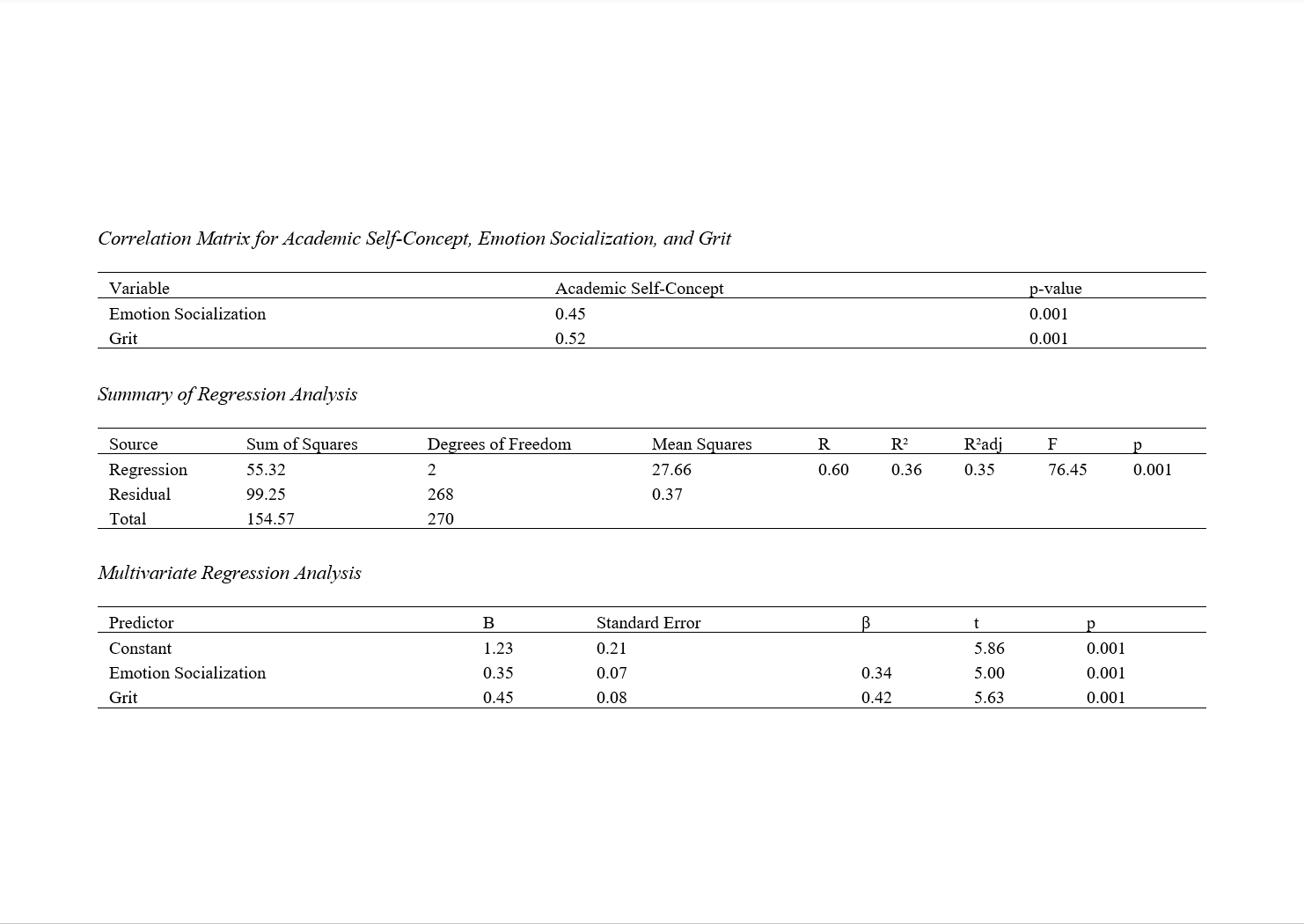
This study aimed to investigate the predictors of academic self-concept in children with hearing impairments, focusing on the roles of emotion socialization and grit. Understanding these relationships can inform interventions to support the academic success and well-being of these children. The study employed a cross-sectional design with a sample of 271 children with hearing impairments, selected based on the Morgan and Krejcie table. Participants were assessed using the Self-Description Questionnaire I for academic self-concept, the Coping with Children's Negative Emotions Scale for emotion socialization, and the Grit Scale. Data were analyzed using Pearson correlation to examine bivariate relationships and linear regression to evaluate the predictive power of emotion socialization and grit on academic self-concept, using SPSS-27. Descriptive statistics indicated moderately high levels of academic self-concept (M = 3.45, SD = 0.58), emotion socialization (M = 4.12, SD = 0.73), and grit (M = 3.89, SD = 0.65). Pearson correlation showed significant positive relationships between academic self-concept and both emotion socialization (r = 0.45, p < 0.001) and grit (r = 0.52, p < 0.001). The regression model was significant (F(2, 268) = 76.45, p < 0.001), explaining 36% of the variance in academic self-concept (R² = 0.36). Emotion socialization (B = 0.35, p < 0.001) and grit (B = 0.45, p < 0.001) were significant predictors of academic self-concept. The study found that both emotion socialization and grit are significant predictors of academic self-concept in children with hearing impairments. These findings suggest that interventions aimed at improving emotion socialization practices and fostering grit could enhance the academic self-concept of these children, supporting their academic success and overall well-being.
Downloads
References
Aghaziarati, A., Karevan Brojerdi, K., Bedayat, E., & Asgari, M. (2020). The Relationship between Social Cognition and Academic Performance with The Mediating Role of Cognitive Abilities and Academic Emotion in Students. Education Strategies in Medical Sciences, 13(4), 371-381.https://edcbmj.ir/article-1-2079-en.html
Ain, Q. u. (2024). Exploring the Efficacy of Self-Concept and Psychosocial Skill Enhancement Interventions in HearingImpaired Children: A Comparative Analysis. Migration Letters, 21(S7), 413-420.https://doi.org/10.59670/ml.v21is7.8698
Al, R., Azab, S. N., Sabealah, M. R. A., Mufadhi, E. A. A., & rawely, A. A. (2019). Anxiety and Language Development Correlation in Hearing Impaired Children. Scholarly Journal of Otolaryngology, 3(3).https://doi.org/10.32474/sjo.2019.03.000161
Areepattamannil, S., & Freeman, J. (2008). Academic Achievement, Academic Self-Concept, and Academic Motivation of Immigrant Adolescents in the Greater Toronto Area Secondary Schools. Journal of Advanced Academics.https://doi.org/10.4219/jaa-2008-831
Athe, R., Dwivedi, R., Sahoo, K. C., Bhattacharya, D., & Jain, S. (2021). A Systematic Review and Meta-Analysis of Screening and Diagnostic Accuracy for Hearing Loss Among UnderFive Children in South-Asian Region. International Journal of Human Rights in Healthcare, 15(3), 305-317.https://doi.org/10.1108/ijhrh-01-2021-0018
Azab, S. N., & Kamel, A. M. A. (2015). Correlation Between Anxiety Related Emotional Disorders and Language Development in Hearing-Impaired Egyptian Arabic Speaking Children. Journal of Communication Disorders Deaf Studies & Hearing Aids,03(03).https://doi.org/10.4172/2375-4427.1000137
Basharpoor, S., & Heidari, F. (2022). The model of structural relationships of family cohesion /adaptability, academic selfconcept and social acceptability with school adjustment: the mediator role of educational engagement. Journal of School Psychology, 11(2), 6-20.https://www.magiran.com/paper/2485315
Berg, D. H., & Klinger, D. A. (2009). Gender Differences in the Relationship Between Academic Self-Concept and SelfReported Depressed Mood in School Children. Sex Roles, 61(7-8), 501-509.https://doi.org/10.1007/s11199-009-9652-2
Bølstad, E., Havighurst, S. S., Tamnes, C. K., Nygaard, E., Bjørk, R. F., Stavrinou, M., & Espeseth, T. (2021). A Pilot Study of a Parent Emotion Socialization Intervention: Impact on Parent Behavior, Child Self-Regulation, and Adjustment [OriginalResearch]. Frontiers in psychology, 12.https://doi.org/10.3389/fpsyg.2021.730278
Breaux, R., Eadeh, H.-M., Swanson, C. S., & McQuade, J. D. (2022). Adolescent Emotionality and Emotion Regulation in the Context of Parent Emotion Socialization Among Adolescents with Neurodevelopmental Disorders: A Call to Action with Pilot Data. Research on Child and Adolescent Psychopathology, 50(1), 77-88.https://doi.org/10.1007/s10802-021-00833-w
Buchmann, M., Grütter, J., & Zuffianò, A. (2021). Parental Educational Aspirations and Children’s Academic Self‐concept: Disentangling State and Trait Components on Their Dynamic Interplay. Child development, 93(1), 7-24.https://doi.org/10.1111/cdev.13645
Buckholdt, K. E., Parra, G. R., & Jobe-Shields, L. (2009). Emotion regulation as a mediator of the relation between emotion socialization and deliberate self-harm. American Journal of Orthopsychiatry, 79(4), 482-490.https://doi.org/10.1037/a0016735
Cézar, R. F., Pinto, N. S., & Garrido, D. (2021). Can Mathematics Achievement Be Predicted? The Role of Cognitive–Behavioral–Emotional Variables. Mathematics, 9(14), 1591.https://doi.org/10.3390/math9141591
Chen, F. (2024). Do We Know Enough About Negative Parenting? Recent Evidence on Parenting Styles and Child Maladjustment. The European Journal of Psychology Applied to Legal Context, 16(1), 37-48.https://doi.org/10.5093/ejpalc2024a4
Coelho, V. A., Marchante, M., & Sousa, V. (2016). Positive Attitude Program’s Impact Upon Self-Concept Across Childhood and Adolescence // Emociones Positivas, Apoyo a La Autonomía Y Rendimiento De Estudiantes Universitarios: El Papel Mediador Del Compromiso Académico Y La Autoeficacia. Revista de Psicodidáctica, 21(2), 261-280.https://doi.org/10.1387/revpsicodidact.15129
Coelho, V. A., Sousa, V., & Figueira, A. P. C. (2014). The Impact of a School-Based Social and Emotional Learning Program on the Self-Concept of Middle School Students // O Impacto De Um Programa Escolar De Aprendizagem Socioemocional Sobre O Autoconceito De Alunos De 3º Ciclo. Revista de Psicodidáctica, 19(2), 347-365.https://doi.org/10.1387/revpsicodidact.10714
Cueli, M., Pérez, C. R., Cañamero, L. M., Núñez, J. C., & Castro, P. G. (2020). Self-Concept and Inattention or Hyperactivity–Impulsivity Symptomatology: The Role of Anxiety. Brain Sciences, 10(4), 250.https://doi.org/10.3390/brainsci10040250
Cui, L., Criss, M. M., Ratliff, E., Wu, Z., Houltberg, B. J., Silk, J. S., & Morris, A. S. (2020). Longitudinal links between maternal and peer emotion socialization and adolescent girls’ socioemotional adjustmentAmerican Psychological
Association. Desoky, H., Raaft, O., & Azab, S. N. (2021). PsychoCommunicative Interruptions in Hearing-Impaired Egyptian Arabic-Speaking Children. Beni-Suef University Journal of Basic and Applied Sciences, 10(1).https://doi.org/10.1186/s43088-021-00124-9
Dyer, N., Luo, W., & Kwok, O.-M. (2009). Effects of Peer Academic Reputation on Achievement in Academically atRisk Elementary Students. Journal of Applied Developmental Psychology, 30(2), 182-194.https://doi.org/10.1016/j.appdev.2008.12.008
Haktanir, A., Watson, J. C., Ermis-Demirtas, H., Karaman, M. A., Freeman, P. D., Kumaran, A., & Streeter, A. (2018). Resilience, Academic Self-Concept, and College Adjustment Among First-Year Students. Journal of College Student Retention: Research, Theory & Practice, 23(1), 161-178.https://doi.org/10.1177/1521025118810666
Haugan, J. A., Frostad, P., & Mjaavatn, P. E. (2021). Girls Suffer: The Prevalence and Predicting Factors of Emotional Problems Among Adolescents During Upper Secondary School in Norway. Social Psychology of Education, 24(3), 609-634.https://doi.org/10.1007/s11218-021-09626-x
Korucu, I., Aytürk, E., Finders, J. K., Schnur, G., Bailey, C. S., Tominey, S. L., & Schmitt, S. A. (2022). Self Regulation in Preschool: Examining Its Factor Structure and Associations With Pre-Academic Skills and Social-Emotional Competence. Frontiers in psychology, 12.https://doi.org/10.3389/fpsyg.2021.717317
Lohbeck, A., & Moschner, B. (2021). Motivational Regulation Strategies, Academic Self-Concept, and Cognitive Learning Strategies of University Students: Does Academic SelfConcept Play an Interactive Role? European Journal of Psychology of Education.https://doi.org/10.1007/s10212-021-00583-9
Malahi, F., & Tabodi, M. (2020). A study of academic self-concept in relation to students' hopes of studying in the first year of high school. medical journal of mashhad university of medical sciences, 62(5.1), 507-517.https://doi.org/10.22038/mjms.2019.15344
McQuade, J. D., & Breaux, R. P. (2017). Parent emotion socialization and pre-adolescent’s social and emotional adjustment: Moderating effects of autonomic nervous system reactivity. Biological Psychology, 130, 67-76.https://doi.org/10.1016/j.biopsycho.2017.10.007
Nejatifar, S., Aghaziarati, A., & Abedi, A. (2021). Developing a Model of Academic Satisfaction in Gifted Students based on the Factors Affecting It: A Grounded Theory Study. Psychology of Exceptional Individuals, 11(43), 141-174.https://doi.org/10.22054/jpe.2022.59758.2298
Niehaus, K., & Adelson, J. L. (2013). Self-Concept and Native Language Background: A Study of Measurement Invariance and Cross-Group Comparisons in Third Grade. Journal of Educational Psychology, 105(1), 226-240.https://doi.org/10.1037/a0030556
Pinxten, M., Wouters, S., Preckel, F., Niepel, C., De Fraine, B., & Verschueren, K. (2015). The formation of academic selfconcept in elementary education: A unifying model for external and internal comparisons. Contemporary Educational Psychology, 41, 124-132.https://www.sciencedirect.com/science/article/pii/S0361476X14000769
Primi, R., Santos, D., John, O. P., & Fruyt, F. D. (2016).Development of an Inventory Assessing Social and Emotional Skills in Brazilian Youth. European Journal of Psychological Assessment, 32(1), 5-16.https://doi.org/10.1027/1015-5759/a000343
Rehman, A. U. (2024). Exploring Disparities in Emotional Intelligence Among Hearing Impaired Students From Segregated and Inclusive Education Systems. JHRR, 4(1),1143-1147.https://doi.org/10.61919/jhrr.v4i1.589
Rowena, V. D. L. C., & Colendrino, M. C. (2018). Using Books in Addressing the Socio-Emotional Problems of Children With Hearing Impairment.https://doi.org/10.17501/icedu.2018.4116
Rusdi, M., Purwaningrum, E. K., & Ramadhan, Y. A. (2023).Effect of Grit on the Work Engagement of the Millennial Generation. Jurnal Ilmiah Psikologi Terapan, 11(1), 1-6.https://doi.org/10.22219/jipt.v11i1.18367
Shi, X., Ji, Y., Cai, S.-Z., Wu, Y., Zhang, L., Shen, L., Jiang, Z., & Chen, Y. (2021). Comorbidities and Functional Impairments in Children With Attention Deficit Hyperactivity Disorder in China: A Hospital-Based Retrospective Cross-Sectional Study. BMJ open, 11(3), e042196.https://doi.org/10.1136/bmjopen-2020-042196
Singh, J., & Chopra, V. G. N. (2018). Workplace Spirituality, Grit and Work Engagement. Asia-Pacific Journal of Management Research and Innovation, 14(1-2), 50-59.https://doi.org/10.1177/2319510x18811776
Teriba, A., & Foley‐Nicpon, M. (2021). Connectedness and Perseverance: Examining Grit’s Relation to Age, Academic Performance and Interest, and Adult Attachment. International Journal of Applied Positive Psychology, 7(1),73-89.https://doi.org/10.1007/s41042-021-00055-x
Wong, M. D., Dosanjh, K. K., Jackson, N., Rünger, D., & Dudovitz, R. (2021). The Longitudinal Relationship of School Climate With Adolescent Social and Emotional Health. BMC public health, 21(1).https://doi.org/10.1186/s12889-021-10245-6
Zolfaghari, M., Janghorbanian, Z., Krevan Brojerdi, K., & Aghaziarati, A. (2020). Investigation the Role of Teaching Styles and Student-Teacher Interaction in Dropped Out Students' Academic Achievement Motivation. Education Strategies in Medical Sciences, 13(3), 220-228.https://edcbmj.ir/article-1-2001-en.htmlER
Downloads
Additional Files
Publication Timeline
Issue
Section
License

This work is licensed under a Creative Commons Attribution-NonCommercial 4.0 International License.