Predicting Self-Esteem through Self-Advocacy and Assistive Technology Use among Adults with Physical Disabilities
DOI:
https://doi.org/10.61838/kman.prien.2.4.5Keywords:
Self-esteem, self-advocacy skills, assistive technology, physical disabilities, empowerment, psychological well-beingAbstract
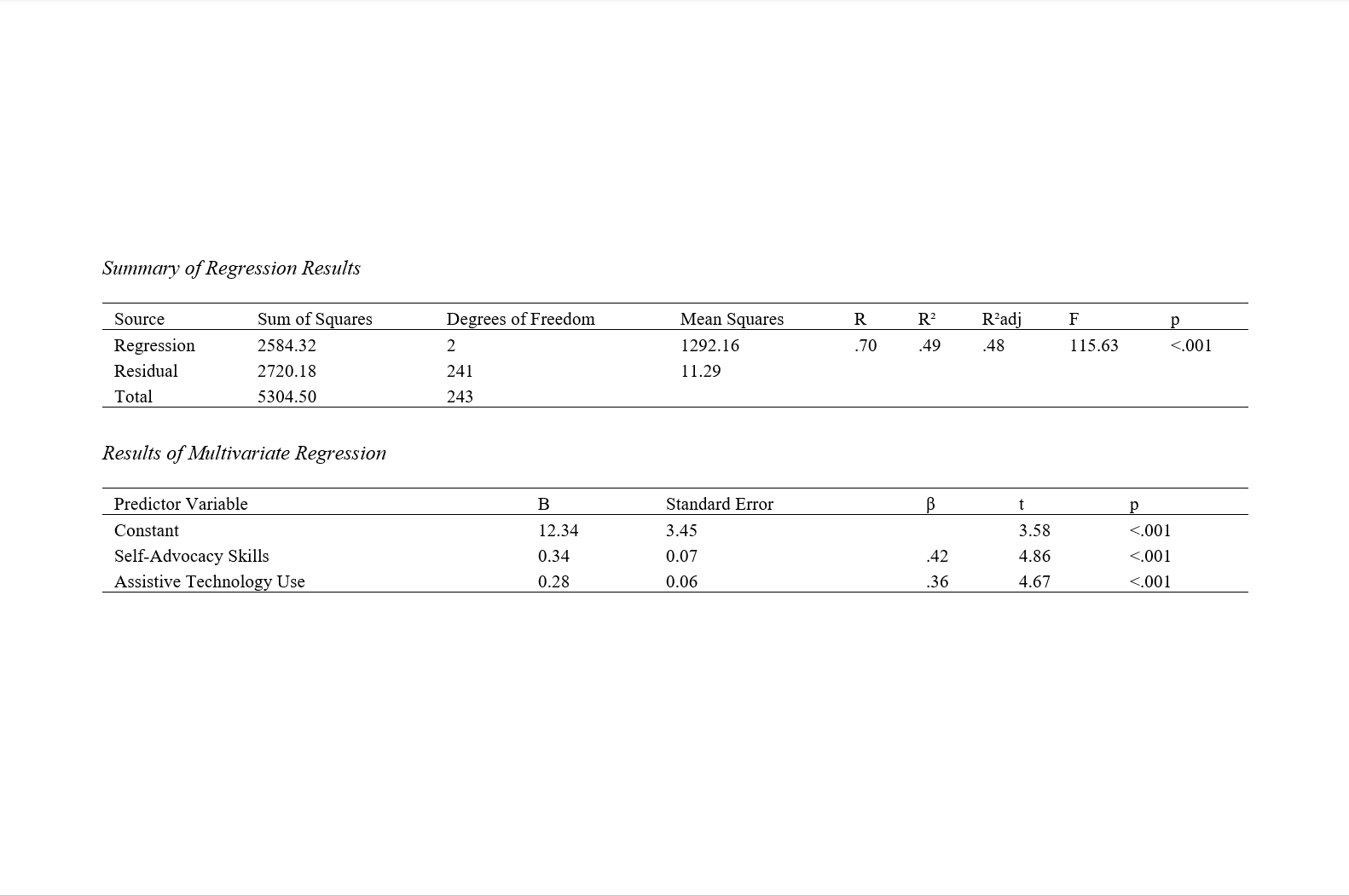
This study aims to examine the relationship between self-advocacy skills, assistive technology use, and self-esteem among adults with physical disabilities. A cross-sectional design was employed, with data collected from 244 adults with physical disabilities. Participants completed validated self-report measures assessing self-esteem, self-advocacy skills, and assistive technology use. Pearson correlation coefficients were calculated to explore the relationships between the variables. A linear regression analysis was conducted to determine the extent to which self-advocacy skills and assistive technology use predict self-esteem. All analyses were performed using SPSS version 27. The results indicated significant positive correlations between self-esteem and both self-advocacy skills (r = .62, p < .01) and assistive technology use (r = .58, p < .01). Self-advocacy skills and assistive technology use were found to be significant predictors of self-esteem, accounting for 49% of the variance (R² = .49, F(2, 241) = 115.63, p < .001). The regression analysis revealed that self-advocacy skills (B = 0.34, β = .42, p < .001) and assistive technology use (B = 0.28, β = .36, p < .001) both positively influence self-esteem. The study concludes that self-advocacy skills and assistive technology use are crucial determinants of self-esteem in adults with physical disabilities. These findings highlight the importance of providing support and training in self-advocacy and access to appropriate assistive technology to enhance psychological well-being and autonomy in this population. Future research should explore these relationships longitudinally and across diverse disability groups.
Downloads
References
Abela, J. R., & Skitch, S. A. (2007). Dysfunctional attitudes, selfesteem, and hassles: Cognitive vulnerability to depression in children of affectively ill parents. Behaviour Research and Therapy, 45(6), 1127-1140.https://www.sciencedirect.com/science/article/pii/S0005796706002269
Acosta-Gonzaga, E. (2023). The Effects of Self-Esteem and Academic Engagement on University Students’ Performance. Behavioral Sciences, 13(4), 348.https://doi.org/10.3390/bs13040348
Adkins, K. L. (2003). Predicting self-esteem based on perceived parental favoritism and birth order. East Tennessee State University.https://search.proquest.com/openview/4e599f897a8b1543e784e34d847eda41/1?pq-origsite=gscholar&cbl=18750&diss=y
Afrooz , G. A., Hosseinian , S., & Shamkhali , L. (2022). The Mediating Role of Locus of Control in the Relationship between Goal Orientations with Self-Esteem In Basij Students. Scientific Journal of Islamic Education, 30(54),215-238.https://www.magiran.com/paper/2455423
Ahadi, B. (2009). Relationship between loneliness and self-esteem with students’ attachment styles. Journal of Psychological Studies, 5(1), 95-112.https://doi.org/10.22051/psy.2009.1593
Ahmadia, A., Safvat, M., Amini, F., Khondel, E., Bibak, A., & Abbasi, H. (2014). The effect of life skills training on selfesteem and self-efficacy of technical school students. Reef Resources Assessment and Management Technical Paper,40(2), 433-438.https://rs.bpums.ac.ir/UploadedFiles/xfiles/The%20Effect%20of%20life%20skills%20training%20on%20selfesteem%20and%20self-efficacy.pdf
Balint-Langel, K., Woods-Groves, S., Rodgers, D. B., Rila, A., & Riden, B. S. (2019). Using a Computer-Based Strategy to Teach Self-Advocacy Skills to Middle School Students With Disabilities. Journal of Special Education Technology, 35(4), 249-261.https://doi.org/10.1177/0162643419864847
Carter, E. W., Lane, K. L., Cooney, M., Weir, K., Moss, C. K., & Machalicek, W. (2013). Self-Determination Among Transition-Age Youth With Autism or Intellectual Disability: Parent Perspectives. Research and Practice for Persons With Severe Disabilities, 38(3), 129-138.https://doi.org/10.1177/154079691303800301
Dawson, S. (2023). Increasing Self-Determination for Students With Disabilities Using the Ask.Explore.Connect Discussion Tool. Journal of the International Society for Teacher Education, 27(2), 29-40.https://doi.org/10.26522/jiste.v27i2.4416
Fawcett, S. B., White, G. W., Balcázar, F. E., Suárez-Balcázar, Y., Mathews, R. M., Paine-Andrews, A., Seekins, T., & Smith, J.F. (1994). A Contextual‐behavioral Model of Empowerment: Case Studies Involving People With Physical Disabilities. American Journal of Community Psychology, 22(4), 471-496.https://doi.org/10.1007/bf02506890
Fiedler, C. R., & Danneker, J. E. (2017). Self-Advocacy Instruction: Bridging the Research-to-Practice Gap. Focus on Exceptional Children, 39(8).https://doi.org/10.17161/fec.v39i8.6875
Gillespie-Lynch, K., Bublitz, D., Donachie, A., Wong, V., Brooks, P. J., & D’Onofrio, J. (2017). “For a Long Time Our Voices Have Been Hushed”: Using Student Perspectives to Develop Supports for Neurodiverse College Students. Frontiers in psychology, 8.https://doi.org/10.3389/fpsyg.2017.00544
Gilmartin, A., & Slevin, E. (2010). ORIGINAL ARTICLE: Being a Member of a Self‐advocacy Group: Experiences of Intellectually Disabled People. British Journal of Learning Disabilities, 38(3), 152-159.https://doi.org/10.1111/j.1468-3156.2009.00564.x
Grenwelge, C., & Zhang, D. (2012). The Effects of the Texas Youth Leadership Forum Summer Training on the Self-Advocacy Abilities of High School Students With Disabilities. Journal of Disability Policy Studies, 24(3), 158-169.https://doi.org/10.1177/1044207312457415
Gruber, L. W., & Martin, B. (2019). Students With Disabilities: The Disconnect Between Self Advocacy and Social Justice Practices of Teachers. Journal of Education and Culture Studies, 3(4), p361.https://doi.org/10.22158/jecs.v3n4p361
Holzberg, D., Test, D. W., & Rusher, D. E. (2018). Self-Advocacy Instruction to Teach High School Seniors With Mild Disabilities to Access Accommodations in College. Remedial and Special Education, 40(3), 166-176.https://doi.org/10.1177/0741932517752059
Huang, R. W., RhD, D. A. D., Msw, R. K., Msw, I. I., Long, H. W., & Dunn, K. (2004). Self-Advocacy Skills in Asian American Parents of Children With Developmental Disabilities. Journal of Ethnic & Cultural Diversity in Social Work, 13(1), 1-18.https://doi.org/10.1300/j051v13n01_01
Judge, S., & Simms, K. (2009). Assistive Technology Training at the Pre-Service Level. Teacher Education and Special Education the Journal of the Teacher Education Division of the Council for Exceptional Children, 32(1), 33-44.https://doi.org/10.1177/0888406408330868
Karpicz, J. R. (2020). “Just My Being Here Is Self-Advocacy”: Exploring the Self-Advocacy Experiences of Disabled Graduate Students of Color. Jcscore, 6(1), 137-163.https://doi.org/10.15763/issn.2642-2387.2020.6.1.137-163
Krueger, C. (2024). Self-Advocacy in Inclusive Research. Social Sciences, 13(3), 134.https://doi.org/10.3390/socsci13030134
McGahee, D. W., King‐Sears, M. E., & Evmenova, A. S. (2021). High School Students With Learning Disabilities: Requesting Accommodations in Role‐Play. Learning Disabilities Research and Practice, 36(2), 82-95.https://doi.org/10.1111/ldrp.12243
Michaels, C. A., & McDermott, J. M. (2003). Assistive Technology Integration in Special Education Teacher Preparation: Program Coordinators' Perceptions of Current Attainment and Importance. Journal of Special Education Technology, 18(3),29-44.https://doi.org/10.1177/016264340301800302
Miller, R. N. Developing Self-Advocacy : The Experience of College Students in Structured Learning Disabilities Programs.https://doi.org/10.18130/v3kk8g
Obeidat, H. M., Hamlan, A. M., & Callister, L. C. (2014). Missing Motherhood: Jordanian Women′s Experiences with Infertility. Advances in Psychiatry, 2014(1), 241075.https://doi.org/10.1155/2014/241075
Parette, H. P., Brotherson, M. J., Hourcade, J. J., & Bradley, R. H. (1996). Family-Centered Assistive Technology Assessment. Intervention in School and Clinic.https://doi.org/10.1177/105345129603200206
Ripat, J., & Woodgate, R. L. (2017). The Importance of Assistive Technology in the Productivity Pursuits of Young Adults With Disabilities. Work, 57(4), 455-468.https://doi.org/10.3233/wor-172580
Seekins, T., Fawcett, S. B., & Mathews, R. M. (1987). Effects of Self-Help Guides on Three Consumer Advocacy Skills: Using Personal Experiences to Influence Public Policy. Rehabilitation Psychology, 32(1), 29-38.https://doi.org/10.1037/h0091553
Thomas, F., & Morgan, R. L. (2021). Evidence-Based Job Retention Interventions for People With Disabilities: A Narrative Literature Review. Journal of Vocational Rehabilitation, 54(2), 89-101.https://doi.org/10.3233/jvr-201122
Walker, A. R., & Test, D. W. (2011). Using a Self-Advocacy Intervention on African American College Students’ Ability to Request Academic Accommodations. Learning Disabilities Research and Practice, 26(3), 134-144.https://doi.org/10.1111/j.1540-5826.2011.00333.x
Downloads
Additional Files
Publication Timeline
Issue
Section
License

This work is licensed under a Creative Commons Attribution-NonCommercial 4.0 International License.