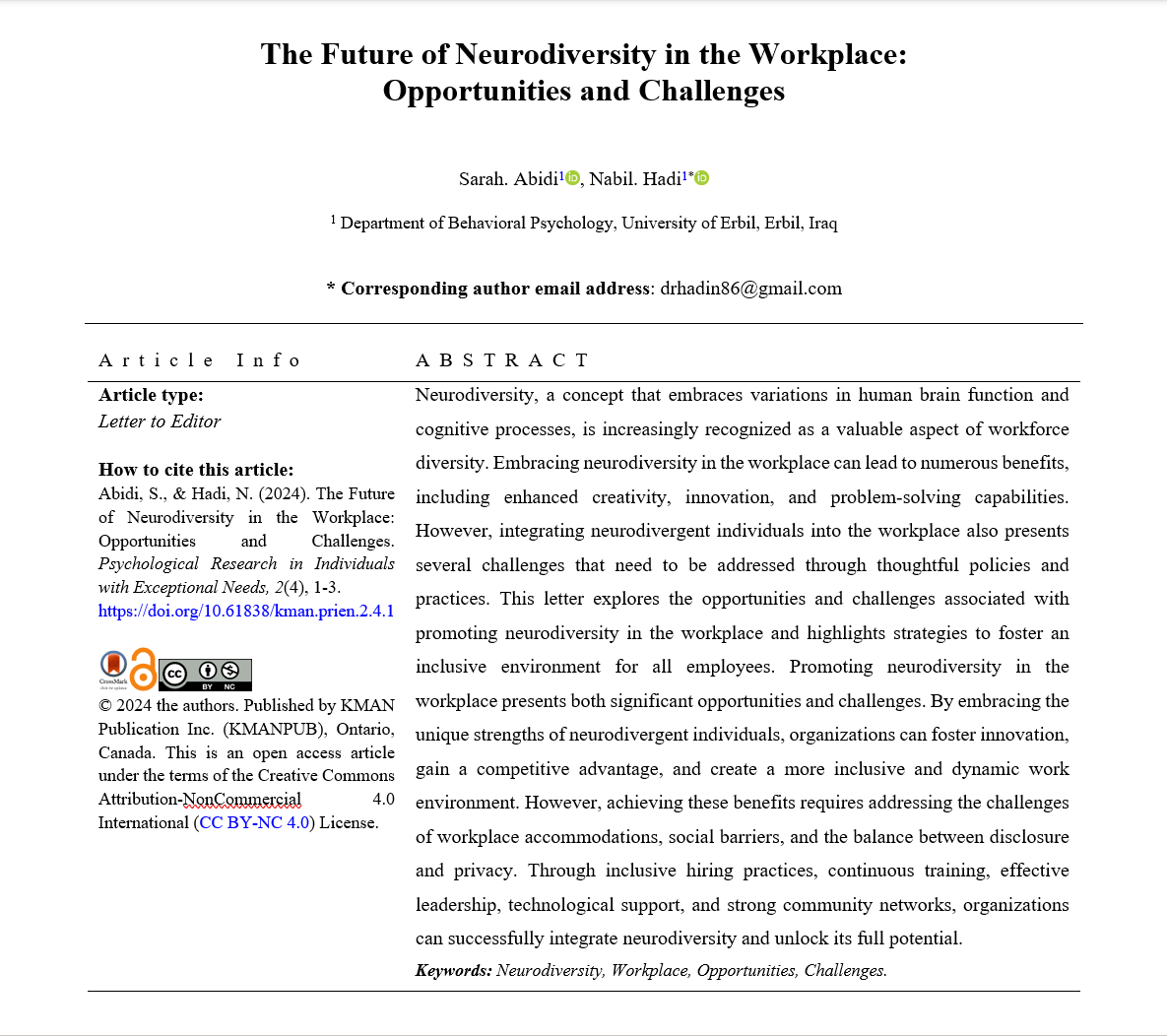
The Future of Neurodiversity in the Workplace: Opportunities and Challenges
DOI:
https://doi.org/10.61838/kman.prien.2.4.1Keywords:
Neurodiversity, Workplace, Opportunities, ChallengesAbstract
Neurodiversity, a concept that embraces variations in human brain function and cognitive processes, is increasingly recognized as a valuable aspect of workforce diversity. Embracing neurodiversity in the workplace can lead to numerous benefits, including enhanced creativity, innovation, and problem-solving capabilities. However, integrating neurodivergent individuals into the workplace also presents several challenges that need to be addressed through thoughtful policies and practices. This letter explores the opportunities and challenges associated with promoting neurodiversity in the workplace and highlights strategies to foster an inclusive environment for all employees. Promoting neurodiversity in the workplace presents both significant opportunities and challenges. By embracing the unique strengths of neurodivergent individuals, organizations can foster innovation, gain a competitive advantage, and create a more inclusive and dynamic work environment. However, achieving these benefits requires addressing the challenges of workplace accommodations, social barriers, and the balance between disclosure and privacy. Through inclusive hiring practices, continuous training, effective leadership, technological support, and strong community networks, organizations can successfully integrate neurodiversity and unlock its full potential.
Downloads
References
Ak, B. (2020). Mixed Reality , Applications in Neurodiversity.https://doi.org/10.31234/osf.io/29y87 Ali, M. (2023). An Exploratory Study of Benefits and Challenges of Neurodivergent Employees: Roles of Knowing Neurodivergents and Neurodiversity Practices. Equality Diversity and Inclusion an International Journal, 43(2), 243-267.https://doi.org/10.1108/edi-03-2023-0092
Ashworth, M., Heasman, B., Crane, L., & Remington, A. (2023). Evaluating a New Supported Employment Internship Programme for Autistic Young Adults Without Intellectual Disability.https://doi.org/10.31219/osf.io/t2x3g
Bruyère, S. M. (2024). Workplace Accommodations and Neurodiversity. 181-205. https://doi.org/10.1007/978-3-031-55072-0_9
Cafaro, F., Brady, E., Chandra, S., Patil, U., & Saxena, A. (2021). E Pluribus Unum: Using Conceptual Metaphor Theory to Explore and Support Mixed-Ability Workplaces. Proceedings of the Acm on Human-Computer Interaction, 5(CSCW2), 1-31.https://doi.org/10.1145/3479528
Doyle, N., & Bradley, E. (2022). Disability Coaching in a Pandemic. Journal of Work-Applied Management, 15(1), 135-147.https://doi.org/10.1108/jwam-07-2022-0042
Essex, J. (2023). Neurodiverse Scientists in the Workplace. Nature Reviews Chemistry, 7(12), 821-822.https://doi.org/10.1038/s41570-023-00554-2
Hall, K. (2024). Designing for Strengths: Opportunities to Support Neurodiversity in the Workplace.https://doi.org/10.1145/3613904.3642424
Kaaria, A. G. (2024). Cultivating Neurodiverse Connections Through Competent Leadership: Integrative Literature Review. International Journal of Advanced Research, 7(1),93-121.https://doi.org/10.37284/ijar.7.1.1814
Kidwell, K. E., Clancy, R. L., & Fisher, G. G. (2023). The Devil You Know Versus the Devil You Don’t: Disclosure Versus Masking in the Workplace. Industrial and Organizational Psychology, 16(1), 55-60.https://doi.org/10.1017/iop.2022.101
Lerner, D. A. (2024). Neurodiversity at Work. 439-455.https://doi.org/10.1093/oxfordhb/9780192897114.013.9
Pandita, P. P. (2024). Neurodiverse Hiring Process in Workplace.1-13. https://doi.org/10.58532/v3bhma27p1ch1
Ru, O. S. (2024). Conceptual Framework of Inclusive Human Resource Management to Support Neurodiversity Employment. International Journal of Academic Research in Business and Social Sciences, 14(2).https://doi.org/10.6007/ijarbss/v14-i2/20922
Sharma, K. (2024). Neurodiversity and Global Business Strategies: Embracing Diversity in the Globalized Workplace. South Asian Research Journal of Business and Management, 6(02), 41-47.https://doi.org/10.36346/sarjbm.2024.v06i02.003
Sinha, S. (2024). Neurodiversity at the Workplace. 333-348.https://doi.org/10.4018/979-8-3693-1938-3.ch018 Szulc, J. M., Davies, J., Tomczak, M., & McGregor, F.-L. (2021).AMO Perspectives on the Well-Being of Neurodivergent Human Capital. Employee Relations, 43(4), 858-872.https://doi.org/10.1108/er-09-2020-0446
Szulc, J. M., McGregor, F.-L., & Çakir, E. (2021). Neurodiversity and Remote Work in Times of Crisis: Lessons for HR. Personnel Review, 52(6), 1677-1692.https://doi.org/10.1108/pr-06-2021-0469
Downloads
Additional Files
Publication Timeline
Issue
Section
License

This work is licensed under a Creative Commons Attribution-NonCommercial 4.0 International License.