Impact of Sleep Disorders on Daily Functioning in Children with Autism Spectrum Disorder
DOI:
https://doi.org/10.61838/kman.prien.2.3.4Keywords:
Autism, Spectrum Disorder, sleep disorders, daily functioning, caregivers, coping strategies, behavioral issues, interventionsAbstract
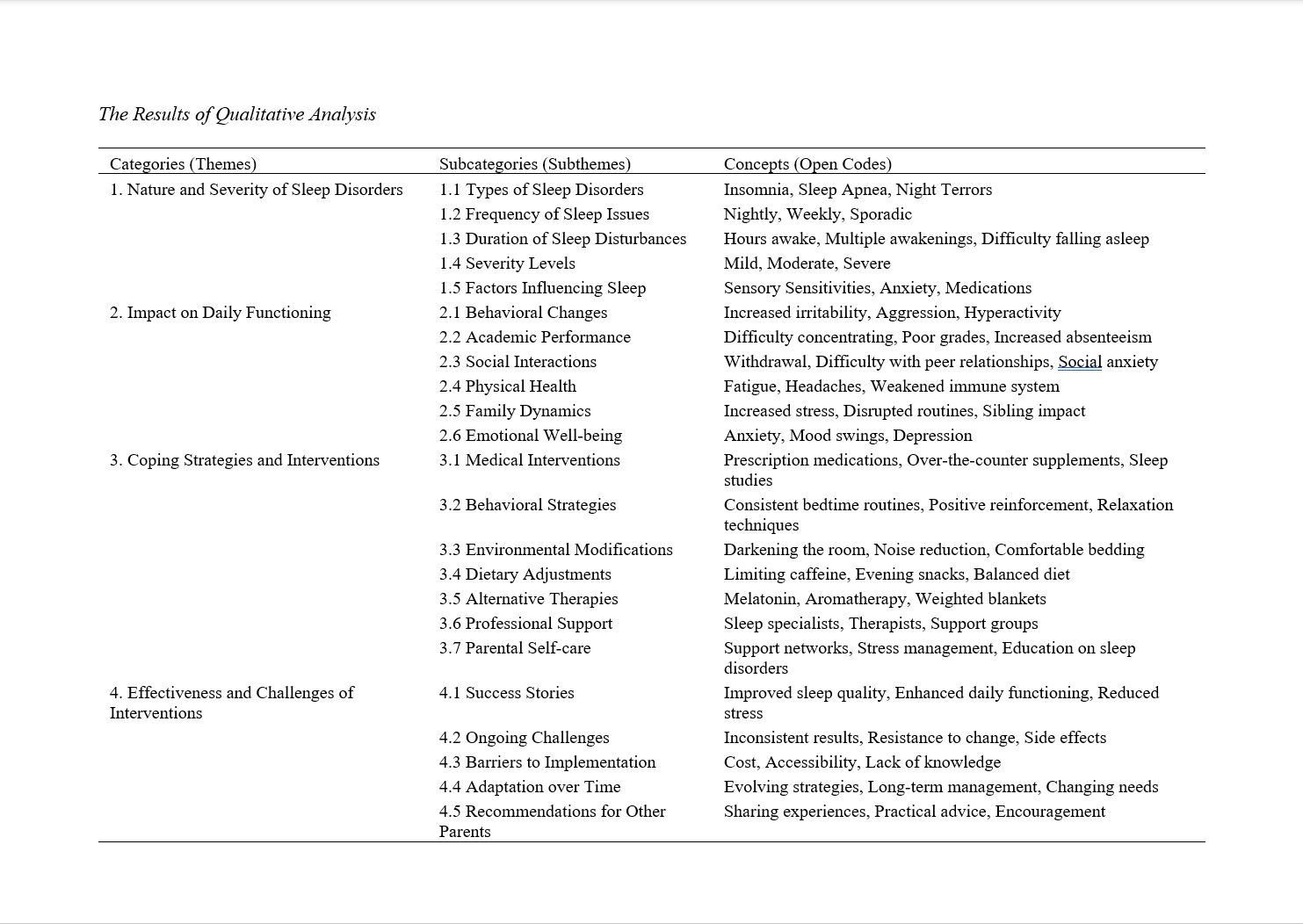
This study aims to explore the impact of sleep disorders on daily functioning in children with Autism Spectrum Disorder (ASD) through the perspectives of their caregivers. A qualitative research design was employed, involving semi-structured interviews with 23 caregivers of children aged 4-12 years diagnosed with ASD. Participants were recruited through local autism support groups, special education schools, and pediatric clinics. Interviews focused on the types, frequency, and severity of sleep disorders, their impact on the child's behavior, academic performance, social interactions, physical health, and family dynamics, as well as the strategies used to manage these issues. Thematic analysis was used to identify key themes and patterns from the data. The study identified several types of sleep disorders among children with ASD, including insomnia, sleep apnea, and night terrors, varying in frequency and severity. Sleep disturbances were found to significantly impact daily functioning, leading to behavioral issues, academic challenges, social difficulties, and physical health problems. Caregivers employed a range of coping strategies, such as medical interventions, behavioral routines, environmental modifications, dietary adjustments, and alternative therapies, with varying degrees of success. Barriers to effective management included cost, accessibility, and lack of knowledge. The need for individualized, adaptive approaches to treatment was emphasized. Sleep disorders in children with ASD have profound effects on their daily functioning and overall quality of life. Addressing these issues requires a comprehensive, individualized approach that considers the unique needs of each child. Collaboration with caregivers and regular adjustments to intervention strategies are essential for effective management. Further research should focus on larger, more diverse samples and incorporate objective sleep measures to provide a more comprehensive understanding of these challenges.
Downloads
References
Arazi, A., Meiri, G., Danan, D., Michaelovski, A., Flusser, H., Menashe, I., Tarasiuk, A., & Dinstein, I. (2019). Reduced Sleep Pressure in Young Children With Autism.https://doi.org/10.1101/706135
Bruni, O., Breda, M., Ferri, R., & Melegari, M. G. (2021). Changes in Sleep Patterns and Disorders in Children and Adolescents With Attention Deficit Hyperactivity Disorders and Autism Spectrum Disorders During the COVID-19 Lockdown. Brain Sciences, 11(9), 1139.https://doi.org/10.3390/brainsci11091139
Choi, A. (2023). Circuit Mechanism Underlying Fragmented Sleep and Memory Deficits in 16p11.2 Deletion Mouse Model of Autism.https://doi.org/10.1101/2023.12.26.573156
Chung, S. (2024). Circuit Mechanism Underlying Fragmented Sleep and Memory Deficits In 16p11.2 Deletion Mouse Model of Autism.https://doi.org/10.21203/rs.3.rs-3877710/v1
Deliens, G., & Peigneux, P. (2019). Sleep–behaviour Relationship in Children With Autism Spectrum Disorder: Methodological Pitfalls and Insights From Cognition and Sensory Processing. Developmental Medicine & Child Neurology, 61(12), 1368-1376.https://doi.org/10.1111/dmcn.14235
Galli, J., Loi, E., Visconti, L. M., Mattei, P., Eusebi, A., Calza, S., & Fazzi, E. (2022). Sleep Disturbances in Children Affected by Autism Spectrum Disorder. Frontiers in Psychiatry, 13.https://doi.org/10.3389/fpsyt.2022.736696
Güneş, S., Ekinci, Ö., Feyzioğlu, A., Ekinci, N., & Kalınlı, M. (2019). ≪p>Sleep Problems in Children With Autism Spectrum Disorder: Clinical Correlates and the Impact of Attention Deficit Hyperactivity Disorder</P>. Neuropsychiatric Disease and Treatment, Volume 15, 763-771.https://doi.org/10.2147/ndt.s195738
Haimovich, A. M., Tikotzky, L., Meiri, G., Ilan, M., Michaelovski, A., Schtaierman, H., Golan, H. M., Sadaka, Y., Menashe, I., & Dinstein, I. (2022). Sleep Disturbances Are Associated With Irritability in ASD Children With Sensory Sensitivities.https://doi.org/10.21203/rs.3.rs-2315885/v1
Hollway, J. A., Mendoza-Burcham, M., Andridge, R., Aman, M. G., Handen, B. L., Arnold, L. E., Lecavalier, L., Williams, C., Silverman, L. B., & Smith, T. (2018). Atomoxetine, Parent Training, and Their Effects on Sleep in Youth With Autism Spectrum Disorder and Attention-Deficit/Hyperactivity Disorder. Journal of Child and Adolescent Psychopharmacology, 28(2), 130-135.https://doi.org/10.1089/cap.2017.0085
Johnson, C. R., Turner, K., Foldes, E., Malow, B. A., & Wiggs, L. (2012). Comparison of Sleep Questionnaires in the Assessment of Sleep Disturbances in Children With Autism Spectrum Disorders. Sleep Medicine, 13(7), 795-801.https://doi.org/10.1016/j.sleep.2012.03.005
Kang, Y.-Q., Song, X.-R., Wang, G.-F., Su, Y., Li, P., & Zhang, X. (2020). Sleep Problems Influence Emotional/Behavioral Symptoms and Repetitive Behavior in Preschool-Aged Children With Autism Spectrum Disorder in the Unique Social Context of China. Frontiers in Psychiatry, 11.https://doi.org/10.3389/fpsyt.2020.00273
Koo, H. W., Ismail, J., Yang, W. W., & Zakaria, S. Z. S. (2021). Sleep Disturbances in Children With Autism Spectrum Disorder at a Malaysian Tertiary Hospital. Frontiers in Pediatrics, 8.https://doi.org/10.3389/fped.2020.608242
Krakowiak, P., Goodlin‐Jones, B. L., Hertz‐Picciotto, I., Croen, L., & Hansen, R. (2012). Sleep Problems in Children With Autism Spectrum Disorders, Developmental Delays, and Typical Development: A Population‐based Study. Journal of Sleep Research, 21(2), 231-231.https://doi.org/10.1111/j.1365-2869.2012.01012.x
Lawson, L. M., & Little, L. (2017). Feasibility of a Swimming Intervention to Improve Sleep Behaviors of Children With Autism Spectrum Disorder. Therapeutic Recreation Journal, 51(2), 97-108.https://doi.org/10.18666/trj-2017-v51-i2-7899
Liu, R., Dong, H., Wang, Y., Lu, X., Li, Y., Xun, G., Xia, K., Zhao, J., Ou, J., & Shen, Y. (2020). The Association of Sleep Problems in Children With Autism and Parental Quality of Life.https://doi.org/10.21203/rs.2.15245/v2
May, T., Cornish, K., Conduit, R., Rajaratnam, S. M. W., & Rinehart, N. (2013). Sleep in High-Functioning Children With Autism: Longitudinal Developmental Change and Associations With Behavior Problems. Behavioral Sleep Medicine, 13(1), 2-18.https://doi.org/10.1080/15402002.2013.829064
Miner, S., McVoy, M., & Damato, E. G. (2023). Evaluation of the Relationship of Sleep Disturbances to Severity and Common Behaviors in Autism Spectrum Disorder.https://doi.org/10.21203/rs.3.rs-2674526/v1
Moore, M., Evans, V., Hanvey, G. A., & Johnson, C. R. (2017). Assessment of Sleep in Children With Autism Spectrum Disorder. Children, 4(8), 72.https://doi.org/10.3390/children4080072
Nguyen, T. D. (2022). Potential of Physical Activity-Based Intervention on Sleep in Children With and Without Autism Spectrum Disorder.https://doi.org/10.5772/intechopen.102534
Park, E. J., & Park, Y.-M. (2020). Melatonin and Sleep Problems in Children With Autism Spectrum Disorder. Chronobiology in Medicine, 2(2), 47-51.https://doi.org/10.33069/cim.2020.0009
Ramanujam, K., Cardinali, D. P., Venkat, S., Spence, D. W., Brown, G. M., & Pandi-Perumal, S. R. (2020). Understanding the Role of Sleep and Its Disturbances in Autism Spectrum Disorder. International Journal of Neuroscience, 130(10),1033-1046.https://doi.org/10.1080/00207454.2019.1711377
Souders, M. C., Mason, T. B. A., Valladares, O., Bućan, M., Levy, S. E., Mandell, D. S., Weaver, T. E., & Pinto‐Martin, J. (2009). Sleep Behaviors and Sleep Quality in Children With Autism Spectrum Disorders. Sleep, 32(12), 1566-1578.https://doi.org/10.1093/sleep/32.12.1566
Tse, A. C. Y., Lee, P. H., Lau, E. Y. Y., Cheng, J. C. H., Ho, A. K., & Lai, E. W. H. (2022). Study Protocol for a Randomized Controlled Trial Comparing the Effectiveness of Physical Exercise and Melatonin Supplement on Treating Sleep Disturbance in Children With Autism Spectrum Disorders. PLoS One, 17(7), e0270428.https://doi.org/10.1371/journal.pone.0270428
Tse, A. C. Y., Lee, P. H., Zhang, J., & Lai, E. W. H. (2018). Study Protocol for a Randomised Controlled Trial Examining the Association Between Physical Activity and Sleep Quality in Children With Autism Spectrum Disorder Based on the Melatonin-Mediated Mechanism Model. BMJ open, 8(4),e020944.https://doi.org/10.1136/bmjopen-2017-020944
Veatch, O. J., Maxwell-Horn, A., & Malow, B. A. (2015). Sleep in Autism Spectrum Disorders. Current Sleep Medicine Reports, 1(2), 131-140.https://doi.org/10.1007/s40675-015-0012-1
Wang, G., Chen, J., Zhang, K., Tang, S., & Wang, G. (2022). The Mediating Role of Gaze Patterns in the Association of Child Sleep Disturbances and Core Symptoms of Autism Spectrum Disorder. Autism Research, 15(9), 1719-1731.https://doi.org/10.1002/aur.2737
Wang, G., Liu, Z., Xu, G., Jiang, F., Lü, N., Baylor, A., & Owens, J. (2015). Sleep Disturbances and Associated Factors in Chinese Children With Autism Spectrum Disorder: A Retrospective and Cross-Sectional Study. Child Psychiatry & Human Development, 47(2), 248-258.https://doi.org/10.1007/s10578-015-0561-z
Wang, Y., Lin, J., Zeng, Y., Liu, Y., Li, Y., Xia, K., Zhao, J., Shen, Y., & Ou, J. (2021). Effects of Sleep Disturbances on Behavioral Problems in Preschool Children With Autism Spectrum Disorder. Frontiers in Psychiatry, 11.https://doi.org/10.3389/fpsyt.2020.559694
Yavuz-Kodat, E., Reynaud, È., Geoffray, M. M., Limousin, N., Franco, P., Bonnet‐Brilhault, F., Bourgin, P., & Schröder, C. (2020). Disturbances of Continuous Sleep and Circadian Rhythms Account for Behavioral Difficulties in Children With Autism Spectrum Disorder. Journal of clinical medicine,9(6), 1978.https://doi.org/10.3390/jcm9061978
Downloads
Additional Files
Publication Timeline
Issue
Section
License

This work is licensed under a Creative Commons Attribution-NonCommercial 4.0 International License.