Effectiveness of Motivational Interviewing on Participation and Emotional Skills in Learning Disabled Adults
DOI:
https://doi.org/10.61838/kman.prien.1.1.5Keywords:
Motivational Interviewing, Learning Disabilities, Extracurricular Involvement, Emotional Self-EfficacyAbstract
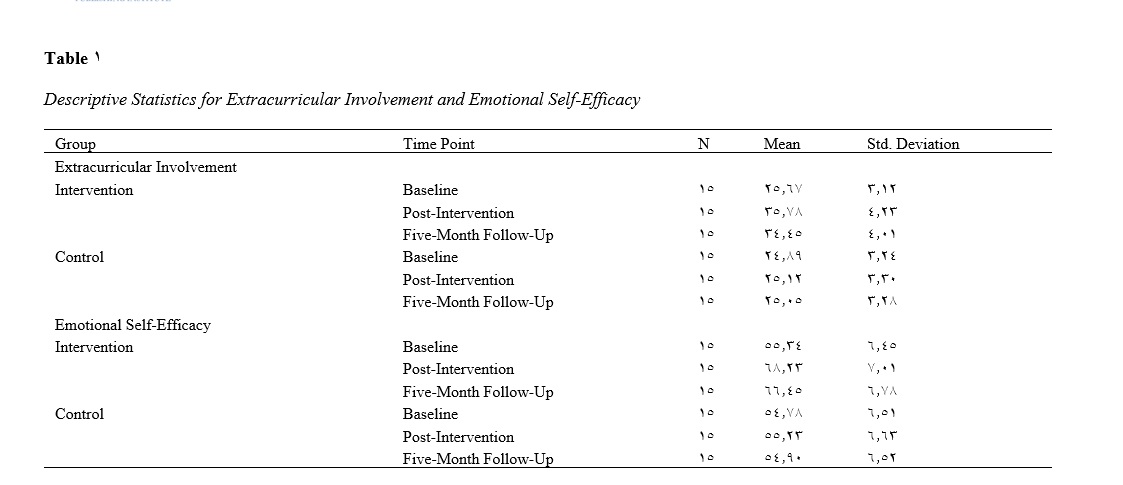
This study aimed to evaluate the effectiveness of Motivational Interviewing (MI) in enhancing extracurricular involvement and emotional self-efficacy among individuals with learning disabilities. A randomized controlled trial was conducted with 30 participants diagnosed with learning disabilities. Participants were randomly assigned to an intervention group (n = 15) receiving eight 90-minute sessions of MI or a control group (n = 15) receiving no intervention. Assessments were conducted at baseline, post-intervention, and at a five-month follow-up using the Student Engagement in Extracurricular Activities Scale (SEAS) and the Emotional Self-Efficacy Scale (ESES). Data were analyzed using repeated measures ANOVA and Bonferroni post-hoc tests in SPSS-27. The intervention group showed significant improvements in extracurricular involvement (baseline mean = 25.67, SD = 3.12; post-intervention mean = 35.78, SD = 4.23; follow-up mean = 34.45, SD = 4.01) compared to the control group (baseline mean = 24.89, SD = 3.24; post-intervention mean = 25.12, SD = 3.30; follow-up mean = 25.05, SD = 3.28). Similarly, emotional self-efficacy scores significantly increased in the intervention group (baseline mean = 55.34, SD = 6.45; post-intervention mean = 68.23, SD = 7.01; follow-up mean = 66.45, SD = 6.78) compared to the control group (baseline mean = 54.78, SD = 6.51; post-intervention mean = 55.23, SD = 6.63; follow-up mean = 54.90, SD = 6.52). The ANOVA results indicated significant main effects of group and time, and significant interactions between time and group for both variables (p < .001). Motivational Interviewing significantly enhances extracurricular involvement and emotional self-efficacy among individuals with learning disabilities. These findings suggest that MI is an effective intervention for improving participation and emotional skills in this population.
Downloads
References
Aghaziarati, A., Fard, F. R., Rahimi, H., & Parsakia, K. (2023). Investigating the Effect of Electrical Stimulation (tDCS) of the Prefrontal Cortex of the Brain on the Improvement of Behavioral and Neurological Symptoms of Children with Specific Learning Disabilities. Health Nexus, 1(2), 44-50.https://doi.org/10.61838/kman.hn.1.2.6
Ahmadi, V., & Valizadeh, H. (2021). The Effectiveness of Acceptance and Commitment-Based Therapy on the Quality of Life and Death Anxiety in the Elderly. Aging Psychology, 7(2), 166-153.https://doi.org/10.22126/jap.2021.6370.1528
Alexander, G., Matoti, S. N., & Zyl, P. G. v. (2021). Ascertaining the Use of Extracurricular Activities in Promoting Learners’ Holistic Development in Multicultural School Settings.https://doi.org/10.36315/2021end039
Arranz, N., Ubierna, F., Arroyabe, M. F., Perez, C., & Fdez. de Arroyabe, J. C. (2017). The effect of curricular and extracurricular activities on university students’ entrepreneurial intention and competences. Studies in Higher Education, 42(11), 1979-2008.https://doi.org/10.1080/03075079.2015.1130030
Asdolahzadeh, P., Sadeghi, J., & Abbasi Asfajir, A. A. (2021). Modeling the Structural Equations of Mode Metacognition with a Tendency to Cyberspace Mediated by Self-efficacy in Gifted Students [Research Article]. Iranian Journal of Educational Sociology, 4(2), 14-23.https://doi.org/10.52547/ijes.4.2.14
Ashrafzadeh, S., Khezrimoghadam, N., & Manzari Tavakoli, V. (2017). Effectiveness of motivational interviewing on the academic self-efficacy and problem solving of female students [Research]. Journal of Psychological Science, 16(63), 413-428.http://psychologicalscience.ir/article-1-143-en.html
Aydoğdu, B. N., Çelik, H., & Ekşi, H. (2017). The Predictive Role of Interpersonal Sensitivity and Emotional Self-Efficacy on Psychological Resilience Among Young Adults. Eurasian Journal of Educational Research.https://doi.org/10.14689/ejer.2017.69.3
Babakhanlou, A. (2023). Presenting Structural Model of Emotional Eating in People with Obesity based on Self-Regulation with the Mediating Role of Emotional Processing. Journal of Psychological Dynamics in Mood Disorders (PDMD), 2(2), 30-40.https://doi.org/10.22034/pdmd.2023.185859
Baker, A. (2009). Motivational Interviewing in the Treatment of Psychological Problems. Drug and Alcohol Review, 28(6), 696-696.https://doi.org/10.1111/j.1465-3362.2009.00129_6.x
Behnaz , H. (2016). Effectiveness of emotional self-efficacy training on social adjustment and social anxiety in adolescents. Journal of Applied Psycology Research, 7(2), 69-80.https://www.magiran.com/paper/2078288
Bulut, S., Bukhori, B., & Parsakia, K. (2024). Enhancing Selective Attention in Children with Learning Disorders: Efficacy of Executive Functions Training. KMAN Counseling & Psychology Nexus, 1(2), 86-93.https://doi.org/10.61838/kman.psychnexus.1.2.14
Chan, Y.-K. (2016). Investigating the Relationship Among Extracurricular Activities, Learning Approach and Academic Outcomes: A Case Study. Active Learning in Higher Education, 17(3), 223-233.https://doi.org/10.1177/1469787416654795
Cheraghi, A. z., & Yousefi, F. (2019). The investigation of mediating role of academic motivation in the relationship between self-efficacy and academic procrastination. Knowledge & Research in Applied Psychology, 2(20), 34-47.https://doi.org/10.30486/jsrp.2019.665258
Galla, B. M., & Wood, J. J. (2012). Emotional self-efficacy moderates anxiety-related impairments in math performance in elementary school-age youth. Personality and individual differences, 52(2), 118-122.https://doi.org/10.1016/j.paid.2011.09.012
García, P. S., Malonda-Vidal, E., Llorca-Mestre, A., MuñozNavarro, R., & Mestre-Escrivá, V. (2021). Victimization and Peer and Parents Attachment: The Mediating Effect of Regulatory Emotional Self-Efficacy. International journal of environmental research and public health.https://doi.org/10.3390/ijerph18042062
Goroshit, M., & Hen, M. (2014). Does Emotional Self-Efficacy Predict Teachers' Self-Efficacy and Empathy? Journal of Education and Training Studies.https://doi.org/10.11114/jets.v2i3.359
Hosseini, S., Rezaei, A., Kazemi, S., & Samani, S. (2020). The Effectiveness of Motivational Interviewing on Academic Procrastination in Adolescents. Psychological Models and Methods, 11(39), 81-94.https://jpmm.marvdasht.iau.ir/article_4310_6b04e0ecc33977a25c0bd83d05de5c1d.pdf
Hung, S.-J., & Blauw, J. (2017). The use of a motivational interviewing instrument to enhance academic self-efficacy and academic motivation of undergraduate students at Assumption University. Scholar: Human Sciences, 9(1).http://www.assumptionjournal.au.edu/index.php/Scholar/article/view/2792
Jenaabadi, H., Elsa Zadeghan, A., & Nemati, M. (2015). The effectiveness of motivational interviewing on enhancing selfefficacy and improving self-concept in High schools underachievement students. Journal of Educational Psychology Studies, 12(21), 43-62.https://doi.org/10.22111/jeps.2015.2156
Kay, E., Vascott, D., Hocking, A., & Nield, H. (2016). Motivational Interviewing in General Dental Practice: A Review of the Evidence. BDJ, 221(12), 785-791.https://doi.org/10.1038/sj.bdj.2016.952
Leffingwell, T. R., Neumann, C. A., Babitzke, A. C., Leedy, M. J., & Walters, S. T. (2006). Social Psychology and Motivational Interviewing: A Review of Relevant Principles and Recommendations for Research and Practice. Behavioural and Cognitive Psychotherapy, 35(01), 31.https://doi.org/10.1017/s1352465806003067
Li, T., & Xie, Q. (2022). Effects of College Students’ Perceived Stress on Anxiety in the Time of COVID-19: The Chain Mediation Role of Psychological Resilience and Regulatory Emotional Self-Efficacy. International Journal of Mental Health Promotion, 24(2), 263-276.https://doi.org/10.32604/ijmhp.2022.019177
Mukesh, H. V., Acharya, V., & Pillai, R. (2022). Are Extracurricular Activities Stress Busters to Enhance Students’ Well-Being and Academic Performance? Evidence From A natural Experiment. Journal of Applied Research in Higher Education, 15(1), 152-168.https://doi.org/10.1108/jarhe-06-2021-0240
Orchard, R. (2003). With You, Not Against You: Applying Motivational Interviewing to Occupational Therapy in Anorexia Nervosa. British Journal of Occupational Therapy, 66(7), 325-327.https://doi.org/10.1177/030802260306600707
Parsafar, A. (2024). Investigating the Effectiveness of Motivational Interviewing on Social Anxiety and Academic Procrastination Among Students. Jayps, 5(3), 55-64.https://doi.org/10.61838/kman.jayps.5.3.6
Rahimi, C., Jamalabadi, P., & Sedaghat Pour Haghighi, M. M. (2022). Cognitive Behavioral Treatment on Self-Esteem and Emotional Self-Efficacy of Female Students with Failure in Love [Original Research Article]. Middle Eastern Journal of Disability Studies---, 12(0), 19-19.https://doi.org/10.29252/mejds.0.0.78
Roy, R. (2017). Efficacy of Motivational Interviewing On Improving Resilience among Students with Below Average Academic Performance: A Case Study. International Journal of Indian Psychology, 4.https://doi.org/10.25215/0402.114
Safaeinaeini, K., Narimani, M., kazemi, r., & mousazadeh, t. (2019). Effectiveness of Motivational Interview and Emotion Regulation Training on Reduction Bulling Behavior and Academic Burnout Juveniles User Virtal Social Networking. Educational Psychology, 15(51), 95-126.https://doi.org/10.22054/jep.2019.27670.2049
Setiawan, A. (2022). The Effectiveness of Motivational Interviewing in Reducing Student Smartphone Addiction. Psikopedagogia Jurnal Bimbingan Dan Konseling, 11(1), 33.https://doi.org/10.12928/psikopedagogia.v11i1.22313
Snape, L., & Atkinson, C. (2017). Students’ views on the effectiveness of motivational interviewing for challenging disaffection. Educational Psychology in Practice, 33(2), 189-205.https://doi.org/10.1080/02667363.2017.1287059
Strait, G. G., Smith, B. H., McQuillin, S., Terry, J., Swan, S., & Malone, P. S. (2012). A RANDOMIZED TRIAL OF MOTIVATIONAL INTERVIEWING TO IMPROVE MIDDLE SCHOOL STUDENTS’ ACADEMIC PERFORMANCE. Journal of Community Psychology, 40(8), 1032-1039.https://doi.org/10.1002/jcop.21511
Vafadar, Z., Reazei, R., & Navidian, A. (2014). Effectiveness of motivational interviewing on the weight self-efficacy life style in overweight and obese teenager boys. International Journal of Behavioral Sciences, 8(2), 185-193.https://www.behavsci.ir/article_67871_dcb43d654d33eaf100de6b4846669eb5.pdf
Zhang, X., Yue, H., Sun, J., Liu, M., Li, C., & Bao, H. (2022). Regulatory Emotional Self-Efficacy and Psychological Distress Among Medical Students: Multiple Mediating Roles of Interpersonal Adaptation and Self-Acceptance. BMC Medical Education.https://doi.org/10.1186/s12909-022-03338-2
Downloads
Additional Files
Publication Timeline
Issue
Section
License

This work is licensed under a Creative Commons Attribution-NonCommercial 4.0 International License.