Body Dissatisfaction and Depressive Symptoms in Youth: The Mediating Role of Self-Criticism
DOI:
https://doi.org/10.61838/kman.jayps.4503Keywords:
Adolescents, Body dissatisfaction, Self-criticism, Depressive symptomsAbstract
Objective: This study aimed to investigate the relationship between body dissatisfaction and depressive symptoms among adolescents, with a particular focus on the mediating role of self-criticism.
Methods and Materials: A descriptive correlational design was employed, with 388 adolescents recruited from educational institutions in Kenya. The sample size was determined using the Morgan and Krejcie table to ensure representativeness and statistical power. Participants completed standardized self-report instruments measuring body dissatisfaction, self-criticism, and depressive symptoms. Data analysis was conducted in two stages. Pearson correlation coefficients were calculated using SPSS version 27 to examine the associations between body dissatisfaction, self-criticism, and depressive symptoms. Structural Equation Modeling (SEM) was subsequently performed in AMOS version 21 to test the hypothesized mediating role of self-criticism in the link between body dissatisfaction and depressive symptoms. Model fit was assessed using multiple indices, including the Comparative Fit Index (CFI), Tucker-Lewis Index (TLI), and Root Mean Square Error of Approximation (RMSEA).
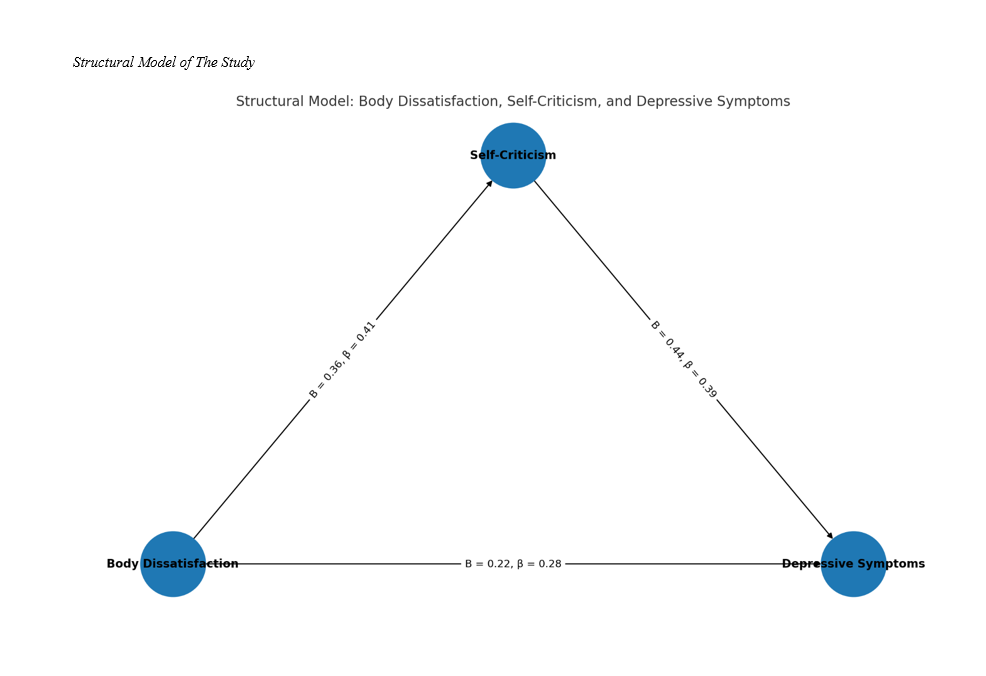
Findings: Pearson correlations indicated significant positive associations between body dissatisfaction and depressive symptoms (r = .46, p < .001), between body dissatisfaction and self-criticism (r = .41, p < .001), and between self-criticism and depressive symptoms (r = .52, p < .001). SEM results supported a partial mediation model, demonstrating that self-criticism significantly mediated the relationship between body dissatisfaction and depressive symptoms (indirect effect = .21, p < .001). The model demonstrated good fit (χ²/df = 2.14, CFI = .94, TLI = .92, RMSEA = .051), confirming the robustness of the mediational pathway.
Conclusion: These findings highlight the critical role of self-criticism in linking body dissatisfaction to depressive symptoms among adolescents.
Downloads
References
Buntaran, F. A. A., Kadir, N. B. A., & Zakaria, S. M. (2025). The Mediating Role of Self-Control in the Link Between Internet Addiction and Depression Among Indonesian Adolescents. E-Bangi Journal of Social Science and Humanities, 22(1). https://doi.org/10.17576/ebangi.2025.2201.27
Chang, J., Huang, K., & Wang, W.-d. (2023). The Influence of Parenting Style in Childhood on Adult Depressed Patients’ Interpersonal Relationships in the Period of Youth. Frontiers in psychology, 14. https://doi.org/10.3389/fpsyg.2023.1169311
Gao, M., Li, X., Lee, C. Y., Ma, H., Chen, T., Zhang, S., & Chiang, Y. C. (2022). Sleep Duration and Depression Among Adolescents: Mediation Effect of Collective Integration. Frontiers in psychology, 13. https://doi.org/10.3389/fpsyg.2022.1015089
Gao, Y., Liu, X., Liu, J., & Wang, H. (2023). The Effects of Self-Criticism and Self-Compassion on Adolescents’ Depressive Symptoms and Nonsuicidal Self-Injury. Psychology research and behavior management, Volume 16, 3219-3230. https://doi.org/10.2147/prbm.s417258
Gu, H., Zhang, P., & Li, J. (2024). The Effect of Self-Esteem on Depressive Symptoms Among Adolescents: The Mediating Roles of Hope and Anxiety. Humanities and Social Sciences Communications, 11(1). https://doi.org/10.1057/s41599-024-03249-1
He, J., Xiao, H., Mao, J., Zhong, P. L., Wei, J., Gu, W., & Nie, Y. (2025). The Mediating Role of Depression and Moderating Role of Self-Consciousness in the Relationship Between Parental Negative Control and Adolescents’ Perceived School Climate. Child and adolescent psychiatry and mental health, 19(1). https://doi.org/10.1186/s13034-025-00896-3
Hou, C.-H., Yan, H., Xiang, Z., Leng, C., Tao, H., Liu, Z., & Lei, H. (2024). The Relationship Between Gender Identity and Depressive Symptoms in Adolescents: A Moderated Mediation Model of Self-Efficacy and Family Functioning. https://doi.org/10.21203/rs.3.rs-4949530/v1
Hu, Y., Yang, Y., He, Z., Wang, D., Xu, F., Zhu, X., & Wang, K. (2024). Self-Concept Mediates the Relationships Between Childhood Traumatic Experiences and Adolescent Depression in Both Clinical and Community Samples. BMC psychiatry, 24(1). https://doi.org/10.1186/s12888-024-05671-w
Huang, X., Hu, N., Yao, Z., & Peng, B. (2022). Family Functioning and Adolescent Depression: A Moderated Mediation Model of Self-Esteem and Peer Relationships. Frontiers in psychology, 13. https://doi.org/10.3389/fpsyg.2022.962147
Kang, B., Hwang, J., Woo, S.-i., Hahn, S. W., Kim, M., Kim, Y., Jin, H., Jeon, H. J., & Lee, Y. J. (2022). The Mediating Role of Depression Severity on the Relationship Between Suicidal Ideation and Self-Injury in Adolescents With Major Depressive Disorder. Journal of Korean Academy of Child and Adolescent Psychiatry, 33(4), 99-105. https://doi.org/10.5765/jkacap.220014
Lee, D., & Lee, S. M. (2023). The Influence of Social Withdrawal and Depression on the Self-Esteem of Female Adolescents: The Mediating Effect of Grit. PLoS One, 18(7), e0288530. https://doi.org/10.1371/journal.pone.0288530
Lin, Y., Jia, G., Zhao, Z., Li, M., & Cao, G. (2024). The Association Between Family Adaptability and Adolescent Depression: The Chain Mediating Role of Social Support and Self-Efficacy. Frontiers in psychology, 15. https://doi.org/10.3389/fpsyg.2024.1308804
Lisanne, A. E. M. v. H., Wever, M. C., Schie, C. C. v., Janssen, L., Wentholt, W. G. M., Tollenaar, M. S., Will, G. J., & Elzinga, B. M. (2023). Sticky Criticism? Affective and Neural Responses to Parental Criticism and Praise in Adolescents With Depression. Psychological medicine, 54(3), 507-516. https://doi.org/10.1017/s0033291723002131
Liu, P., Mo, B., Yang, P., Li, D., Liu, S., & Cai, D. (2023). Values Mediated Emotional Adjustment by Emotion Regulation: A Longitudinal Study Among Adolescents in China. Frontiers in psychology, 14. https://doi.org/10.3389/fpsyg.2023.1093072
Nariswari, A. A., & Muttaqin, D. (2023). Relational Aggression Victimization and Depression: Testing Self-Compassion and Self-Criticism as Moderator and Mediator. Humaniora, 14(1), 59-68. https://doi.org/10.21512/humaniora.v14i1.8318
Park, Y. S., & Yoo, J. Y. (2024). The Effect of Delinquent Experience on Self-Injury Behavior in Adolescents: Moderated Mediating Effect of Negative Self-Perception by Depression. Correct Welf Soc Korea, 87, 57-85. https://doi.org/10.35422/cwsk.2024.87.57
Piao, M. Y., Jeong, E. J., & Kim, J. A. (2022). Mental Health of Parents and Their Children: A Longitudinal Study of the Effects of Parents’ Negative Affect on Adolescents’ Pathological Gaming. Healthcare, 10(11), 2233. https://doi.org/10.3390/healthcare10112233
Tang, Y., Xu, M., Zhong-wei, T., & Liu, Y. (2024). The Impact of Social Network Use on Adolescent Depression: The Chain Mediation Between Self-Objectification and Body Satisfaction. Frontiers in psychology, 15. https://doi.org/10.3389/fpsyg.2024.1347858
Yu, J., Liu, W., She, X., Wang, H., Wang, M., Abbey, C., Singh, M. K., Rozelle, S., & Tong, L. (2023). How Self-Esteem and Resilience Mediate the Association Between Screen Time and Depression Symptoms in Chinese Adolescents. https://doi.org/10.21203/rs.3.rs-3232916/v1
Zhong, Y., Hu, Q., Chen, J., Li, Y., Chen, R., Li, Y., Cong, E., & Xu, Y. (2024). The Impact of Childhood Trauma on Adolescent Depressive Symptoms: The Chain Mediating Role of Borderline Personality Traits and Self-Control. BMC psychiatry, 24(1). https://doi.org/10.1186/s12888-024-05829-6
Downloads
Additional Files
Publication Timeline
- Submitted
- Revised
- Accepted
Issue
Section
License

This work is licensed under a Creative Commons Attribution-NonCommercial 4.0 International License.