The Effect of Parental Attachment and Peer Rejection on Social Anxiety in Teenagers
DOI:
https://doi.org/10.61838/kman.jayps.6.4.13Keywords:
Social Anxiety, Parental Attachment, Peer Rejection, Adolescents, Correlational Study, KenyaAbstract
Objective: This study aimed to investigate the effects of parental attachment and peer rejection on social anxiety among adolescents in Kenya.
Methods and Materials: This study employed a descriptive correlational research design, involving 350 adolescent participants from Kenyan secondary schools selected randomly, with sample size determined by Morgan and Krejcie's sampling table. Data were collected using validated and reliable standard measurement tools, including the Social Anxiety Scale for Adolescents (SASA), the Parental Bonding Instrument (PBI), and the Peer Nominations Inventory (PNI). Statistical analyses included descriptive statistics, Pearson correlation coefficients, and multiple linear regression, performed using SPSS-27 software. Regression assumptions, including normality, linearity, homoscedasticity, and absence of multicollinearity, were verified and confirmed prior to analysis.
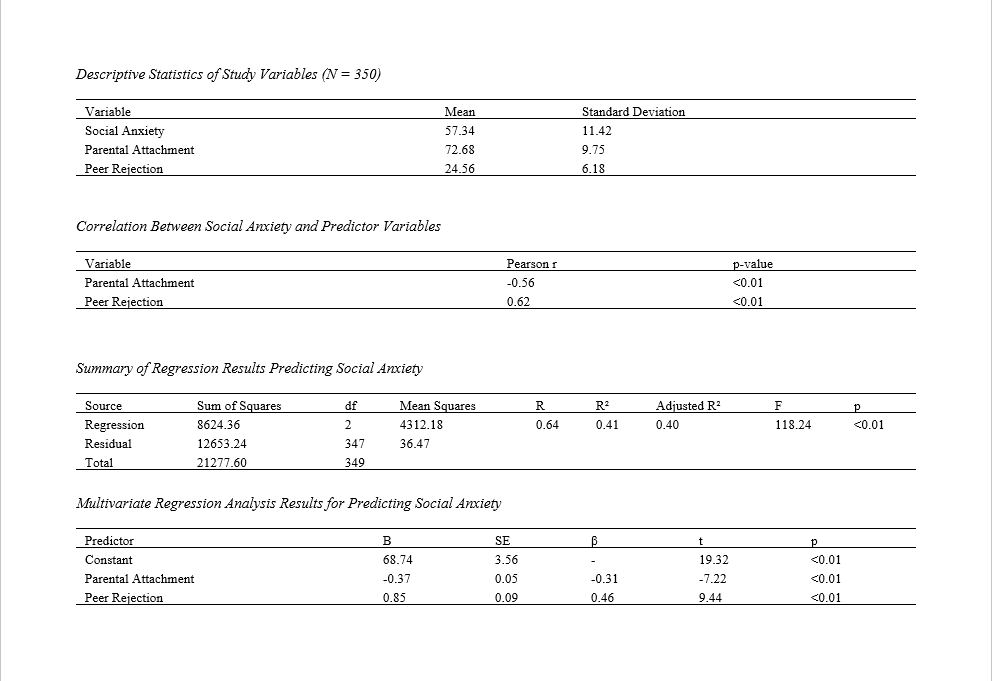
Findings: Descriptive statistics indicated moderate levels of social anxiety (M = 57.34, SD = 11.42), relatively high parental attachment (M = 72.68, SD = 9.75), and moderate peer rejection (M = 24.56, SD = 6.18). Correlation analyses revealed significant negative correlations between parental attachment and social anxiety (r = -0.56, p < 0.01), and significant positive correlations between peer rejection and social anxiety (r = 0.62, p < 0.01). Regression analyses demonstrated that parental attachment and peer rejection significantly predicted social anxiety (R² = 0.41, F = 118.24, p < 0.01). Individually, parental attachment negatively predicted social anxiety (β = -0.31, p < 0.01), while peer rejection positively predicted social anxiety (β = 0.46, p < 0.01).
Conclusion: Findings highlight that parental attachment significantly mitigates social anxiety, while peer rejection exacerbates anxiety symptoms among adolescents. These results underscore the importance of fostering secure parental bonds and supportive peer relationships in reducing social anxiety among adolescents. Future interventions should integrate strategies that enhance family dynamics and peer interactions to effectively support adolescent mental health.
Downloads
References
Adare, A. A., Zhang, Y., Hu, Y., & Wang, Z. (2021). Relationship Between Parental Marital Conflict and Social Anxiety Symptoms of Chinese College Students: Mediation Effect of Attachment. Frontiers in psychology, 12. https://doi.org/10.3389/fpsyg.2021.640770
Alfasi, Y., Maytles, R., & Besser, A. (2025). Parental Stress and Mental Health Outcomes Following the October 7th Events: Insights From Israeli Families of Children With Special Needs. Behavioral Sciences, 15(2), 148. https://doi.org/10.3390/bs15020148
Astuti, U., Hartono, H., & Sunawan, S. (2020). The Influence of Parental Attachment Toward Early Childhood Children's Separation Anxiety. Journal of Primary Education, 9(5), 501-510. https://doi.org/10.15294/jpe.v9i5.43210
Bao, C., & Bihn, D. (2021). Excess Anxiety's Effect on the Occurrence of Insomnia in Adolescents in Late Adolescence. Journal of Asian Multicultural Research for Medical and Health Science Study, 2(3), 52-59. https://doi.org/10.47616/jamrmhss.v2i3.162
Bozorgi, Y. D., & Davoodi, A. (2020). Mediator Role of Difficulty in Emotion Regulation in Relation Between Attachment to Parents and Social Anxiety Disorder Symptoms in Adolescent Females. Shenakht Journal of Psychology and Psychiatry, 7(1), 43-56. https://doi.org/10.52547/shenakht.7.1.43
Chen, X., Li, M., Gong, H., Zhang, Z., & Wang, W. (2021). Factors Influencing Adolescent Anxiety: The Roles of Mothers, Teachers and Peers. International journal of environmental research and public health, 18(24), 13234. https://doi.org/10.3390/ijerph182413234
Drouin, M., McDaniel, B. T., Pater, J., & Toscos, T. (2020). How Parents and Their Children Used Social Media and Technology at the Beginning of the COVID-19 Pandemic and Associations With Anxiety. Cyberpsychology Behavior and Social Networking, 23(11), 727-736. https://doi.org/10.1089/cyber.2020.0284
Huang, Q. (2024). A Review on the Impact of Family Factors on Adolescences Anxiety. Lecture Notes in Education Psychology and Public Media, 56(1), 152-156. https://doi.org/10.54254/2753-7048/56/20241648
Jiayao, C. (2022). Evaluation of Causes and Impacts of Emotional Pressure Among Teenagers. https://doi.org/10.2991/assehr.k.220105.265
Kanwar, P. (2024). Role of Pubertal Timing and Perceived Parental Attachment in Internalizing Problem Behaviours Among Adolescents. Psychological Reports. https://doi.org/10.1177/00332941241226684
Knopf, A. (2024). CDC: Many Teens Say They Don't Receive Emotional Support, but Parents Say They Do. The Brown University Child and Adolescent Behavior Letter, 40(9), 9-9. https://doi.org/10.1002/cbl.30814
Kovalev, P. A., & Shulga, T. I. (2021). The Features of Socialization of Orphans and Children Left Without Parental Care in a Children’s Health Camp. Social Sciences and Childhood, 2(2), 59-68. https://doi.org/10.17759/ssc.2021020205
Liu, J. (2022). The Effect of Parent-Child Attachment Relationships on Anxiety Levels in Early Childhood. 780-789. https://doi.org/10.2991/978-2-494069-89-3_92
Liu, Z., Wang, S., & Zhao, X. (2023). Relationship Between Parental Psychological Control and Problematic Smartphone Use Among College Students in China During and After the COVID-19 Pandemic: A Mediation Analysis. Sustainability, 15(17), 12967. https://doi.org/10.3390/su151712967
Ma, J. (2023). Avoidance Attachment and Smartphone Addiction in Rural Secondary School Students. Academic Journal of Humanities & Social Sciences, 6(8). https://doi.org/10.25236/ajhss.2023.060819
Maia, B., Coelho, C. V. G., Marques, M., & Carvalho, F. (2021). Associations Between Social Anxiety and Avoidance, Attachment Styles and Parental Marital Status, in Late Adolescence. European Psychiatry, 64(S1), S183-S183. https://doi.org/10.1192/j.eurpsy.2021.484
Muzi, S., Rogier, G., & Pace, C. S. (2022). Peer Power! Secure Peer Attachment Mediates the Effect of Parental Attachment on Depressive Withdrawal of Teenagers. International journal of environmental research and public health, 19(7), 4068. https://doi.org/10.3390/ijerph19074068
Nijssens, L., Vliegen, N., & Luyten, P. (2020). The Mediating Role of Parental Reflective Functioning in Child Social–emotional Development. Journal of Child and Family Studies, 29(8), 2342-2354. https://doi.org/10.1007/s10826-020-01767-5
Rini, W. N. E., Lanita, U., Sari, R. E., & Sari, P. (2023). The Relationship of Knowledge, Parental Support and Self-Acceptance With the Level of Anxiety of Young Women in Facing Puberty at Junior High School 7 Jambi City in 2022. Kesans International Journal of Health and Science, 2(9), 720-729. https://doi.org/10.54543/kesans.v2i9.187
Sadeghy, M., Chermahini, S. A., Bahrami, A., & mousavi, P. s. S. (2022). Effectiveness of Attachment-Based Theraplay on Parental Self-Efficacy, Emotion Regulatoin and Social Adjustment in Children With Separation Anxiety: A Case Report. Journal of Applied Psychology, 16(2), 132-107. https://doi.org/10.52547/apsy.2021.224105.1180
Sadka, D. A., Doron, G., & Mikulincer, M. (2023). Parents’ Attachment Anxiety and Preoccupation With Their Child’s Social Functioning: The Moderating Role of Social Rejection and Acceptance. Journal of Social and Personal Relationships, 40(12), 3932-3954. https://doi.org/10.1177/02654075231196277
Thornton, E. M., Dys, S. P., Hernandez, C. S., Smith, R. J., & Moretti, M. M. (2024). Parent–Youth Attachment Insecurity and Informant Discrepancies of Intrafamilial Aggression. Child Psychiatry & Human Development. https://doi.org/10.1007/s10578-023-01662-2
Wang, M., Wu, X., & Wang, J. (2019). Paternal and Maternal Harsh Parenting and Chinese Adolescents’ Social Anxiety: The Different Mediating Roles of Attachment Insecurity With Fathers and Mothers. Journal of interpersonal violence, 36(21-22), 9904-9923. https://doi.org/10.1177/0886260519881531
Yu, Y., Liu, S., Song, M., Fan, H., & Zhang, L. (2019). Effect of Parent–Child Attachment on College Students’ Social Anxiety: A Moderated Mediation Model. Psychological Reports, 123(6), 2196-2214. https://doi.org/10.1177/0033294119862981
Yun, L., & Yan, J. (2021). The Influence of Problematic Mobile Social Media Use on Adolescent Empathy and the Moderating Effect of Peer Attachment. American Journal of Applied Psychology, 10(6), 178. https://doi.org/10.11648/j.ajap.20211006.17
Downloads
Additional Files
Publication Timeline
- Submitted
- Revised
- Accepted
Issue
Section
License

This work is licensed under a Creative Commons Attribution-NonCommercial 4.0 International License.