The Effect of Positive Psychotherapy on Positive Youth Development in Adolescent Girls with Social Anxiety
Keywords:
Positive Psychotherapy, Positive Youth Development, Social Anxiety, Adolescent GirlsAbstract
Objective: This study aimed to determine the effectiveness of positive psychotherapy in improving positive youth development among adolescent girls with social anxiety.
Methods and Materials: This quasi-experimental study employed a pretest–posttest design with a control group and follow-up assessment. The statistical population consisted of adolescent girls with social anxiety living in Isfahan, Iran, during spring 2023. Using purposive sampling, 36 eligible participants were selected and randomly assigned to experimental and control groups. The experimental group received ten sessions of positive psychotherapy, whereas the control group received no psychological intervention during the study period. Data were collected using the Social Phobia Inventory developed by Connor et al. (2000) and the Positive Youth Development Scale developed by Geldhof et al. (2014). Repeated-measures analysis of variance was used to evaluate changes in positive youth development across the pretest, posttest, and follow-up assessments and to compare the trajectories of the two groups.
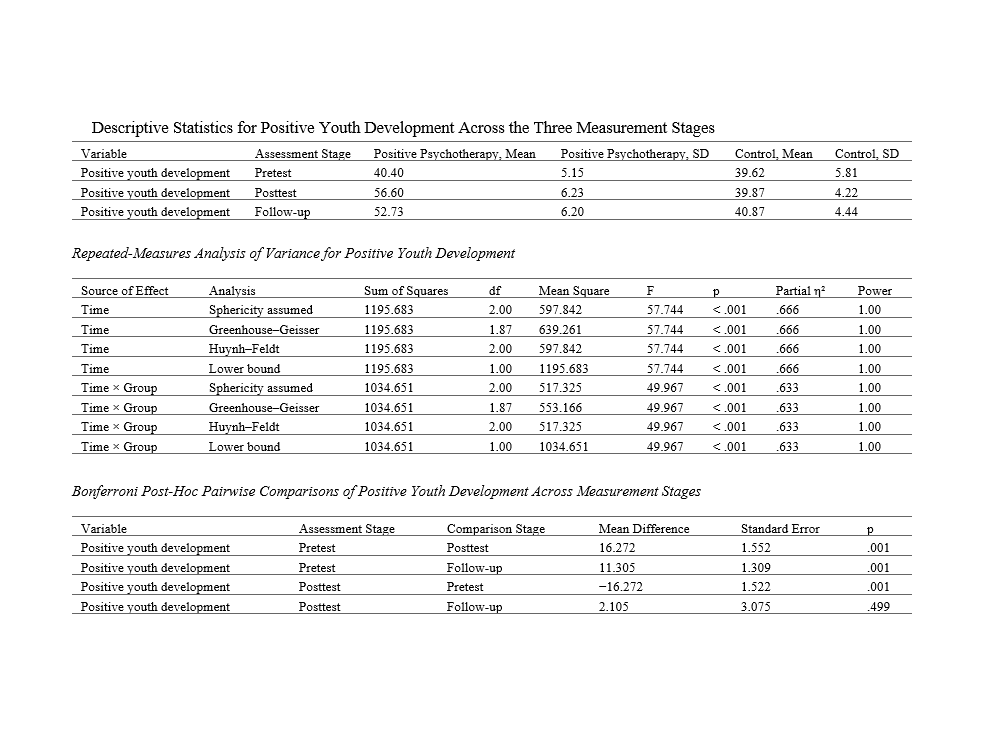
Findings: Inferential analyses demonstrated a statistically significant difference between the experimental and control groups in positive youth development across the assessment stages (p < .05). Participants who received positive psychotherapy showed significantly greater improvement in positive youth development at posttest compared with participants in the control group. The improvement observed following the intervention was also maintained at the follow-up assessment, indicating that the therapeutic effects were not limited to the immediate post-intervention period. The pattern of repeated-measures findings therefore supported the effectiveness and relative durability of positive psychotherapy in promoting positive developmental outcomes among adolescent girls experiencing social anxiety.
Conclusion: Positive psychotherapy appears to be an effective intervention for enhancing positive youth development in adolescent girls with social anxiety, with beneficial effects persisting during follow-up. Accordingly, this intervention may be incorporated into psychological, counseling, and school-based programs designed to strengthen positive developmental capacities among socially anxious adolescents.
Downloads
References
Abdi, F., Jamali, S. A. B., Ahadi, H., & Koushki, S. (2019). Psychometric Properties of the Connor-Davidson Resilience Scale in Women with Breast Cancer. Journal of Research in Psychological Health, 13(2).
Benson, P. L., Scales, P. C., Hamilton, S. F., & Sesma Jr, A. (2007). Positive Youth Development: Theory, Research, and Applications. In (Vol. 1). https://doi.org/10.1002/9780470147658.chpsy0116
Catalano, R. F., Berglund, M. L., Ryan, J. A., Lonczak, H. S., & Hawkins, J. D. (2004). Positive Youth Development in the United States: Research Findings on Evaluations of Positive Youth Development Programs. The Annals of the American Academy of Political and Social Science, 591(1), 98-124. https://doi.org/10.1177/0002716203260102
Chen, N. T., Clarke, P. J., MacLeod, C., & Guastella, A. J. (2012). Biased Attentional Processing of Positive Stimuli in Social Anxiety Disorder: An Eye Movement Study. Cognitive behaviour therapy, 41(2), 96-107. https://doi.org/10.1080/16506073.2012.666562
Dimitrova, R., & Wiium, N. (2021). Handbook of Positive Youth Development: Advancing the Next Generation of Research, Policy and Practice in Global Contexts. In (pp. 3-16). Springer. https://doi.org/10.1007/978-3-030-70262-5
Ekinci, N., & Akat, M. (2023). The Relationship between Anxious-Ambivalent Attachment and Social Appearance Anxiety in Adolescents: The Serial Mediation of Positive Youth Development and Instagram Addiction. Psychological Reports, 126(5), 2465-2488. https://doi.org/10.1177/00332941231159600
Field, T. (2020). Social Anxiety in Adolescents: A Narrative Review. Journal of anxiety disorders, 3(2), 127. https://doi.org/10.46527/2582-3264.127
Geldhof, G. J., Bowers, E. P., Boyd, M. J., Mueller, M. K., Napolitano, C. M., Schmid, K. L., & Lerner, R. M. (2014). The Creation and Validation of Short and Very Short Measures of PYD. Journal of Research on Adolescence, 24(1), 163-176. https://doi.org/10.1111/jora.12039
Gootman, J. A., & Eccles, J. (2002). Community Programs to Promote Youth Development. National Academies Press.
Hajizadeh Anari, M., & Miri, M. N. (2025). Comparing the Effectiveness of Positive Psychology Training and Mindfulness-Based Cognitive Therapy on Self-Efficacy and Teaching Anxiety of Physics Student-Teachers. Psychological Sciences, 24(152), 81-100.
Heinze, H. J. (2013). Beyond a Bed: Support for Positive Development for Youth Residing in Emergency Shelters. Children and Youth Services Review, 35(2), 278-286. https://doi.org/10.1016/j.childyouth.2012.10.018
Jabbari, S., Basharpour, S., & Narimani, M. (2021). The Effect of Self-Acceptance Group Therapy on Students with Social Anxiety. Health and Development Journal, 10(1), 39-45.
Jia, F., Li, Y., Yang, Z., Wang, S., & Mao, Y. (2026). Positive psychology approaches to alleviating foreign language classroom anxiety among university students: Insights from self-efficacy, flow, and self-compassion. BMC psychology. https://doi.org/10.1186/s40359-026-02145-9
Johnson, J., Gooding, P. A., Wood, A. M., & Tarrier, N. (2010). Resilience as Positive Coping Appraisals: Testing the Schematic Appraisals Model of Suicide (SAMS). Behaviour Research and Therapy, 48(3), 179-186. https://doi.org/10.1016/j.brat.2009.10.007
Johnson, J., Gooding, P. A., Wood, A. M., Taylor, P. J., Pratt, D., & Tarrier, N. (2010). Resilience to Suicidal Ideation in Psychosis: Positive Self-Appraisals Buffer the Impact of Hopelessness. Behaviour Research and Therapy, 48(9), 883-889. https://doi.org/10.1016/j.brat.2010.05.013
Joshi, C. (2013). Positive Thinking: A Powerful Tool to Reduce Social Anxiety of Undergraduate Students. Indian Journal Research, 2(8), 62-64.
Kashdan, T. B. (2007). Social Anxiety Spectrum and Diminished Positive Experiences: Theoretical Synthesis and Meta-Analysis. Clinical psychology review, 27(3), 348-365. https://doi.org/10.1016/j.cpr.2006.12.003
Kashdan, T. B., Weeks, J. W., & Savostyanova, A. A. (2011). Whether, How, and When Social Anxiety Shapes Positive Experiences and Events: A Self-Regulatory Framework and Treatment Implications. Clinical psychology review, 31(5), 786-799. https://doi.org/10.1016/j.cpr.2011.03.012
Kazemi, N., Zadeh, R., Vahid, M., & Taghi, S. (2019). The Effect of Positive Thinking Training on Social Anxiety and Cognitive Avoidance in Mothers of Children with Specific Learning Disabilities. Child Mental Health Quarterly, 5(4), 148-158.
Kessler, R. C., Petukhova, M., Sampson, N. A., Zaslavsky, A. M., & Wittchen, H. U. (2012). Twelve-Month and Lifetime Prevalence and Lifetime Morbid Risk of Anxiety and Mood Disorders in the United States. International Journal of Methods in Psychiatric Research, 21(3), 169-184. https://doi.org/10.1002/mpr.1359
Kozina, A., Wiium, N., & Pivec, T. (2020). Positive Youth Development Perspective: The Interplay between the 5Cs and Anxiety. In (pp. 173-182). https://doi.org/10.36315/2021pad16
Linver, M. R., Urban, J. B., Chen, W. L., Gama, L., & Swomley, V. I. (2022). Predicting Positive Youth Development from Self-Regulation and Purpose in Early Adolescence. Journal of Research on Adolescence, 32(4), 1312-1327. https://doi.org/10.1111/jora.12621
Martínez-Martí, M. L., & Ruch, W. (2017). Character Strengths Predict Resilience over and above Positive Affect, Self-Efficacy, Optimism, Social Support, Self-Esteem, and Life Satisfaction. The Journal of Positive Psychology, 12(2), 110-119. https://doi.org/10.1080/17439760.2016.1163403
Meulenbeek, K., Loheide-Niesmann, L., Spagnuolo, F., & Cima, M. J. (2026). Positive youth development and prosocial behavior: A systematic review and multilevel meta-analysis. Journal of adolescence, 98(1), 7-35. https://doi.org/10.1002/jad.70040
Milot, A. S. (2014). Positive Youth Development as a Framework for Examining the Relationships between Conformity to Gender Norms, Social Support, and Adolescent Mental Health Boston College].
Pour, G., Goudarzi, G., Far, D., Padarvand, & Hafez. (2021). Effectiveness of Group-Based Positive Thinking Training on Improving Empathy and Reducing Social Anxiety in Male Students with Learning Disabilities. Learning Disabilities, 10(3), 366-379.
Rashid, T., & Seligman, M. P. (2018). Positive Psychotherapy: Clinician Manual. Oxford University Press. https://doi.org/10.1093/med-psych/9780195325386.001.0001
Roth, J. L., & Brooks-Gunn, J. (2003). What Is a Youth Development Program? Identification of Defining Principles. In (pp. 197-224). SAGE Publications, Inc. https://doi.org/10.4135/9781452233642.n29
Shek, D. T., Dou, D., Zhu, X., & Chai, W. (2019). Positive Youth Development: Current Perspectives. Adolescent Health, Medicine and Therapeutics, 131-141. https://doi.org/10.2147/AHMT.S179946
Smith, K. M. (2025). Critical Positive Youth Development in Non-Traditional Sport Spaces. Youth, 5(2), 55. https://doi.org/10.3390/youth5020055
Steinberg, L., & Lerner, R. M. (2004). The Scientific Study of Adolescence: A Brief History. The Journal of Early Adolescence, 24(1), 45-54. https://doi.org/10.1177/0272431603260879
Walter, H. J., Bukstein, O. G., Abright, A. R., Keable, H., Ramtekkar, U., Ripperger-Suhler, J., & Rockhill, C. (2020). Clinical Practice Guideline for the Assessment and Treatment of Children and Adolescents with Anxiety Disorders. Journal of the American Academy of Child & Adolescent Psychiatry, 59(10), 1107-1124. https://doi.org/10.1016/j.jaac.2020.05.005
Yousefpour, N. (2025). The effectiveness of positive psychology training on anxiety, social skills, and meaning in life among older adults. Aging Psychology, 11(4).
Zarrett, N., & Lerner, R. M. (2008). Ways to Promote the Positive Development of Children and Youth. https://doi.org/10.1037/e456902008-001
Downloads
Additional Files
Publication Timeline
- Submitted
- Revised
- Accepted