Developing a Dialectical Behavior Therapy-Based Addiction Prevention Package for Adolescents: A Qualitative Study
DOI:
https://doi.org/10.61838/kman.jayps.4604Keywords:
Dialectical Behavior Therapy (DBT), Addiction Prevention, Adolescents, Emotion Regulation, Qualitative Study, MindfulnessAbstract
Objective: This study aimed to design and validate an addiction prevention training package for adolescents based on the theoretical and practical framework of Dialectical Behavior Therapy (DBT).
Methods and Materials: This qualitative research was conducted using conventional content analysis following the Hsieh and Shannon (2005) approach. Relevant literature on DBT and adolescent addiction was systematically reviewed according to inclusion and exclusion criteria until theoretical saturation was reached. Data analysis identified two core dimensions in DBT (pathology and interventions) and two major dimensions in adolescent addiction (predisposing and protective factors). The DBT dimensions included emotional vulnerability, invalidating environment, and emotion dysregulation, while the intervention dimension encompassed individual and group skill training (mindfulness, distress tolerance, emotion regulation, and interpersonal effectiveness). Adolescent addiction dimensions included family, individual, social, educational, and policy factors. Using Yusefi and Golparvar’s (2023) seven-step model, these dimensions were integrated to develop the prevention package. The content and structure of the program were reviewed and validated by university faculty and clinical psychologists specializing in adolescent psychotherapy.
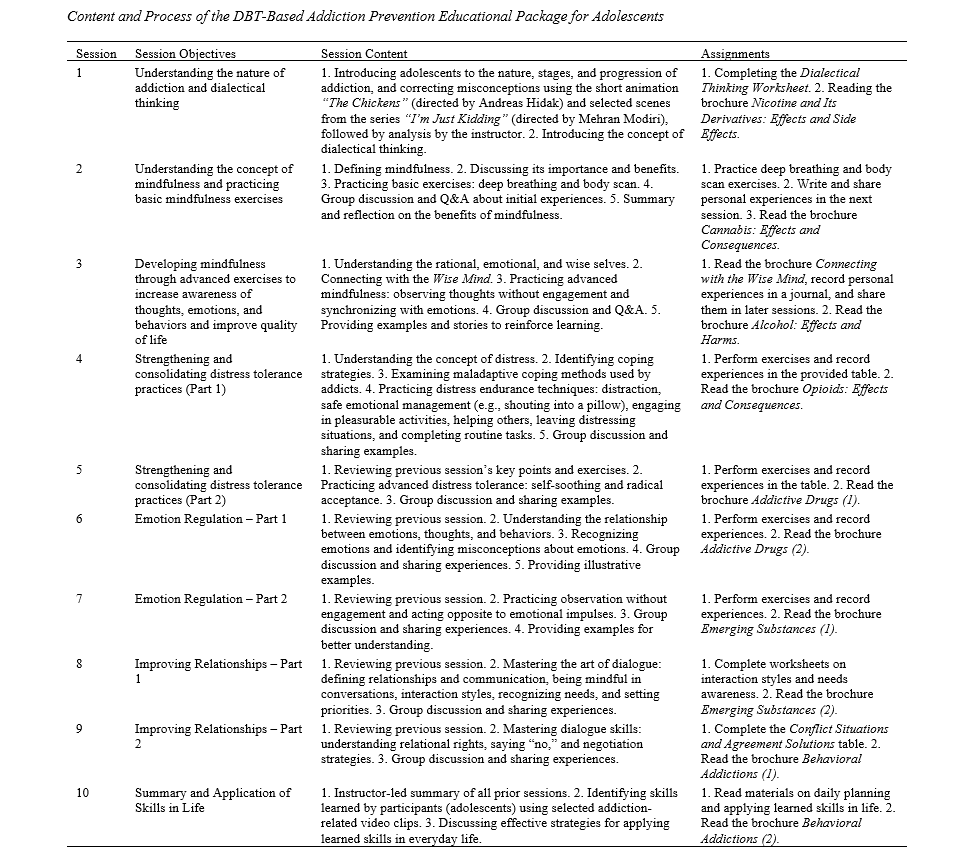
Findings: A ten-session DBT-based educational package was developed and validated. The content analysis yielded 106 primary codes for adolescent addiction and 75 for DBT. Expert evaluation confirmed the conceptual alignment and cultural adaptability of the package, with high inter-rater agreement indicating strong content validity. The sessions emphasized dialectical thinking, mindfulness, distress tolerance, emotion regulation, and interpersonal communication, each tailored to adolescent developmental needs and contextualized within Iranian cultural norms.
Conclusion: The developed DBT-based prevention package provides a structured, evidence-informed educational framework to enhance adolescents’ emotional regulation, resilience, and interpersonal skills, thereby reducing susceptibility to substance use. Its theoretical rigor and cultural fit suggest strong potential for school- and community-level implementation in adolescent addiction prevention programs.
Downloads
References
Aali Sari Nasirloo, K., Naderi, F., Homayee, R., & Makvandi, B. (2023). The Effectiveness of Dialectical Behavior Therapy on Self-Conscious Affect and Family Quality of Life in Mothers of Children with Intellectual Disabilities. Bimonthly Scientific-Research Journal of Rehabilitation Science, 12(3), 446-459. https://doi.org/10.32598/SJRM.12.3.3
Aghaeipour, Y., Ghahramani, A., & Rostami Kol, A. (2024). Investigating the Causes of Addiction to Drugs and Alcoholism, Methods of Prevention, Treatment, and Demand Reduction. Bimonthly Journal of Elite in Science and Engineering, 9(1), 122-138. https://www.sid.ir/paper/1143721/fa
Amighi, H., Ebrahimi Moghadam, H., & Kashani Vahid, L. (2025). Effectiveness of dialectical behavior therapy (DBT) on aggression, anxiety, and attention in girls with obsessive-compulsive disorder: A quasi-experimental study. Journal of Rafsanjan University of Medical Sciences, 23(11), 973-989. https://doi.org/10.61186/jrums.23.11.973
Amini, Z., & Heidary, B. S. (2020). What components of adolescents' responsibility are effective in preventing addiction? Advanced Biomedical Research, 9(1), 2-2. https://doi.org/10.4103/abr.abr_204_19
Asadi Fard, M. (2024). The Model for Managing Social Prevention of Drug Addiction in Women. Scientific Quarterly of Addiction Research, 18(72), 7-32. https://doi.org/10.61186/etiadpajohi.18.72.1
Bazrafshan, M. R., Delam, H., & Kavi, E. (2020). The Importance of Life Skills Training in Preventing Addiction Recurrence between January and February 2020: A Narrative Review Article. Journal of Health Sciences & Surveillance System, 8(2), 58-62. https://jhsss.sums.ac.ir/article_46634.html
Bedayat, E., Mohammadi, N., Rahimi Taqanaki, C., & Aflak Sir, A. (2024). Investigating the Psychometric Properties of the Persian Version of the Post-Injury Risky Behavior Questionnaire in Individuals with Symptoms of Post-Traumatic Stress Disorder. Journal of Psychological Sciences, 23(141), 71-88. https://psychologicalscience.ir/browse.php?a_id=2316&sid=1&slc_lang=en
Bowers, D., Colon, M., Morgan, C., & Wood, T. (2024). Impact of Dialectical Behavioral Therapy on Anxiety Levels Among African American Adolescents. Journal of Psychosocial Nursing and Mental Health Services, 62(8), 7-10. https://doi.org/10.3928/02793695-20240111-01
Centers for Disease, C., & Prevention, N. C. f. H. S. (2022). Mortality data on CDC WONDER. U.S. Department of Health and Human Services.
Ciesinski, N. K., Sorgi-Wilson, K. M., Cheung, J. C., Chen, E. Y., & McCloskey, M. S. (2022). The effect of dialectical behavior therapy on anger and aggressive behavior: A systematic review with meta-analysis. Behaviour Research and Therapy, 154, 104122-104122. https://doi.org/10.1016/j.brat.2022.104122
Dallenbach, M. L., Moeller, K., & Givens, A. (2025). Does duration of dialectical behavioral therapy for adolescents (DBT-A) skills groups affect outcomes: A rapid review. Child and Adolescent Social Work Journal, 42(3), 285-298. https://doi.org/10.1007/s10560-024-00961-4
Dimeff, L. A., Koerner, K., & Rizvi, S. L. (2021). Dialectical behavior therapy in clinical practice: Applications across disorders and settings (2nd ed.). Guilford Press. https://books.google.com/books/about/Dialectical_Behavior_Therapy_in_Clinical.html?id=xlzyDwAAQBAJ
Fadaei, M. H., Farokhzadian, J., Miri, S., & Goojani, R. (2020). Promoting drug abuse preventive behaviors in adolescent students based on the health belief model. International Journal of Adolescent Medicine and Health, 34(3). https://doi.org/10.1515/ijamh-2019-0170
Ghaffari Charati, M., Mohammadi Pour, M., & Azizi, A. (2022). The Effectiveness of Dialectical Behavior Therapy on Emotion Dysregulation and Aggression in Adolescent Girls with Symptoms of Depression. Islamic Lifestyle Centered on Health, 6(4), 392-402. https://www.islamiilife.com/article_185851.html
Ghasemi, Z., Khaki, S., & Matin zadeh, M. (2024). Effectiveness of dialectic behavior therapy on the experiential avoidance and psychological distress in the girls with the experience of domestic violence. medical journal of mashhad university of medical sciences, 67(1), 312-324. https://mjms.mums.ac.ir/article_24152.html
Ghorbani, A., & Asadi, J. (2023). A Comparison of Personality Traits, Mental Health, and Sensation Seeking Between Adolescents with Drug-Dependent Parents and Normal Adolescents. Scientific Quarterly of Addiction Research, 17(69), 137-160. https://doi.org/10.61186/etiadpajohi.17.69.137
Haft, S. L., O'Grady, S. M., Shaller, E. A., & Liu, N. H. (2022). Cultural adaptations of dialectical behavior therapy: A systematic review. Journal of consulting and clinical psychology, 90(10), 787-802. https://doi.org/10.1037/ccp0000730
Hashemi Moghaddam, L., Torokan, H., & Yusofi, Z. (2020). A Qualitative Study of Protective and Risk Factors in Addiction Among Men and Women in the City of Isfahan. Scientific Quarterly of Addiction Research, 14(55), 133-150. https://doi.org/10.29252/etiadpajohi.14.55.133
Hatoum, A. H., & Burton, A. L. (2024). Applications and efficacy of radically open dialectical behavior therapy (RO DBT): A systematic review of the literature. Journal of Clinical Psychology, 80(11), 2283-2302. https://doi.org/10.1002/jclp.23735
Hawkins, G. T., Chung, C. S., Hertz, M. F., & Antolin, N. (2023). The school environment and physical and social‐emotional well‐being: implications for students and school employees. Journal of School Health, 93(9), 799-812. https://doi.org/10.1111/josh.13375
Herd, T., & Kim-Spoon, J. (2021). A systematic review of associations between adverse peer experiences and emotion regulation in adolescence. Clinical Child and Family Psychology Review, 24(1), 141-163. https://doi.org/10.1007/s10567-020-00337-x
Homayounpour, P., Seyrafi, M. R., & Vaghar, S. (2021). The Effectiveness of Dialectical Behavior Therapy in Reducing Negative Emotions and Weight Loss in Obese Women. https://ijohp.journals.pnu.ac.ir/article_8584.html
Hosseini, S. H., Hajebi, A., Motevalian, S. A., Hojjat, S. K., Ashoorkhani, M., & Sadeghi, R. (2021). Developing an Educational Parenting Skills Package to Parents Undergoing Substance Abuse Treatment for Preventing Addiction among Adolescents: A Study Protocol Based on Social Marketing Approach. Addiction & Health, 13(2), 68-76. https://www.magiran.com/paper/2296366/developing-an-educational-parenting-skills-package-to-parents-undergoing-substance-abuse-treatment-for-preventing-addiction-among-adolescents-a-study-protocol-based-on-social-marketing-approach?lang=en
Kabbash, I., Zidan, O., & Saied, S. (2022). Substance abuse among university students in Egypt: prevalence and correlates. Eastern Mediterranean Health Journal, 28(1), 70-78. https://doi.org/10.26719/emhj.22.001
Khaghani, F., & Yusofi, Z. (2020). A Qualitative Study of Factors Affecting Treatment Adherence in Drug-Dependent Individuals Undergoing Maintenance Treatment with Methadone in the City of Isfahan. Scientific Quarterly of Addiction Research, 14(56), 59-78. https://doi.org/10.29252/etiadpajohi.14.56.59
Kivan, K., Haroon Rashidi, H., & Kazemianmoghadam, K. (2022). The effectiveness of dialectical behavior therapy for academic buoyancy and psychological capital. Educational Psychology, 18(64), 109-127. https://jep.atu.ac.ir/article_15274.html
Kothgassner, O. D., Goreis, A., Robinson, K., Huscsava, M. M., Schmahl, C., & Plener, P. L. (2021). Efficacy of dialectical behavior therapy for adolescent self-harm and suicidal ideation: A systematic review and meta-analysis. Psychological medicine, 51(7), 1057-1067. https://doi.org/10.1017/S0033291721001355
Liu, T., Pang, P. C., & Lam, C. K. (2024). Public health education using social learning theory: a systematic scoping review. BMC public health, 24, 1906-1906. https://doi.org/10.1186/s12889-024-19333-9
Luke, M., Foster, H., & Chen, Y. (2024). Mapping dialectical behavior therapy skills in clinical fields related to addiction: A conceptual synthesis and future perspectives. Frontiers in psychology, 15, 1398421-1398421.
Maggs, J. L., Calhoun, B. H., & Allen, H. K. (2023). Substance use across adolescence and early adulthood: Prevalence, causes, developmental roots, and consequences. In. https://doi.org/10.1037/0000298-033
Marshall, L., Kletzka, N., Kanitz, J., Opperman, K. J., & Rockwell, J. (2024). Effectiveness of Dialectical Behavior Therapy (DBT) in a Forensic Psychiatric Hospital. The journal of the American Academy of Psychiatry and the Law, 52(2), 196-206. https://pubmed.ncbi.nlm.nih.gov/38834364/
McMain, S. F., Guimond, T., Streiner, D. L., Cardish, R. J., Links, P. S., & O'Reilly, K. (2021). Six-month versus twelve-month dialectical behavior therapy for borderline personality disorder: Noninferiority randomized clinical trial. American Journal of Psychiatry, 178(1), 41-49.
Mendelo, V., Zhylin, M., Koliadenko, N., Maksymets, S., & Ihnatovych, O. (2024). Importance of developing emotional intelligence in preventing addiction syndrome. Archives of Psychiatry Research, 60(3), 227-238. https://doi.org/10.20471/may.2024.60.03.05
Molaei Jolandan, M., Khalatbari, J., & Ghorban Shiroudi, S. (2024). Comparing the Effectiveness of Positive Therapy and Dialectical Behavior Therapy on Self-Awareness in Vulnerable Adolescents Covered by the Welfare Organization of Tehran. Journal of Mashhad University of Medical Sciences, Faculty of Medicine, 67(4). https://mjms.mums.ac.ir/article_25073.html
Nath, A., Choudhari, S. G., Dakhode, S. U., Rannaware, A., Gaidhane, A. M., Dakhode, S., & Gaidhane, A. (2022). Substance abuse amongst adolescents: An issue of public health significance. Cureus, 14(11), e31286-e31286. https://doi.org/10.7759/cureus.31193
Peguoh, A., & Yusofi, Z. (2024). The Effectiveness of Mode Deactivation Therapy on Marital Burnout and Desire for Divorce in Wives of Men Recovered from Addiction. Scientific Quarterly of Addiction Research, 18(73), 7-30. https://doi.org/10.61186/etiadpajohi.18.73.7
Pour Nemmat, S., Nosratpour, F., & Sukhteh Zari, S. (2023). Tendency to Use Drugs Among High School Students and Ways to Prevent It. Specialized Scientific Journal of Psychology and Educational Sciences in the Third Millennium, 7(3), 36-50. https://www.pejournal.ir/fa/downloadpaper.php?pid=351&rid=30&p=A
Rahbar Karbasdehi, E., Afrooz, G., & Rahbar Karbasdehi, F. (2024). The Effect of Teaching a Family-Centered Behavioral Management Program on Dysfunctional Attitudes and Psychological Well-being in Adolescents Inclined to Drug Use. Scientific Quarterly of Addiction Research, 18(71), 85-102. https://doi.org/10.61186/etiadpajohi.18.71.85
Rahmani Moghaddam, F., Bagherzadehgolmakani, Z., Tozandehjani, H., & Nejat, H. (2023). The Effectiveness of Dialectical Behavior Therapy on Emotion Regulation and Rumination in Physically-Motor Disabled Individuals Covered by the Welfare Organization of Mashhad County. Journal of Clinical Psychology and Counseling Research, 13(1), 123-138. https://tpccp.um.ac.ir/article_43984.html?lang=en
Rizvi, S. L., Bitran, A. M., Oshin, L. A., Yin, Q., & Ruork, A. K. (2024). The state of the science: Dialectical behavior therapy. Behavior therapy. https://doi.org/10.1016/j.beth.2024.02.006
Sabzian, S., & Lajevardi, H. (2024). The Mediating Role of Boredom in the Relationship Between Cognitive Abilities and Addiction Preparedness in Students. Scientific Quarterly of Addiction Research, 18(71), 7-30. https://doi.org/10.61186/etiadpajohi.18.71.7
Shamshir saz, T. (2024). Effectiveness of dialectical behavior therapy on depression symptoms and emotion regulation of self-injury teenagers. Child Emotional Development Psychology, 1(1). https://www.journalcedp.com/article_206668.html?lang=en
Simsek, M., Tacoy, S., & Karasalih, S. (2022). Developing personal and social Life Skills to protect children and youth from substance addiction. The European Journal of Social & Behavioural Sciences. https://doi.org/10.15405/ejsbs.320
Syversen, A. M., Schønning, V., Fjellheim, G. S., Elgen, I., & Wergeland, G. J. (2024). Evaluation of dialectical behavior therapy for adolescents in routine clinical practice: a pre-post study. BMC psychiatry, 24(1), 447-447. https://doi.org/10.1186/s12888-024-05876-z
Trucco, E. M. (2020). A review of psychosocial factors linked to adolescent substance use. Pharmacology Biochemistry and Behavior, 196, 172969-172969. https://doi.org/10.1016/j.pbb.2020.172969
Uhlhaas, P. J., Davey, C. G., Mehta, U. M., Shah, J., Torous, J., Allen, N. B., Avenevoli, S., Bella-Awusah, T., Chanen, A., Chen, E. Y. H., Correll, C. U., Do, K. Q., Fisher, H. L., Frangou, S., Hickie, I. B., Keshavan, M. S., Konrad, K., Lee, F. S., Liu, C. H., . . . Wood, S. J. (2023). Towards a youth mental health paradigm: a perspective and roadmap. Molecular Psychiatry, 28(8), 3171-3181. https://doi.org/10.1038/s41380-023-02202-z
Vakili, M., Bagherzadeh Golmakani, Z., & Bolghan-Abadi, M. (2024). Comparing the effectiveness of dialectical behavior therapy with acceptance and commitment therapy on psychological coherence in binge eating patients. medical journal of mashhad university of medical sciences, 67(2), 556-570. https://mjms.mums.ac.ir/article_24678.html
Van Dijk, S., & Deans, C. (2021). Don't let your emotions run your life for teens: Dialectical behavior therapy skills for helping you manage mood swings and stress. New Harbinger Publications.
Wilkins, N. J. (2023). School connectedness and risk behaviors and experiences among high school students-Youth Risk Behavior Survey, United States, 2021. MMWR supplements, 72. https://doi.org/10.15585/mmwr.su7201a2
Yousefi, Z., & Golparvar, M. (2023). Step-by-step integration of two psychotherapy methods to achieve a unified method: An example of autoethnographic research.
Zorita-Oña, J., Rojo, L., & Rodríguez, C. (2020). Dialectical behavior therapy for substance users: A comprehensive treatment manual. Pirámide Press.
Downloads
Additional Files
Publication Timeline
- Submitted
- Revised
- Accepted