































Comparison of the Effects of a Single Bout of Resistance, Endurance, and Concurrent Exercise on Circulating miRNA-221 Expression in Physically Active Healthy Women
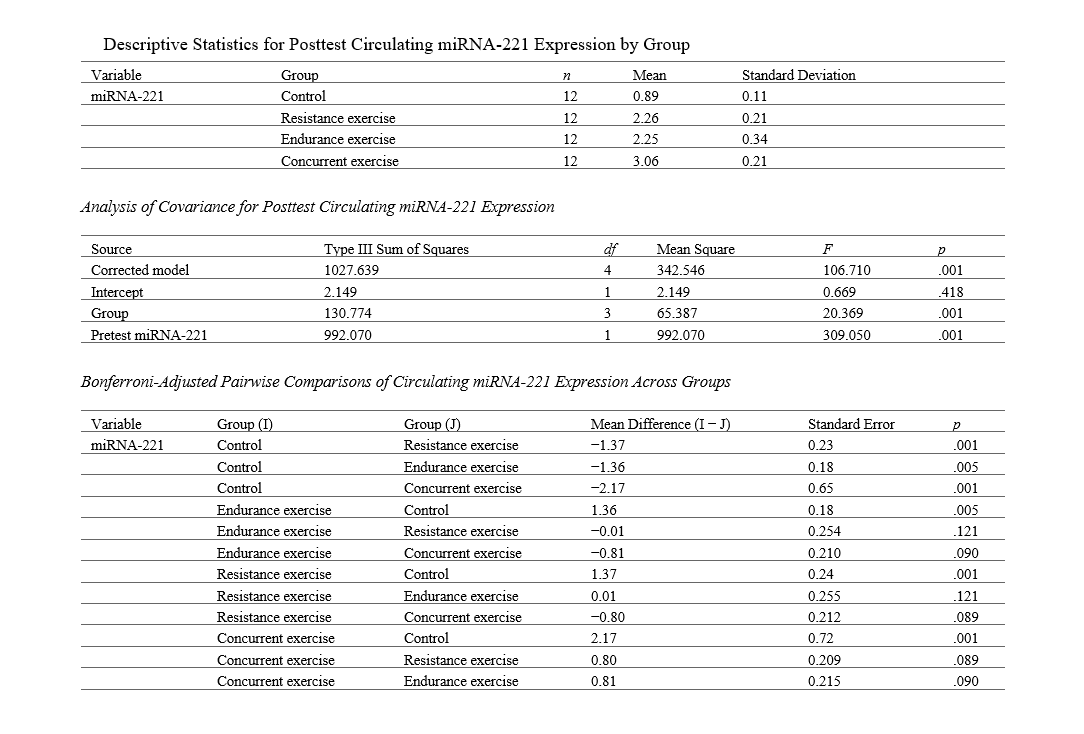
The present study aimed to compare the effects of a single bout of resistance, endurance, and concurrent exercise on circulating miRNA-221 expression in physically active healthy women. In terms of its objective, this was an applied study, and in terms of its methodology, it employed a quasi-experimental pretest–posttest design with a control group. The statistical population consisted of physically active healthy women. Accordingly, 48 participants were selected through purposive sampling and randomly assigned to four groups: control (n = 12), resistance exercise (n = 12), endurance exercise (n = 12), and concurrent exercise (n = 12). The resistance exercise protocol consisted of front squats, back squats, abdominal crunches, leg presses, and leg extensions performed at 90% of one-repetition maximum for five sets of four to six repetitions. The endurance exercise protocol consisted of running on a treadmill at a 0% incline and a speed of 8 km/h for 30 minutes, followed by cycling on a stationary bicycle at a workload of 100 W for 20 minutes. The concurrent exercise protocol consisted of performing both resistance and endurance exercise within the same session. Blood samples were collected at two time points: before the exercise session and immediately after completion of the exercise protocol. Circulating miRNA-221 expression was quantified using real-time quantitative reverse transcription polymerase chain reaction (RT-qPCR), with cel-miR-39 used as an exogenous control. Data were analyzed using descriptive statistics, mixed-design analysis of variance with repeated measures, and the Bonferroni post hoc test at a significance level of .05. The results showed that a single bout of exercise produced a significant change in circulating miRNA-221 expression in physically active healthy women (p < .05). Significant differences in changes in miRNA-221 expression were also observed between the control group and each of the resistance, endurance, and concurrent exercise groups (p < .05). Although the mean change in miRNA-221 expression was greater in the concurrent exercise group than in the endurance and resistance exercise groups, the differences among the three exercise groups were not statistically significant (p > .05). Overall, the findings indicated that a single bout of exercise, irrespective of exercise modality, significantly alters circulating miRNA-221 expression in physically active healthy women and may contribute to the activation of molecular responses associated with exercise-induced adaptations. However, exercise modality did not produce a significant difference in the magnitude of changes in miRNA-221 expression following a single exercise session.