Analyzing Barriers to Data-Driven Governance in Iraq’s Public Policymaking: Evidence from COVID-19 Crisis Management in Salah al-Din Province
Keywords:
Data-Driven Governance; Public Policymaking; COVID-19; Crisis Management; Big Data; Digital Governance; Salah al-Din Province; IraqAbstract
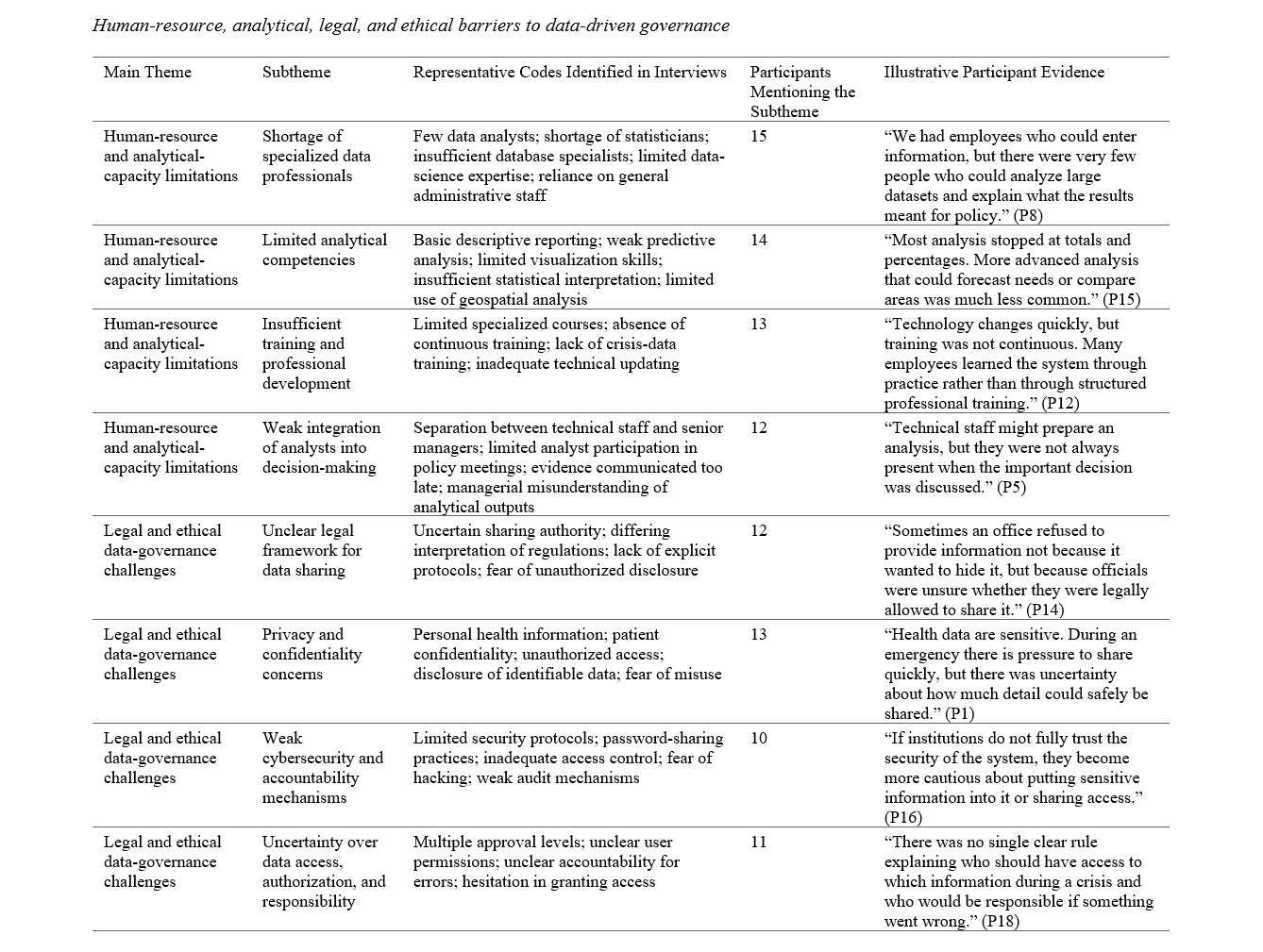
This study aimed to analyze the technological, institutional, human-resource, legal, ethical, socio-cultural, and political-administrative barriers to data-driven governance in Iraq’s public policymaking through the experience of COVID-19 crisis management in Salah al-Din Province. This qualitative, applied, descriptive-analytical study was conducted in Salah al-Din Province, Iraq. Participants were 18 individuals with relevant professional experience in public administration, healthcare management, information technology, data management, digital governance, policymaking, and COVID-19 crisis response. Participants were selected through purposive sampling, and data collection continued until thematic saturation was achieved. Data were collected through individual semi-structured interviews focused on digital infrastructure, data quality, interagency coordination, analytical capacity, legal and ethical considerations, organizational culture, and crisis-related evidence use. Interviews were recorded with consent, transcribed, and analyzed using thematic analysis through familiarization, initial coding, theme development, theme review, theme definition, and interpretation. Credibility, dependability, confirmability, and transferability were strengthened through systematic documentation, constant comparison, careful transcription, reflexive analysis, and cross-checking of emerging themes. The analysis identified five interrelated categories of barriers: technological and data-infrastructure limitations, institutional and organizational fragmentation, human-resource and analytical-capacity limitations, legal and ethical data-governance challenges, and socio-cultural and political-administrative barriers. Institutional fragmentation emerged as the most pervasive barrier, followed by weak data quality and standardization, lack of interoperability, bureaucratic delays, shortages of specialized analytical personnel, insufficient training, ambiguous data-sharing rules, privacy and cybersecurity concerns, resistance to digital transformation, weak interorganizational trust, and continued reliance on authority- and experience-based decision-making. During the COVID-19 crisis, these barriers contributed to delayed situational awareness, inconsistent public-health indicators, difficulty forecasting healthcare demand, inefficient resource allocation, and predominantly reactive rather than anticipatory crisis management. Data-driven governance in Salah al-Din Province is constrained by a systemic combination of technological, institutional, human, regulatory, and cultural weaknesses, indicating that effective reform requires integrated improvements in digital infrastructure, data interoperability, analytical capacity, interagency coordination, legal safeguards, and evidence-oriented administrative practices.
Downloads
References
1. Mergel I, Edelmann N, Haug N. Defining Digital Transformation: Results from Expert Interviews. Government Information Quarterly. 2019;36(4):101385. doi: 10.1016/j.giq.2019.06.002.
2. Zhu X. Public Administration with, of, and through AI: Toward a New Paradigm in the Era of Intelligence. Policy Design and Practice. 2025;8(1):30-57. doi: 10.1080/23812346.2025.2578589.
3. Valle-Cruz D, Criado JI, Sandoval-Almazan R, Ruvalcaba-Gomez E. The Strategic Use of AI in the Public Sector: A Public Values Analysis of National AI Strategies. Government Information Quarterly. 2024;41(1):101914. doi: 10.1016/j.giq.2024.101914.
4. Morçöl G. Complexity, Governance and Policy: Routledge; 2023.
5. Jamarani A, Haddadi S, Sarvizadeh R, Kashani MH, Akbari M, Moradi S. Big Data and Predictive Analytics: A Systematic Review of Applications. Artificial Intelligence Review. 2024;57:176. doi: 10.1007/s10462-024-10811-5.
6. Gupta M, George JF. Toward the Development of a Big Data Analytics Capability. Information & Management. 2016;53(8):1049-64. doi: 10.1016/j.im.2016.07.004.
7. Giest S. Big Data for Policymaking: Fad or Fasttrack? Policy Sciences. 2017;50(3):367-82. doi: 10.1007/s11077-017-9293-1.
8. Klievink B, Romijn BJ, Cunningham S, de Bruijn H. Big Data in the Public Sector: Uncertainties and Readiness. Information Systems Frontiers. 2017;19(2):267-83. doi: 10.1007/s10796-016-9686-2.
9. Peters BG. The Challenge of Policy Coordination: Policy Press; 2018.
10. Janssen M, van der Voort H, Wahyudi A. Factors Influencing Big Data Decision-Making Quality. Journal of Business Research. 2017;70:338-45. doi: 10.1016/j.jbusres.2016.08.007.
11. Aoki N, Tatsumi T, Naruse G, Maeda K. Explainable AI for Government: Does the Type of Explanation Matter to the Accuracy, Fairness, and Trustworthiness of an Algorithmic Decision as Perceived by Those Who Are Affected? Government Information Quarterly. 2024;41(4):101965. doi: 10.1016/j.giq.2024.101965.
12. Nikiforova A, Lnenicka M, Melin U, Valle-Cruz D, Gill A, Flores CC, editors. Responsible AI Adoption in the Public Sector: A Data-Centric Taxonomy of AI Adoption Challenges2025.
13. Nanni R, Napolitano M. Dataspaces, Public Administration, and Collective Rationality: Opportunities and Limits for Data-Driven Policymaking. Public Money & Management. 2024;44(6):1-12. doi: 10.1080/09540962.2023.2298260.
14. Meijer A, Bolívar MPR. Governing the Smart City: A Review of the Literature on Smart Urban Governance. International Review of Administrative Sciences. 2016;82(2):392-408. doi: 10.1177/0020852314564308.
15. Ansell C, Sørensen E, Torfing J. The COVID-19 Pandemic as a Game Changer for Public Administration and Leadership? Public Management Review. 2021;23(7):949-60. doi: 10.1080/14719037.2020.1820272.
16. Wang CJ, Ng CY, Brook RH. Response to COVID-19 in Taiwan: Big Data Analytics, New Technology, and Proactive Testing. JAMA. 2020;323(14):1341-2. doi: 10.1001/jama.2020.3151.
17. Capano G, Howlett M, Jarvis DSL, Ramesh M, Goyal N. Mobilizing Policy Capacity to Fight COVID-19. Policy and Society. 2022;41(1):1-18. doi: 10.1093/polsoc/puab018.
18. Bragazzi NL, Dai H, Damiani G, Behzadifar M, Martini M, Wu J. How Big Data and Artificial Intelligence Can Help Better Manage Future Pandemics. International Journal of Environmental Research and Public Health. 2023;20(3):2235.
Downloads
Publication Timeline
- Submitted
- Revised
- Accepted