Comparison of the Effectiveness of Cognitive Behavioral Therapy and Repetitive Transcranial Magnetic Stimulation on Adaptive and Maladaptive Cognitive Emotion Regulation Strategies in Patients with Multiple Sclerosis
Keywords:
multiple sclerosis, cognitive behavioral therapy, repetitive transcranial magnetic stimulation, emotion regulationAbstract
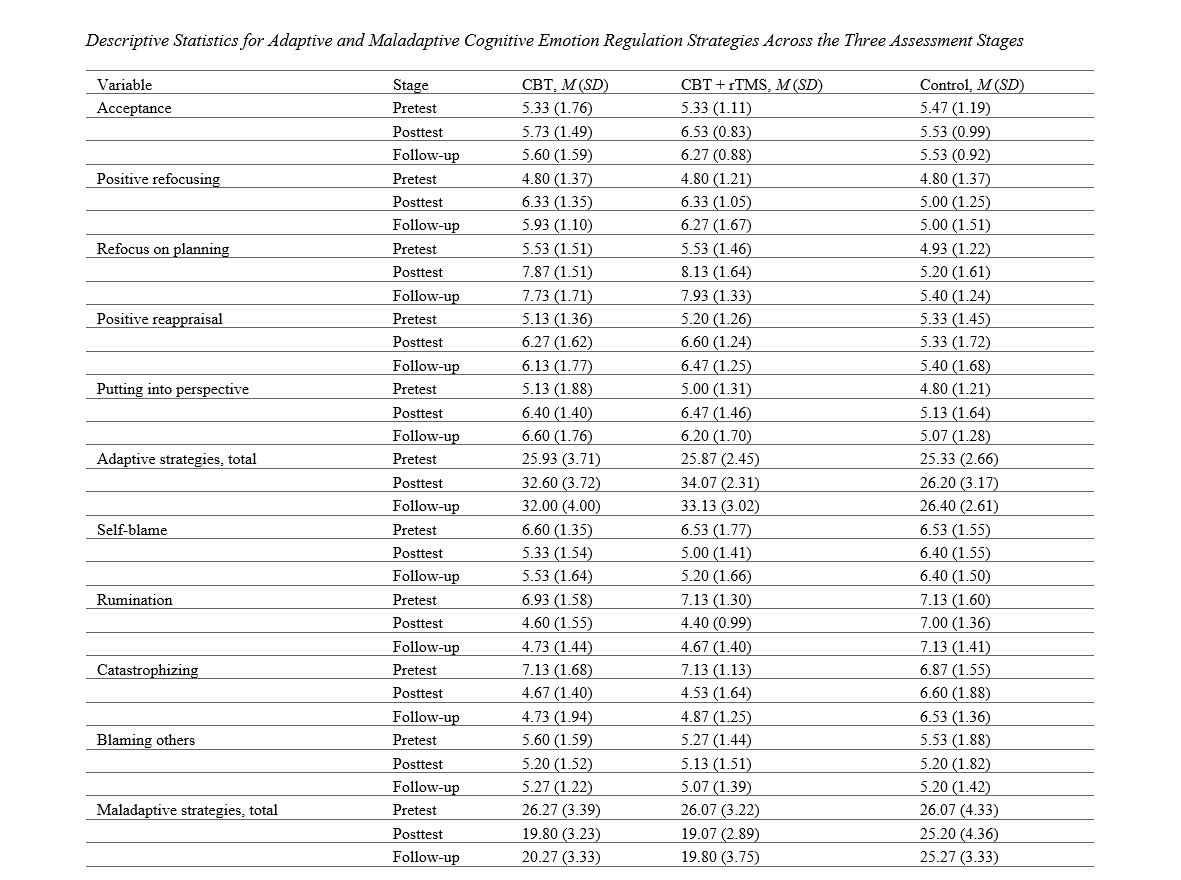
The present study aimed to compare the effectiveness of cognitive behavioral therapy (CBT) and repetitive transcranial magnetic stimulation (rTMS) on adaptive and maladaptive cognitive emotion regulation strategies in patients with multiple sclerosis (MS). This applied, quasi-experimental study employed a pretest–posttest design with a one-month follow-up and a control group. The statistical population consisted of all patients with multiple sclerosis who attended a specialized clinic in Kerman, Iran, during 2025–2026. Using convenience sampling, 45 eligible patients were selected and randomly assigned to three groups of 15 participants each: a cognitive behavioral therapy group, a cognitive behavioral therapy combined with repetitive transcranial magnetic stimulation group, and a control group. Data were collected using the Cognitive Emotion Regulation Questionnaire (CERQ; Garnefski & Kraaij, 2006). The experimental groups received, respectively, a 12-session CBT protocol and CBT combined with 30 sessions of rTMS, whereas the control group received no intervention. Data were analyzed using mixed analysis of variance (ANOVA) with repeated measures in SPSS version 26. The findings indicated that the group × time interaction effect was statistically significant for both primary study variables, namely adaptive and maladaptive cognitive emotion regulation strategies (p < .001). Compared with the control group, both interventions significantly increased adaptive cognitive emotion regulation strategies and decreased maladaptive cognitive emotion regulation strategies (p < .001), and these effects were maintained at the one-month follow-up. A direct comparison of the two interventions indicated no substantial difference between the two approaches in terms of the overall scores. The results demonstrated that both interventions were effective in improving emotion regulation and that repetitive transcranial magnetic stimulation contributed to an increase in adaptive strategies and a reduction in maladaptive strategies. Given the maintenance of the observed effects, the combined application of these interventions is recommended in the treatment of patients with multiple sclerosis.
Downloads
References
1. Pahlevanpour P, Kiani G, Moravvaji M. Predicting Anxiety Based On Behavioral Brain Systems With The Mediation Of Cognitive Avoidance And Ambiguity Tolerance In Patients With Multiple Sclerosis. Journal of Modern Psychological Researches. 2024;19(75):245-56.
2. Schenk A, Popa CO, Cojocaru C, Marian Ș, Maier S, Băjenaru OL, et al. An Online Single-Session Cognitive Behavioral Therapy For Depression And Anxiety Associated With Multiple Sclerosis—Pilot Study. Behavioral Sciences. 2024;14(7):620.
3. Xu W, Shen B, Xu H, Zhou Y, Wang Y. Effectiveness Of Cognitive Behavioral Therapy For Depression In Patients With Multiple Sclerosis: A Systematic Review And Meta-Analysis. Medicine. 2026;105(16):e48327.
4. Fakhrmand A, Mehrinejad A, Khosravi Z, Kamali H. Effectiveness Of Cognitive Behavioral Therapy Integrated With Mindfulness On Negative Affect And Cognitive Emotion Regulation In Patients With Multiple Sclerosis: A Clinical Trial. Toloo‑e Behdasht. 2024;23(5):50-65.
5. Pahlavansand-Aqadi Z, Akbarnejad Ghansheh K, editors. The Effectiveness Of Cognitive-Behavioral Therapy On Cognitive Emotion Regulation And Anxiety In Women With Multiple Sclerosis. 21st International Conference on Health, Treatment, and Health Promotion; 2021.
6. Prakash RS. Mindfulness Meditation: Impact On Attentional Control And Emotion Dysregulation. Archives of Clinical Neuropsychology. 2021;36(7):1283-90.
7. Heidari M, Mami S, Ahmadi V, Khamoushian K. A Comparative Study Of The Effectiveness Of Schema Therapy And Cognitive-Behavioral Therapy On Negative Emotions In Women With Multiple Sclerosis. Psychological Studies of Adolescents and Young Adults. 2023;4(6):61-75.
8. Heydari M, Mami S, Ahmadi V, Khamushian K. Comparing The Effectiveness Of Schema Therapy With Cognitive Behavioral Therapy On Negative Emotions In Women With Multiple Sclerosis. Journal of Psychological Studies of Adolescent and Youth. 2023;4(6):61-75.
9. Nordin L, Rorsman I. Cognitive Behavioural Therapy In Multiple Sclerosis: A Randomized Controlled Pilot Study Of Acceptance And Commitment Therapy. Journal of Rehabilitation Medicine. 2011;44(1):87-90.
10. Virto-Farfan H, Tafet GE. Psychoneuroimmunoendocrinological And Neuroanatomical Basis Of Suicidal Behavior: Potential Therapeutic Strategies With A Focus On Transcranial Magnetic Stimulation (Tms). Brain Behavior & Immunity - Health. 2025;46:101002.
11. Schmidt JC. Case Report: Personalizing Transcranial Magnetic Stimulation Therapy For Treatment-Resistant Depression For A Patient With Complex Medical History. Harvard Review of Psychiatry. 2025;33(6):319-27.
12. Sunder K, Makale MT, Makale M, Bodhanapati J, Murphy KT, Dennen CA, et al. Coupling Bio-Resonance Neurotechnology (Brnt) And Dual Hemispheric Repetitive Transcranial Magnetic Stimulation (Rtms) Reduces Comorbid Major Depressive Disorder (MDD) And Generalized Anxiety Disorder (GAD). Psychology Research and Behavior Management. 2025:225-40.
13. Rajaei Moshaei G, Rasouli N. Effectiveness Of Repetitive Transcranial Magnetic Stimulation On Emotion Regulation And Doubt In Adults With Obsessive-Compulsive Disorder. International Journal of Body, Mind and Culture. 2025;12(9):285-92.
14. Saeidi-Nejad N, Forouzandeh MA, Besharat NM, Beni-Taba SM. Effectiveness Of Repetitive Transcranial Magnetic Stimulation On Depression And Ruminative Response In Mothers Of Premature Infants. Journal of Health Promotion Management. 2025;14(1):53-64.
15. Samadi Bi Niyaz D, Nikzad B, Hashemi T, Salekzamani Y. The Effectiveness Of Repeated Transcranial Magnetic Stimulation On The Performance Of Continuous Attention And Risky Decision Making Of Elementary School Students With Special Learning Disorder. Clinical and Health Journal. 2025;19(1):43-51.
16. Hao M, Wang X, Tao W, Sheng C. Repetitive Transcranial Magnetic Stimulation Combined With Ginkgo Diterpene Lactone Meglumine Injection Recover Cognitive And Neurological Functions Of Patients With Acute Ischemic Stroke. Actas Esp Psiquiatr. 2025;53(1):110-8.
Downloads
Publication Timeline
- Submitted
- Revised
- Accepted