A Predictive Model of Academic Well-Being Based on Achievement Goal Orientations: The Mediating Role of Academic Buoyancy among Female Secondary School Students
DOI:
https://doi.org/10.61838/Keywords:
academic well-being; academic buoyancy; achievement goal orientation; mastery goals; performance goals; structural equation modeling; secondary school studentsAbstract
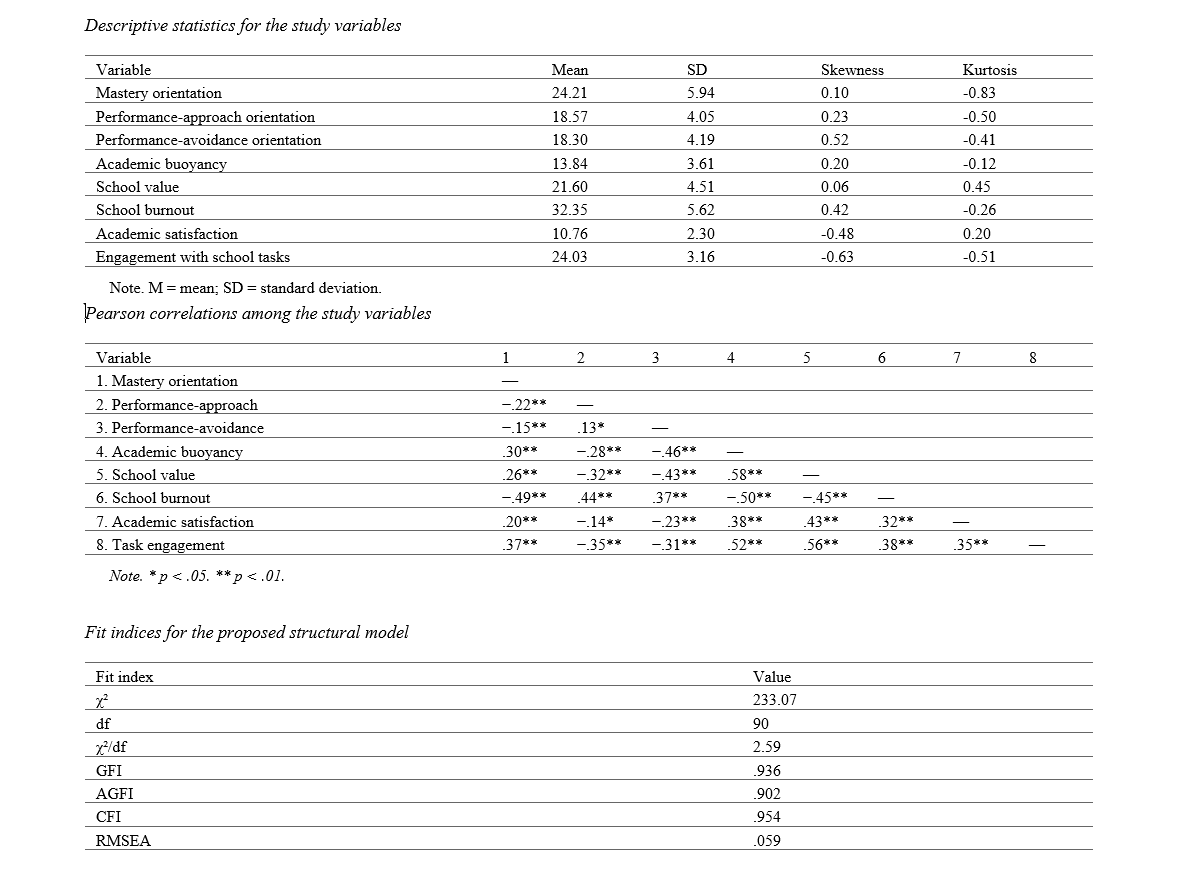
Academic well-being reflects students’ cognitive, emotional, and motivational experiences at school. Achievement goal orientations may shape these experiences by directing students toward learning and personal improvement or toward social comparison and avoidance of failure. Academic buoyancy—the capacity to respond adaptively to ordinary academic setbacks—may partly explain these relationships. This cross-sectional, descriptive-correlational study included 250 female students in Grades 10–12 in Tehran, Iran, during the 2024–2025 academic year. Participants were selected through multistage cluster random sampling. They completed the Academic Well-Being Questionnaire, the goal-orientation subscales of the Patterns of Adaptive Learning Scales, and the Academic Buoyancy Questionnaire. Structural equation modeling and bootstrap tests of indirect effects were conducted with SPSS 27 and AMOS 23. The model showed acceptable fit: χ²(90) = 233.07, χ²/df = 2.59, GFI = .936, AGFI = .902, CFI = .954, and RMSEA = .059. Mastery orientation positively predicted academic buoyancy (β = .411) and academic well-being (β = .488). Performance-approach (β = −.171) and performance-avoidance orientations (β = −.352) negatively predicted buoyancy. Buoyancy positively predicted well-being (β = .422). Indirect effects through buoyancy were positive for mastery orientation (β = .173) and negative for performance-approach (β = −.072) and performance-avoidance orientations (β = −.148). The model explained 62% of the variance in academic well-being. Mastery-oriented goals and adaptive responses to routine academic difficulties were associated with higher academic well-being. Goals centered on outperforming others or avoiding poor performance were associated with lower buoyancy and well-being. School practices emphasizing learning, personal progress, constructive feedback, and recovery from setbacks may support students’ academic well-being.
Downloads
References
1. Hossain S, O'Neill S, Strnadova I. What Constitutes Student Well-Being: A Scoping Review Of Students' Perspectives. Child Indicators Research. 2023;16(2):447-83. [PMID: 36405573] [PMCID: PMC9668225] [DOI]
2. Tuominen H, Niemivirta M, Lonka K, Salmela-Aro K. Motivation Across A Transition: Changes In Achievement Goal Orientations And Academic Well-Being From Elementary To Secondary School. Learning and Individual Differences. 2020;79:101854. [DOI]
3. Tuominen-Soini H, Salmela-Aro K, Niemivirta M. Achievement Goal Orientations And Academic Well-Being Across The Transition To Upper Secondary Education. Learning and Individual Differences. 2012;22(3):290-305. [DOI]
4. Midgley C, Kaplan A, Middleton M, Maehr ML, Urdan T, Anderman LH, et al. The Development And Validation Of Scales Assessing Students' Achievement Goal Orientations. Contemporary Educational Psychology. 1998;23(2):113-31. [PMID: 9576837] [DOI]
5. Li QL, Zhao JY, Tian J, Sun T, Zhao CX, Guo HC, et al. The Association Among Achievement Goal Orientations, Academic Performance, And Academic Well-Being Among Chinese Medical Students: A Cross-Sectional Study. Frontiers in Psychology. 2021;12:694019. [PMID: 34408710] [PMCID: PMC8365171] [DOI]
6. Ji Q, Zhang L, Xu J, Ji P, Song M, Chen Y, et al. Associations Of Mental Well-Being With Higher Education-Related Stress And Orientation Of The Academic Goals Among Nursing Students: A Cross-Sectional Study. International Journal of Mental Health Nursing. 2024;33(4):1062-72. [PMID: 38414160] [DOI]
7. Zhao W, Ma R. Investigating The Relationship Between Goal Orientation, Self-Efficacy, Positive Emotionality, And Affective Engagement Among Chinese Students. Acta Psychologica. 2025;253:104735. [PMID: 39862451] [DOI]
8. Sideridis GD. A Physiological Analysis Of Achievement Goal Orientations Under Pressure: An Experimental Analysis. International Journal of School & Educational Psychology. 2020;8(3):227-38. [DOI]
9. Martin AJ, Marsh HW. Academic Buoyancy: Towards An Understanding Of Students' Everyday Academic Resilience. Journal of School Psychology. 2008;46(1):53-83. [PMID: 19083351] [DOI]
10. Putwain DW, Jansen In De Wal J, Van Alphen T. Academic Buoyancy: Overcoming Test Anxiety And Setbacks. Journal of Intelligence. 2023;11(3):42. [PMID: 36976135] [PMCID: PMC10056025] [DOI]
11. Putwain DW, Wood P, Pekrun R. Achievement Emotions And Academic Achievement: Reciprocal Relations And The Moderating Influence Of Academic Buoyancy. Journal of Educational Psychology. 2022;114(1):108. [DOI]
12. Hoferichter F, Hirvonen R, Kiuru N. The Development Of School Well-Being In Secondary School: High Academic Buoyancy And Supportive Class- And School Climate As Buffers. Learning and Instruction. 2021;71:101377. [DOI]
13. Collie RJ, Caldecott-Davis K, Martin AJ. Academic Buoyancy Among Female Secondary School Students: An Examination Of Predictors And Outcomes Up To Age 22. Social Psychology of Education. 2024;27(2):363-88. [DOI]
14. Thapa A, Cohen J, Guffey S, Higgins-D'Alessandro A. A Review Of School Climate Research. Review of educational research. 2013;83(3):357-85. [DOI]
Downloads
Additional Files
Publication Timeline
- Submitted
- Revised
- Accepted